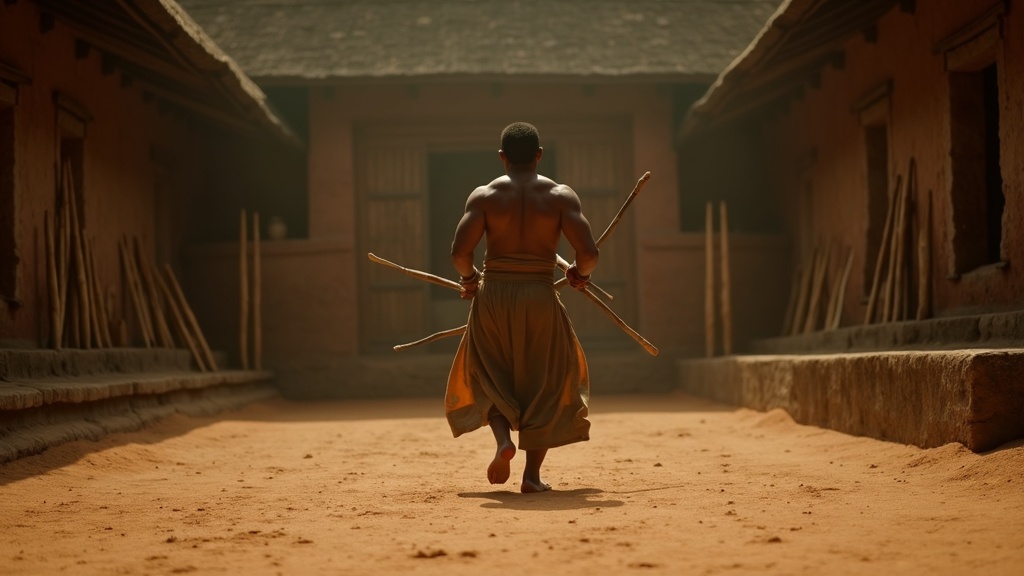
Kalaripayattu History and Origin: Where the Practice Comes From
Kalaripayattu History and Origin: Where the Practice Comes From
Most accounts of Kalaripayattu's history do one of two things. They repeat the founding legend as if it were a date, or they skip past the chapters that nearly ended the practice. Both fail the reader who actually wants to know where this art comes from. The honest story is more dramatic than either version — a martial tradition that grew out of Kerala's village warrior culture, was nearly extinguished by a colonial ban in 1804, and was rebuilt by a handful of teachers who refused to let it disappear. This guide gives you the documented timeline, the legends in their proper place, and a clear answer to the question every careful searcher arrives with: what is actually known, and what is myth.
Kalaripayattu history stretches from Dravidian combat traditions referenced in Sangam-era Tamil literature (roughly 600 BCE to 300 CE) through the codified Kerala practice that took shape between the eleventh and twelfth centuries CE, into the catastrophic British ban of 1804, and finally into the twentieth-century revival led by a small number of teachers in northern Kerala. The popular Parashurama founding legend gives the practice its sacred frame; the popular Bodhidharma → Shaolin story is plausible but not historically supported. What survived is a living lineage only a few generations from disappearing.
Key Takeaways
- Kalaripayattu took recognisable shape in Kerala between the eleventh and twelfth centuries CE, with combat precursors traceable to the Sangam period (roughly 600 BCE to 300 CE).
- The legendary founder is Parashurama, the sixth avatar of Vishnu — a founding myth, not a historical date.
- Kalaripayattu became the village-level military training of the Nair warrior caste and powered Kerala's regional armies through the rule of the Chera, Chola and Pandya dynasties.
- The British East India Company banned the practice in 1804 after the rebellion of Pazhassi Raja; it was kept alive in secret for more than a hundred years.
- The public revival began in the 1920s, led by teachers like Kottackkal Kanaran Gurukkal and a circle of contemporaries who reopened kalaris under the cultural pressure of the Indian independence movement.
- The popular Bodhidharma → Shaolin Kung Fu connection is debated; the historical evidence is thin, and the link to Kalaripayattu specifically appears in twentieth-century writing, not in contemporary records.
- What you train today is a practice that was, in a real sense, only a few generations from extinction — preserved by teachers who chose secrecy over surrender.
Where Kalaripayattu Comes From — A Short Answer
Kalaripayattu comes from Kerala, on the southwestern coast of India. Its precursors are Dravidian combat traditions described in Sangam-era Tamil literature roughly two thousand years ago. The codified form — built around the kalari (the training pit) and the four-stage curriculum — took recognisable shape between the eleventh and twelfth centuries CE during the long territorial wars between the Chera, Chola and Pandya dynasties.
For the next six centuries it functioned as the everyday military training of the Nair warrior caste. The 1804 colonial ban broke that system. The 1920s revival rebuilt it from what teachers had kept alive in private. Everything else in this article is the long version of that one paragraph.
The Legend: Parashurama and the First Kalaris
Every traditional kalari that I have ever entered has a small altar in the corner called the puttara. On that altar sit the deities of the lineage, and at the centre of the lineage story sits a figure called Parashurama — Rama with the Axe, the sixth avatar of Vishnu.
According to the founding legend, Parashurama created Kerala itself. He stood on the western mountains and hurled his axe into the sea. Where the axe landed, the sea retreated, and the land of Kerala rose from the waves. He then established 108 (in some tellings, 42) kalaris across the new land and taught the art of combat to twenty-one master teachers. Those twenty-one are the named ancestors of every classical lineage that exists today.
There is a parallel version in which the sage Agastya, who is associated with the south more broadly, plays the equivalent role for the southern Kerala and Tamil traditions. Some teachers hold both stories at the same time. They are not in competition; they sit at different ends of the peninsula.
How to read the legend
The temptation, when someone says "Kalaripayattu is six thousand years old," is either to accept it or to reject it. Both responses miss what the legend is actually for.
A founding myth does not work like a historical document. It does not claim a date. It claims a frame. The Parashurama story says: this practice is not an invention; it is an inheritance. It belongs to the land; the land was given by a god; the teachers are heirs in an unbroken line. When a Gurukkal lights the lamp before a session, that frame is what he is invoking — not a number, but a relationship between practice, place, and lineage.
The mistake most modern writing makes is to translate the frame into a date and then print the date as a fact. The legend is not falsified by the historical record. It simply belongs to a different category of speech.
The Historical Record — What Is Actually Documented
When you strip the legends back, what remains is still substantial. Dravidian combat traditions appear in the Tamil literature of the Sangam period, the kalari as a named training space and the practice in something close to its current form appear from the medieval period onward, and a continuous chain of teachers can be traced from the eleventh and twelfth centuries to today.
The work of the American scholar Philip Zarrilli, particularly his book When the Body Becomes All Eyes, is the standard academic reference. Zarrilli spent years in apprenticeship inside the C.V.N. Kalari lineage in Thiruvananthapuram and worked through the textual and oral records. The dates and structures used by most serious sources today derive from his work.
Sangam-era precursors (600 BCE – 300 CE)
The Sangam period refers to the body of classical Tamil literature produced roughly between 600 BCE and 300 CE, much of it in what is now Tamil Nadu and southern Kerala. The two great anthologies that matter for combat references are the Purananuru (the four hundred poems on the "outside" world of war, kingship and public life) and the Akananuru (the four hundred poems on the "inside" world of love and personal experience).
The Purananuru in particular contains many concrete references to weapon training, single combat, and the warrior ethic of the time. Spears, bows and swords are named. The warriors of the three Tamil kingdoms — the Cheras of present-day Kerala, the Cholas of the Tamil heartland, and the Pandyas of the south — appear repeatedly.
What the Sangam literature gives us is not Kalaripayattu by name. It gives us a vivid picture of a martial culture in which such a practice could grow. The codified Kerala form is a later crystallisation of that older Dravidian field.
Parallel to the Dravidian root runs the Sanskritic Dhanurveda tradition — the "science of the bow," treated in classical Indian sources as one of the upavedas or subsidiary Vedic sciences. The Dhanurveda concerns itself with the science of warfare, weapons, and the warrior ethic. Kalaripayattu in its Kerala form draws on Dhanurveda categories, especially in the systematic treatment of weapons, but it is not derived from a single Vedic text. It is a regional South Indian synthesis.
The eleventh and twelfth centuries — when the form crystallised
Between roughly the ninth and twelfth centuries CE, southern India was reshaped by a long territorial conflict often described as the Chera-Chola-Pandya wars. The Chola dynasty, at the height of its power, repeatedly invaded the western coast. The Chera dynasty, which had ruled present-day Kerala in earlier centuries, eventually fragmented into smaller local principalities. The result, by the twelfth century, was a Kerala of many small kingdoms — each defended by its own warrior caste, each maintaining its own training tradition.
This is the period in which Kalaripayattu becomes recognisable. The kalari as a fixed institution — the rectangular sunken pit, the east-west orientation, the puttara, the four-stage curriculum — emerges as a permanent feature of Nair village life. Each landholding family maintained or supported a kalari. Boys of the warrior caste began training at age seven. The teacher (Gurukkal) was both military instructor and traditional healer.
The historical Kerala of this period was not a single unified kingdom but a network of small states whose stability depended on having trained militias on call. Kalaripayattu was the infrastructure of that system.
The peak: fourteenth to sixteenth centuries
By the time European travellers began writing accounts of the Malabar Coast, Kalaripayattu was at its public height. The Portuguese traveller Duarte Barbosa, who served as an interpreter and scribe in Portuguese Kochi in the early sixteenth century, left one of the clearest early descriptions of the Nair warrior tradition. In his 1518 account he describes how the boys of the warrior caste began training around the age of seven, trained twice a day, and continued through their lives.
Barbosa's account is the kind of contemporary external evidence historians prize. It tells us not just that the practice existed but that it was woven into ordinary social life — boys went to the kalari the way children today go to school.
Alongside the Portuguese accounts runs another body of evidence: the Vadakkan Pattu ballads of northern Kerala. These oral folk songs, transmitted in Malayalam, celebrate the lives of legendary warriors of the medieval and early modern period. The most famous figures — Thacholi Othenan, Aromal Chekavar, his sister the warrior-woman Unniyarcha, the rivals of the Kalari ankam duels — are still household names in Kerala.
The Vadakkan Pattu are not documentary history in a modern sense. They are poetic memory. But they preserve, in remarkable detail, the texture of kalari training: the daily schedule, the duels, the politics of the warrior families, the place of the Gurukkal in village life, the rituals around a fight to the death. For a historian, they are the closest thing to a literary record of medieval Kalaripayattu in its lived form.
The British Ban and the Secret Years (1804 – 1920s)
The historical chapter that most casual articles skip is the one that almost ended the practice. From the late eighteenth century onward, the East India Company had been consolidating its control over the Malabar Coast. Kerala, with its many small kingdoms, resisted that consolidation more stubbornly than most regions. The principal resistance came from a figure called Pazhassi Raja.
Pazhassi Raja — Kerala Varma Pazhassi Raja, sometimes called the Lion of Kerala — was the prince of the small state of Kottayam in northern Malabar. From around 1793 he led a sustained guerrilla war against the British, supported by Kurichiya and Mappila militias and built on the foundation of kalari-trained Nair warriors. He used the forests of Wayanad as his base. For more than a decade he held off the Company's regular forces using exactly the kind of unconventional, mobile warfare that the kalari system trained men for.
He was finally killed in November 1805. The ban on Kalaripayattu had already been issued the previous year, in 1804, as the Company moved to dismantle the military culture that had sustained him.
Why the ban
A trained Nair militia was a direct military threat. Each village kalari was, from the Company's perspective, a small armoury and a small officer school. As long as the kalaris remained open, the Company would face a steady supply of trained insurgents.
The 1804 ban therefore went after the institution. Public training was forbidden. Weapons were confiscated. Kalaris were ordered closed. In the decades that followed, kalari practice that had been openly visible in village life became invisible. The social structure that had carried the practice for centuries — the Nair landholding families, the village kalari, the boys beginning at seven — was systematically broken.
For a parallel figure from the same broader resistance you can read the profile of Velu Thampi Dalava, the prime minister of Travancore who issued the 1809 Kundara Proclamation against the British and whose rebellion ended in his death the same year. Velu Thampi and Pazhassi Raja are the two great public faces of the southern and northern Kerala resistance respectively, and both depended on a kalari-trained military culture that the ban was designed to dismantle.
The hundred-year underground
What happened between 1804 and the 1920s is the part of the story that I find changes how a practitioner feels the form. For more than a century, the practice was kept alive in secret.
Some Gurukkals continued to teach a small number of trusted students — often inside family compounds, often at night, often with strict instructions about who could be told. Weapons were hidden. Training spaces were disguised. The cultural memory of the kalari survived in the Vadakkan Pattu ballads, which villagers still sang, and in the everyday work of kalari chikitsa — the traditional bone-setting and soft-tissue medicine that was inseparable from the martial tradition. A Gurukkal who could no longer publicly train students could still publicly treat injuries, and a great deal of practical kalari knowledge survived inside that medical practice.
What that means in plain terms is that for the better part of five generations, the only reason Kalaripayattu still existed at all was that specific named teachers, in specific Kerala villages, decided that the practice was worth the risk of teaching in private. There is no romantic way to soften this. The practice you train today was carried through that century on individual decisions, in small numbers, mostly anonymously.
The Twentieth-Century Revival
The change in conditions came with the Indian independence movement. From the 1910s and 1920s onward, the cultural mood across India shifted toward reclaiming indigenous traditions that had been suppressed or marginalised under colonial rule. Music, dance, theatre, medicine, and yes — martial arts — were re-evaluated as living heritage worth preserving.
The public revival of Kalaripayattu began in northern Kerala in the 1920s. The names most commonly cited in this revival are Chandu Panicker and especially Kottackkal Kanaran Gurukkal, a teacher who is credited in oral tradition with selling parts of his own land to finance the reopening of kalaris and the training of a new generation of teachers. A small number of other Gurukkals across northern and central Kerala did similar work in the same period.
A separate but related lineage developed in Thiruvananthapuram in the early twentieth century around the C.V.N. Kalari, founded by C.V. Narayanan Nair (1905-1944). The CVN Kalari system became one of the most influential standardised forms of Kalaripayattu in the post-independence period and is the lineage in which Philip Zarrilli later did his apprenticeship and research.
By the late twentieth century the form had been recognised at the national level as a traditional Indian martial art. In 2017 the Indian government conferred the Padma Sri — one of the country's highest civilian honours — on Meenakshi Amma, a Kalaripayattu teacher from Vatakara then in her seventies, in recognition of her decades of teaching and her preservation of the northern lineage. The award was symbolic of how far the public recognition had travelled from the 1804 ban.
What is striking, when you stand inside this history, is how recent the revival actually is. The kalari I trained in for the first time is one Gurukkal-generation removed from teachers who themselves trained with the men of the 1920s revival. When you trace any classical lineage active today, you almost always arrive at the same small circle of early twentieth-century teachers within three or four generations. The practice is not, in lived terms, ancient. It is freshly rebuilt — on ancient foundations, by recent hands.
Did Kalaripayattu Travel to China? The Bodhidharma Question
The other story that travels with Kalaripayattu is the claim that it gave birth to Kung Fu — specifically that the South Indian Buddhist monk Bodhidharma carried the practice to the Shaolin Monastery in the sixth century CE and seeded what became Shaolin Kung Fu.
The story is repeated as fact in many martial-arts magazines, in many tourism brochures, and on many Kalari school websites. It is worth handling carefully because the historical evidence is more contested than most articles admit.
What the historical record actually shows
Bodhidharma is a real figure in the sense that he is named in early Chan Buddhist sources as the patriarch who brought Chan (Zen) Buddhism from India to China. The earliest references to him date from the sixth and seventh centuries CE. None of these contemporary or near-contemporary sources mention him teaching martial arts.
The story that Bodhidharma taught physical exercises at Shaolin that became the basis of Shaolin Kung Fu first appears in a Chinese text called the Yijin Jing (Muscle/Tendon Change Classic). The standard scholarly dating, supported by the work of the historian Meir Shahar in The Shaolin Monastery (2008), puts the Yijin Jing in the early seventeenth century CE — around 1624. That is more than a thousand years after Bodhidharma is said to have lived. The text is now widely understood as a creative retrospective attribution, not as a historical record.
The specific claim that what Bodhidharma taught at Shaolin was Kalaripayattu is a further layer added on top of the Yijin Jing story, and that addition is essentially a twentieth-century one. It does not appear in classical Indian or Chinese sources. It begins to circulate in popular writing on Asian martial arts in the second half of the twentieth century and has been amplified by the rise of Indian martial arts in global media since.
How a careful teacher answers the question
In my own teaching I handle this the same way every time. The Bodhidharma claim is repeated everywhere. The historical evidence for it is thin. The cultural fact that Indian and Chinese contemplative and martial traditions exchanged influence over many centuries is plausible and unsurprising; specific direct transmission from a single named monk to a single named monastery is not supported by contemporary records.
A different and more careful claim can be made: the same broad principles — low stances, conditioning, the cultivation of internal awareness, the study of vital points — appear independently in many martial cultures across Asia. Parallel development does not require a single point of origin. The "mother of all martial arts" framing borrows the prestige of being a single origin in order to make the practice sound important. The practice does not need that prestige. Its depth stands on its own.
For a deeper look at the evidence for and against the global-origin claim, see our honest answer on whether Kalaripayattu is the mother of all martial arts.
Northern, Southern, and Central Styles — A Product of Geography
One thing that often confuses readers approaching Kalaripayattu for the first time is that the practice is not a single uniform system. It has three main regional styles, and the differences between them are essentially a product of the geography and history of the Kerala–Tamil border region.
Vadakkan — the northern style
Vadakkan simply means "northern" in Malayalam. The northern style is centred in the Kannur–Kozhikode region of northern Kerala. It is the most widely recognised internationally and is often what people picture when they hear the word Kalaripayattu — long flowing low stances, elaborate weapon forms, animal postures (vadivu) named after the elephant, the horse, the lion, the cock, and the snake.
Vadakkan emphasises classical structure, four-stage progression, and a wide weapons curriculum. Its lineage descends most directly from the medieval Nair warrior tradition of northern Kerala. The Vadakkan Pattu ballads are the literary expression of this same regional culture.
Thekkan — the southern style
Thekkan means "southern." The southern style is centred in the Thiruvananthapuram and Kanyakumari regions, near the Tamil border. It is shorter and harder than the northern style — fewer flowing stances, more striking, with a strong emphasis on vital-point work (the strike side of marma).
Thekkan style is closer in spirit and technical lineage to the Tamil martial tradition of Adimurai (also spelled Adi Murai or Varma Kalai), which developed in what is now southern Tamil Nadu. The shared border makes this continuity natural. Many southern teachers train in both systems and treat them as siblings rather than rivals.
Madhya — the central style
The Madhya or central style blends elements of north and south and is sometimes called the central Kerala synthesis. It is less widely practised today than the other two, and many teachers describe it as more of a regional variation than a fully distinct system. Its existence is a reminder that the boundaries between styles are not sharp.
The point of naming the three styles is not to set them in competition. It is to recognise that the practice has always been regional. There was never a single national curriculum. What there was — and still is — is a family of related lineages whose distinct emphases reflect the histories of the places that carried them.
Why the Practice Survived
After spending some years inside this history, the question that still moves me most is not how old Kalaripayattu is or whether Bodhidharma carried it to China. It is why it survived at all.
Three things kept the practice alive. The first is the village memory of the Vadakkan Pattu — the fact that ordinary people in northern Kerala kept singing the names of Aromal Chekavar and Thacholi Othenan even when public training was forbidden. A culture that remembers its warriors does not entirely lose its warrior art.
The second is the inseparable medical tradition. Kalari chikitsa — the bone-setting, soft-tissue and herbal treatment that every Gurukkal practises alongside the combat training — gave teachers a public reason to continue working with bodies. Treatment was legal when training was not. A great deal of practical knowledge survived in that legal channel.
The third is the simple fact that a small number of specific named teachers, in specific named places, made the decision to keep teaching. Kottackkal Kanaran Gurukkal sold land. Chandu Panicker reopened kalaris under public scrutiny. Anonymous others taught at night. C.V. Narayanan Nair built a standardised southern lineage in Thiruvananthapuram. None of them had any guarantee that the practice would survive their own lifetimes.
When you step into a low stance today — aswa vadivu, the horse posture, knees deep, weight settled into the earth — you are practising a form that was nearly lost. The continuity is not abstract. It runs through specific hands and specific decisions, most of them within the last hundred years.
That is what I want a new student to understand before they begin. The practice you are about to enter exists because someone refused to let it disappear. The way you train it matters in part because of that refusal.
For more on why people walk into a kalari today — beyond curiosity about the history — see why anyone actually practises Kalaripayattu.
Common Misconceptions About Kalaripayattu's History
A few persistent misunderstandings show up in almost every casual article on the subject. Worth naming them here.
The first is the figure of six thousand years. You will find this number on tourism websites, in martial arts magazines, and on many Kalari school pages. It is not supported by any textual or archaeological evidence. The defensible figures are: Sangam-era references to South Indian combat (roughly 600 BCE – 300 CE), codified Kerala practice from the eleventh and twelfth centuries CE. Anything older relies on the legends.
The second is the assumption that "ancient martial art" means "unchanged for centuries." It does not. Kalaripayattu in 2026 is not identical to Kalaripayattu in 1500, or in 1100. Forms have been added, dropped, standardised. The twentieth-century revival in particular involved choices about what to teach in public and what to drop. Continuity does not mean stasis.
The third is the framing of the British ban as a footnote. In most modern articles it gets a single sentence. The ban broke a continuous social structure that had carried the practice for centuries. The fact that the form survived at all required active, sustained refusal across multiple generations. Treating the ban as a footnote misses the most important chapter in the story.
The fourth is the silent merger of the Parashurama legend, the Bodhidharma claim, and the historical record into a single narrative. These belong in three different categories. Mythology, contested cultural claim, documented history. Holding them apart is the only honest way to talk about where the practice comes from.
Frequently Asked Questions About Kalaripayattu's History
How old is Kalaripayattu?
In its codified Kerala form Kalaripayattu is documented from the eleventh to twelfth century CE. Combat precursors referenced in Sangam-era Tamil literature push the lineage of South Indian martial practice back to roughly 600 BCE to 300 CE. Popular figures of three thousand or six thousand years are not supported by the textual record.
Who founded Kalaripayattu?
No single founder is documented historically. Tradition names Parashurama, the sixth avatar of Vishnu, as the legendary originator who is said to have taught the first twenty-one master teachers. The codified practice grew from a wider field of South Indian combat traditions and was consolidated in medieval Kerala by generations of teachers whose names are largely unrecorded.
Where did Kalaripayattu originate?
Kalaripayattu originated in Kerala, on the southwestern coast of India, with parallel Dravidian combat traditions across what is now Tamil Nadu. The codified form, built around the kalari training pit and the four-stage curriculum, is specifically Keralan. Northern Kerala is widely considered the heartland of the classical northern style.
Is Kalaripayattu the oldest martial art in the world?
It is among the world's oldest continuously practised martial systems, but cannot be verified as the single oldest. Combat traditions arose independently in many cultures. What is defensible is that South Indian martial practice referenced in Sangam literature is very old and that the codified Kerala practice has a continuous lineage few other systems can claim.
Did Bodhidharma really take Kalaripayattu to China?
The evidence is thin. The story of Bodhidharma teaching martial arts at Shaolin first appears in the Yijin Jing dated to about 1624 CE — more than a thousand years after Bodhidharma is said to have lived. The specific link to Kalaripayattu was added during the twentieth century. Most academic historians treat the transmission story as legend, not record.
Why did the British ban Kalaripayattu?
The British East India Company banned the practice in 1804 after the rebellion of Pazhassi Raja in northern Kerala. A trained Nair militia, fluent in weapons and capable of unconventional warfare, was a direct military threat. The ban shut most kalaris, criminalised weapon training, and pushed teaching underground for more than a hundred years.
When was Kalaripayattu revived?
The public revival began in the 1920s in northern Kerala, led by teachers like Kottackkal Kanaran Gurukkal as the Indian independence movement reframed traditional arts as cultural heritage. A parallel southern lineage developed around the CVN Kalari, founded by C.V. Narayanan Nair. Recognition at the national level continued through the post-independence period.
What is the difference between Northern and Southern style?
Vadakkan (northern) emphasises long flowing low stances, animal postures, and a wide weapons curriculum; its lineage descends from the medieval northern Nair tradition. Thekkan (southern) is shorter, harder, and built around vital-point work, closer to the Tamil Adimurai tradition. A third Madhya (central) style blends elements of both and is less widely practised today.
What role did the Nair caste play in Kalaripayattu history?
The Nair warrior caste of Kerala was the primary inheritor of Kalaripayattu through the medieval period. Boys began training around age seven, families maintained their own small kalaris, and Nair militias formed the core of Kerala's regional armies. When the British ban broke this system, it broke the social structure that had carried the practice.
What are the Vadakkan Pattu ballads?
The Vadakkan Pattu, or Northern Ballads, are a body of oral folk songs from northern Kerala that celebrate the lives of legendary warriors such as Thacholi Othenan, Aromal Chekavar, and the warrior-woman Unniyarcha. They preserve detailed scenes of kalari training, duels, and the social life around the practice, and are the closest literary record of medieval Kalaripayattu.
Was Kalaripayattu mentioned in the Vedas?
Not by the name Kalaripayattu. The Dhanurveda tradition, considered a subsidiary of the Yajurveda, addresses the science of warfare and weapons in classical Indian literature. Kalaripayattu in its Kerala form draws on Dhanurveda categories, especially in the systematic treatment of weapons, but the practice as we know it today is a regional South Indian tradition rather than a directly Vedic one.
Does the history matter for someone training today?
Yes, but not in the way most assume. The depth of the practice does not depend on whether the Bodhidharma story is true or whether the form is six thousand years old. What matters is that the form you train today exists because a small number of teachers, in living memory, kept it alive in secret. When you drop into a low stance, you are practising a movement that nearly disappeared. That changes how the form feels.
Sources and Further Reading
- Kalaripayattu — Wikipedia — the most comprehensive overview, with extensive citations to Zarrilli and other scholarship.
- Pazhassi Raja — Wikipedia — biography of the northern Kerala prince whose rebellion triggered the 1804 ban.
- Sangam period — Wikipedia — overview of the classical Tamil literary period and its sources.
- Bodhidharma — Wikipedia — academic discussion of the historical figure and the later transmission legends.
- CVN Kalari — Wikipedia — the standardised southern lineage founded in early twentieth-century Thiruvananthapuram.
- C.V. Narayanan Nair — Wikipedia — founder of the CVN Kalari lineage.
- Indian martial arts — Wikipedia — broader context for the Indian martial tradition.
- Vadakkan Pattu — Wikipedia — the Northern Ballads of Kerala and their warrior heroes.
- Parashurama — Wikipedia — the legendary founder of the practice in tradition.
- Dhanurveda — Wikipedia — the classical Indian science of warfare.
- Philip B. Zarrilli, When the Body Becomes All Eyes: Paradigms, Discourses and Practices of Power in Kalarippayattu, a South Indian Martial Art (Oxford University Press, 1998) — the standard academic reference.
- Meir Shahar, The Shaolin Monastery: History, Religion and the Chinese Martial Arts (University of Hawaii Press, 2008) — the standard academic treatment of the Shaolin / Bodhidharma question.
Conclusion
The history of Kalaripayattu is more interesting than the legends and more dramatic than the tourism summaries. Combat precursors stretch back into the Sangam period two thousand years ago. The codified Kerala practice took shape in the medieval period under the long Chera–Chola–Pandya conflicts and was sustained for centuries by the Nair warrior caste. The British ban of 1804 nearly ended it. A small number of teachers in northern and southern Kerala rebuilt it in the early twentieth century, and the practice we have today descends in only a few generations from their decision to keep it alive.
The legend of Parashurama gives the practice its sacred frame. The Bodhidharma claim travels with it but is not supported by contemporary record. What matters more than either is what survived: a four-stage curriculum, a working medical tradition, a network of regional lineages, and the felt experience of moving in a form that nearly disappeared and did not.
The best way to feel what that history actually weighs is to step into one movement of it. The first lesson at Kalari University is free — no payment, no commitment, just the entry-level body work that every classical lineage starts with. If the history above has made you curious about what the practice feels like from the inside, create your account and start the free first lesson here.
About the Author
Raphael Gorschlüter — Co-Founder and Head Teacher, Kalari University
Raphael Gorschlüter has trained Kalaripayattu for more than twelve years and teaches it internationally — in Germany, Spain, and India. He is one of Europe's most experienced practitioners of the form and is known for developing students' ability to feel their movement, not just perform it. He works inside a classical lineage rooted in the post-revival Kerala teaching tradition and runs annual immersive retreats in Tamil Nadu at the foot of Arunachala.
