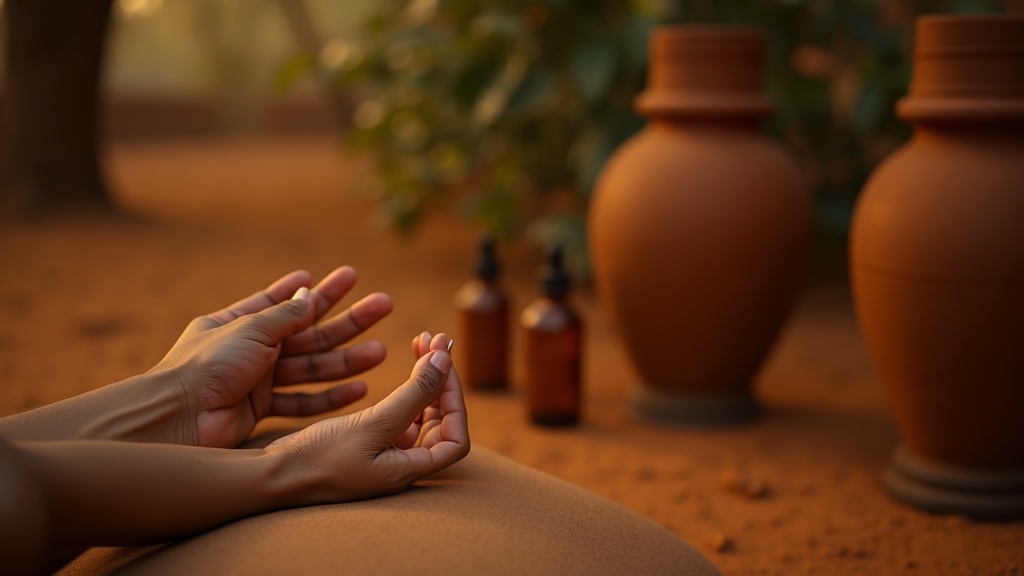
Kalaripayattu Marma Therapy — A Practitioner's Guide
Kalaripayattu Healing and Marma Therapy: A Practitioner's Guide
The same hand that learns where to strike learns where to heal. Inside the kalari, those are not two separate skills — they are two faces of the same anatomical study. A senior student learns how a joint folds before they learn how to lock it, and learns how a tissue knits before they learn how to bruise it.
Most of what is written in English about kalari marma therapy is written by treatment centres selling packages. The mechanism gets vague, the promises get loud, and the actual tradition disappears behind a brochure. This guide does something different: it explains kalaripayattu healing and marma therapy from inside the practice — what marma points are, how kalari chikitsa is structured, what a serious student of the system will and will not encounter, and where the honest boundary sits between cultural knowledge and medical care.
This is not a sales page for healing services. It is a teacher's map of the territory.
Kalaripayattu healing and marma therapy — together called kalari chikitsa — is the traditional medical branch of Kalaripayattu, the martial art of Kerala. It applies medicated oils, hand massage and foot massage with reference to marma, the points the tradition describes as anatomical junctions of vessels, tissues and nerves. It grew up inside the kalari training school to treat injuries from practice and combat, and it shares its roots with classical Ayurveda. It is a cultural and traditional practice — not a substitute for qualified medical care.
Key Takeaways
- Kalari chikitsa is the healing branch of kalaripayattu and is centred on hand work, foot work, and the application of traditional medicated oils.
- Marma are vital points the tradition describes as anatomical junctions; classical Ayurveda lists 107 in Sushruta, popular accounts cite 108, and a working kalari teacher usually focuses on around 64 abhyasa marma.
- The three core treatment forms are thaila lepanam (oil application), kai uzhichil (hand massage) and chavitti uzhichil (foot massage), each suited to different recipients and goals.
- Marma vidya — the deeper knowledge of marma — is traditionally restricted: it is taught only to senior students of long standing, for ethical reasons that the lineage takes seriously.
- Kalari marma therapy is a traditional practice rooted in lineage and culture; it is not a substitute for medical diagnosis, prescription medication or surgery, and a qualified doctor should be your first call for any health concern.
What Kalari Marma Therapy Actually Is
Kalari marma therapy is the bodywork side of a martial tradition. Inside the kalari — the practice ground itself — the teacher trains the student to move, to strike, to fall, to recover. Outside the floor work, the same teacher trains the student's body across the year with oil and pressure: warming, releasing, conditioning, repairing. The two parts hold each other up.
This is not how it tends to be presented to a Western audience. Most marketing copy isolates the massage as a wellness service and detaches it from the training tradition that produced it. That detachment is convenient for selling packages, but it makes the underlying practice harder to understand.
A more accurate frame: the kalari is a school of the body. Payattu is what you do to learn that body — kicks, postures, sequences, weapons. Chikitsa is what you do to repair, prepare and refine it. Different verbs, same body, same teacher.
Marma — the vital points
In the classical sources, marma is a Sanskrit term for points on the body where the tradition holds that several types of tissue come together — mamsa (muscle), sira (vessel), snayu (ligament), asthi (bone) and sandhi (joint). Sushruta, the surgeon whose Sanskrit treatise is the founding text of Indian surgical practice, devoted careful attention to these points in his Sushruta Samhita. He catalogued them by location, by size, and by the consequence of injury — some immediately fatal, some slow, some painful but recoverable.
The kalari uses the same anatomical map, but does two things with it that classical Ayurveda does not. It teaches the marma in the context of how the body strikes and falls, and it teaches the marma in the context of how the body is then put back together. The same point that a senior practitioner can disrupt, a senior practitioner can also help to release.
This is why the tradition speaks of marma as junctions of life-force — points where many systems meet at once. The Sanskrit phrase often translated "vital point" is doing real anatomical work, not vague mysticism.
Chikitsa — the healing branch
Chikitsa simply means treatment. Kalari chikitsa is the body of treatment knowledge that grew up inside the kalari to handle the medical reality of long-term martial training: the bruises, the sprains, the over-stretched joints, the back that goes after years of low vadivu (postures), the shoulder that locks after the introduction of weapons.
Three things sit at the centre of kalari chikitsa: the oils, the hand, and the foot. The oils carry the work of the herbs into the body. The hand and foot carry the work of the practitioner. Marma is the anatomical reference that tells the practitioner where to attend most carefully and where not to press.
A senior chikitsaka — a kalari healing practitioner — usually trains for years inside the kalari before being formally taught chikitsa. That is the point: the system rests on the assumption that the practitioner already knows the body from the inside, as their own body, before they reach for the body of another. The pedagogy is sequential.
Why the same teacher learns both sides
The Western mind tends to split fighters and healers into different professions. The kalari does not. The same teacher learns both sides because both sides are the same study of the body — one in motion, one at rest, one expressed outward, one inward.
In twelve years inside the practice I have watched this play out in small daily ways. A student strains a hip flexor doing aswa vadivu (the horse posture) for the first time. The teacher does not call an outside specialist. The teacher knows where the strain sits, knows the muscle, knows the recovery sequence, and walks the student through what to do over the next ten days. Then the practice continues. There is no philosophical statement happening — the integration is simply how training works.
That integration is also why the question "should I take a marma course?" has a different answer inside the tradition than outside it. Inside, marma is not a course; it is a stage of training that the body earns access to over time.
The Origins of Kalari Healing
The origins of kalari healing are partly documented and partly oral. The documented part runs through three streams: the classical Sanskrit medical tradition, the practical history of martial training in Kerala, and the more local current of Siddha medicine in southern India. The oral part is everything that gets passed teacher to student inside the kalari and is never written down at all.
Training injuries and the need for medicine
The first reason kalari needed a medical tradition is mundane and obvious. The training is hard. It is done barefoot on a clay floor, often at five in the morning, with sustained low postures, kicks, jumps, falls and weapon work. Without a working system of recovery, no student would stay in training long enough to become a teacher.
So the medicine grew up around the practice. Practitioners noted what worked: which oils warmed the body and which cooled it, which postures restored, which contact applied to which point released a chronically tight area. Over generations the knowledge was systematised — and codified inside individual lineages, more than as a unified national doctrine.
This is one reason "the tradition" is plural rather than singular. Different schools have somewhat different oil formulations, somewhat different point maps, somewhat different protocols. They share a core, but they do not match in every detail.
Connection to Ayurveda and Siddha
The relationship between kalari chikitsa and Ayurveda is best described as a particular branch growing from a larger tree. Ayurveda is the umbrella classical Indian medical system, codified across millennia in texts attributed to Charaka, Sushruta, and others, and still practised across India under government regulation today. Kalari chikitsa borrowed its core anatomical and pharmacological vocabulary from Ayurveda — especially from shalyatantra, the surgical branch — and adapted it to musculoskeletal work and the needs of martial training.
The relationship with Siddha medicine, the Tamil classical medical tradition, is harder to draw cleanly. Southern-style kalaripayattu — including the adi murai and varma kalai lineages from Tamil Nadu — has more visible Siddha influence in its terminology and oils. The northern Kerala lineages lean more clearly into Ayurveda. The boundary is fuzzy and the dialogue between the traditions has been long and continuous.
If you are reading about kalari chikitsa and the article seems to use Ayurvedic and Siddha terms interchangeably, that is not always sloppiness; sometimes it reflects the real overlap. But the precise lineage of a given oil or technique often does have a single origin if you ask carefully enough.
Marma in the classical record
A short historical note keeps this honest. Marma is mentioned in the Rig Veda in scattered references — the points where life is held. The first systematic catalogue is in Sushruta, dated to roughly the first half-millennium BCE depending on the scholar. Sushruta lists 107 marma, classified by size, location, and the consequence of injury. The later Ashtanga Hridayam, composed by Vagbhata, tightens the language and is the text most quoted in Kerala Ayurvedic schools today.
The kalari adopted these classical lists and worked them into its own context. The famous popular figure of 108 marma is a later, looser count that aligns marma with other Indian counts of 108 (mala beads, sacred names, and so on). It is convenient but it is not the figure Sushruta gives.
This is the kind of detail that gets flattened in marketing copy and is worth holding onto if you want to take the tradition seriously.
The Three Forms of Kalari Chikitsa
In practical terms, traditional kalari chikitsa is usually described in three forms: thaila lepanam, kai uzhichil, and chavitti uzhichil. Different lineages emphasise them differently, but most centres offer some combination of all three. The choice is governed by the recipient — their age, build, condition, and what the treatment is meant to address.
Thaila lepanam — medicated oil application
Thaila lepanam is the application of medicated oil to the body. The oil is warmed and applied across specific regions, sometimes followed by gentle hand work, sometimes left to be absorbed. In Kerala, this is the most accessible form of kalari treatment and the one most non-practitioners experience first.
The oils carry the active work. Murivenna is the most famous of the kalari oils — a coconut-based preparation infused with multiple herbs (including karuka, cherula, cheriya tulasi and others depending on the lineage). It is the oil traditionally reached for in the case of sprains, dislocations, soft-tissue injuries and bruising.
Other oils have other functions. Kottamchukkadi thailam is used in the tradition for stiffness and inflammatory complaints. Dhanwantharam thailam is a more general restorative oil, used in pre- and post-natal care in classical Ayurveda and also reached for in kalari for general rejuvenation. These are descriptions of how the tradition uses these preparations — not therapeutic claims.
The oil is not incidental. In the kalari understanding, the oil is itself the medicine; the hand or foot is the delivery mechanism. This is one of the structural features that distinguishes kalari chikitsa from a Western massage tradition, where oil is mostly a lubricant.
Kai uzhichil — massage with the hands
Kai uzhichil is the hand massage form. The practitioner works the warmed oil into the recipient's body with the palms, fingers, knuckles and forearms, following long strokes along the limbs, the back and the trunk, with careful attention near marma points.
The choreography is specific. The practitioner usually stands or sits beside the recipient, who lies on a wooden table (the droni). The strokes follow the direction of the muscle fibres and the orientation of the limbs. Pressure is moderate. The hands work with the body rather than against it.
This is the form most appropriate for a recipient who is older, smaller, more sensitive, or in recovery. It is also the form most often taught first to a student of chikitsa, because the hand provides finer feedback than the foot.
Chavitti uzhichil — massage with the feet
Chavitti uzhichil is the dramatic-looking form: foot massage delivered by a practitioner suspended from a rope hung from the ceiling. The rope is not a prop. It is the practitioner's mechanism for controlling exactly how much body weight passes through which foot at which moment.
This form is reserved in the tradition for a recipient who is strong, structurally healthy, and prepared for the depth of contact. It is most associated with athletes, dancers and serious martial students. The practitioner moves their feet along the recipient's body with the same anatomical care as in kai uzhichil, but the contact is broader and the pressure can be considerable.
What looks aggressive from the outside is actually highly controlled. A well-trained chavitti practitioner can vary pressure with millimetre precision, lift fully off, redirect across a joint, or pause over a marma. The rope is the steering wheel.
Murivenna and the oils of the kalari
A short note on the oils, because they are the most under-described element in most online accounts. Each oil is a medicated coconut-oil or sesame-oil preparation, simmered with herbs and reduced over time according to traditional protocols. The recipes are lineage-specific and have been refined over generations.
Murivenna is the most widely known but it is not the only one. A serious kalari treatment centre will keep a small pharmacy of oils — one for injuries, one for stiffness, one for general conditioning, one for older practitioners, one for women's care, and so on. The choice of oil for a given session is itself part of the treatment.
This is also where regulation matters. Authentic murivenna and the related oils are made in Kerala by licensed Ayurvedic pharmacies under AYUSH ministry standards. Outside India, what is sold under these names varies considerably in quality. If you are buying oils online, source matters.
Marma Points — 108, 107, or 64
The number question is one of the most asked and most poorly answered points in popular writing on kalari. Three different counts circulate, each with a different basis. None of them is wrong; they refer to different things.
The Sushruta tradition — 107 marma
The classical Ayurvedic count is 107, set down by Sushruta in the Sushruta Samhita. Sushruta organised the points by anatomical region (limbs, trunk, head and neck) and by their composition (which combinations of muscle, vessel, ligament, bone and joint converge at each point). He also classified them by the consequence of injury — sadyahpranahara (rapidly fatal), kalantarapranahara (slowly fatal), vishalyaghna (lethal once a foreign object is removed), vaikalyakara (causing impairment), and rujakara (causing pain).
This is the count most respected in classical Ayurvedic study today and the one Kerala Ayurveda schools teach. It is also the number most useful to anyone who wants to understand the anatomical logic, because Sushruta's groupings carry information that the bare number does not.
The popular count — 108 marma
The figure of 108 appears constantly in modern wellness writing and in some popular Indian sources. It rounds Sushruta's 107 to the symbolically loaded 108, which recurs throughout Indian spiritual life (mala beads, sacred names, sacred sites). It is not a textual count; it is a cultural one. There is no harm in it, but it should not be presented as the medical figure.
If you see "108 marma points" in a wellness brochure, treat it as evocative rather than precise. If you see "107 marma" in an Ayurvedic text, that is the classical count.
The kalari classification — 64 abhyasa marma
The kalari, in practical use, usually does not work with the full Sushruta list. A working kalari teacher focuses on what is sometimes called the 64 abhyasa marma — the marma relevant to abhyasa (practice), to training, to injury and to treatment.
This is a more compact, more clinically useful list. It corresponds roughly to the marma a chikitsaka actually needs to know to do the work. The exact 64 vary by lineage. Some schools count slightly more, some slightly fewer. The principle is what matters: the kalari distils the larger Ayurvedic catalogue into a working sub-set tailored to its own purpose.
So all three counts are real. 107 is the classical Ayurvedic figure. 108 is a popular round number. 64 is the working clinical set inside the kalari. They are not in competition; they are simply three different ways of organising the same body.
Why Marma Knowledge Is Traditionally Restricted
This is the part of the tradition that does not fit neatly into wellness marketing, which is precisely why it matters. The deeper knowledge of marma — marma vidya, or in some lineages marmashastram — is traditionally restricted. It is not taught early, it is not taught publicly, and it is not taught to students who have not earned the trust of their teacher.
The ethics of dual-use knowledge
The principle is straightforward. The points that can be used to heal can also be used to harm. The same hand contact at the same location, applied with different pressure, intent and timing, has very different effects. A serious kalari teacher therefore treats the knowledge as something that needs a holder — not a buyer.
This is why classical instruction protocols specified the kind of student to whom marma vidya could be taught. Not the strongest, not the most ambitious, not the one who paid the most — the one whose temperament, restraint and integrity the teacher had observed over years.
It is easy to romanticise this. The honest version is simpler. The teacher carries a responsibility for what happens with the knowledge after they pass it on. The restriction is the form that responsibility takes.
What a kalari student is and is not taught
For a serious physical kalari student, marma enters the curriculum gradually and obliquely. In the early years, a student will hear marma named occasionally during postures — "this is near a vital point, keep the position controlled." They will learn the most general safety principles. They will not learn how to attack a marma, and they will not learn how to treat one.
That formal study begins much later, usually only with senior students who have stayed with the same teacher for years, and even then it begins with the healing branch — chikitsa — before any reference to the combat application of marma is made. Most lifelong practitioners of kalaripayattu never receive deep marma vidya. That is the design of the system, not a failure of it.
Why the average online student will not give a marma treatment
This needs to be said plainly because it is constantly elided in wellness marketing. If you study kalaripayattu online — including with Kalari University — you will not be qualified to give or receive marma treatment as a professional service at the end. That is not what online study delivers, and any programme that claims it does should be treated with caution.
What you do receive from serious online kalari training is the foundation. You build the body literacy, the postural discipline, the anatomical attention, and the basic vocabulary of the tradition. That foundation is what makes deeper study possible later, in person, with a teacher, if your path takes you that way.
The honest framing is: marma is the territory; the kalari floor is how you earn the map.
What Marma Study Does to the Practitioner
Almost everything written in English about marma is written from the recipient's point of view — what the massage feels like, what conditions it is said to help. Very little is written from the practitioner's side. That is the more interesting question, because it is what changes the person who does the work.
Body as a map you can read
The first thing serious marma study does is turn the body into a map you can actually read. Before the study, the body is a vague continuous surface with a few obvious landmarks (the knee, the elbow, the small of the back). After the study, the same body has structure. You can locate where the tendon enters the joint capsule. You can feel where a fascia line restricts a movement two segments above the apparent restriction. You can name what you are touching.
This is not mystical knowledge. It is anatomical literacy, gained slowly through repetition under a teacher who already has it. The marma names give the practitioner pegs to hang the learning on — points around which a more complete picture of the body can be built.
Anatomical attention as a side effect of training
Even before formal chikitsa study, the kalari develops anatomical attention as a side effect of the training itself. You learn the vadivu by feeling where your weight sits. You learn the kicks by tracking the path of the leg through space. You learn the falls by paying attention to where the floor meets which bone.
After years of this, the practitioner has built a sensory vocabulary they did not have at the start. They can feel a hip socket from the inside. They can locate where a movement is being initiated, and where it should be initiated. This sensitivity is the precondition for any deeper marma work — without it, even the most precise anatomical instruction has nothing to land in.
You can build a fair amount of this body literacy with sustained kalari practice alone. The marma study deepens it but does not create it. This is one of the practical answers to "why do I need to train before I learn marma?" — because the marma instruction needs a trained body to be received by.
What changes in how you experience your own body
Over time, the practitioner stops needing the formal map for everyday awareness. The vocabulary becomes embedded. You walk through your day with a clearer sense of where you are loading, where you are guarding, where the breath is held, where you are about to strain.
For most readers of this article that change in self-experience is the more relevant outcome of any serious kalari engagement. You will probably not give marma treatments. You will probably live in a different body. The two are different scales of benefit, both real.
A useful way to think about it: the formal marma study is a specialist skill that a small minority of kalari students will end up developing. The change in body literacy is a general gift that any committed kalari practitioner can expect over years of work. The first depends on access to the right teacher; the second depends on showing up to your own practice.
Kalari Marma Therapy Today
The living centre of kalari chikitsa is Kerala. A serious treatment session in a traditional kalari centre is a specific cultural experience — not a spa visit, not a hospital visit, and not always comfortable for someone arriving with Western expectations.
Traditional centres in Kerala
Established kalari schools and treatment centres operate across Kerala — in Kozhikode, Thrissur, Palakkad and Thiruvananthapuram, among others. Some of these centres are linked to long-standing martial lineages. Others are wellness-focused operations that treat without teaching the martial side. Both exist on the same street, sometimes, and quality varies. Lineage and teacher reputation matter more than signage.
Tamil Nadu has its own related lineage, particularly through the southern kalari schools and the varma kalai tradition. The treatment vocabulary differs in places but the underlying anatomy and principles are continuous.
What a traditional treatment session looks like
A typical kalari treatment session begins with a short conversation — the practitioner asks about your training history, current discomfort, recent injuries, sleep, digestion, medication. This is not bedside manner; it is data. The selection of oil and the treatment plan flow from it.
You change, you lie on a wooden table or sit on a low stool, depending on the form. The oil is warmed in a brass pot beside the table. The practitioner begins — long strokes, careful pressure, working a specific region rather than chasing everything in one session. A full kalari treatment plan in Kerala is usually multi-day, not a single appointment; the lineage works in courses of seven, fourteen, twenty-one or more days, with daily sessions.
After the session you rest. There is usually a dietary instruction (warm food, no heavy lifting that day, no cold water on the body). Some schools ask you to avoid certain activities for the duration of a treatment course.
This is the cultural form. It does not transfer well to a sixty-minute one-off appointment in a Western wellness centre, which is part of why what is often offered outside India as "marma massage" is not quite the same practice.
Honest scope: what kalari marma therapy is not
This is the part most marketing copy avoids. Worth being explicit.
Kalari marma therapy is not a medical treatment. It does not diagnose disease. It does not replace prescription medication. It is not a substitute for surgery, physiotherapy under a licensed clinician, psychiatric care, or any specialist medical intervention. A good kalari practitioner will tell you this themselves and refer you to a doctor when appropriate.
It is also not a one-stop wellness fix. The tradition does not promise to "cure" arthritis, sciatica, disc bulges, or chronic diseases, despite some treatment-centre marketing claims to the contrary. The tradition holds that consistent treatment may support recovery and ease musculoskeletal complaints — that is a real and traditional claim, distinct from a clinical promise.
And it is not a stand-alone hobby skill. If you want to give marma treatment professionally, that is a years-long apprenticeship inside a recognised lineage. Most of what is sold as "marma certification" online does not meet that standard. Be careful what you call yourself.
This honesty is itself the point. The tradition is more interesting than the marketing of it.
Common Misconceptions About Kalari Marma Therapy
There are six recurring misconceptions in popular writing on kalari marma therapy. Worth naming them directly because each one shapes how new readers approach the tradition.
One — marma is the same as acupuncture points. It is not. Both systems work with points on the body, but the anatomical frameworks are different, the point maps overlap only loosely, and the treatment methods (needles versus hand and foot contact with oil) are not interchangeable. Reading them as the same thing flattens both traditions.
Two — marma therapy is for treating disease. It is a traditional bodywork practice, not a medical intervention. The tradition holds it supports musculoskeletal recovery and general wellbeing; it does not claim to treat illness as a doctor does. Anyone presenting it otherwise should be treated with caution.
Three — 108 is the correct number of marma. It is not the classical figure. Sushruta gives 107, the kalari working set is around 64, and 108 is a culturally loaded popular round number. All three exist; only one is the classical medical count.
Four — anyone can learn it in a weekend. Real chikitsa training is a multi-year apprenticeship inside a lineage. Weekend introductions can give you the vocabulary; they do not produce practitioners. Be careful about what is being implied.
Five — kalari healing and Ayurveda are the same thing. They are closely related and share much vocabulary, but they are not identical. Ayurveda is the broader classical system; kalari chikitsa is a specialised regional practice with its own emphases, oils and conventions. Knowing the difference is part of taking the tradition seriously.
Six — you can't really learn kalaripayattu without the marma part. You can. Marma is one specialised branch of a much larger practice. The vast majority of serious kalari students worldwide focus on the physical training and never undertake formal chikitsa study. That is normal, not lesser.
Frequently Asked Questions
What is kalari marma therapy?
Kalari marma therapy, more accurately called kalari chikitsa, is the traditional healing branch of kalaripayattu. It uses oil applications, hand massage and foot massage applied with reference to marma — points on the body where the tradition holds that vessels, tissues and nerves intersect. It developed inside kalari training schools to address injuries from practice and combat, and shares its roots with classical Ayurveda. It is a cultural and traditional practice, not a substitute for medical diagnosis or treatment.
How many marma points are there in kalaripayattu?
The classical Sanskrit text Sushruta Samhita identifies 107 marma. The broader popular figure cited in modern wellness writing is 108. Inside the kalari practice itself, teachers usually work with a more compact list of around 64 abhyasa marma — the points relevant to training, injury and treatment. Different lineages count and group these differently. None of these counts is wrong; they refer to different things.
What is the difference between kalari chikitsa and ayurveda?
Ayurveda is the broad classical Indian medical system documented in the Sushruta Samhita, Charaka Samhita and other texts. Kalari chikitsa is a regional Kerala practice that grew up inside martial training schools and borrowed heavily from Ayurveda, especially from its surgical branch shalyatantra. In practice today, kalari chikitsa specialises in musculoskeletal work and the use of medicated oils such as murivenna, while Ayurveda is far broader in scope, covering internal medicine, pharmacology, surgery and lifestyle.
Is kalari marma therapy the same as acupuncture?
No. Both systems work with points on the body, but the underlying frameworks are different. Acupuncture comes from Chinese medicine and uses fine needles inserted along meridians. Kalari marma therapy uses hand contact, foot contact and medicated oils applied with reference to marma, which the tradition describes as anatomical junctions rather than energy meridians. The point maps overlap only loosely, and the techniques are not interchangeable.
Can you learn marma therapy without training in kalaripayattu?
Several modern programmes teach marma-style massage as a stand-alone modality. Inside the traditional kalari, however, marma study is part of a long pedagogical sequence — a student first learns the body through years of physical practice and only then earns access to the healing knowledge. The lineage view is that the knowledge needs the prior practice to be safely held. Outside India this view is sometimes set aside; whether that matters depends on what kind of training you are looking for.
What is chavitti uzhichil (foot massage)?
Chavitti uzhichil is the form of kalari massage in which the therapist applies pressure with their feet rather than their hands, using a rope hung from the ceiling for balance and control. It is reserved in the tradition for a recipient who is strong and structurally healthy, often athletes or martial students. It looks dramatic from the outside but is technically demanding for the therapist — the rope is the mechanism for controlling exactly how much weight passes through which foot at which moment.
What conditions is kalari marma chikitsa traditionally used for?
Within the tradition, kalari chikitsa is most associated with musculoskeletal complaints — sprains, training and sports injuries, stiffness, back and joint discomfort, postural patterns. The tradition also holds that it can support general flexibility, circulation and recovery. These are traditional claims, not clinical claims. Anyone with a medical concern should see a qualified doctor first; traditional bodywork can sit alongside medical care but does not replace it.
Is kalari marma therapy safe?
Received from a trained, qualified practitioner in an established centre, kalari treatment is widely considered safe by the tradition. The risk is not the practice itself but the absence of regulation — anyone can call themselves a marma therapist. Ask about lineage, training duration, and whether the practitioner studied kalaripayattu before chikitsa. As with any bodywork, disclose existing health conditions, recent surgeries and medications, and never use it as a substitute for medical care.
Where is kalari marma therapy practiced today?
The living centre of kalari chikitsa is Kerala in southern India, with established schools and treatment centres in Kozhikode, Thrissur, Palakkad and Thiruvananthapuram. Tamil Nadu has its own related lineage through the southern kalari schools and the varma kalai tradition. Outside India, marma-style bodywork is offered in many countries but the depth of training varies enormously; lineage and teacher reputation matter more than location.
Will I learn marma therapy if I study kalaripayattu online?
Almost certainly not, and that is honest rather than disappointing. Online kalari training focuses on the physical practice — postures, sequences, body conditioning, the gradual development of body literacy. Marma study traditionally happens late in training, in person, with a senior teacher. What an online student does receive is the foundation that makes deeper study possible later — the anatomical attention, the postural discipline and the basic kalari vocabulary.
Is marma therapy a medical treatment?
No. Marma therapy is a traditional cultural practice from India. It is not a substitute for medical diagnosis, medical examination, prescription medication or surgery. If you have a health concern of any kind, see a qualified doctor first. Kalari chikitsa can sit alongside medical care as a traditional bodywork practice — it should not replace it. That distinction matters and is taken seriously by every responsible practitioner.
What is the difference between marma and marmasthana?
Marma is the general Sanskrit term for a vital point. Marmasthana is the more formal compound term — literally the location or seat of a marma — used in classical medical texts to denote the precise anatomical site. In practical conversation today the two terms are often used interchangeably. The classical sources, especially the Sushruta Samhita, treat marmasthana with care: location, size, the surrounding structures, and the consequences of injury are each catalogued.
Sources & Further Reading
- Kalaripayattu — Wikipedia — encyclopedic overview of the martial art, including a short section on marma and the medical branch
- Marma (Marmam) — Wikipedia — concise reference for the broader Indian tradition of vital points
- Ayurveda — Wikipedia — overview of the classical Indian medical system from which kalari chikitsa draws much of its vocabulary
- Sushruta and the Sushruta Samhita — Wikipedia — context for the 107-marma classical catalogue
- Charaka Samhita — Wikipedia — companion classical text underpinning the wider Ayurvedic system
- Siddha Medicine — Wikipedia — the southern Indian classical medical tradition relevant to varma kalai and the southern kalari lineages
- Kerala — Wikipedia — the cultural home of kalaripayattu and the centre of living kalari chikitsa
- Ministry of AYUSH — Government of India — official body for Ayurveda, Yoga, Unani, Siddha and Homeopathy in India, including licensing of Ayurvedic pharmacies that produce traditional oils
- Kerala Tourism — Kalaripayattu — official cultural overview from the Government of Kerala
- PMC — Concept of Marma in Ayurveda — academic article on the classical concept of marma in the Ayurvedic literature
- Indian martial arts — Wikipedia — broader context for the martial tradition that produced kalari chikitsa
- Murivenna — Wikipedia — the most well-known of the traditional kalari medicated oils
Conclusion
Kalaripayattu healing and marma therapy is, at its root, the medicine that grew up around a body in long-term training. It is not a separate wellness modality bolted onto a martial art; it is the other side of the same anatomical study. The teacher who knows where the body folds also knows how it knits. The student who learns to move with attention is the same student who, much later, may be trusted with marma.
For most readers of this article, the practical implication is simpler than the tradition's full depth might suggest. You probably will not receive a formal kalari treatment in the next month, and you probably will not study chikitsa in person in Kerala this year. What you can do is begin to develop the body literacy on which all of this rests — the capacity to feel where you actually are, where you are loading, where you are holding, where the movement is initiating. That is the kalari floor of the whole tradition, and it is where every serious chikitsaka began.
The free first lesson at Kalari University is the lowest-stakes way to find out whether that path is yours — no equipment, no payment, no commitment, just the first foundational movement done with attention. If the body answers, the rest of the tradition is there to meet you over time. Start the free lesson →
About the Author
Raphael Gorschlüter — Co-Founder and Head Teacher, Kalari University.
Raphael has trained and taught kalaripayattu for over twelve years, working internationally between Germany, Spain and India. He co-founded Kalari University with Paulus to make the traditional Kerala practice accessible to serious students worldwide — without losing what makes it serious. His teaching focuses on the development of body awareness through traditional kalari forms, and he leads annual residential retreats in Tiruvannamalai, Tamil Nadu, at the foot of Arunachala. He is known in the kalari community for an instruction style that develops the ability to feel movement, not just perform it.
This article is a cultural and educational guide to a traditional Indian practice. It is not medical advice. For any health concern, consult a qualified medical doctor. Where the article describes traditional uses of kalari chikitsa, those are descriptions of how the tradition uses the practice — they are not clinical promises and they do not substitute for diagnosis or treatment by a licensed clinician.
