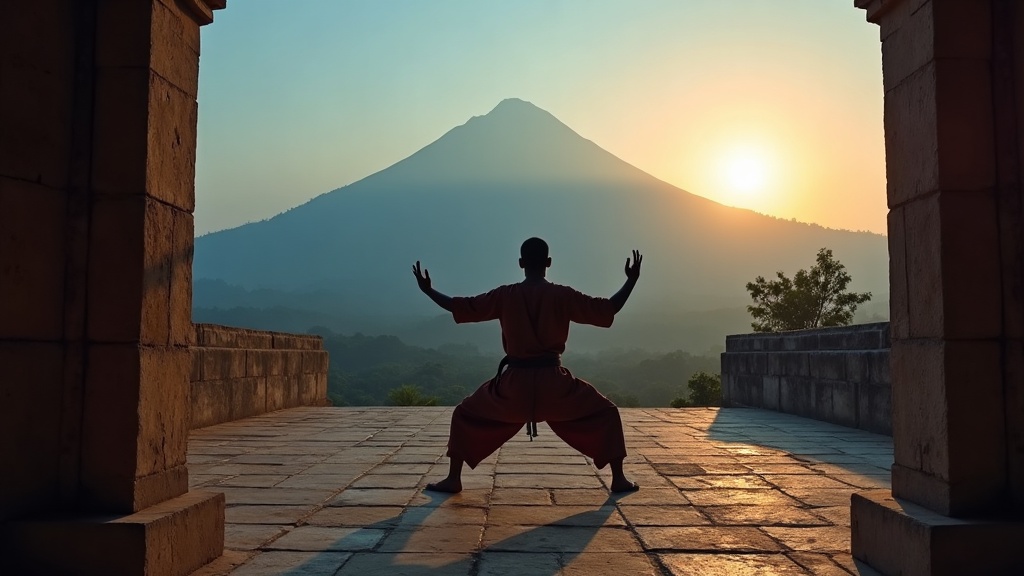
Kalaripayattu Retreat Tiruvannamalai — 15 Days at Arunachala
Kalaripayattu Retreat Tiruvannamalai — 15 Days at Arunachala
Most kalaripayattu retreats are held in Kerala, where the practice was born. This one is not. From 1 to 17 August 2026, Kalari University runs a fifteen-day residential retreat at the foot of Arunachala — the sacred mountain that sits at the edge of Tiruvannamalai in Tamil Nadu, four to five hours south-west of Chennai. The pairing is deliberate. Kalaripayattu is a fiery, body-first martial art. Tiruvannamalai is a town that has spent two thousand years teaching people how to sit still. Trained together, in the same fifteen days, they do something neither does alone. This guide is for the person trying to decide whether to come.
A kalaripayattu retreat in Tiruvannamalai is a residential immersion into one of India's oldest martial arts, held at the foot of the sacred Arunachala mountain in Tamil Nadu rather than in Kalaripayattu's traditional home of Kerala. The August 2026 retreat runs fifteen days, with pre-dawn body practice, sattvic vegetarian meals, and a small group capped at twenty participants. It is built for Western practitioners who already train but want to move from the head into the body.
Last updated: 27 May 2026
Key Takeaways
- The Kalari University retreat runs 1 to 17 August 2026 in Tiruvannamalai, Tamil Nadu — fifteen full training days at the foot of Arunachala mountain.
- All-inclusive pricing starts at €1,800 for a shared room, €1,950 for a double room and €2,200 for a single room, covering accommodation, sattvic vegetarian meals, training, study materials and local transfers.
- The retreat is held at the Shivalaya Boutique Guesthouse, a small property with a direct view of Arunachala and walking access to the pradakshina path.
- Training runs four to five hours per day across a pre-dawn morning session and an afternoon session, with rest and study blocks between.
- No prior kalaripayattu experience is required; the group is capped at twenty so each person can be met where they stand.
- This is one of the only Kalaripayattu retreats held outside Kerala, chosen for the deliberate pairing of body-first martial practice with the contemplative culture of a pilgrimage town.
- Application is by short personal call plus deposit. Contact: [email protected] or WhatsApp +91 8137037856.
Why Tiruvannamalai and Not Kerala
The obvious question first. Kalaripayattu was born in Kerala and is still taught most authentically there, in red-earth courtyards called kalaris that have been continuously in use for generations. If your goal is to study in the art's original soil, Kerala is the right answer and you should go there.
This retreat is held elsewhere on purpose.
Tiruvannamalai is a small temple town in northern Tamil Nadu, dominated by a single ancient volcanic mountain called Arunachala. The town has been a pilgrimage destination for centuries — for Shaivas who associate the mountain with Shiva, for the followers of the twentieth-century teacher Ramana Maharshi who built his ashram at its base, and for the steady stream of seekers from around the world who arrive each year to walk around the mountain in silence. The town is built for stillness. It is built for the kind of slow internal work that the practice asks for around the edges of training.
That contrast is the point. Kalaripayattu in the body is fire — sharp, fast, low to the ground, demanding. The town around the practice is the opposite — quiet, slow, oriented toward sitting still with whatever is left when you stop moving. Together they form a feedback loop most Western practitioners struggle to build at home: train hard, then have somewhere quiet enough to actually feel what just happened.
There is a second practical reason. The Shivalaya Boutique Guesthouse, where the retreat is held, sits at the lower edge of Arunachala with a clear view of the mountain from its terrace and walking access to the inner pradakshina path. The training space, the accommodation, the meals, the optional evening walk — all of it is within a short distance. No driving, no rural isolation, no logistical chaos. The retreat is small, the location is dense, and the days are uncluttered.
If you want the full traditional kalari experience inside a rural Kerala village, this is not your retreat. If you want what Kalari trains, held inside one of the quietest towns in India, this is.
What This Retreat Is, and What It Is Not
Honest framing first, because most retreat pages oversell.
This is fifteen days of physical practice held in residential format. The day begins before sunrise, ends after dinner, and is structured around training. You will be sore by day three. You will hit a wall somewhere around day six. You will, if you stay with the work, feel something fundamental shift in the way your body holds itself by day twelve. That is the arc.
It is not a yoga retreat with a few kalari moves added. The spine of the day is martial-art training in the traditional sense — stances, kicks, body sequences and partner work, practised barefoot on a wooden floor with a teacher who has trained the art for over a decade. The discipline runs underneath everything else.
It is not a wellness holiday or a spa break. There is no Ayurveda panchakarma program built in, no massage menu, no afternoon poolside. The food is good and vegetarian, the rooms are clean and quiet, the schedule has rest blocks. But the day is organised around physical work, and the work asks something of you.
It is not a silent meditation retreat either. The town around the practice carries the silence; the training itself is alive, communicative and human. You will talk during meals. You will laugh during partner work. You will not, however, be on your phone every spare hour — and that is part of the point.
What it is, plainly: a structured fifteen-day immersion into the foundations of Kalaripayattu, held in a place quiet enough that the work has somewhere to land.
A Day at the Retreat
The schedule is the same most days, with small variations for the optional pradakshina walk and one rest afternoon mid-retreat.
Morning — Meypayattu and Chuvadu before sunrise
The morning bell rings at 5:15 AM. You have fifteen minutes to wash, dress in loose cotton and walk down to the training hall. The pre-dawn start is not for spiritual atmosphere — it is because the body works best in this window, the air is cool, and the late afternoons in August are humid.
The first hour is warm-up, joint mobilisation, and basic stances. The next ninety minutes work the meypayattu sequences — long, flowing body forms that combine the eight foundational stances, the eight kicks and the connective transitions into a single continuous practice. Beginners learn one short sequence and repeat it; more experienced practitioners work through longer chains.
By 8:30 AM the morning session ends and you walk back up to the guesthouse. You are sweaty, slightly tired, and quietly awake. Breakfast is waiting.
Midday — Sattvic meals, rest, study
Breakfast at 9:00 AM is South Indian and substantial — idli, dosa, sambar, fresh fruit, filter coffee or chai. Meals at the retreat are sattvic — a vegetarian style traditional to Hindu and Ayurvedic culture, light on heavy spices and heavy oils, designed for clarity of body and mind. Most participants eat more than they expect to.
The middle of the day is open. Some people nap. Some read in the shade of the terrace. There is a short optional study block at 11:30 AM — twenty minutes where Raphael walks through the underlying logic of what was practised that morning, the names in Malayalam and Sanskrit, the history. No participation required.
Lunch at 1:00 PM is the largest meal of the day — rice, lentils, two or three vegetable dishes, yoghurt or buttermilk, a sweet to close. After lunch, two hours of rest. Most people sleep some of it. The body is asking.
Afternoon — Skill work, application, partner practice
The afternoon session starts at 4:00 PM and runs about two hours. This block is different in character from the morning. Mornings build the form; afternoons work the application. We slow down individual movements and trace why they exist — what a particular kick does in real space, why the low stance is held the way it is, how the breath fits inside a sequence.
A portion of each afternoon is partner work, kept simple and safe. Standing and engaging at low intensity with another body in the room is information you cannot get from solo practice. There is no sparring in the competitive sense. Nothing on the schedule risks injury when followed.
The session closes at 6:00 PM with cool-down and short standing breath work. By 6:15 PM you are walking back toward the guesthouse as the sun is going down behind Arunachala.
Evening — Closing practice, dinner, pradakshina (optional)
Evening dinner is at 7:30 PM, lighter than lunch — rice, a vegetable, dal, fruit. After dinner the day is yours. Some participants read on the terrace. Some sit in silence with the view of Arunachala. On three or four evenings during the retreat, those who want to can join a partial pradakshina — the traditional clockwise walk around the base of the mountain. The full path is fourteen kilometres and takes several hours; the partial walk we usually do is about four kilometres on the inner path, lit by oil lamps near the small shrines along the route.
Lights out around 9:30 PM, because morning comes at 5:15.
Who This Retreat Is For
Two readers tend to arrive here, and they want different things out of the same fifteen days. We name them separately rather than blending the voices.
The Western practitioner who already trains but stays in the head
If you already train — gym, yoga, martial arts, climbing, whatever — and you have noticed that the training is producing results in your body without ever fully landing in your awareness, this retreat is built for you. You do the work; you do not feel the work. You can perform the movement; you cannot feel the movement.
That gap has a name in our framing: you are practising from the head down instead of from the body up. The fifteen-day arc here is structured to close it. The slowness of the meypayattu sequences, the demand of the low stances, the time spent simply standing in a position before you move from it — all of it asks the same thing. Feel what is here, then move from it.
For more on this specifically, see embodiment training for men who already train but stay in their head and what kalaripayattu actually builds in the body that other training does not.
The practitioner with Indian roots looking for an entry into a heritage practice
If you are Indian, or have Indian heritage, and grew up with the vague sense that there was a serious physical tradition belonging to your culture that you never really touched — this retreat is also for you, and it is for you in a different way.
You are not coming to learn embodiment as a missing skill. You are coming to enter, finally, a practice that has been part of the cultural inheritance of Indian martial arts for two millennia. The town itself — a Tamil temple town with deep roots in Hinduism and Shaiva tradition — adds another layer of return. You will be among other Indians and Western practitioners alike, and the teaching will not flatten the difference in why each of you is there.
No prior kalaripayattu experience is needed. The Malayalam and Sanskrit terminology will be explained as it appears. You will not be tested on lineage knowledge.
The complete beginner, regardless of background
If you have never done kalari and have no particular tradition or training history pulling you toward it, but the idea of fifteen days of physical immersion in a small Indian temple town is calling — this retreat is open to you too.
Beginners and experienced practitioners train side by side. The same sequences, adjusted in depth. What matters more than starting experience is two things: reasonable physical health (no severe joint or back injuries; if uncertain, ask before applying), and the willingness to begin at the foundation. There is no fast-track. Everyone starts with the same chuvadu, the basic stances, and builds from there.
Where You Stay — Shivalaya Boutique Guesthouse
The retreat is held at the Shivalaya Boutique Guesthouse, a small property on the lower slope of Arunachala in Tiruvannamalai. The location matters: most of the guesthouse rooms have a direct view of the mountain, the training hall is on-site, and the pradakshina path begins a short walk down the road.
The property is modest and clean. Rooms are simple in the style typical of South Indian guesthouses — concrete or stone floor, ceiling fan, mosquito net, ensuite or shared bathroom depending on room type, hot water by geyser. There are no televisions in the rooms, which is deliberate. Wi-Fi is available in common areas only, also deliberate. The kitchen serves the three retreat meals plus filtered drinking water and tea throughout the day.
Three room types are offered.
A shared room sleeps three or four people of the same gender in single beds. This is the entry-price option and the social one — most participants who choose this option report it being part of what made the retreat memorable.
A double room sleeps two people, either two friends travelling together or two retreat participants paired by us. Private bathroom.
A single room is what it sounds like. Private bathroom, more space, more silence between sessions.
All three options include the same training, the same meals, the same access to everything the retreat covers. The only difference is sleep and personal space.
Pricing and What Is Included
The pricing is all-inclusive minus flights, paid as a deposit at application plus the balance before arrival.
| Room type | Price (EUR) | Includes |
|---|---|---|
| Shared room (3–4 bed) | €1,800 | All training, all meals, all accommodation, study materials, local transfers, airport pickup/drop-off |
| Double room | €1,950 | Same as above, private double room |
| Single room | €2,200 | Same as above, private single room |
Included: - 16 nights of accommodation at Shivalaya Boutique Guesthouse (1–17 August 2026) - All kalaripayattu training across the fifteen training days - Three sattvic vegetarian meals per day, plus tea and filtered water - Study materials and reading recommendations - Shared airport transfer from Chennai (MAA) on 1 August and return transfer on 17 August - All local transfers within Tiruvannamalai if any are needed - Optional guided pradakshina walks on selected evenings
Not included: - International flights to and from Chennai - Visa fees (most participants need an Indian tourist e-visa, easily applied for online) - Travel insurance (required; we cannot accept participants without it) - Personal expenses — laundry beyond basic, additional food outside of meals, souvenirs - Tips or donations
The group is capped at twenty people. Confirmation is in the order deposits arrive. We expect to fill the retreat.
How to Apply for August 2026
Application is by short personal call rather than by online form. The reason: we want to make sure the retreat is the right fit, and you want to make sure the same. A fifteen-day residential immersion is a meaningful commitment in time and money. A twenty-minute conversation in advance is the right amount of friction.
The process:
- Email [email protected] or WhatsApp +91 8137037856 with your name, the room type you want, and a one-line description of your training background (if any) and what you are hoping to get out of the retreat. Either German or English is fine.
- We reply within two working days to schedule a short video call.
- After the call, if both sides feel it is the right match, we send payment details. A non-refundable deposit of €400 confirms your spot. The balance is due by 1 July 2026, six weeks before arrival.
- Six weeks before the retreat we send the full preparation document — packing list, travel logistics from Chennai, suggested reading, what to expect physically, contact emergency information.
No high-pressure sales process. No upsells. The same person who teaches the retreat is the person you speak with in the application call.
How to Get to Tiruvannamalai
Fly into Chennai International Airport, code MAA. Chennai is well connected to most major European, Middle Eastern and Asian hubs.
From Chennai, Tiruvannamalai is about 200 kilometres south-west and takes four to five hours by road. We organise a shared minibus transfer from Chennai airport on 1 August 2026 and a return transfer on 17 August. Both are included in the retreat price. If your flight lands at an awkward hour or you want to arrive earlier, independent transfers by private taxi (around ₹4,000–₹5,000) or by the regular bus service are both fine.
You will need a tourist visa for India. Most participants are eligible for the e-Visa which can be applied for online about two to four weeks before travel. We recommend applying early.
The Tiruvannamalai climate in early August is warm and humid — average daytime highs around 32°C, evening temperatures dropping to around 24°C. The monsoon is mostly winding down by the time the retreat begins; some afternoon showers are possible.
What to Bring
Short, concrete, no fitness-influencer kit list.
- Three or four sets of loose cotton clothing you can move in fully — drawstring trousers, loose t-shirts, kurta-style tops. Avoid tight athletic wear, leggings, anything that restricts deep stance work.
- One slightly nicer set for evenings and rest days.
- Comfortable sandals for everyday wear. Training is barefoot — no shoes needed for sessions.
- A refillable water bottle. The guesthouse provides filtered water for refilling.
- A small notebook and pen for the study blocks and your own notes.
- Sun protection — high-SPF sunscreen, a wide-brimmed hat, light long-sleeved cotton for the strongest hours.
- Personal toiletries. The guesthouse provides linens, towels, basic soap.
- Any personal medication you take regularly, in original packaging, with enough for the full stay plus a buffer.
- An Indian SIM card or international roaming, if you want connectivity. The guesthouse has Wi-Fi in common areas.
- A small headlamp or torch — useful for early-morning walks down to the training hall and for any evening pradakshina.
What not to bring: tight modern athletic wear, heavy hiking boots, expensive jewellery, anything fragile. The retreat is simple and the climate is humid; light, washable, replaceable is the right principle.
What to Expect from the Soreness, the Heat, and the Wall
Three honest things to know in advance.
You will be sore. Not catastrophically, but meaningfully. The low stances and the body sequences ask the legs and the hip-openers in a way most adult bodies are not used to. Days three through five tend to be the heaviest. By day eight the body adapts and the soreness fades. We adjust depth, never pace. Nobody is pushed past their structural capacity. But the first week asks the body to come alive in places it has been dormant.
You will feel the heat. August in Tiruvannamalai is warm and humid even with the monsoon partly tempering it. The pre-dawn morning sessions are pleasant. The afternoon sessions are sweaty work. We schedule deliberately so that the most demanding work happens in the cooler hours. Hydration matters; the guesthouse keeps filtered water available all day.
You will hit a wall, probably around day six or seven. It is normal. It looks different for different people: a wave of doubt about why you came, a stretch of poor sleep, a flatness in practice. It passes if you stay with the schedule. The fifteen-day length is intentional precisely because shorter retreats do not give the body and the nervous system enough time to move through this stage. By day nine the wall is behind you and the second half of the retreat opens up.
If you would like a deeper map of the arc of a kalari retreat from inside the practice, what to expect at a kalaripayattu retreat in general walks through the fifteen-day phases in more detail, and the pillar guide to kalaripayattu retreats in India sets the wider context for choosing a retreat at all. For a teacher-written comparison of different program lengths and formats, see how to choose a residential kalari training program.
Arunachala — the Mountain Beside the Practice
A short word on the place itself, because it shapes the retreat as much as the training does.
Arunachala is a volcanic hill about 800 metres high, sitting at the edge of Tiruvannamalai. In Tamil and broader Hindu tradition it is identified with Shiva, and the great Arunachaleswarar Temple at its foot is one of the Pancha Bhuta Stalas — five temples corresponding to the five elements, this one being fire. Pilgrims have walked clockwise around its base for centuries in a practice called pradakshina. The full walk is about fourteen kilometres and takes most people three to four hours.
In the twentieth century the town became internationally known through Ramana Maharshi, a teacher who arrived as a sixteen-year-old in 1896 and spent the rest of his life on and near the mountain. His ashram at the southern foot of Arunachala is open to visitors today and is a place many retreat participants spend a quiet morning at during one of the rest blocks.
You do not need to be religious, or interested in Indian philosophy, or sympathetic to any spiritual framework, for any of this to do its work. The town is simply quieter than most places, the air around the mountain is denser than the surrounding plain, and the long human history of people sitting still here is somehow felt. The practice runs on the body; the town runs underneath it. For readers new to the art itself and wondering whether the idea of fifteen days of it is even the right starting point, what kalaripayattu actually is explains the practice from the inside.
Common Misconceptions About a Kalaripayattu Retreat
Three things people sometimes assume about a kalari retreat that this one is not.
"It will be a holiday with some training mixed in." No. The day is structured around training. There is rest, the food is good, the place is beautiful, but the centre of gravity is the practice. If you are looking for primarily holiday with light movement, a different format will serve you better.
"I need to be in shape first." No. You need to be in honest health — no major joint or back injuries that limit movement, no untreated cardiac issues, reasonable everyday fitness. Beyond that, the practice meets you where you are. Many of the most useful retreat outcomes happen for people who arrived feeling under-prepared.
"I need to be young." No. The kalari rewards body awareness, and adult learners often progress faster than younger ones precisely because they listen better. We have had participants in their late fifties train alongside participants in their twenties without issue.
"It is religious." No. Kalaripayattu has cultural roots in Hindu tradition and the retreat is held in a temple town, but no religious participation is asked of any participant. The optional pradakshina is offered as a walk and a contemplative practice, not as worship. The teaching is secular in delivery.
Frequently Asked Questions
Is there a kalaripayattu retreat in Tiruvannamalai
Yes. Kalari University runs a fifteen-day kalaripayattu retreat in Tiruvannamalai from 1 to 17 August 2026, held at the Shivalaya Boutique Guesthouse at the foot of Arunachala. This is the only Kalaripayattu retreat we know of held in Tiruvannamalai rather than Kerala. The group is capped at twenty participants.
When is the next kalaripayattu retreat in Tiruvannamalai
The next retreat runs 1 to 17 August 2026, fifteen full training days plus arrival and departure. Applications are open now and confirmed in the order deposits arrive. Future retreats will be announced after this one closes.
Do I need prior kalaripayattu experience to join a retreat
No. The retreat is built so a complete beginner can start from day one alongside more experienced practitioners. Everyone trains the same foundational sequences, and depth is adjusted per person. What matters more than experience is general physical health and willingness to start at the bottom.
How many hours of training per day on a kalari retreat
Roughly four to five hours of physical practice per day, split into a pre-dawn morning session of about two and a half hours and an afternoon session of about two hours. The rest of the day is meals, rest, study, optional reading or quiet time, and an evening close. It is full but not gruelling.
Why hold a kalaripayattu retreat in Tiruvannamalai and not Kerala
Kalaripayattu was born in Kerala and is best learned there if you want full traditional immersion in the art's home soil. Tiruvannamalai is chosen on purpose for a different reason: the silence of the town around Arunachala mountain pairs with the fiery body-first practice in a way that helps Western practitioners land what they learn. The art is fire; the town is stillness. Together they form a complete loop.
What is included in the retreat price
All accommodation at Shivalaya Boutique Guesthouse, three sattvic vegetarian meals per day, all kalaripayattu training, study materials, local transfers within Tiruvannamalai, and the airport pickup from Chennai on arrival day and drop-off on departure day. International flights, visas, travel insurance, and personal expenses are not included.
What is daily life like at the retreat
Days start before sunrise with two and a half hours of practice, followed by breakfast and rest until the afternoon session. Afternoons cover skill work, partner practice, and short study blocks. Evenings are quiet — a closing practice, then dinner, then your time. Many participants walk the lower path around Arunachala in the evenings.
Is the retreat suitable for women
Yes. Kalaripayattu has always been open to women, and women train the same curriculum as men with no separate track. Rooms are gender-arranged in shared options, with private double and single rooms available. The town of Tiruvannamalai is one of the safer pilgrimage destinations in India for solo female travellers.
Is the retreat suitable for someone over 40
Yes, and often more so. Kalaripayattu rewards body awareness over raw youth, and adult learners in their forties and fifties frequently progress faster than younger participants because they already know how to listen to their bodies. We adjust depth, not whether you train.
What should I pack for a kalaripayattu retreat
Loose cotton clothing you can move in fully, comfortable sandals, a refillable water bottle, a notebook, sun protection, and basic toiletries. The guesthouse provides linens. Training is barefoot, no shoes needed. Avoid bringing tight athletic wear or anything that restricts deep stance work.
How do I get to Tiruvannamalai
Fly into Chennai International Airport (MAA), then drive four to five hours south-west to Tiruvannamalai. We organise a shared transfer from Chennai on arrival day (1 August 2026) included in the retreat price. Independent arrivals by taxi or bus from Chennai, Bangalore or Pondicherry are also fine.
What spiritual context does Arunachala add to the practice
Arunachala is one of the oldest sacred mountains in India, associated with Shiva and the teacher Ramana Maharshi. Pilgrims have walked around it for centuries in a practice called pradakshina. The retreat does not require any spiritual belief, but the quiet of the place around the practice tends to deepen what training does in the body.
Sources and Further Reading
- Kalaripayattu (Wikipedia) — overview of the martial art, its history in Kerala and its four traditional stages.
- Tiruvannamalai (Wikipedia) — background on the town, its temples and its place in Tamil Nadu pilgrimage culture.
- Arunachala (Wikipedia) — the sacred mountain and its identification with Shiva in the Pancha Bhuta tradition.
- Ramana Maharshi (Wikipedia) — the twentieth-century teacher whose ashram remains a centre of the town's contemplative life.
- Pradakshina (Wikipedia) — the practice of clockwise circumambulation around a sacred place, walked by pilgrims around Arunachala for centuries.
- Indian martial arts (Wikipedia) — broader context for kalaripayattu within India's traditional fighting systems.
- Kerala (Wikipedia) — the south-western Indian state where kalaripayattu originated.
- Tamil Nadu (Wikipedia) — the state where Tiruvannamalai is located.
Apply for August 2026
If reading this you have been quietly checking your calendar, the retreat is open and we would be glad to talk with you. The August dates and the small group size mean places fill in a single window, not a rolling one — most retreats of this size in this town fill four to six months before the start date.
If you want to be in the room, this is the moment.
The August retreat in Tiruvannamalai is open for applications — 15 training days at the foot of Arunachala, all-inclusive from €1,800. Email [email protected] or WhatsApp +91 8137037856 with your name, preferred room type, and a one-line note about your training background. We will reply within two working days to set up a short call. Deposit of €400 confirms your spot.
About the Author
Raphael Gorschlüter — Co-Founder and Head Teacher, Kalari University
Raphael Gorschlüter is one of Europe's most experienced Kalaripayattu teachers, with over twelve years of training and teaching in the art. He teaches internationally — in Germany, Spain, and India — and is the co-founder of Kalari University, the leading English-language online and immersive Kalaripayattu programme. Raphael is known for developing the ability to feel movement, not just perform it, and has led residential trainings, workshops and retreats for practitioners ranging from complete beginners to senior martial artists. He leads the August 2026 Tiruvannamalai retreat in person across all fifteen training days.
