Somatic Movement Training: A Practitioner's Path
Somatic Movement Training: A Practitioner's Path
Last updated: 27 May 2026
Search for "somatic movement training" and the first page of results will mostly try to sell you a three-year teacher certification costing five figures. That is not what most readers actually want. The reader who types those words into a search bar usually wants to train themselves in a somatic method — to develop, in their own body, the capacity to feel movement from the inside. Not to qualify to teach it to others. Not yet, anyway, and possibly never.
This guide is written for that reader. It separates the two paths cleanly — practitioner training and teacher certification — names what each actually involves, lays out how to choose a practitioner program, compares the major traditions you can train in, and ends with a 90-day plan you can start today without enrolling anywhere. The aim is to give you a usable map before you spend a single euro on a course.
Somatic movement training is any structured course of practice through which a person develops their own ability to feel and move from internal sensation, rather than from external instruction or visual reference. For the practitioner — as distinct from the teacher trainee — it usually means a short entry course, then daily home practice, then progressive deepening in one method. It is not a single certification track; it is a discipline you build over months and years by training the same three inner senses again and again: proprioception, interoception, and felt sense.
Key Takeaways
- Somatic movement training splits into two distinct paths: practitioner training (you, learning to feel your body) and teacher certification (you, learning to teach others). Most search results show only the second.
- A practitioner does not need a certification to train somatically. A short structured course plus consistent daily practice is enough to develop the three inner senses the field actually rests on.
- Major traditions you can train in include the Feldenkrais Method, Body-Mind Centering, Hanna Somatics, Somatic Experiencing (clinical, separate category), and traditional martial movement such as Kalaripayattu.
- A useful training program for a practitioner is short to enter (under 30 days), low-cost (under €100), daily-practice oriented, and tradition-rooted enough that there is a teacher to go to next when home practice plateaus.
- A 90-day practitioner plan — three weeks of orientation, three weeks of deepening, six weeks of integration with the rest of your training — is enough to know whether somatic work belongs in your life permanently.
- Teacher training only makes sense once practitioner training has produced consistent felt changes for at least one to two years. Anything shorter is paying to learn what you have not yet lived.
Two Types of Somatic Training — Practitioner and Teacher Certification
The first thing to clear up is the split that the search results obscure. When you type "somatic movement training" into Google, the SERP collapses two very different things into one phrase: training to do somatic movement, and training to teach it. They are not the same path, they do not cost the same, and most people searching this term want the first while the SERP overwhelmingly shows the second.
Practitioner training — for the person who wants to feel
Practitioner training is what most readers actually need. You are not planning to put up a website and run group classes. You want to train your own body. The goal is to develop, in yourself, the felt capacity that somatic methods build: more accurate proprioception, more available interoception, a workable felt sense of what is happening when you move.
For this, the structure is straightforward. A short entry course gives you a method and a vocabulary. Daily home practice — short and consistent — develops the senses themselves. Periodic teacher time catches what your attention has not yet caught. There is no exam at the end, because nobody is asking you to certify anything.
Most practitioner courses run between five days and three months. Costs range from free (YouTube, public classes) through €25 to €300 for structured entry courses, up to €1,000–€3,000 for longer immersive programs. Compare that with teacher certification prices and the gap becomes obvious.
Teacher certification — for the person who wants to lead classes
Teacher certifications in somatic methods are serious commitments. A full Feldenkrais practitioner training runs four years, roughly 800 contact hours, and costs in the range of €15,000–€25,000 depending on country and training organisation. A Body-Mind Centering certification runs three to five years and is similarly priced. Somatic Experiencing — though it is a therapy modality, not a movement practice — is a three-year clinical program costing €8,000 and up.
These are professional qualifications. They make sense if you intend to make somatic work your livelihood, or if you already work in a related field (bodywork, physiotherapy, psychology, movement teaching) and want to add a formal credential. They do not make sense as a starting point for the person who simply wants to feel their own body.
The problem on the SERP is that certification programs run paid ads. Practitioner-level offerings often don't. The first page of results therefore looks like the only option is to spend €15,000 to qualify, when in reality the practitioner version of the same field can be entered for under €30.
Why this guide focuses on the practitioner path
For 95% of people searching "somatic movement training," the practitioner path is the right one — even if they later go on to teach. The certification programs themselves require, as a prerequisite, some years of personal practice in the method. You cannot meaningfully teach a felt sense to others before you have lived in it yourself. The practitioner stage is therefore not a lesser version of teacher training; it is the necessary foundation under any future certification.
The rest of this guide is for that practitioner. If you decide, two or five years from now, that you want to teach, the last section names the criteria for that decision. Until then, the work is your own body.
What Practitioner Training Actually Looks Like
A practitioner training in somatic movement is not a single intensive event. It is a structure built from three interlocking elements: an entry course, a daily home practice, and periodic teacher contact. The proportions shift over time, but all three are present from the beginning.
The entry course — what it gives you
An entry course is the orientation layer. It hands you the working vocabulary of a specific method — proprioception, interoception, felt sense, slow movement, breath as feedback, the particular conventions of the tradition — and gives you a small set of structured exercises to begin with.
A good entry course is short by design. Five to thirty days is the typical band. The point is not to teach you everything; the point is to give you enough to begin practising independently with a coherent frame. A 14-week introduction is usually a teacher-training prerequisite in disguise. A 7-day or 21-day course is calibrated for the practitioner.
The course should be tradition-rooted. Generic "somatic movement" courses that mix exercises from five different methods often produce confusion rather than competence. Pick one tradition — Feldenkrais, Hanna Somatics, yoga, tai chi, Kalaripayattu, whatever resonates — and let the entry course be entirely inside it. The cross-tradition view comes later, after you have a feel for what one tradition is.
Daily home practice — where the change actually happens
Once you have an entry course, the centre of gravity moves to daily practice. This is the part most beginners under-rate and most experienced practitioners insist on.
The neural changes that a somatic practice produces — the sharpening of interoception, the updating of the proprioceptive map, the lowering of baseline nervous-system tone — accumulate through repetition. The Harvard Health editorial team and most somatic teachers describe the same pattern: short daily sessions outperform long occasional ones. Five minutes a day for thirty days will change you more than two ninety-minute classes a week for the same period.
Daily does not mean elaborate. A five-minute slow weight-shift with breath, done attentively in your kitchen before coffee, is enough to maintain the channel. Once the channel is open, longer sessions become possible — but the daily five minutes is what keeps it open in the first place.
The full operational version of this daily practice — the one I give to students starting out — is laid out in the companion guide on what a somatic movement practice actually involves. The training guide you are reading now sits one level higher: it answers the question of how to structure your overall path, not the moment-to-moment of a session.
Periodic teacher contact — for what attention can't catch
The third element is teacher time. Home practice will take you a long way, but every body has compensations and held patterns that are invisible from the inside. A teacher catches them in minutes — the shoulder that climbs without you noticing, the breath that protects rather than releases, the hip that has been locked so long you no longer feel it as locked.
For a practitioner — as opposed to a teacher trainee — the right frequency of teacher contact is modest. A weekly group class, a monthly private session, or a periodic residential workshop is enough. Some traditions (Feldenkrais, in particular) make teacher work especially valuable because individualised "functional integration" sessions can reorganise patterns that group classes cannot reach. Other traditions (tai chi, Kalaripayattu, yoga) carry most of their teaching through group work.
The mistake here is to skip teacher contact entirely and rely on video courses indefinitely. The other mistake is to over-rely on weekly classes and skip the daily practice. Both elements are needed. The proportion is roughly 80% home practice, 20% teacher contact, by minute count — and that 20% multiplies the value of the other 80%.
Time investment — realistic, not idealised
Across all three elements, the realistic time investment for a practitioner in the first year breaks down roughly like this:
- Entry course: 1–4 weeks elapsed time, 1–3 hours per week total
- Daily home practice: 5–20 minutes per day, every day
- Teacher contact: 1–4 hours per month, typically as a weekly class or monthly session
- Total weekly time after the entry course: 1.5–4 hours
This is not a heavy commitment. It is roughly the time most adults spend scrolling social media on a slow evening. The reason the field can feel daunting is that the certification programs sit at the top of the search results and announce 800-hour curricula — but those numbers are for teachers, not practitioners.
How to Choose a Somatic Movement Training Program
Now to the practical decision. If you are about to spend money or time on a program, the following criteria will help you separate the practitioner-grade offerings from the teacher-track ones and the half-baked ones.
Criterion 1 — Length and entry barrier
A practitioner program should be enterable within a month and ideally completable within three. If a program requires a year of weekly group meetings before you can start practising on your own, it is structured as a teacher-training pipeline whether or not it calls itself one.
Good signals: a 7-day, 21-day or 30-day entry course; a clearly defined start and end; immediate access to daily home practice material.
Warning signals: ongoing weekly subscription that cannot be paused; "modules" that gate the next step behind months of waiting; requirement to attend in person for the entry layer.
Criterion 2 — Cost matched to scope
A practitioner-level entry course should cost under €100 for short formats (5–14 days) and under €500 for longer formats (1–3 months). Anything substantially above that is either a residential immersion (which includes lodging and food) or a teacher-track program priced like the certification it leads to.
The free option exists too. YouTube has good somatic content from established teachers. Free public sessions exist in most cities for tai chi and yoga. The cost of a structured course is the cost of curation and sequencing — what you save in time and confusion by following one teacher's plan rather than assembling your own.
Compare the costs honestly: a full Feldenkrais teacher training at €18,000 over four years, a Body-Mind Centering certification at €15,000 over three to five years, a Somatic Experiencing professional training at €8,000 over three years — all are professional investments. A practitioner course at €24.90 or €99 or €250 is a different category entirely.
Criterion 3 — Daily-practice orientation
The single biggest predictor of whether a program will produce real change is whether it gives you a daily home practice and treats that as the centre of the training, not as homework on the side.
A program that meets weekly for two hours and gives you nothing to do in between is shaped wrong for somatic work. The nervous system updates through frequency, not through dosing. Even the in-person somatic methods most committed to teacher-led work — Feldenkrais Awareness Through Movement and Hanna Somatics — release home material so that practitioners can keep the channel open between sessions.
Good signals: the program explicitly names a daily practice; recordings or written instructions are sent for at-home work; the entry course is structured around "this is what you do tomorrow morning."
Criterion 4 — Tradition rooting
Avoid programs that pitch themselves as "somatic movement" in a generic, brand-neutral way without naming a tradition. The somatic field is real, but the training of the field happens inside specific lineages — Feldenkrais, Hanna Somatics, BMC, the somatic side of named yoga schools, traditional martial schools.
A program rooted in a tradition can hand you off to a teacher when you plateau. A generic "somatic movement program" cannot, because it belongs to nobody and has no teacher community to deepen into. You will have learned a vocabulary that does not connect to any living practice.
This is also a vetting tool: look up the tradition the program belongs to and find out whether there are teachers in your country you could eventually train with in person. If yes, the program has a future for you. If no, the program has a ceiling.
Criterion 5 — Teacher credentials and lineage
The teacher behind the program should be reachable to a degree. Their training history should be visible — where they trained, with whom, for how long. Their broader teaching should be documented somewhere other than the sales page.
The somatic field is small enough that anyone serious has a public footprint: workshops in named cities, students who have been with them for years, a body of writing or video that pre-dates the course you are buying. If the only visible content is the course itself, treat it as a yellow flag.
Criterion 6 — Honest claims, no medical promises
Reputable somatic teachers do not promise to cure your back pain, your anxiety, your insomnia, or your trauma. They describe the practice and let you experience its effects. If a program advertises specific medical or psychological outcomes, that is either a regulatory issue (in most countries, somatic teachers are not licensed to make medical claims) or a marketing inflation that signals the rest of the offer is similar.
Look for language like "you may notice…," "many practitioners describe…," "in my experience teaching this…" — first-person, qualified, observational. Avoid programs that announce results as guaranteed.
Training in Different Somatic Traditions — A Comparison
The field is not a monolith. Different traditions train the same underlying inner senses through different architectures, and which one suits you depends on the body you arrive with and the kind of demand you want the practice to make on you.
Feldenkrais Method — small, subtle, deeply intelligent
Feldenkrais, developed by Moshé Feldenkrais in the mid-20th century, works through very small differentiated movements. A typical lesson might spend forty minutes exploring how the rib cage can move while you lie on the floor. The aim is to expand the brain's map of itself by giving it new movement information.
Practitioner training: Awareness Through Movement (ATM) classes — group lessons, audio or live — are the entry layer. Costs are modest (€10–€20 per class). The international Feldenkrais Guild maintains a directory of certified teachers in most countries.
Best suited for: people with chronic pain, repetitive strain, post-injury rehabilitation, or any movement habit they want to reorganise rather than reinforce. Practitioners who find loud demanding practice off-putting.
Less suited for: people who need physical intensity to stay engaged. Feldenkrais is profound but quiet, and active practitioners sometimes mistake the quiet for absence.
Body-Mind Centering — exploratory, anatomical, slow
Body-Mind Centering, developed by Bonnie Bainbridge Cohen, treats the body as a series of anatomical systems (skeletal, muscular, organ, fluid, nervous) that can each be experienced and inhabited from the inside. Movement is exploratory rather than choreographed.
Practitioner training: BMC has a smaller teacher network than Feldenkrais and runs primarily through workshops and immersives. Entry-level material is available through some online platforms; full programs are immersive and expensive.
Best suited for: dancers, therapists, somatic practitioners who already have a movement vocabulary and want to deepen anatomically. People with a strong appetite for self-directed exploration.
Less suited for: beginners who want a structured day-by-day plan. BMC's strength is the open inquiry; that is also its barrier for entry.
Hanna Somatics — clinical, pandiculation-based, fixable
Hanna Somatics, developed by Thomas Hanna (who coined the modern use of "somatic"), uses a specific technique called pandiculation — slow voluntary contract-and-release sequences that retrain chronically held muscles to release. It is more directive and more goal-oriented than Feldenkrais.
Practitioner training: video courses, group classes, and one-on-one sessions with certified Hanna Somatic educators. Entry costs are modest (€50–€200 for entry video courses). The clinical orientation makes it appealing to people working with specific dysfunction.
Best suited for: people with named musculoskeletal complaints (chronic back pain, neck pain, hip restriction) who want a method with a clear protocol.
Less suited for: people looking for an open movement practice. Hanna Somatics is targeted; it is not a general somatic lifestyle.
Somatic Experiencing — clinical, therapeutic, not a movement practice
Somatic Experiencing, developed by Peter Levine, is included in this comparison only to draw the distinction. It is a clinical therapy modality for trauma resolution, delivered one-on-one by a licensed practitioner. It is not a movement practice you train in for general body awareness.
If you are reading this guide because of trauma symptoms — flashbacks, dissociation, hyperarousal — SE is the relevant referral, not a movement course. Most cities have SE practitioners; the official directory is the cleanest source.
If you are looking for general body training, SE is not the field you are in.
Yoga (the somatic styles) — accessible, breath-led, widely available
Most styles of yoga, done attentively, qualify as somatic movement. Restorative yoga, slow vinyasa, Iyengar with attention turned inward, Yin — all of these can train the three inner senses well, depending on the teacher and on how the practitioner shows up.
Practitioner training: yoga is the most accessible somatic tradition in most countries. Entry-level group classes are everywhere, costs are low (€10–€20 per class), and online libraries are extensive. The challenge is curation — not all yoga is somatic, and a power-yoga class focused on shape can train very little interoception.
Best suited for: practitioners who want a wide network of teachers, low cost of entry, and a tradition with thousands of years of refinement around breath and posture.
Less suited for: men who find the prevailing yoga studio culture off-putting (a common but solvable problem — there are styles and teachers for every disposition).
Tai Chi and Qigong — slow, weight-shifted, deeply researched
Chinese internal arts — tai chi and qigong — are explicitly somatic by design. The slow choreographed sequences train weight transfer, breath, and felt sense in parallel, and have been studied extensively in clinical research, with documented benefits for balance, fall prevention, and stress markers.
Practitioner training: park classes (often free), community centre classes, and a long tradition of teacher-student transmission. Costs are modest. Entry is accessible.
Best suited for: practitioners who want a calm, weight-aware tradition with strong research backing. Older adults in particular.
Less suited for: people who want a tradition that includes physical demand and combative application. Tai chi can be combative — at the higher levels it is — but the entry layer is gentle by design.
Kalaripayattu — traditional martial, body-first, demand-meeting
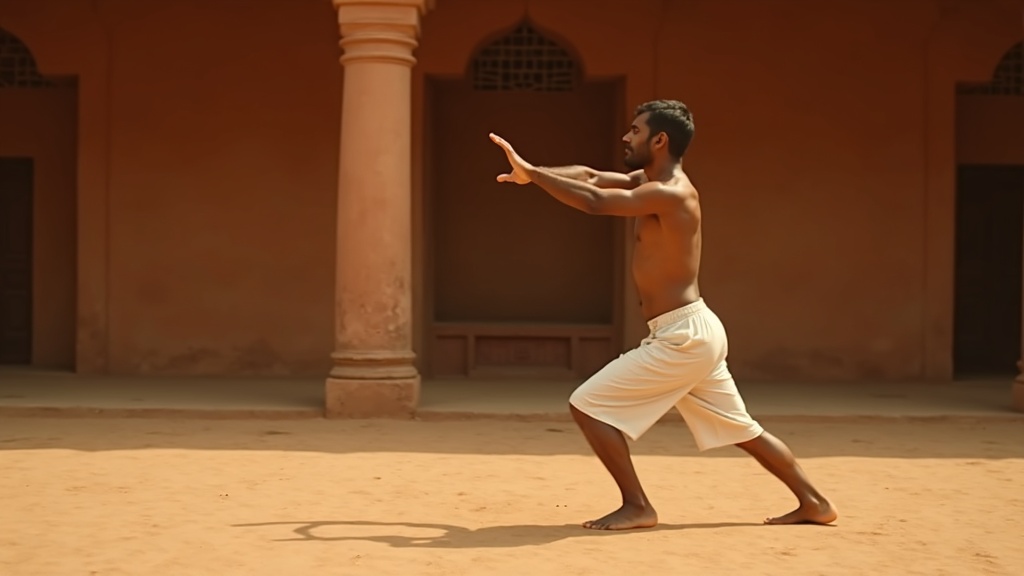
Kalaripayattu is the traditional martial art of Kerala, India. Its early stages — meithari and the meypayattu animal sequences — train all three inner senses through slow, weight-loaded, breath-coordinated movement. The full curriculum runs through unarmed work into sticks, sharp weapons and empty-hand combat, but the entry layer is somatic in every operational sense.
Practitioner training: short structured online courses (a 7-day foundations course is calibrated exactly for the entry layer described in this guide), longer online programs, and residential retreats. Costs at the entry layer are modest (€25 for the 7-day course, similar for monthly memberships). Teacher network is small outside India and Europe — finding live teaching usually means traveling for a retreat or attending a workshop when one comes to your region.
Best suited for: practitioners who already train (gym, yoga, martial arts) and want a somatic practice that meets their existing intensity rather than asks them to soften. Men in particular often find that the martial container of Kalaripayattu makes the somatic work accessible in a way other entry points do not.
Less suited for: practitioners with significant orthopaedic limitations who cannot work with low stances and floor contact. Most of these can be adapted, but Kalaripayattu by default is more physically demanding than Feldenkrais.
A quick visual summary
| Tradition | Intensity | Cost (entry) | Daily home practice | Teacher access (West) | Best for |
|---|---|---|---|---|---|
| Feldenkrais | Low | €10–€20/class | Yes (ATM recordings) | Wide | Pain, subtlety, intelligence |
| Body-Mind Centering | Low–Med | €100–€500+ | Yes (self-directed) | Narrow | Dancers, deep explorers |
| Hanna Somatics | Low | €50–€200 video | Yes (pandiculation) | Moderate | Targeted musculoskeletal |
| Yoga (somatic styles) | Low–High | €10–€20/class | Yes (everywhere) | Very wide | Accessibility, breath |
| Tai Chi / Qigong | Low | Often free | Yes | Wide | Calm, balance, longevity |
| Kalaripayattu | Med–High | €25–€50 entry | Yes | Narrow (mostly online) | Already trains, wants demand |
The comparison is a guide, not a verdict. Several practitioners train in two traditions in parallel — for example, a tai chi practice in the morning and weekly Feldenkrais lessons for chronic pain, or daily Kalaripayattu and monthly Feldenkrais for the integration. The traditions are not competitors; they are different shapes of the same underlying field.
A 90-Day Somatic Movement Training Plan You Can Start Today
The fastest way to find out whether somatic training belongs in your life is to do it for ninety days. The plan below requires no enrolment, no payment, and no equipment beyond a patch of floor. It will not certify you in anything. It will tell you, definitively, whether the field is real for your body.
Week 1–3 — orientation phase
The first three weeks are about getting the channel open. The goal is daily contact with attention turned inside, not duration or complexity.
Daily practice (5 minutes). Stand barefoot, feet hip-width apart, knees soft. Three slow breaths through the nose. Slow weight-shift from one foot to the other over a count of twenty, then back, eyes open. Repeat twice. Then twice more with eyes closed. End with thirty seconds of standing still, noticing how the floor reads from your feet now compared with the start.
This is the same five-minute starter described in the companion guide on a daily somatic movement practice. It is enough to begin training all three inner senses in parallel.
Once a week. Spend twenty minutes doing a longer version of the same sequence, or replacing it with a slow yoga session, a Feldenkrais ATM recording (many are free on YouTube), or a tai chi class if one is locally accessible. The variety is to start sampling traditions; the daily five minutes is the anchor.
Tracking. Keep a one-sentence note at the end of each session: what you noticed. This is not a journal; it is a sensory log. "Right ankle louder than left today." "Breath caught when eyes closed." "Felt the soles for the first time after coffee."
By the end of week three, you will know two things: whether the daily practice is sustainable for your schedule, and whether anything has begun to shift in your felt awareness. Most people who actually do the daily five minutes report a first concrete change between day ten and day twenty. If nothing has shifted by day twenty-one, see the troubleshooting note further down.
Week 4–6 — deepening phase
Once the daily channel is open, the deepening phase introduces a single longer session per week and starts to commit to one tradition for the rest of the ninety days.
Daily practice (10 minutes). Same structure as the five-minute starter, but doubled — slower weight-shifts, more time at the end standing still, optionally a slow arm sequence or a gentle floor exploration added to the front.
One longer session per week (45–60 minutes). Choose a tradition based on the comparison earlier in this guide and commit to it for the next nine weeks. If you cannot decide, the default for the reader profile this guide is written for — already training, wants demand — is the Kalaripayattu entry layer. If you prefer something gentler, slow vinyasa yoga or a Feldenkrais ATM series.
Tradition study. Spend one hour a week reading or watching from inside the tradition you have chosen. Not generic somatic content — material from teachers in that specific lineage. This builds the vocabulary and the sense of what you are heading toward.
By week six, the practice should be feeling more like something the body wants than something the schedule imposes. If it doesn't yet, the issue is usually one of two things: the tradition you chose isn't matching your body's appetite, or the daily practice has become too cognitive. Both are fixable. The first by switching traditions for the next phase; the second by re-reading the section on common mistakes in the somatic movement practice guide.
Week 7–12 — integration phase
The last six weeks fold the practice into the rest of your training and your day, so that by the end of the ninety days it is not a separate item on the schedule but a layer that runs underneath everything.
Daily practice (15 minutes). Continue the morning practice. Add one or two short attention-anchors during the day: a slow breath cycle while standing at the kettle, a sixty-second weight-shift before a meeting, three breaths with eyes closed before getting out of the car. These are not separate practices; they are the same practice, briefer.
Two teacher-touched sessions. If your tradition allows it, attend two longer teacher-led sessions during this phase. For online traditions like Kalaripayattu, this means joining live group classes or working through a structured course with video instruction. For Feldenkrais or yoga, attend in-person classes. The teacher contact accelerates everything the home practice has been building.
Integration into existing training. Bring the somatic attention into your existing sport, gym, or martial training. Pick one exercise per session and do it as a somatic practice — slowly, with attention inside, with the goal of feeling rather than performing. A single squat done that way, every workout for six weeks, will quietly change your relationship to the rest of the work.
Final review. At day ninety, sit down and write three things: what changed in your body, what changed in your other training, and whether you want this practice in your life for the next year. If the answer to the third question is yes — and for most people who complete the ninety days honestly, it is — you are no longer experimenting. You are practising.
Troubleshooting — what to do if nothing is shifting
A small number of practitioners report no felt change after three weeks of honest daily work. Almost always, the reason is one of four:
- The five minutes have become mechanical. Attention has drifted into "doing the exercise" rather than feeling. The fix is to shorten to three minutes and slow down to half-speed.
- The narration is louder than the sensation. This is the classic head-trap: the mind narrates the movement and you mistake the narration for feeling. The fix is to soften the narration deliberately, even at the cost of "missing" sensations.
- The tradition isn't matching the body. Some practitioners need more demand than slow weight-shifts provide before interoception switches on. Try a more loaded entry — a low Kalaripayattu stance, a Yin yoga long-hold, a slow tai chi sequence — for a week.
- There is something the body is actively avoiding. Old injury, held trauma, or chronic tension can make the body refuse the channel. In this case, one or two sessions with a Feldenkrais teacher, a Somatic Experiencing practitioner (if there is a clinical reason), or an experienced bodywork teacher usually surface what self-practice cannot.
The plan is not a guarantee. It is the most efficient ninety-day path I know for finding out whether somatic training belongs in your life. If it does, the rest will build itself over the next several years.
When to Consider Teacher Training
For some practitioners, the question of teacher training does arrive — usually two to five years in. The criteria below help separate the moment when teacher training makes sense from the moment when it would only be paying to learn what hasn't yet been lived.
You have a daily practice that has been steady for at least two years
This is the threshold most certified programs will state explicitly or imply through their prerequisites. A practitioner who has not yet held a daily practice for two years is being asked to certify a depth of relationship with the method that does not yet exist. Teacher training will not produce the depth; it can only formalise what daily practice has already built.
You have ongoing teacher relationships in the tradition
If you cannot name two or three teachers in your tradition whose work you know directly, you do not yet know the tradition well enough to teach it. A teacher training is a transmission, and transmission requires teachers you have actually worked with — not just learned from at a distance.
You have specific people you are likely to teach
The strongest argument for teacher training is a clear vision of the students it will let you serve. A physiotherapist who wants to add somatic work to their practice with chronic pain patients. A movement teacher who wants to deepen what they already offer. A martial artist who wants to bring somatic principles into the school they already run. In each case, the certification has a use the day it is finished.
The weakest argument is "I love this practice and want to know more." Loving a practice is a reason to deepen your own training, not necessarily to pay €15,000–€25,000 to formalise a teaching credential. The deepening can happen — and usually does — through continued personal practice and informal study, far more economically.
You can carry the financial and time cost without distortion
Most teacher trainings run three to five years and cost between €8,000 and €25,000. They require regular travel for residentials, weekday absences for intensives, and ongoing study time during the certification period. Before committing, the realistic question is whether this can be carried without distorting the rest of your life — including the daily practice that motivated the interest in the first place.
A teacher training that consumes the personal practice it grew out of has lost its purpose. If the calendar cannot accommodate both, the personal practice wins. The teacher training can wait.
When practitioner training is genuinely enough
For the large majority of people who arrive at somatic work, practitioner training is the whole journey. They develop a deep personal practice, integrate it with their existing life, and never teach formally. That is not a lesser path; it is the field functioning as intended. Most of what somatic methods do for the world is done through practitioners, not through teachers — because the practitioners take the changed bodies and the sharper attention into the rest of their lives, families, and work.
If teacher training never calls you, the practice has not been incomplete. It has been complete in the only way that ultimately matters: it has changed how you live in your body.
Frequently Asked Questions About Somatic Movement Training
What is somatic movement training in simple terms
Somatic movement training is any structured course of practice through which a person develops their own ability to feel and move from internal sensation, rather than from external instruction. It trains three inner senses in parallel — proprioception, interoception, and felt sense — through slow attentive movement done daily. For most practitioners it means a short entry course plus daily home practice in one tradition such as Feldenkrais, Hanna Somatics, yoga, tai chi, or Kalaripayattu.
Do I need a certification to practise somatic movement
No. Certification is a teaching credential. To practise somatic movement for your own development, you need a coherent method, a daily practice, and periodic teacher contact. A short entry course (5–30 days) plus consistent daily practice plus occasional teacher time is enough to develop the felt capacities the field rests on. Certification is only relevant if you intend to teach others, and most certifications require years of personal practice as a prerequisite.
How long does somatic movement training take to work
The first concrete shift usually arrives between day ten and day twenty of consistent daily practice, even with five-minute sessions. Earliest markers are tension release and felt ground contact. Balance and breath rhythm change in week three to six. The deeper shift — moving from felt sense rather than from thought — typically lands in month two. Ninety days of honest daily practice is enough to know whether somatic training belongs in your life permanently.
What is the difference between practitioner training and teacher training
Practitioner training develops your own ability to feel and move somatically. It is short, low-cost, and home-practice-centred. Teacher training is a professional certification that qualifies you to teach others. It runs three to five years, costs €8,000–€25,000, and requires you to already have a personal practice as a prerequisite. For 95% of people searching "somatic movement training," practitioner training is the right path.
How do I choose a good somatic movement training program
A good practitioner program is short to enter (5–30 days), modestly priced (under €100 for short formats, under €500 for longer ones), built around daily home practice, rooted in a named tradition with a reachable teacher community, led by a teacher with visible credentials, and honest in its claims (no medical promises). Avoid generic "somatic movement" programs that mix traditions, lock you into ongoing subscriptions, or advertise specific clinical outcomes.
What is the best somatic movement tradition for beginners
There is no single best tradition; the right one depends on your body. The Feldenkrais Method is excellent for chronic pain and subtle awareness. Yoga is the most accessible globally. Tai chi is the most clinically researched and especially good for balance. Hanna Somatics works well for targeted musculoskeletal complaints. Kalaripayattu suits practitioners who already train and want a somatic practice that meets that intensity. Sample two or three before committing to one for the long term.
Can I do somatic movement training at home
Yes, and home is where most of the training actually happens. The daily five-minute starter requires no equipment, no supervision, and no special space. After three to six weeks of consistent home practice, most practitioners benefit from some teacher contact to catch what attention has not yet caught. The proportion in a sustainable practice is roughly 80% home, 20% teacher.
How much does somatic movement training cost
Practitioner training costs are modest: free (YouTube, public tai chi classes) up to about €300 for a structured entry course, and €500–€3,000 for longer immersive programs. Teacher certification is a different category: €8,000 for Somatic Experiencing, €15,000–€25,000 for Feldenkrais or Body-Mind Centering. The first page of search results often surfaces the second category and obscures the first.
Is somatic movement training good for men who already train hard
Yes, and this group often benefits most. Men who have trained gym, yoga or martial arts for years usually have strong proprioception but weak interoception — the "I keep training but nothing is landing" pattern. A somatic practice closes the gap by training the missing channel. Practices with built-in demand, such as Kalaripayattu, often land more cleanly for this profile than gentler entry points. The case is laid out in detail in the guide on embodiment training for men.
Is somatic movement training the same as somatic therapy
No. Somatic therapy — most commonly Somatic Experiencing developed by Peter Levine — is a clinical modality delivered one-on-one and aimed at trauma resolution. Somatic movement training is a discipline you build yourself through daily structured practice. The effects can overlap, but the contexts are different: therapy treats, training trains. People sometimes use both in parallel.
What is the youngest a person can start somatic movement training
Children can begin somatic-style movement informally from a very young age, but the structured daily practice described in this guide is suited from roughly adolescence onward. Adults of any age can begin. There is no upper limit — Feldenkrais and tai chi are widely practised by people in their seventies and eighties, and the somatic styles of yoga are accessible across the full adult lifespan.
Can somatic movement training replace physiotherapy or medical care
No. Somatic movement training is not a substitute for clinical treatment of any condition. It works alongside medical care and often supports it — practitioners frequently report that chronic pain, baseline stress, and recovery from injury improve with a consistent practice — but the training itself is not regulated as a medical intervention. If you have a diagnosed condition, follow medical guidance and use somatic training as a complement, not a replacement.
Sources & Further Reading
- Cleveland Clinic — What Are Somatic Workouts? — Editorial overview of the recognised somatic practice list.
- Harvard Health — What are somatic workouts? — Editorial guide on frequency and accessibility of somatic practice.
- Cleveland Clinic — Proprioception — Definition and mechanisms of the spatial-position sense.
- NIH / PMC — Interoception research review — Peer-reviewed background on interoception as the foundation of self-awareness.
- NIH / PMC — Slow breathing and parasympathetic activation — Documented physiological effects of slow movement and breathing practices.
- Somatics — Wikipedia — Origin of the term and the field, popularised by Thomas Hanna.
- Feldenkrais Method — Wikipedia — Background on the Feldenkrais tradition and its teacher-training structure.
- Body-Mind Centering — Wikipedia — Background on Bonnie Bainbridge Cohen's tradition.
- Somatic Experiencing — Wikipedia — Reference for the clinical somatic therapy modality distinguished from somatic movement training.
- Kalaripayattu — Wikipedia — Background on the traditional Kerala martial art and its training stages.
- Yoga — Wikipedia — Background on the largest globally-practised tradition that overlaps with somatic movement.
Conclusion — Start the Practitioner Path, Not the Certification
Most of what the search results show you under "somatic movement training" is the wrong product for the question you are actually asking. You do not need to spend €15,000 over four years to develop the felt capacities of a somatic practice in your own body. You need a coherent method, a short entry course, a daily practice you actually do, and the patience to give the work ninety days before judging it.
The choice of tradition matters less than the consistency of the practice. Feldenkrais will get you there. Yoga will get you there. Tai chi will get you there. Kalaripayattu will get you there. What will not get you there is jumping between traditions, treating somatic work as a weekend project, or paying for a teacher certification before you have lived in any of them.
If you keep training but nothing is landing — and you want a somatic entry point that meets the intensity of the training you already do rather than apologising for it — the 7-day Kalaripayattu foundations course is built for exactly that profile. Seven days, one foundational movement per day, each one designed around the three inner senses this guide has unpacked. You will feel the difference by day three.
Start the 7-day Kalaripayattu foundations course — €24.90 →
(If the 7-day course page is not yet live: the first lesson of the full Level 1 curriculum is free — no payment, no commitment. Create your account and start today →)
About the Author
Raphael Gorschlüter — Co-Founder & Head Teacher, Kalari University
Raphael Gorschlüter is the co-founder of Kalari University and one of Europe's most experienced Kalaripayattu teachers. He has trained and taught the practice for over twelve years, with regular work in Germany, Spain and India — including the annual Tiruvannamalai retreat. His teaching focus is the somatic side of the tradition: developing the ability to feel movement rather than only perform it. He writes from inside the practice. The guide you have just read comes out of fifteen years of teaching practitioners who arrived already trained but did not yet land — and out of watching the same questions about training, certification, and choice of method come up in nearly every first conversation.
→ More about Raphael and Kalari University
