Grounding Through Movement: How to Actually Feel It
Grounding Through Movement: How to Actually Feel It
You already train. You move three, four, five times a week. You know the difference between a good session and a bad one — and most of them are bad in a very specific way: your body did the work, but you were somewhere else the whole time. The reps happened. The form was correct. Nothing landed.
Almost every article on grounding will tell you to count five things you can see and four things you can hear. That advice is for someone in a panic attack. It is not for you. You are not anxious. You are disconnected — moving without inhabiting the movement — and the fix is not a stress technique you reach for in a crisis. The fix is a different way of training.
This guide treats grounding through movement as a trainable capacity, not an emergency brake. You will learn what grounded actually feels like in the body, why most training does not produce it, the three qualities every grounding movement shares, and a concrete practice you can start today.
Grounding through movement is the practice of using slow, weighted, attention-directed movement to bring perception out of mental chatter and into direct body sensation. It activates the parasympathetic nervous system, trains proprioception and interoception, and builds a reliable felt sense of being present in your own body. Unlike emergency grounding techniques used in moments of anxiety, movement-based grounding is a daily training capacity you develop over weeks.
Key Takeaways
- Grounding through movement is a trainable capacity, not a one-off technique. You build it with daily practice the same way you build mobility or strength.
- The mechanism is simple: slow weighted movement gives the nervous system rich sensory input, which pulls attention out of the head and into direct body sensation.
- Most exercise does not produce grounding because it rewards external metrics — speed, output, mirror form — instead of inward attention.
- Three qualities make a movement grounding: weight in the stance, slowness in the transitions, and attention turned inward rather than outward.
- "Grounded" is the top-reported outcome word from long-term Kalaripayattu students, and it is a specific perceptual state, not a vibe.
- A reliable grounding capacity typically develops over six to twelve weeks of practice three to five times per week, with a noticeable shift in the first session.
- Grounding is different from earthing, different from calming down, and different from somatic therapy — and confusing them is the reason most readers cannot find the practice they actually need.
What Grounded Actually Feels Like in the Body
Most articles on grounding stop at words like calm, centred, present. Those words are accurate but useless — they describe the outcome without telling you what to look for in your own body. So here is the felt sense, in concrete terms.
You notice weight first. Your bodyweight stops being an abstraction and becomes a sensation: heavy in the feet, settled through the legs, dropping from the chest down into the pelvis. People often report feeling heavier the moment grounding lands, even though nothing has actually changed about their mass. Weight, when you feel it instead of carry it, registers as presence.
The breath deepens on its own. You did not tell yourself to breathe — your diaphragm just dropped a few centimetres lower than it usually does. Inhalations get longer without effort. The ribs move in three dimensions instead of just rising and falling. If you have spent years doing breath exercises, this is what they were trying to install — and it shows up for free the moment grounding takes.
The sensation, in concrete terms
The visual field changes. Things look less sharp at the edges. Your eyes stop scanning. You can hold a soft gaze on one point without your attention flicking elsewhere. This is one of the most reliable markers — when the eyes settle, you are usually in.
The internal commentary quiets. Not because you suppressed it, not because you replaced it with a mantra, but because the body is loud enough now that the thoughts move to the background. You can still think; the thoughts just stop being the foreground of experience. This is the difference between meditation that works and meditation that feels like wrestling.
Most importantly — the body stops feeling like a vehicle you are driving from inside your head. It feels like the place you live. People describe this as coming home, but the home metaphor is misleading. It is more accurate to say the body stops being an object and becomes a location. You are not in your body. You are the body.
Why most training does not produce it
Here is the uncomfortable part. You can run for an hour. You can lift heavy for ninety minutes. You can roll on the mat in a hard BJJ class and tap out a dozen times. None of it has to produce a grounded state — and for most people, none of it does.
The reason is not that those activities are wrong. It is that they reward a different thing. Running rewards distance and pace. Lifting rewards load and reps. BJJ rewards survival and submissions. In all three, your attention naturally goes to the external metric — and stays there. You are using the body the entire time. You are not being the body.
A grounded state requires attention to turn inward during the movement, not after it. The hot shower or the cooldown stretch where you finally feel something — that is not grounding-through-movement. That is grounding through recovery from movement, and it is a much weaker effect. Real grounding happens inside the rep, not after the workout.
Why Movement Grounds You (and Why Some Movement Doesn't)
The physiology is more interesting than most articles let on. When you move slowly under load, three things happen at once — and they are the reason this works at all.
First, proprioception lights up. Proprioception is the sense of where your body is in space — joint angles, muscle length, pressure in the feet. The Cleveland Clinic describes it as your body's internal positioning system, running on receptors in muscles, tendons, and joints. Fast movement floods this system so quickly that conscious attention cannot track it; slow movement, especially in a weighted stance, gives the brain time to actually perceive each piece of data.
Second, interoception turns on. Interoception is the perception of internal states — heartbeat, breath, gut, the temperature of your skin. It is processed largely by the insular cortex and the vagus nerve. Slow weighted movement, particularly when paired with conscious breathing, increases vagal tone — and increased vagal tone is one of the most well-studied physiological markers of a regulated nervous system.
The parasympathetic shift
Third — and this is the part most articles get right but explain badly — the autonomic nervous system shifts toward the parasympathetic branch. The parasympathetic nervous system is the "rest and digest" side, the counterweight to the sympathetic "fight or flight" branch. Research summarised in the National Library of Medicine consistently shows that slow rhythmic movement, low-load stances, and conscious breathing activate parasympathetic pathways. The classic markers — heart rate variability rises, blood pressure settles, digestion resumes — are measurable in a single session.
But the shift toward parasympathetic is not the same as feeling tired or sedated. You are not winding down. You are entering a state of engaged calm — alert, present, and physically capable. Anyone who has finished a Tai chi form, a long Yoga session, or a Kalaripayattu meipayattu sequence knows the feeling: more energy than before, not less, but with the agitation drained out of it.
The catch: none of this is automatic. Fast movement, mirror-checking, mental rehearsal of choreography, and external competition all keep you in sympathetic dominance even while you train. You can sweat for an hour and finish more dysregulated than when you started. The movement itself is neutral. What you do with your attention during it is what determines whether the parasympathetic shift takes.
The felt sense of contact
There is one more piece, often missed: the role of contact. Where the body meets the floor — the soles of the feet, the seat of the pelvis when you sit, the palms in a quadruped position — is where grounding starts, every time, without exception. When you feel the pressure of weight pressing into a surface, the nervous system has a clear anchor for attention. When you do not, attention drifts back into the head.
This is why barefoot practice on a firm surface tends to ground people faster than shoes on a treadmill. It is not magic. The feet have an extraordinary density of mechanoreceptors, and shoes — even good ones — dampen the input. The fastest way to feel a movement is to let the floor speak to your feet without padding in between.
This is also why traditional martial arts and traditional movement systems often produce grounding more reliably than modern training. Practitioners of Kalaripayattu, Tai chi, and certain branches of Hatha yoga train barefoot, low to the ground, and slowly enough to feel each transfer of weight. They were not designed as grounding practices in the modern sense — but they produce the same effect, because the underlying mechanism is identical.
The Three Things Every Grounding Movement Has in Common
If you strip away the cultural costume — the bowing in Aikido, the chants in some Yoga schools, the Sanskrit and Malayalam terminology in Indian traditions — you find that all movement practices reliably producing grounding share three structural features. None of them is exotic. None of them requires a master. But all three have to be present, or the practice does not work.
Weight — the stance carries you
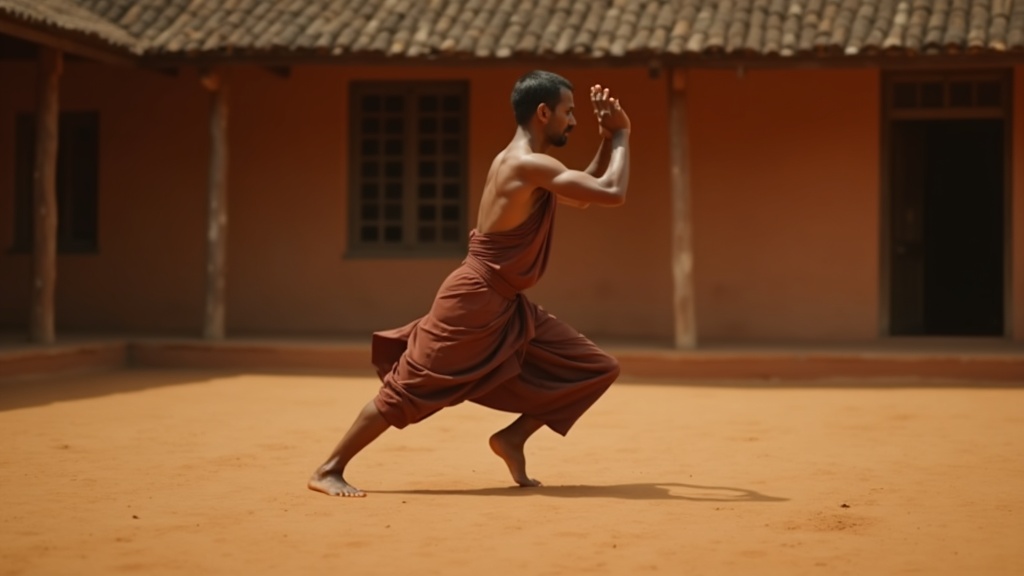
The first feature is a stance with weight in it. In Kalaripayattu we call the basic stance aswa vadivu — the horse stance — knees bent, feet planted, pelvis dropped between the thighs. In Yoga it shows up as utkatasana (chair pose) or a deep malasana (garland pose). In Tai chi it is the simple weighted shift between the feet in zhan zhuang standing. In every case, the body is asked to hold itself low — and the work of holding creates the felt sense.
Standing tall does not ground you. Standing in a position where gravity has something to pull on does. The moment you bend the knees and let weight drop into the legs, the nervous system has to deal with reality: this is where you are, this is what you weigh, this is what holding takes. The mental commentary cannot stay in charge when the quadriceps are starting to talk back.
The misconception is that the stance has to be hard. It does not. A deep stance for thirty seconds is enough — long enough to feel the weight, short enough that suffering is not the point. The work is felt-sense, not endurance. If you are bracing through pain, you are no longer grounding; you are gritting your teeth and adding sympathetic tone.
Slowness — you can feel each transition
The second feature is slowness, specifically in transitions. When you move from one position to another, the speed of the transition determines whether you feel it or merely execute it. Move too fast and the brain shortcuts the proprioceptive data; you arrive at the next position without having truly inhabited the path between.
The instruction move at the speed of feeling is taught in many somatic traditions and is precisely correct. If you cannot feel the weight shift, you are moving too fast. Slow down until each centimetre of motion is registered. People are usually shocked to discover that what they think is slow is actually medium — true slowness, the slowness that produces grounding, is closer to Tai chi push-hands or a deliberate Kalaripayattu floor transition than to a Yoga vinyasa.
Slowness has a side benefit too: it makes the practice safer. Most training injuries happen at speed, in the moment of transition between positions, when the body has not had time to organise around the load. Slow movement is grounding and protective, which is part of why traditional systems use it for the elderly and the recovering as well as for the young and strong.
Attention turned inward, not toward the mirror
The third feature is attention — specifically, where it is pointed during the movement. If your eyes are on a mirror, if your phone is propped up to film the form, if you are mentally checking how the movement looks — your attention is outside the body. The movement happens; the grounding does not.
This is the single biggest reason people who already train hard still feel disconnected. The training culture itself instructs them, often without saying so, to keep attention outside the body the entire time. The Yoga class with mirrors. The gym with the wall of screens. The dojo with the sensei correcting form from across the room. Every external cue is one more reason for attention to stay out.
Grounding requires you to keep attention inside the body throughout the movement. You feel your feet, you feel your breath, you feel the weight in your stance, you feel the line of force in the leg you are about to push off from. You are not performing the movement; you are inhabiting it. The same shape, done with inward attention, is a completely different practice from the shape done for external feedback.
If you want to go deeper into how this single shift transforms training, the longer-form treatment is in body awareness as the actual benefit of Kalaripayattu.
How to Practise Grounding Through Movement
You do not need a teacher, a studio, or any equipment to begin. You need a floor, ten minutes, and an honest willingness to move slowly enough to feel. Here is a four-step practice you can do today and continue indefinitely.
Start with the feet
Stand barefoot on a firm floor. Not a thick rug, not a yoga mat over carpet — a wooden floor, tile, or packed earth if you have access to it. Place the feet hip-width apart, parallel.
Without doing anything else, spend two minutes simply feeling the contact. Where is the pressure heavier — the heels, the balls of the feet, the outside edges? Can you feel each of your toes against the floor independently? Can you sense the temperature of the surface through the soles?
Most people, on first attempt, discover they cannot feel their feet in any specific detail. The soles register only as a vague platform. This is normal — and the act of trying to perceive what is there starts to wake the system up. By the end of two minutes, you will usually feel more in your feet than you did when you started, even though physically nothing has changed.
Add the stance
Bend the knees. Drop the hips. Aim for a position where your thighs are at roughly a 45-degree angle to the floor — deeper than a quarter squat, shallower than a full sit. Keep the back upright, not folded forward. Allow the breath to settle.
Hold this stance for thirty seconds, then come up slowly. Then drop down again. Then up again. Three rounds.
What you are looking for is not endurance — it is the felt sense of weight in the legs. By the third drop, the quadriceps will be talking. By the third rise, you will notice the breath has shifted on its own — usually deeper, often slower. Stay with the sensation as you rest. Do not move on to the next thing yet.
Slow the transitions
Now add lateral weight shifts. From the parallel stance, slowly shift all your weight onto the right foot. Take a full eight seconds to make the shift. The left foot stays on the floor but unloads to about ten percent of bodyweight. Then reverse: eight seconds to transfer back to the left.
The first time, you will probably get to four seconds and feel impatient. Slow down anyway. The point is not the destination; the point is the felt sense of the weight moving through the legs, through the pelvis, settling into the new standing foot.
Do five rounds in each direction. By the end, most people report two things: the inside of their legs feels alive in a way it normally does not, and their mind has stopped narrating. The grounding has started to take.
Use the breath as a check, not a metronome
Many traditions teach grounding by giving you a breath pattern — four-in, six-out, or square breathing. These work, but they are also a trap. The moment the breath becomes a task, attention goes to the task of breathing rather than to the fact of being a body. You can hit perfect four-six breathing while completely disembodied.
Instead, use the breath as a check. Every minute or so, notice whether your breath has dropped lower on its own. Is the inhalation reaching the lower ribs? Are the side ribs expanding outward as well as forward? Is the exhalation moving freely or being braced against?
If the breath has deepened on its own, you are grounding. If it has not, slow the movement further until it does. The breath is the gauge, not the lever. This single distinction — letting the breath be the read-out of the state, rather than the cause of it — separates effective somatic practice from forced breathwork that never lands.
For a longer, structured treatment of how to build this into a daily routine, see somatic movement practice: a guide to feeling your body, not just moving it.
Why Kalaripayattu Works as a Grounding Practice
I have taught Kalaripayattu for twelve years now, in Germany, in Spain, and in India. The single most common feedback I receive from long-term students — measured across hundreds of conversations and post-retreat reviews — is the same word every time. Grounded. Not stronger, not more flexible, not calmer. Grounded.
This is not because Kalaripayattu is mystical or because Kerala has some special property. It is because the form itself enforces all three grounding qualities at once.
The basic stances of Kalaripayattu — aswa (horse), gaja (elephant), sarpa (snake), kukkuda (rooster) — are all low and weighted. They are not optional aesthetics; you cannot do the next move correctly without sinking into them first. The body has to inhabit the stance, or the technique fails. Compare this to a yoga warrior pose where, if you are tired, you can quietly shorten the back leg and most teachers will not notice. The kalari stance does not let you shorten it. The next strike, the next defensive move, the next weapon position requires you to be already down.
The transitions are slow because the sequences — meipayattu — are built from precise weight shifts that depend on the previous shift having landed. Try to move fast and you lose the line; the teacher will simply ask you to start the sequence again. So the slowness is enforced by the form, not by a separate "go slowly" instruction. The form is the slowness.
The attention turns inward because the practice happens barefoot on a packed-earth floor, in a covered pit (the kalari), with no mirrors. There is nothing to look at. The teacher corrects by touching the back of your knee or pressing on a hip. The feedback is felt, not seen. After the first month, students stop trying to figure out how the movement looks — because they cannot — and begin to discover what it feels like instead.
This is also why generic "fitness Kalaripayattu" classes — taught in mirrored studios, accelerated for cardio benefit, performed in sneakers on rubber flooring — usually do not produce the same effect. The form is the same. The conditions that make it grounding are gone. If you want to understand the difference between a Kalaripayattu class designed for embodiment and one designed for fitness, the longer treatment is in Kalaripayattu for beginners: how to start and what to expect.
A note on heritage: the practice is at least two thousand years old, originating in the Sangam period of South India, taught in lineages traceable to teachers in northern Kerala. It was not designed as a grounding modality. It was designed as a complete training system — combat, healing, conditioning, breathwork — and the grounding effect is a side-product of having all three of the qualities described above present in the same form. The men I teach are not signing up for a martial art. They are signing up to feel their bodies. The form is just the most reliable container I have found for producing that experience.
Common Mistakes That Keep You in Your Head
If grounding through movement is so straightforward, why do most people who already train fail to find it? Because the training cultures they belong to actively reward the opposite. Here are the four most common ways serious movers stay disconnected, in order of frequency I see in new students.
Pushing harder when nothing is landing
The most common mistake — and the most counterproductive. You finish a workout and feel like you are not really in your body. The default response is to train harder, train longer, add a third session this week, push to a heavier weight. The logic is: if a normal dose did not land, a bigger dose will.
It does not work. A bigger dose of training that does not produce grounding produces a bigger dose of disconnection. The fix is not more intensity — it is a change of mode. One slow weighted session per week, done with inward attention, will land more grounding than five hard sessions done with attention outside the body. You do not need to abandon your current training. You need to add a different kind of session and protect it from the achievement frame.
The men I work with who break through this fastest are the ones who agree to do their grounding work separately from their performance work. Not "I'll add some mindful breathing to my deadlift session." That never lands. The new session has its own slot, its own purpose, and explicitly no performance metric attached. The performance training continues unchanged. The grounding practice is the new thing.
Treating grounding as a quick fix
The second mistake is the most readers' fault, because every article on the internet has framed grounding this way. You feel anxious — you reach for a grounding technique. You feel disconnected — you do a thirty-second body scan. You expect immediate results, and when the technique does not solve the problem in one session, you decide grounding does not work for you.
It does work. You are just using the wrong frame. Grounding through movement is a capacity, like cardiovascular fitness or mobility — it is built over weeks, drawn on whenever needed. A practitioner with six months of daily grounding practice can drop into the state in thirty seconds. A first-time user cannot, just as someone whose first run is a 5K cannot expect to feel comfortable. Asking grounding to work like a pill is a category error.
This is what makes the emergency-brake framing so damaging. It teaches you to expect grounding only when you need it — at the exact moment your nervous system is least receptive to learning a new skill. The men I see who finally get traction are the ones who flip this. They build grounding when they don't need it, so it is there when they do.
Mistaking calm for grounded
The third mistake is more subtle. People assume that if they feel calm, they are grounded. They sit on a meditation cushion. The mind quiets. The breath slows. They report being "really grounded today." And they may not be — they may just be tired, or sedated, or having a low-arousal day.
Calm is one possible state of a grounded body. It is not the same thing. You can be intensely alert and fully grounded — sparring partners and dancers know this state well. You can be quietly calm and completely disembodied — half of meditation practitioners spend years in this state without realising. The distinguishing marker is not the level of arousal. It is whether the body is the foreground of awareness.
A simple test: while you are sitting calmly, can you feel your feet in detail without first directing attention there? If yes — feet are spontaneously present in your perceptual field — you are grounded. If you have to deliberately go look for the feet and bring them online — you were calm, not grounded. The two states use overlapping language but they are functionally distinct.
Treating grounding as a quick fix for psychological distress
The fourth mistake matters because it crosses into territory this article cannot address. If you are managing a clinical anxiety condition, post-traumatic stress, depression, or any diagnosed mental-health issue — grounding through movement may be useful as part of a broader plan, but it is not a substitute for professional care. The somatic field has good clinicians (the Somatic Experiencing community founded by Peter Levine is one well-established lineage). A daily movement practice complements clinical work; it does not replace it. If you are uncertain whether what you are dealing with is "stuck mover" disconnection or something requiring a clinician, the safe default is to ask one.
Frequently Asked Questions
What does it mean to be grounded in your body?
Being grounded in your body means your attention is inside your sensations rather than in your thoughts about them. You feel your weight on the floor, your breath in your ribs, the texture of contact in your feet. It is not a mood or a vibe — it is a specific perceptual state where the body is the foreground of awareness and the mental commentary moves to the background.
How does movement help you feel grounded?
Movement gives the nervous system fresh sensory data to process — pressure in the feet, weight shifts, breath, joint angles. When the movement is slow and weighted enough to be felt, attention naturally follows the sensation downward into the body. This activates proprioceptive and interoceptive pathways and shifts the autonomic nervous system toward a parasympathetic state.
What is the difference between grounding and earthing?
Earthing refers to physical contact between the skin and the surface of the planet, often barefoot on grass or soil, with claimed electrical effects. Grounding in the psychological and somatic sense is a perceptual state — feeling present in your body — regardless of whether you are touching bare earth or a wood floor in your living room. The two terms get confused but they describe different things.
Why do I feel disconnected from my body even when I exercise?
Most exercise rewards output, not awareness. You can run, lift, or train martial arts for years while your attention stays on form, mirror, reps, or external goals — never landing inside the sensation of the movement itself. Disconnection is not a deficit of activity; it is a deficit of inward attention during activity. Adding more of the same activity rarely solves it.
Can martial arts be a grounding practice?
Yes, when the practice emphasises low weighted stances, slow transitions, and inward attention. Traditional systems such as Kalaripayattu, Tai chi, and certain branches of Aikido were built around these elements long before grounding was a recognised concept. Combat-focused or competition-focused training often loses these elements and stops working as grounding.
How long does it take to feel grounded through movement?
Most people feel a noticeable shift within a single 20-minute session if the practice is slow and weighted enough. A reliable capacity — being able to drop into a grounded state on demand, even outside training — typically develops over six to twelve weeks of practice three to five times per week. The first session shows you that the state exists; the next twelve weeks make it your default.
What kind of movement is best for grounding?
Movement that is slow, weighted, low to the ground, and done with attention turned inward. Low stances, deliberate weight shifts, and breath-led transitions all work. Fast, percussive, or mirror-checking movement tends to keep attention in the head and rarely produces grounding. Specific practices that reliably work: traditional Kalaripayattu meipayattu, Tai chi long form, slow Yin yoga, and deliberate barefoot walking on uneven surfaces.
Is grounding through movement the same as somatic therapy?
They overlap but are not identical. Somatic therapy — such as Somatic Experiencing developed by Peter Levine — is a clinical method for processing trauma through tracking body sensations. Grounding through movement is a daily training practice that builds the same underlying capacity for inward attention, without the therapeutic frame. The skills transfer in both directions.
Can I practise grounding through movement at home without a teacher?
Yes — the foundational work is simple enough to start alone. Standing in a low stance, shifting weight slowly between the feet, and breathing into the sensation of pressure does not require supervision. Advanced sequences and weapon work need a teacher, but the grounding mechanism itself is accessible from day one at home. The four-step practice in this article is a complete starting point.
What does grounded actually feel like?
Most people describe it as a settling — weight drops down the spine into the feet, the breath deepens without effort, the visual field softens, and the mental chatter quiets without being suppressed. There is often a sensation of being heavier and more present at the same time. The body feels like home rather than a vehicle you are driving from inside your head.
Why do men in particular struggle to feel grounded?
Most male training cultures reward external metrics — reps, weight, speed, sparring outcomes — and treat inward attention as either irrelevant or weak. A man can train hard for a decade and never be invited to notice what the movement feels like from inside. The result is high capacity with low awareness, which is the precise definition of being ungrounded while strong. The longer treatment of this dynamic is in embodiment training for men: what it is and how to start.
Can grounding through movement help with anxiety or stress?
Many practitioners report a calmer baseline and better stress recovery, and these effects are consistent with what researchers know about parasympathetic activation through slow weighted movement. This article does not claim to treat anxiety disorders or replace professional mental-health care. If you are managing a clinical condition, speak with a qualified clinician — grounding practice can complement that care but should not replace it.
Sources & Further Reading
- Proprioception (Cleveland Clinic) — clear physiological breakdown of how the body senses its own position.
- Parasympathetic Nervous System (Cleveland Clinic) — the autonomic branch activated by slow weighted movement.
- Vagus Nerve (Cleveland Clinic) — the main pathway through which somatic practices affect autonomic state.
- Grounding (psychology) — Wikipedia — historical and clinical context for the concept.
- Proprioception — Wikipedia — broader sensory and neurological background.
- Interoception — Wikipedia — the perception of internal body states underlying felt sense.
- Somatic Experiencing — Wikipedia — Peter Levine's clinical somatic method.
- Kalaripayattu — Wikipedia — overview of the traditional South Indian martial art referenced throughout.
- Tai chi — Wikipedia — the most widely studied slow-movement grounding practice.
- Hatha yoga — Wikipedia — the branch of yoga where weighted stances are most prominent.
- Aikido — Wikipedia — a modern martial art with an explicit grounding lineage.
- Yin yoga — Wikipedia — a still, weighted, long-hold practice with strong grounding effect.
- Sangam period — Wikipedia — historical period during which Kalaripayattu's roots are first textually recorded.
- Heart Rate Variability and the Autonomic Nervous System (NIH/NLM) — scientific review of HRV as a measure of parasympathetic regulation.
- Mind-body therapies and the autonomic nervous system (NIH/NLM) — research summary on slow movement, breath, and ANS regulation.
- Earthing — Wikipedia (disambiguation) — for distinguishing earthing from somatic grounding.
Conclusion — Grounding Is Built, Not Found
The story most articles tell about grounding is wrong for you. They treat it as an emergency tool — something you reach for when the wheels come off. You are not in that category. You already train. You are not anxious. You are disconnected, and the disconnection has been getting worse the longer you have been training in the same mode that produced it.
The fix is not a new technique to deploy in moments of crisis. The fix is a different way of moving, done a few times a week, for long enough that the capacity becomes yours. Slow. Weighted. Low. Attention turned inward, eyes soft, feet alive on the floor, breath dropping on its own. None of this is mysterious. None of it requires a guru. All of it requires that you decide feeling the movement is more valuable to you than performing it — and that you spend twenty minutes, a few times a week, training the felt sense the same way you train everything else.
If you keep training and nothing is landing, the 7-day course is built for exactly that. Seven days, one foundational Kalaripayattu movement per day — designed to put you back in your body, not just through the motions. You will feel the difference by day three. Start the 7-day course — €24.90 →
If the 7-day course is not yet open for your region, the free first lesson is the lowest-stakes way to experience what a single weighted stance can actually do — no payment, no commitment, just one movement done the way it was meant to be done.
About the Author
Raphael Gorschlüter — Co-Founder and Head Teacher, Kalari University
Raphael has trained Kalaripayattu for over twelve years and teaches internationally — in Germany, Spain, and South India. He is the co-founder of Kalari University and one of Europe's most experienced Kalaripayattu teachers. His work focuses on developing the ability to feel movement, not just perform it — a difference his long-term students consistently describe with one word: grounded. He trains and teaches in Kerala and runs annual immersive retreats in Tiruvannamalai, Tamil Nadu.
