Kalaripayattu Meaning and Etymology: What the Word Says
Kalaripayattu Meaning and Etymology: What the Word Says
Most pages that explain Kalaripayattu spend two sentences on the word and then move on to history. That is a mistake. The word itself is the clearest doorway into the practice: once you know what kalari and payattu actually mean — and what the compound says about the relationship between them — you understand something about Kalaripayattu that no list of techniques can teach you. It is a practice named after its training ground. The room and the practice are not separable. This article walks the word apart, then puts it back together, so that the next time you hear someone say "Kalaripayattu" you hear what is inside the name.
Kalaripayattu is a Malayalam compound that literally means practice in the training ground — formed from kalari (the consecrated training space, traditionally a sunken earthen pit in Kerala) and payattu (combat practice, exercise, fight). The word names the oldest continuously practised martial art of South Asia, and its meaning encodes the tradition's central rule: the art is taught inside a particular kind of space, and the space shapes how the body learns.
Key Takeaways
- Kalaripayattu is a Malayalam compound built from two words: kalari (training ground) and payattu (practice, fight, combat exercise).
- The literal meaning is "practice of the training ground" or "combat exercise of the kalari" — the art is named after the place where it happens.
- The root kalari likely descends from the Sanskrit khalurika (a place for military exercise) attested in the Kamika Agama and from the Sangam-period Tamil kalam (battlefield, arena, threshing floor).
- The English spelling varies — kalaripayattu, kalarippayattu, kalarippayatt, kalaripayat — all transliterate the same Malayalam word; the doubled "pp" is the academically preferred form.
- The English pronunciation is roughly kah-luh-ree-puh-YUT-too, with a soft retroflex t in payattu and the stress on the second syllable of payattu.
- The word kalari is older and broader than the martial art — in Kerala it has also named Sanskrit schools, Kathakali theatre training halls, and Ayurvedic massage rooms.
- A practice named after its room cannot be cleanly separated from the room: this is why authentic Kalaripayattu training is built around the kalari itself, not around portable techniques.
What Kalaripayattu Means (Short Answer)
Kalaripayattu is a Malayalam word that means combat practice in (or of) the training ground. The first half — kalari — names the physical space where the art is practised. The second half — payattu — names the practice itself. Joined together, the word does not point to a style or a school. It points to a relationship: a place, a practice, and the body that links them. The art that the word names is the traditional martial art of Kerala in southwestern India, structured in four progressive training stages and one of the oldest continuously practised martial traditions on earth. If you want the broader picture, the practitioner's complete guide to Kalaripayattu sits alongside this article.
Breaking Down the Word: Kalari + Payattu
Once you split the word, two distinct ideas appear. Each has its own history, its own range of meanings, and its own significance for how the art is taught today. Then the way they fuse into a compound adds a third layer — the relationship between them.
What Kalari Means
Kalari (Malayalam: കളരി) is the older of the two words. In modern Malayalam — the language spoken in Kerala — it primarily means a training ground or arena, especially the consecrated space used for martial training. But the word has a wider semantic field that English translations usually flatten.
The Malayalam dictionary entries cover roughly six senses, often given together because they describe the same kind of space at different moments of use:
- a training ground or gymnasium
- an open battlefield or arena
- a threshing floor (a hard, packed-earth surface)
- a place where instruction is given (a school, in the older sense)
- a workshop or guild space
- a consecrated indoor pit specifically built for martial practice
What unites these is not the activity inside but the kind of space — a defined, prepared, often consecrated rectangle of earth or floor where a structured, repeatable activity happens. In rural Kerala in earlier centuries a child's first Sanskrit lessons might be given in a kalari; so might a young man's first weapon-handling. The word does not specialise to combat until the modern era foregrounds the martial sense above the rest. You can read more about how that physical space was actually built and used in the practitioner's guide to what Kalaripayattu is.
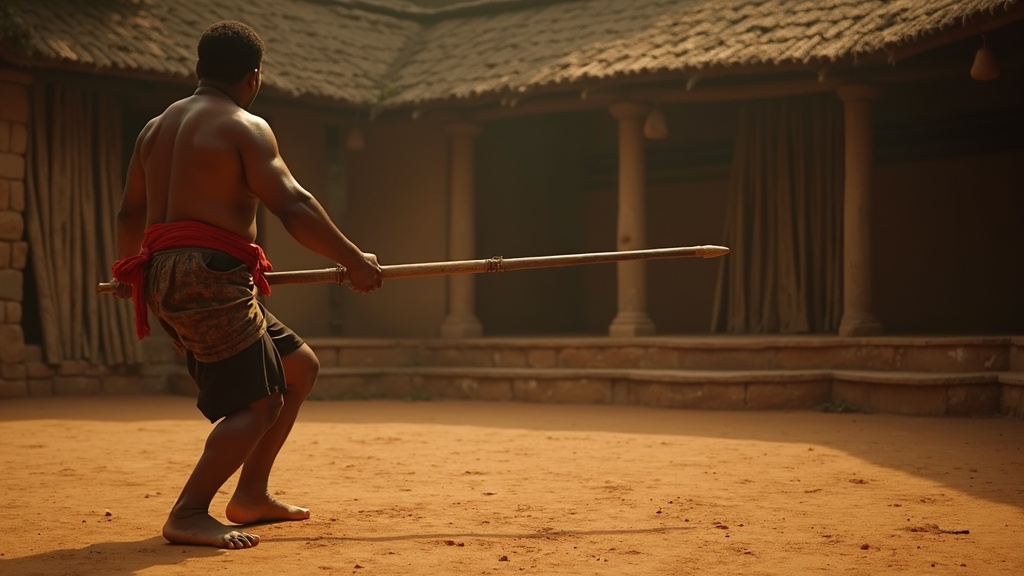
The martial kalari itself is a particular thing. The classical northern-style structure (in Vadakkan Kalarippayattu) is a rectangular pit dug roughly four feet into the earth, traditionally oriented east-west, measuring forty-two feet by twenty-one feet, roofed low to keep the temperature stable and the sunlight soft. The earthen floor is treated with herbal preparations so it grips rather than slips. A sacred corner — the puttara — holds the lineage's deities, and a small lamp burns there during practice. Students bow to the floor on entering. They do not wear shoes. The space is not a venue; it is part of the practice, and the word kalari carries all of that.
In my twelve years of teaching this art, the first thing I tell a Western student stepping onto a real kalari floor for the first time is: the room is going to teach you before I do. The lower ceiling forces stances down. The packed earth refuses to forgive sloppy footwork. The east-west orientation means the morning light enters one wall and leaves through the other, so the same posture looks and feels different at hour one and hour three. None of this is poetry. It is the practical reason the word kalari sits at the front of the name.
What Payattu Means
Payattu (Malayalam: പയറ്റ്) is younger as a written word but no less rooted. It comes from a Dravidian verbal root shared with Tamil — payil, meaning "to practise, to become trained, to grow familiar through repetition." From that root grow nouns and verbs meaning exercise, training, drill, fencing, fight, combat practice. The same root produces the modern Tamil payirchi (training, exercise).
In Malayalam, payattu is the noun form: a session of structured practice, especially one with an opponent or a weapon. It also serves as a generic word for a fight or contest. Crucially it is not the word for a single technique or a posture. Payattu names the doing — the continued, repeated, embodied activity of training, not the static thing being trained.
A note on what the word does not mean. Payattu is not the same as yuddha (Sanskrit: war) or pori (Tamil: battle). It does not point to actual combat between enemies. It points to the practice of combat skills — the training, the drill, the rehearsal under the eye of a teacher. That distinction matters. Kalaripayattu is not the art of fighting wars. It is the art of training the body, in a particular space, in skills that could be used in war but are practised for their own value.
How the Two Words Join
The grammar that fuses kalari and payattu is a Sanskrit-influenced construction called a tatpurusha compound — literally "his man" — in which the first element modifies or qualifies the second. The first word answers a case-question about the second: whose practice? where? of what? In kalaripayattu, the relationship is locative: practice in the kalari, or possibly genitive: practice of the kalari.
Both readings carry weight. In the locative reading, the word stresses where the practice happens — inside the consecrated room. In the genitive reading, the word stresses ownership — this is the practice that belongs to the kalari, the practice that the room itself contains and transmits. Most teachers in living lineages will tell you both are true, and that the question is not which reading is correct but how the two together describe a single thing: a practice that is bound to its place.
The order of the compound matters as well. The room comes first. The practice comes second. That order tells you what generations of teachers have taken for granted — that the student walks into a kalari, and then the practice begins. You do not pick up Kalaripayattu the way you pick up a portable skill. You enter it the way you enter a room.
Where the Word Kalaripayattu Comes From
The history of the word runs deeper than the history of the modern martial art. Three threads weave together to make the word as we have it now: a Sanskrit precedent, an ancient Tamil cognate, and the medieval consolidation of Kerala's martial tradition.
The Sanskrit Thread: Khalurika
One probable ancestor of kalari is the Sanskrit word khalurika (खलूरिका). The Kamika Agama, a Shaiva ritual text often dated to the early medieval period, uses khalurika to mean a place built for military exercise — a training arena. The phonetic path from khalurika to kalari is straightforward by the normal sound shifts that move Sanskrit loanwords into Malayalam: the aspirated kh- simplifies, the long internal vowels reduce, the final syllable drops.
If this derivation is correct — and it is the most cited in the linguistic literature — then kalari has been a word for a martial training ground for at least fifteen hundred years, and probably longer. The word predates almost everything else we associate with the modern art: the four-stage curriculum, the named styles, the specific weapons. What survived from the deep past is the room and the word for the room.
The Tamil Thread: Kalam and the Sangam Era
The second thread runs through the old Tamil literature of the Sangam period — roughly the third century BCE to the third century CE. Sangam-era poems such as those collected in the Purananuru and the Akananuru use the word kalam (Tamil: களம்) for a battlefield, an arena, an open field, and — significantly — a threshing floor. The word kalari in Malayalam is widely understood as a cognate or near-derivation, formed when the Dravidian -am ending shifts and a feminine or specifying suffix is added.
The Sangam evidence matters because it shows the word's semantic core long before there was a separate Malayalam language or a separate state called Kerala. The same word, in the same broad sense — a defined ground for a structured activity — was already in use across the southern peninsula two thousand years ago. When martial training in what would later become Kerala began to be done inside a particular kind of consecrated pit, the existing word for an arena attached itself naturally to the new space.
The Medieval Consolidation
The compound kalaripayattu, as a single word for the unified martial art we now recognise, becomes visible in Kerala's records between the eleventh and twelfth centuries. This is the period when the four-stage curriculum settled into its present shape, when the regional styles diverged into the northern (Vadakkan) and southern (Thekkan) forms, and when the named lineages began to take responsibility for the transmission of the art. The word follows the institution. As the practice consolidated, so did the language for it. Earlier sources speak of payattu or of training "in the kalari" in looser ways; the compound becomes standard as the practice itself becomes standard.
This timeline matters for one reason: it tells you that the word kalaripayattu is medieval, not ancient. The practice the word names is older than the word, and the building blocks of the word — kalari and payattu — are much older still. But the precise compound, the name you Google today, hardened into shape around a thousand years ago, alongside the curriculum and the institutions of the lineages. If you want the broader historical arc the word now refers to, the history and origins of Kalaripayattu traces the practice through the same medieval consolidation, the British-era suppression, and the twentieth-century revival.
How to Spell Kalaripayattu (and Why It Varies)
The English spelling of kalaripayattu is unsettled, and you will see at least four common forms in print:
- Kalaripayattu — the most common spelling in popular media and tourism material
- Kalarippayattu — the form preferred by most academic literature and many in-tradition writers
- Kalarippayatt — the form used by some older scholarly works and traditional schools
- Kalaripayat — a simplified form sometimes seen in casual writing
All four refer to the same Malayalam word. The variations come from the inherent difficulty of transliterating Malayalam — a Brahmic script language with sounds and gemination patterns that English orthography handles poorly.
Two issues drive the variants:
- The doubled consonant. The Malayalam word contains a geminated (doubled) p sound, which strict transliteration represents as "pp." Some English spellings preserve this doubling; others drop it for readability.
- The final t. Malayalam payattu ends in a soft retroflex tt sound followed by a faint vowel. Strict transliteration sometimes renders this as "tt" with no final vowel (payatt), sometimes as "ttu" or "tu" with the vowel restored for English-speaking readers.
If you want a single rule of thumb, two of them are widely respected. Academic publications and serious in-tradition writing tend to use kalarippayattu. General readers, tourism material, and most search-engine results use kalaripayattu. Both are accepted; choose by your audience.
In this article we use kalaripayattu because that is the spelling most readers will type into a search engine, and because the simpler form does no violence to either the meaning or the pronunciation. When you read older texts or academic work you will see kalarippayattu; the word is the same.
How to Pronounce Kalaripayattu
The English-readable pronunciation is roughly:
kah-luh-REE-puh-YUT-too
Broken into syllables: ka-la-ri-pa-yat-tu, six syllables total, with the primary stress on the second-to-last syllable (yat) and a lighter secondary stress on the third (ri).
In phonetic notation it falls around /kɐləɾipajɐt̪t̪u/, with a few specifics that matter:
- The opening ka is short and crisp, closer to the a in "father" than to the a in "cat."
- The r in kalari is a soft, slightly rolled or tapped Indian r, not the English retroflex r and not the German rolled r either. If you cannot produce it, an English r will do.
- The pa in payattu is short.
- The doubled tt in payattu is held slightly longer than a single t would be. In rapid speech it sounds nearly identical to a normal English t, but the careful pronunciation gives it a faint pause.
- The final u is soft and short — closer to the u in "put" than to the oo in "boot," though most English speakers naturally lengthen it.
The most common mistakes among English speakers:
- Stressing the first syllable. "KAH-la-ri-payattu" is wrong. The stress sits later in the word.
- Hardening the r. Pronouncing it like the r in "car" turns the word into something a Malayalam ear would not recognise. Soften and tap.
- Adding a glide. Some readers say "kala-ri-pay-AH-too" with a vowel glide before the final syllable. The Malayalam word has no glide.
The word does not need to be pronounced perfectly to be understood, especially by Malayalam speakers used to hearing it mispronounced by foreigners. But if you say it out loud as you read this article, give it the rhythm — short, short, short, short, stress, short. kah-luh-ree-puh-YUT-too.
What Kalari Means Outside the Martial Art
Here is where the word becomes interesting beyond martial arts. Kalari in Kerala has named several other kinds of training space, and the breadth of its use tells you something about how Keralite culture thinks about teaching itself.
A traditional Sanskrit school — the kind a Brahmin family might send a child to in the seventeenth century — was sometimes called a kalari, or an ezhuthu kalari (writing kalari). The space was prepared the same way: an earthen-floored room, a teacher seated facing the students, a deity in the corner. Children began their letters there by tracing them in rice flour on the floor. The word kalari attached itself to the room because the room was structured the same way as a martial kalari — a defined space, a teacher, a body of knowledge transmitted through repetition.
Kathakali — the classical dance-drama of Kerala — also has its kalari. The training halls where young Kathakali performers spend years learning eye movements, facial expressions, hand gestures, and the demanding body postures of the form are called kalari. Many Kathakali masters trained in or were taught by people who also trained in Kalaripayattu; the body conditioning overlaps, and the room is built on similar principles. If you walk into a Kathakali kalari and a Kalaripayattu kalari on the same morning, the floors will feel related.
There are healing applications as well. In some traditional Kerala households, the room where Ayurvedic massage and the seasonal uzhichil treatments were given was called the kalari — particularly in families that had Kalaripayattu lineage and where the same teacher trained the body to fight and treated the body to heal. The connection here is not metaphorical. The same physical room, with the same orientation, the same earthen floor, the same low ceiling, served both functions in some lineages. The injuries from morning practice were treated in the afternoon in the same space.
This broader use of kalari tells you something the dictionary definition will not. The word names a particular cultural relationship — between a defined space, a tradition of knowledge, and a teacher who holds both. That relationship was the unit of transmission for many Keralite disciplines, not just martial arts. The fact that the martial art is named kalari-payattu, and not just payattu, places it inside that broader cultural pattern.
Why the Name Matters for the Practice
Here is the angle that no other source on the etymology will give you. A practice named after its training ground is not a portable skill. It is a relationship. And that has practical consequences for anyone who wants to learn Kalaripayattu today.
In twelve years of teaching this art across Germany, Spain, and India, the question I am asked most often by serious beginners is some version of: can I learn this from videos? The honest answer is: you can learn the shape of the movements from a video. You can learn the sequences. You can begin to condition your body. What you cannot get from a video is the room — and the word kalaripayattu itself tells you why that matters.
A real kalari has a sunken floor that forces a deeper stance than you would naturally take. It has a low ceiling that prevents the kind of upright, spinal-extended postures that a yoga studio invites. It has packed earth that grips so you can drive force through your feet, but punishes lazy footwork by refusing to slide. It has the lamp in the corner, the bow at the threshold, the silence broken only by the teacher's voice and the breath of the students. All of that is part of the curriculum.
When you train inside one, your body adjusts to the room. When you train outside one, the room adjusts to your body — which means the room teaches you nothing. This is not romance. It is the practical reason why even the best online Kalaripayattu programmes (including the one I co-teach) are designed as a preparation for entering a kalari, not as a replacement for the experience. The word names the practice as it really happens, and the practice as it really happens cannot be detached from the ground.
That is why we say in our school: the first lesson is free, and we want you to take it — but if at some point you want to know what the word kalaripayattu actually means, you will need to step onto a kalari floor and let the room work on you. The video can teach you the practice. The kalari teaches you what kalari means.
Common Misconceptions About the Word
A handful of confusions appear regularly when newcomers first encounter the word. Each of them is easy to clear up once you know what to look for.
It is not "kalari" alone. Some Western media — and even some casual conversation inside India — uses kalari as a shorthand for the martial art. Strictly, kalari names the place. The art is kalaripayattu. Purists object to the shorthand because it collapses the two halves of the word and loses the relationship the compound encodes. If you want to sound informed, use the full word for the art and reserve kalari for the room.
It is not a Sanskrit word. Kalaripayattu is a Malayalam compound. One of its roots (kalari, via khalurika) likely has a Sanskrit ancestor, and the grammatical structure of the compound is Sanskrit-influenced. But the word itself, as a unit, belongs to Malayalam. Calling it a Sanskrit word is incorrect.
It is not specifically about killing or warfare. Payattu means practice or exercise, not war. The word names a training tradition, not a battlefield art. The fact that Kalaripayattu includes lethal techniques does not mean the word translates as anything dramatic. Translations like "the art of war" or "the deadly practice" are marketing inventions, not etymology. For a longer look at how dramatic framings of the art took hold and what the more honest description is, see how the "deadliest martial art" framing misses the practice.
It is not singular or plural — it is just the name. English speakers sometimes ask whether kalaripayattu takes a plural form. In Malayalam it does not — it is a mass noun naming the tradition. In English the convention is to treat it as singular: "Kalaripayattu is" rather than "Kalaripayattu are."
It is not the same as kalaripayattu kalari. A few sources outside Kerala have produced confused English where the word is doubled. If you see kalaripayattu kalari in a sentence, it usually reflects a translation error. The art is kalaripayattu. The room is kalari. The two together are not a new term.
Why the Word Survived
One quiet historical fact is worth noting. The art that kalaripayattu names was nearly destroyed in the nineteenth century. The British colonial administration banned its public practice after 1804 in the wake of the Velu Thampi Dalava revolt; in many districts only a handful of teachers continued the practice in secret. By the early twentieth century the lineages were dangerously thin.
What survived through that gap was, above all, the word — and the rooms. Teachers protected the curriculum, of course. But the language for the practice and the physical kalaris where lineages had trained for generations carried the tradition through the period when the practice itself was suppressed. When the revival came in the twentieth century, the new generation of teachers had something to return to because the word had not been forgotten and the rooms had not all been destroyed.
That history is one more reason to take the word seriously. It is not just a label. It is a piece of the tradition itself — and it carries within it the same instruction every Kalaripayattu teacher has been giving for centuries: enter the room, and the practice will follow.
Frequently Asked Questions About Kalaripayattu's Meaning
What does kalaripayattu literally mean in English?
Kalaripayattu literally means "practice in the training ground" or "combat exercise of the kalari." It is a Malayalam compound formed from kalari (training ground, arena, threshing floor) and payattu (practice, drill, fight). The compound describes the practice as something that happens inside a particular kind of consecrated space, and the order of the words places the room first.
What does the word kalari mean on its own?
Kalari in Malayalam means a training ground or arena, especially a consecrated rectangular pit dug into the earth and used for martial training. The word has a wider field of meanings — battlefield, threshing floor, school, gymnasium — all describing a defined, prepared space where a structured activity happens. In modern Malayalam the martial sense is most prominent, but the word historically named several kinds of training space.
What does payattu mean?
Payattu in Malayalam means combat practice, exercise, drill, or fight. It comes from the Dravidian root payil, meaning "to practise, to become trained through repetition." It is the word for the doing of training — the structured, repeated activity — rather than for a single technique or posture. Payattu does not mean war; it means the practice of combat skills.
Is it spelled kalaripayattu or kalarippayattu?
Both spellings are correct and refer to the same Malayalam word. Kalaripayattu (single p) is more common in popular media, tourism material, and search-engine results. Kalarippayattu (double p) is preferred by academic literature because it more accurately transliterates the geminated consonant in the Malayalam original. Choose by your audience; neither spelling is wrong.
How do you pronounce kalaripayattu?
Roughly: kah-luh-REE-puh-YUT-too, six syllables, with the primary stress on the yat syllable (second from last) and a softer secondary stress on ri. The r is a soft, lightly tapped Indian r, not the hard English r. The doubled tt in payattu is held slightly longer than a single t. The final u is short and soft.
Where does the word kalaripayattu come from?
The word combines two older Dravidian and possibly Indo-Aryan roots. Kalari probably descends from the Sanskrit khalurika (a place for military exercise, attested in the Kamika Agama) and is cognate with the Sangam-era Tamil kalam (battlefield, arena, threshing floor). Payattu comes from the Dravidian verbal root payil (to practise). The compound itself, as a single word for the unified martial art, becomes standard in Kerala between the eleventh and twelfth centuries.
Is kalaripayattu a Sanskrit or Malayalam word?
It is a Malayalam word. One of its roots (kalari) likely has a Sanskrit ancestor (khalurika), and the grammatical structure of the compound is Sanskrit-influenced. But the word as a whole, as it is used today, belongs to Malayalam — the language of Kerala in southwestern India. Calling it a Sanskrit word is technically incorrect.
What language is the word kalaripayattu?
Malayalam — the Dravidian language spoken by roughly thirty-five million people, primarily in the southwestern Indian state of Kerala and the union territory of Lakshadweep. Malayalam uses its own Brahmic script and is one of the six classical languages of India recognised by the Government of India.
Can I just say "kalari" instead of "kalaripayattu"?
In casual conversation many people do, but strictly kalari names the room, not the practice. Using kalari alone for the art collapses the two halves of the compound and loses the relationship the word encodes. If you want to be precise, use kalaripayattu for the martial art and reserve kalari for the physical training ground.
Does kalaripayattu have a plural form?
In Malayalam, kalaripayattu functions as a mass noun naming the whole tradition and does not normally take a plural. In English, the same convention applies: it is treated as singular. You say "Kalaripayattu is the traditional martial art of Kerala," not "Kalaripayattu are." The plural of kalari (the room itself) is kalaris in English usage, though in Malayalam the plural is formed differently.
Why are there so many different spellings of kalaripayattu?
Because Malayalam uses a script and a sound system that English alphabets cannot represent exactly. The geminated pp of the Malayalam original is sometimes preserved (kalarippayattu) and sometimes simplified (kalaripayattu). The final retroflex tt sound is sometimes written without a vowel (payatt) and sometimes with one (payattu, payat). All the variants transliterate the same single Malayalam word. The variation is a transliteration problem, not a definitional one.
What is the connection between kalari and the deity worshipped there?
Every traditional kalari has a puttara — a seven-tiered sacred corner that holds the deities of the lineage. The deity most commonly honoured is the Kalari Paradevata or Kalari Bhagavathi, a fierce form of the goddess often associated with Bhadrakali. Students bow to the corner on entering the room. The word kalari deivam ("deity of the kalari") names this protective figure. The connection reinforces what the etymology already suggests: the room itself, not just the practice inside it, is what the tradition treats as sacred.
Sources and Further Reading
- Kalaripayattu — Wikipedia — overview of the practice with a short etymology section and historical timeline
- Malayalam language — Wikipedia — background on the Dravidian language that gives the word its form
- Sangam period — Wikipedia — the early Tamil literary period in which kalam (battlefield, arena) appears as a cognate of kalari
- Puranānūṟu — Wikipedia — Sangam-era anthology with references to kalam
- Sanskrit compound (tatpurusha) — Wikipedia — the grammatical structure that joins kalari and payattu into a single word
- Agama (Hinduism) — Wikipedia — the Shaiva ritual literature that includes the Kamika Agama's reference to khalurika
- Kerala — Wikipedia — the Indian state whose language and culture produced the word and the practice
- Brahmic scripts — Wikipedia — the script family that includes Malayalam and explains the transliteration difficulties
- Malayalam script — Wikipedia — the specific writing system used for the original word
- Kathakali — Wikipedia — the Kerala classical dance-drama whose training halls are also called kalari
- Bhadrakali — Wikipedia — the goddess often honoured in the puttara corner of a traditional kalari
- Indian martial arts — Wikipedia — broader context for where Kalaripayattu sits within the subcontinent's martial traditions
- Kerala Tourism — Kalaripayattu origin — government cultural source on the practice's place in Kerala identity
- Marma adi — Wikipedia — the vital-point knowledge that complements Kalaripayattu's combat training inside the same lineages
Conclusion: Practice in the Training Ground
Kalaripayattu means practice in the training ground. Once you hear the word that way, you hear what the tradition has been saying for a thousand years: this is a practice you do inside a particular kind of room, with a particular kind of teacher, and the room and the teacher are part of the curriculum. The word does not name a portable skill. It names a relationship between a body, a practice, and a space.
That is also why a written explanation of the meaning can only take you so far. To know what the word means — fully, in the way the tradition means it — you eventually need to feel the room work on your body. Until then, the best you can do is start where every beginner has always started: with the first foundational movement, taught slowly, in your own body, before you ever set foot on a kalari floor.
The first lesson is free — no payment, no commitment. Create your account and take it today. Start with Lesson 1 →
About the Author
Raphael Gorschlüter — Co-Founder and Head Teacher, Kalari University
Raphael Gorschlüter is one of Europe's most experienced Kalaripayattu teachers, with more than twelve years of training and teaching across Germany, Spain, and India. He has taught beginners and committed students through online programmes, workshops, and residential retreats — most recently a 15-day immersive retreat at the foot of Arunachala in Tiruvannamalai. He is known for teaching the ability to feel movement, not just perform it, and for refusing the marketing language that surrounds traditional martial arts. He trained in Kerala under teachers in the Vadakkan lineage and continues to travel between Europe and India each year to deepen and transmit the practice.
