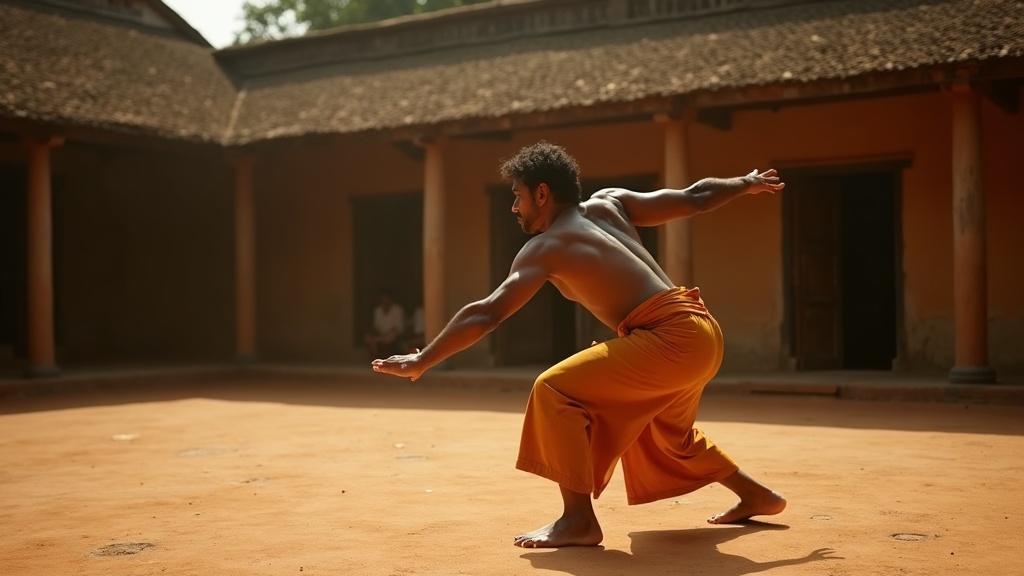
What Is Kalaripayattu? A Practitioner's Complete Guide
What Is Kalaripayattu? A Practitioner's Complete Guide
Most articles describe Kalaripayattu from the outside — a list of facts about a martial art most readers will never try. This one is written from inside the practice, by a teacher who has trained and taught it for more than a decade across Europe and India. The facts are all here — etymology, origins, stages, styles, weapons, healing. But framed around the one question every real searcher is silently asking: what would happen in my body if I actually did this? By the end you will know what Kalaripayattu is, where it comes from, how the training is built, and whether it might be the practice you have been looking for.
Kalaripayattu is a traditional martial art from the southwestern Indian state of Kerala, structured around four progressive training stages — body conditioning, wooden weapons, metal weapons, and bare-hand combat — and rooted in a teacher-student tradition that integrates fighting, healing, and embodied awareness. The name itself is the practice: kalari (training ground) plus payattu (combat practice). Its documented history stretches back through medieval Kerala into Sangam-period references, making it among the oldest continuously practised martial arts in the world.
Key Takeaways
- Kalaripayattu is the traditional martial art of Kerala, India — a unified system that combines combat training, weapon work, and the traditional healing knowledge of kalari chikitsa.
- The word itself describes the practice: kalari is the training space, payattu is the practice that happens inside it; the art cannot be cleanly separated from where and how it is taught.
- Training is built in four progressive stages — meipayattu (body conditioning), kolthari (wooden weapons), angathari (metal weapons), and verumkai (bare-hand combat) — in that fixed order.
- Two main lineages exist: Vadakkan (northern style) emphasises flowing low stances and animal postures; Thekkan (southern style) is shorter, harder, and built around vital-point strikes.
- Kalaripayattu is documented in Sangam-era literature and was formalised in its present shape between the 11th and 12th centuries, making it one of the oldest continuously practised martial arts in the world.
- The practice integrates marma (vital-point knowledge) and the traditional Ayurvedic healing science: in a complete lineage the same teacher who teaches the strike also treats the injury.
- Anyone in reasonable health can begin, regardless of age or prior martial-arts background; what matters is willingness to train slowly and feel the body before forcing it.
- The often-repeated claim that Kalaripayattu is "the mother of all martial arts" is partly true and partly mythology — it is plausibly the oldest continuous martial tradition, but the single-origin theory through Bodhidharma is not supported by historical record.
What Kalaripayattu Actually Is
Strip away the legends and what remains is a coherent, learnable practice. Kalaripayattu is a Kerala-born martial system that trains the body in a specific sequence: first the body itself becomes a weapon through conditioning, then external weapons are added in order of difficulty, and only at the end does the practitioner learn to fight with empty hands. The whole structure rests on one assumption that separates it from most modern martial arts — that you cannot fight well with anything until you can feel where your body is in space.
The word itself — kalari and payattu
The compound kalaripayattu fuses two Malayalam words. Kalari is the training ground itself — traditionally a rectangular pit dug into the earth, oriented east-west, with a low roof and a sacred corner (the puttara) that holds the lineage's deities. Payattu is combat practice, the doing. Put together, they describe an art that is inseparable from its space.
This is unusual. Karate is named after a quality (empty hand). Kung fu is named after the discipline of effort. Kalaripayattu is named after the room. The implication runs through everything: the practice is something that happens between a teacher, a student, and a particular kind of consecrated space — not a set of techniques you carry around in your head.
A definition for someone who has never heard of it
If you have never seen Kalaripayattu, picture this. A roofed earthen pit, the floor slightly damp and cool. Inside, practitioners in red cotton wrappers move through low stances — knees deeply bent, weight shifting between feet — then sweep into a spinning kick, drop into a forward roll, and rise into a posture named after an elephant or a horse. Later they take up sticks. Months later, swords. Years later, they spar with bare hands. Throughout, the teacher massages the bodies with herbal oils and treats the inevitable strains with techniques that have been refined inside this same room for centuries.
That is Kalaripayattu in its complete form. It is martial, but it is also somatic, ritual, and medical at once. It cannot be reduced to any one of these dimensions without losing the practice. (Our full breakdown of the term itself is in what the word kalaripayattu actually means — a deeper read on why the room and the practice share a single name.)
How it differs from karate, kung fu, or BJJ in one paragraph
Karate trains hard linear strikes on a sprung floor. Kung fu is an umbrella for hundreds of Chinese schools, most of which emphasise upright forms and applications. Brazilian Jiu-Jitsu is a ground-grappling system focused on submissions. Kalaripayattu is none of these. Its postures are lower than almost any other standing martial art (your hips often sit below your knees), its sequences blend striking, kicking, leaping, and ground transitions into one continuous flow, and its earliest training stage has almost no application against an opponent — it exists purely to prepare the body to feel itself. The closest cousin is probably Silambam from neighbouring Tamil Nadu, with which it shares stick work and historical links.
Where Kalaripayattu Comes From
Kalaripayattu's history is layered. There is a documented record stretching back nearly two millennia. There are legends that may carry some truth and certainly carry symbolic weight. And there is a near-extinction event in the 19th century that shapes the lineage of almost every teacher alive today. All three layers matter — but they need to be kept separate.
Kerala roots and the Sangam-era references
The earliest written references to martial practices that look like proto-Kalaripayattu appear in Sangam literature, the corpus of Tamil poetry composed between roughly the 3rd century BCE and the 3rd century CE. These poems describe warriors trained in unarmed combat, spear, sword, and bow — and they describe training spaces and martial communities concentrated along what is today the Kerala-Tamil Nadu coast. The art was formalised into the shape we now recognise — four progressive stages, the kalari as a defined ritual space, the marma points integrated into both attack and healing — between the 11th and 12th centuries, during a period of consolidated military culture in medieval Kerala.
By the 16th century, descriptions of Kalaripayattu practitioners appear in travellers' accounts: trained warriors, often from the Nair community, fighting in inter-kingdom conflicts and serving as bodyguards to local rulers. The practice continued under figures like the 18th-century freedom-fighter Pazhassi Raja, whose guerrilla resistance to the British East India Company was conducted partly by Kalaripayattu-trained men.
The Parashurama legend — and what historians actually say
Almost every popular article about Kalaripayattu opens with the myth of Parashurama, the warrior-sage said to have flung his axe into the sea, raising the land of Kerala from the waters, and then taught Kalaripayattu to its first inhabitants. It is a beautiful origin story. It is also, taken literally, not history.
What historians of Indian martial arts actually say is more interesting. The Parashurama legend functions the way most martial-art origin myths do: it locates the practice in a sacred lineage, tells you what kind of person an authentic practitioner should be (a warrior who has reckoned with violence), and roots the art in the land itself. The literal historical origin is messier and richer: a long evolution of southern Indian combat practices, drawing on shared regional traditions, formalised over centuries inside a network of kalaris across what is now Kerala.
Where the legend matters most is inside the kalari itself. Practitioners salute Parashurama and the lineage's deities before training. Whether you take the myth literally or read it as metaphor, the gesture is the same: this practice did not begin with you, and it will not end with you.
For the full historical picture — Sangam roots, British ban, 20th-century revival — see the history and origin of Kalaripayattu.
British colonial ban and 20th-century revival
In 1804, after the suppression of the Pazhassi Rebellion, the British colonial government banned the public practice of Kalaripayattu. The kalaris were closed. Teachers continued in secret, in private homes and in the inner rooms of families with strong martial lineages, but the open transmission stopped. For the better part of a century, the art nearly disappeared.
Its revival is owed to a small group of teachers in the early 20th century — most notably C. V. Narayanan Nair in northern Kerala, who in 1933 reopened public training and began documenting the system. Without those few teachers, the lineage you can train in today would not exist. This is worth remembering when modern Kalaripayattu is criticised as "tourist-friendly" or "watered down": the version we have was preserved through one of the closest calls in the history of martial arts.
How the Training Works — The Four Stages
The four stages of Kalaripayattu are not a curriculum invented to fill a syllabus. They are a sequence built around one principle: you cannot use a tool well until your body knows itself. Each stage prepares the body for the next, and skipping ahead corrupts everything that comes after.
A complete breakdown of every weapon and discipline inside each stage is in the four disciplines and weapons of Kalaripayattu. The summary below explains the logic.
Meipayattu — the body before the weapon
Mei means body; payattu is practice. Meipayattu is the practice of the body itself. This is where every student begins, and where many traditional teachers say the entire art is contained — if your meipayattu is good, everything else falls into place.
Concretely, this stage trains:
- Low standing postures (chuvadu) and animal-named stances (vadivu) — horse, elephant, lion, serpent, peacock, fish, boar, rooster
- Long sequences of kicks, jumps, turns, and ground-to-standing transitions
- Floor work — rolls, leg sweeps, body conditioning against the earth
- Daily oil massage (uzhichil), often given by the teacher, that prepares the muscles for the depth of the postures
A serious student spends six months to two years inside meipayattu before touching a weapon. Western beginners often resist this — the body is asked to wait, to feel, to learn slowly, when the mind wants to skip to the impressive part. Almost every long-time practitioner I have trained with says the same thing in retrospect: the slowness of meipayattu was the whole point. (For the felt experience of this first stage from inside an adult body, see the body awareness benefits of Kalaripayattu.)
Kolthari — wooden weapons teach the geometry
The second stage introduces wooden weapons. The most important is the long staff (kettukari, about 1.5–1.8 metres), followed by a shorter stick (cheruvadi) and a curved club (ottakkol or otta) shaped roughly like an elephant's tusk. Each weapon teaches a different relationship: long-range geometry with the staff, close-range timing with the short stick, vital-point precision with the curved club.
The pedagogical logic is simple. A wooden weapon extends the body into space and makes the geometry of attack and defence visible. If your hips are misaligned, the staff tells you immediately — it goes where it should not. If your stance is too high, your body cannot generate force through the weapon. Wood is the teacher because wood is honest.
This is also the stage where partner work begins. Choreographed weapon exchanges between two students train timing, distance, and the felt sense of another body in space. By the end of kolthari, the student can hold their own with a stick — and, more importantly, has begun to internalise the geometry that everything after this point depends on.
Angathari — metal weapons demand precision
In the third stage, the weapons become metal. Angathari introduces the sword and shield (val and paricha), the dagger (katara), and at advanced levels the famous urumi — a flexible sword that looks like a sharpened metal whip and is considered one of the most dangerous weapons in any martial tradition because it can wound the wielder as easily as the opponent.
The shift from wood to metal is not just about danger; it is about precision. A wooden staff forgives sloppy distance. A blade does not. The student who has rushed through meipayattu and treated kolthari as exercise will not survive angathari in any meaningful sense — the body will not move with the precision the metal demands. This is one of the deeper reasons the stages cannot be skipped: each one builds the prerequisite the next assumes.
The urumi in particular is taught only after years of conditioning, often only to senior students, and is one of the practices most associated with the Vadakkan northern lineage.
Verumkai — bare hand last, not first (and why)
The fourth stage is verumkai — empty hand. Strikes, locks, throws, and the application of marma knowledge to disable an opponent at vital points.
The order seems backwards if you come from karate or boxing, where the empty hand is the foundation. In Kalaripayattu, the empty hand comes last because the body must already understand geometry, timing, and the precise application of force before it can be trusted to apply those qualities with no tool in between. The weapon is a teacher; once the lesson has been internalised, the weapon can be set down and the body becomes the weapon itself.
A practitioner who reaches verumkai in a traditional lineage has typically trained for five to ten years. The strikes look simple — and they are — but their economy and accuracy reflect everything that came before.
The Two Main Styles — Vadakkan and Thekkan
Kalaripayattu is not monolithic. Two distinct living traditions exist, named for their regions of origin: Vadakkan (northern) and Thekkan (southern). A third tradition, sometimes called Madhya (central), is recognised by some lineages but is closer to a variation than a separate style.
Vadakkan — northern style: flow, depth, animal forms
Vadakkan is the style most outsiders mean when they say "Kalaripayattu." It is what you see in Kerala tourism videos, what most documentary footage captures, and what the majority of internationally teaching schools practise.
Characteristics:
- Deep, low postures and long flowing sequences
- A strong emphasis on flexibility, leaping kicks, and ground transitions
- Animal-named stances and forms central to the curriculum
- Strict adherence to the four-stage progression with extensive weapon training
- The urumi (flexible sword) is a Vadakkan signature
The training pit (kalari) in the northern tradition is typically dug into the earth and ritually consecrated. The flow of the sequences gives Vadakkan a visual quality that is often described as dance-like — though the lethality, when the same sequences are decoded for application, is unambiguous.
Thekkan — southern style: short, hard, pressure-point focused
Thekkan developed in southern Kerala and Tamil Nadu and has stronger overlap with Tamil martial traditions, including Silambam. It is structurally different from Vadakkan in several ways:
- Shorter, harder, more compact movements
- A central focus on vital-point (marma) striking, often called marma adi
- Less emphasis on the deep flowing sequences and animal forms
- Training often happens in an open courtyard rather than a roofed pit
- The legendary figure of Agastya, rather than Parashurama, is associated with the lineage
Thekkan is rarer outside Kerala and Tamil Nadu and is less commonly taught internationally. When you hear marketing language about "the deadliest pressure-point martial art," it is usually Thekkan that the writer has in mind, even if they do not name it.
Which style most Western students encounter first
If you study Kalaripayattu anywhere outside the southern tip of India, you are almost certainly studying Vadakkan. This is partly historical (the northern tradition was the first to be revived publicly in the 1930s and the first to be documented in English) and partly aesthetic (the flowing animal-form sequences read more clearly to a Western audience than the compact southern style).
This is not a value judgement. Both lineages are complete. But it is useful to know which one you are training in, and why a particular school's curriculum looks the way it does.
Beyond Combat — Marma, Healing, and the Whole Practice
If you stopped at the martial dimension, you would still not have the full practice. A complete Kalaripayattu lineage carries two more traditions: the knowledge of vital points (marma) and the system of traditional healing built around them (kalari chikitsa). Both are inseparable from the martial training, because both come from the same anatomical knowledge.
For a deeper treatment of the healing side, see the full guide to Kalaripayattu healing and marma therapy.
Marma points and marmashastram
Marma are vital points distributed across the body — traditionally 107 of them, plus the mind itself counted as the 108th. The systematic study of these points is called marmashastram — the science of vital points. It originates in the Ayurvedic medical tradition, specifically in the surgical text Sushruta Samhita, where marma were described as critical anatomical zones that the surgeon must be aware of.
Kalaripayattu inherited this knowledge from Ayurveda and put it to two simultaneous uses. In combat, marma indicates where to strike to disable an opponent with minimal force. In healing, marma indicates where to apply pressure, oil, or treatment to release blocked energy and restore function. The same map is used for opposite ends — which is why the same teacher, in a complete lineage, both fights and heals.
Why the same teacher trains the body and treats injury
A traditional Kalaripayattu teacher (the gurukkal or asan) is also a practitioner of kalari chikitsa — the healing system. This is not an add-on. It follows directly from the structure of the art. Daily training involves intense physical demand, occasional injuries, and a steady accumulation of muscular and joint stress. The teacher who pushes the body must also know how to repair it. In any serious kalari, you will see the same hands that demonstrated a sword form in the morning applying herbal oils and pressure-point work to a strained shoulder in the afternoon.
This integration of martial and medical practice is one of the things that separates Kalaripayattu from most modern martial arts. In a typical Western martial-arts school, the instructor teaches; injuries go to a physiotherapist. In a kalari, both happen under the same roof, often from the same person, drawing on the same anatomical map.
Connection to Ayurveda — without overstating it
It is easy to overstate the Kalaripayattu-Ayurveda connection. They are not the same system, and Ayurveda is vastly broader than anything that happens inside a kalari. What is true: the marma knowledge that Kalaripayattu uses for both combat and healing is borrowed from Ayurvedic medical texts; the herbal oils used in Kalaripayattu massage often follow Ayurvedic preparations; and the lifestyle disciplines a serious traditional practitioner observes (diet, sleep, daily oil application) overlap with Ayurvedic principles.
What is overstated: that Kalaripayattu is a form of yoga, or that it is "Ayurvedic martial therapy." It is its own complete practice that draws on a shared south-Indian medical tradition. For how Kalaripayattu actually relates to yoga in particular — historically, philosophically, and in practice — see Kalaripayattu vs yoga.
What Kalaripayattu Feels Like in Practice
Every article in the top of the search results describes Kalaripayattu's structure. Almost none of them describes what it feels like to do. This is the gap this section is here to fill.
For a more complete treatment of how Kalaripayattu changes body awareness over time, follow the link. The shorter version is below.
The low postures and animal forms
The first thing your body learns is to be lower than it has ever been while still standing. The basic chuvadu postures put your hips somewhere between your knees and the floor. Your spine is long, your gaze is steady, and your weight is distributed in ways your body has probably never been asked to hold before.
Within a few weeks of regular training, the legs begin to remember. Within three months, what felt impossible in week one — sitting in ashvavadivu (horse stance) and breathing slowly — becomes something close to comfortable. The animal forms (vadivu) layer onto this: the elephant's grounded weight, the serpent's spiral, the horse's forward charge, the lion's coiled stillness before a strike. You start to feel that these are not poetic names but precise descriptions of how the animal moves through space — and that you can move in the same way, if your body learns to listen.
Why every session begins on the ground
A Kalaripayattu session almost always begins on the floor. Stretches, low rolls, body conditioning against the earth. There is a reason this is not a warm-up in the gym sense. The ground is the reference point. Every standing posture is judged against the ground; every transition begins and ends with the awareness of where your weight is in contact with the floor. Practitioners who skip this — who arrive ten minutes late and start with the kicks — never develop the ground awareness that makes the standing work coherent.
In my own training, the floor work was what I resisted longest and what changed me most. The standing forms got easier with months of practice. The floor work taught me, slowly, how much of my body I had never actually felt.
What changes in your body in the first three months
If you train Kalaripayattu twice a week for three months, here is roughly what changes. (This is from teaching dozens of beginners through their first quarter, not from a study.)
- The legs become noticeably stronger in the eccentric, slow-controlled range — not gym strength, but the ability to hold a low position for longer than your previous self could.
- Hip mobility opens. Most adults arrive with hips that are tighter than they realised; the low stances reveal it and then, week by week, address it.
- Floor-to-standing transitions stop being an event and become an unconscious capability. Most adults lose this by their thirties; Kalaripayattu restores it.
- Coordination of the two sides of the body improves — left-right symmetry, cross-body movements, the ability to track a stick or a partner with the gaze while moving the feet independently.
- The breath drops. Not as a technique but as a consequence: you cannot hold the low stances with shallow chest breathing, so the breath finds the belly without being told.
What does not happen in three months: you do not become a Kalaripayattu warrior. The four-stage timeline is real. What you do is begin — and begin in a way that, for most adults, no other form of training has given them.
Who Kalaripayattu Is For (and Who It Is Not)
The most honest answer to "should I try Kalaripayattu?" is: it depends on what you are looking for, what your body can currently do, and whether you are willing to train slowly.
For a complete onboarding, see the beginner's guide to starting Kalaripayattu. The summary below sets the frame.
Beginners: what to expect honestly
If you are new to Kalaripayattu, expect three things. First, you will be slower than you want to be — beginners who push hard usually strain something in the first month. Second, you will feel parts of your body you have not felt in years. Some of this is satisfying (waking up the deep stabilisers of the hips); some of it is uncomfortable (discovering that one side of your body is significantly less coordinated than the other). Third, you will likely surprise yourself with how quickly the basic postures start to feel less impossible. The body remembers more than the mind expects.
Age, fitness, prior experience — what actually matters
Kalaripayattu can be started at virtually any adult age. I have taught beginners in their twenties and beginners in their late fifties. The decisive variable is not age and not raw fitness — it is willingness to train the body as it actually is, not the body the mind thinks it should have. People who arrive expecting to perform tend to plateau; people who arrive willing to feel tend to progress.
Prior martial-arts background is a mixed signal. Some carry over (timing, basic conditioning, an unflappable nervous system in contact drills). Some carries the wrong way (habits of upright stance, ingrained strike patterns that have to be unlearned for Kalaripayattu's lower geometry). The most adaptable beginners I have taught tend to come from a background in yoga, dance, or no martial training at all.
When Kalaripayattu is the wrong choice
It is. Not every reason to look for a practice ends well in this one.
- If you want to learn to fight quickly for self-defence in three months, choose a striking art or BJJ — Kalaripayattu's four-stage structure is the wrong tool for that timeline.
- If you have an acute knee or hip injury, the low postures will aggravate it; address the injury first.
- If you cannot find a qualified teacher and are not willing to use online training as a foundation rather than a complete substitute, the practice will be diluted to the point of frustration.
- If what you actually want is fitness, there are simpler and faster ways to get fit; Kalaripayattu gives fitness as a side-effect, not as the main outcome.
Why someone might choose it anyway, and the deeper reasons people return to it for years, are covered in why practice Kalaripayattu — a fuller treatment of the question that this guide only opens.
Common Misconceptions About Kalaripayattu
A handful of claims circulate the internet about Kalaripayattu that deserve direct correction. None of them is malicious; most come from well-meaning tourism copy or romantic histories. But they shape what beginners expect, and false expectations make the practice harder to learn.
"Kalaripayattu is the deadliest martial art in the world." This is sensationalist marketing, not a meaningful claim. Every serious martial tradition can be deadly when fully trained. What is true is that Kalaripayattu's vital-point knowledge is unusually detailed, and that the urumi is among the most dangerous weapons in any tradition. Neither makes it "the deadliest." (We address the related "mother of all martial arts" claim more carefully in a measured look at the mother-of-martial-arts question.)
"Bodhidharma carried Kalaripayattu to China and founded Shaolin." A persistent legend, repeated by tourism boards and martial-arts magazines. The historical evidence is thin — Bodhidharma's biography is itself shrouded in legend, and the chain of transmission to Shaolin kung fu is not supported by reliable sources. What is plausible: south Indian martial traditions had influence in Southeast Asia and possibly farther. What is unsupported: a single founding event.
"Kalaripayattu is older than yoga." Both traditions have roots in pre-classical India and both were formalised over centuries. The texts of yoga are older than the surviving texts of Kalaripayattu, but both practices likely descend from older oral traditions whose relative ages cannot be cleanly determined. The "older than yoga" claim is more marketing than scholarship.
"You need to start as a child to learn Kalaripayattu." Traditional Kerala families do begin children around age seven, but this reflects cultural transmission patterns, not a biological requirement. Adult beginners can and do learn the art. They progress through the four stages the same way younger students do, with the advantages of patience and self-awareness that adults usually carry.
"Online Kalaripayattu is not real Kalaripayattu." Partly fair, partly false. What does not transfer through a screen: hands-on correction of posture, the felt presence of a teacher, the kalari space itself. What does transfer: the structure of the foundational stage, the principles, the daily discipline. Many serious adult practitioners begin online and add in-person training when they can. The honest framing of what online can and cannot give is treated in depth in the online training guide.
Frequently Asked Questions
What is Kalaripayattu in simple words?
Kalaripayattu is the traditional martial art of Kerala, India. It is a complete system that trains the body in four progressive stages — first conditioning, then wooden weapons, then metal weapons, and finally bare-hand combat. It also includes the traditional healing knowledge of kalari chikitsa, so the same lineage that teaches the strike also teaches how to treat the body that bears it. The name itself is the practice: kalari is the training space and payattu is the practice that happens inside it.
Where did Kalaripayattu originate?
Kalaripayattu originated in what is today the southwestern Indian state of Kerala. The earliest written references to martial practices that look like proto-Kalaripayattu appear in Sangam-period Tamil literature from roughly the 3rd century BCE to the 3rd century CE. The art was formalised in its current four-stage structure between the 11th and 12th centuries, during a period of consolidated military culture in medieval Kerala. The mythological origin attributes the art to the sage Parashurama, who is also credited with raising Kerala from the sea.
Is Kalaripayattu the oldest martial art in the world?
It is among the oldest continuously practised martial arts in the world, but "the oldest" is a claim that cannot be cleanly established. Documented references go back nearly two thousand years; the art has been practised in some form ever since. Other traditions — including various wrestling systems and parts of the Chinese martial tradition — have comparably old roots. The defensible claim is that Kalaripayattu is one of the oldest continuous martial traditions, not that it is unambiguously the oldest.
What are the four stages of Kalaripayattu training?
The four stages, in fixed order, are: meipayattu (body conditioning through low postures, animal forms, and ground work), kolthari (wooden weapons, primarily the long staff), angathari (metal weapons including the sword, dagger, and the flexible urumi), and verumkai (bare-hand combat). The order is structural: each stage builds the prerequisite the next assumes. The bare hand comes last because the body must already understand geometry, timing, and precision — which the weapons teach — before the empty hand can apply those qualities cleanly.
What is the difference between Kalaripayattu and karate?
Karate is a Japanese striking art trained predominantly upright on a sprung floor, with the empty hand as the foundation. Kalaripayattu is a south-Indian system trained much lower (hips often below the knees), built around long flowing sequences that blend striking, kicking, leaping, and ground transitions, with weapons taught before bare hand. Kalaripayattu also integrates traditional healing (kalari chikitsa) and vital-point knowledge (marma) as part of the same lineage — something karate does not formally include. Both are valid arts; they ask different things of the body.
Can anyone learn Kalaripayattu?
In principle, yes. Most adults in reasonable health can begin Kalaripayattu, regardless of age or prior martial-arts experience. What matters more than age is willingness to train slowly and to feel the body as it actually is. People with acute knee or hip injuries should address those first. People who are looking specifically for fast self-defence will probably be better served by a striking art or BJJ. For everyone else, the practice meets the body where it is.
How long does it take to learn Kalaripayattu?
Mastery of the full four-stage system traditionally takes seven to twelve years of consistent training. Within that, a beginner can expect six months to two years inside meipayattu before touching a weapon, two to three further years inside kolthari with the staff, and several more years through metal weapons and bare hand. Practical capability — strong stances, basic forms, a working staff sequence — usually arrives inside the first year of regular training. Depth comes with time.
Is Kalaripayattu still practised today?
Yes, actively. After near-extinction during the 1804 British ban, the art was revived publicly in the 1930s and has grown steadily since. Today it is taught in hundreds of kalaris across Kerala, in major Indian cities, in schools across Europe and North America, and increasingly online. It is recognised by Kerala Tourism as a cultural treasure of the state and is taught both as a martial discipline and as a performance art.
What weapons are used in Kalaripayattu?
Wooden weapons (long staff or kettukari, short stick cheruvadi, curved club otta) and metal weapons (sword and shield val and paricha, dagger katara, spear, and the flexible sword urumi) are the main armament. Each weapon is introduced at a specific point in the training sequence — wood before metal, short before long, fixed before flexible. The urumi, often described as the most dangerous weapon in any martial tradition because it can wound the wielder, is taught only at advanced levels and only to senior students.
What is the meaning of the word Kalaripayattu?
The word combines two Malayalam terms: kalari, meaning the training ground (traditionally a roofed earthen pit oriented east-west, with a sacred corner for the lineage deities), and payattu, meaning combat practice or exercise. Together they describe an art inseparable from its space — the practice is not just techniques, but something that happens between a teacher, a student, and a particular kind of consecrated training ground. The deeper meaning is treated in our guide to what the word itself reveals.
What is the difference between Vadakkan and Thekkan Kalaripayattu?
Vadakkan is the northern style, characterised by deep low postures, long flowing sequences, animal forms, and extensive weapon training including the urumi. Thekkan is the southern style, with shorter and harder movements and a central focus on vital-point (marma) striking. Vadakkan is the form most commonly taught internationally. Both are complete systems; they reflect different lineages and different cultural contexts within Kerala and Tamil Nadu.
Can you learn Kalaripayattu online?
Foundational work can absolutely be learned online — particularly the first stage (meipayattu), where most of what needs to be transmitted is structure, sequence, and daily discipline. What does not transfer through a screen: hands-on correction of subtle posture errors, the felt presence of a teacher in the same room, and the kalari space itself. The honest answer is that online training is an excellent way to begin and to maintain a daily practice, but at some point in a serious practitioner's path, in-person training becomes necessary. Our first Level 1 lesson is free and is designed exactly as that kind of foundational beginning.
Sources & Further Reading
- Kalaripayattu — Wikipedia's comprehensive entry, the most exhaustive single source online; covers history, stages, weapons, styles, and modern revival in encyclopaedic detail.
- Indian martial arts — Wikipedia overview placing Kalaripayattu in the wider context of South Asian martial traditions.
- Martial art — Britannica's overview of the global martial-arts landscape, useful for situating Kalaripayattu among other traditions.
- Kalaripayattu — Kerala Tourism — the Kerala state government's official cultural-heritage page on Kalaripayattu, the most authoritative tourism-board source.
- Sangam period — Wikipedia entry on the early Tamil literary period that contains the earliest references to proto-Kalaripayattu.
- Marma (Marma Adi) — Wikipedia entry on the vital-point knowledge shared between Kalaripayattu and Ayurveda.
- Ayurveda — Wikipedia entry on the medical tradition from which Kalaripayattu inherited its anatomical and healing knowledge.
- Bodhidharma — Wikipedia entry on the figure at the centre of the Kalaripayattu-to-Shaolin transmission legend.
- Pazhassi Raja — Wikipedia entry on the 18th-century freedom fighter whose Kalaripayattu-trained guerrilla forces resisted the East India Company.
- Parashurama — Wikipedia entry on the warrior-sage of Kalaripayattu's origin myth.
Conclusion
Kalaripayattu is not the deadliest art in the world, not the single mother of all martial arts, and not a shortcut to anything. What it is, when you set the marketing aside, is one of the oldest continuously practised martial traditions on earth — a coherent system that takes a body and teaches it, in a fixed sequence, to know itself, to move in space, to use tools, and finally to fight without them. It also carries a healing tradition that uses the same anatomical map as the combat side, taught by the same teacher inside the same space. There is no other martial art shaped quite like this.
For the curious reader, that is most of what there is to know about what Kalaripayattu is. The deeper questions — should I try it, where do I begin, what will it ask of me — are best answered by trying the practice itself rather than reading more about it.
The first lesson is free — no payment, no commitment. Create your account and start today →
About the Author
Raphael Gorschlüter — Co-Founder & Head Teacher, Kalari University
Raphael Gorschlüter has trained Kalaripayattu for more than twelve years and teaches internationally — at Kalari University's main school in Germany, in Spain, and on annual retreats in India. He co-founded Kalari University to make foundational Kalaripayattu training available to adult learners who cannot easily reach a traditional kalari, and he is known among his students for developing the ability to feel movement rather than only perform it. His teaching is grounded in the Vadakkan northern lineage and informed by ongoing study with senior teachers in Kerala. He has taught both Western beginners with no martial background and practitioners from established martial-arts traditions adapting to Kalaripayattu's lower geometry. The first Kalari University retreat under his direction takes place in Tiruvannamalai in August 2026 — see the retreats overview for upcoming dates.
