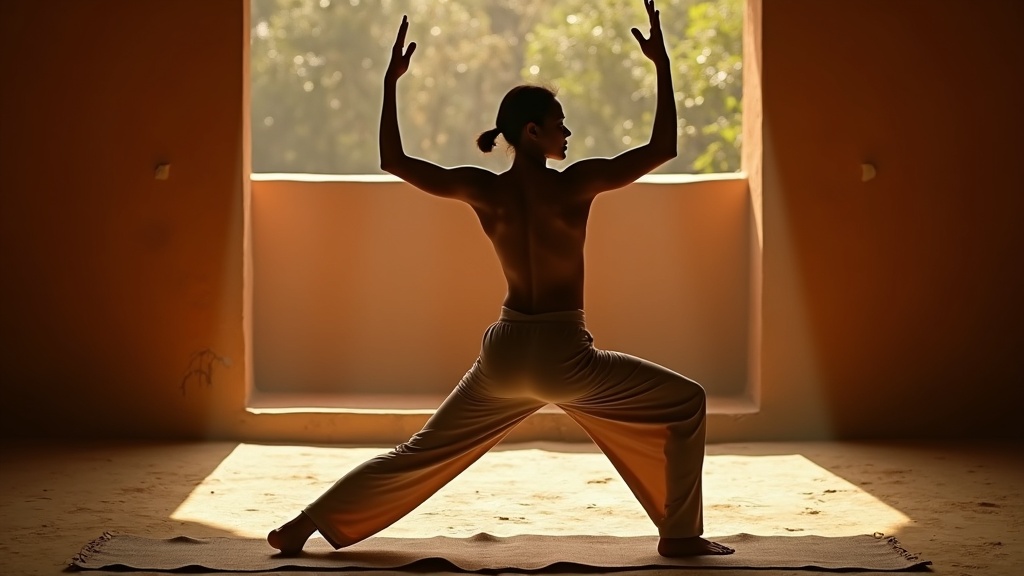
Kalaripayattu vs Yoga: Differences, Origins, How to Choose
Kalaripayattu vs Yoga: Differences, Origins, How to Choose
Most people who type kalaripayattu vs yoga into a search bar are not really choosing between them. They are trying to figure out whether Kalaripayattu is "yoga that fights" or something else entirely. Both come from India. Both treat the body as the doorway. Both share several postures. And yet the body learns very different things in each. After twelve years of teaching Kalaripayattu — to yoga practitioners, to martial artists, to people who had never trained anything — I have come to think of them as siblings with opposite jobs. This article gives you the comparison side by side, an honest correction of the "which is older" question, and a clear answer to which one to start with.
Kalaripayattu is a traditional martial art from Kerala in southwest India that trains attention outward — through dynamic, sequenced movement, partner work, and progressively introduced weapons. Yoga is a broad Indian tradition of physical postures, breath regulation, and meditation that trains attention inward — toward sensation, breath, and stillness. The two share Indian roots and several postures, but they are not the same practice; they ask the nervous system to do opposite things.
Key Takeaways
- Kalaripayattu and yoga share Indian roots and several postures, but they train attention in opposite directions — inward in yoga, outward in Kalaripayattu.
- Yoga is older as a textual tradition: Patanjali's Yoga Sutras are dated roughly to the 2nd–4th centuries CE, with pre-classical references in the Vedas and Upanishads. Kalaripayattu's documented form in Kerala dates to the 11th–12th centuries CE.
- Beginners with no consistent movement practice often start more comfortably with yoga; people drawn to dynamic, reactive movement often land deeper in Kalaripayattu.
- Yoga and Kalaripayattu stack well — many Kalaripayattu students use yoga for recovery and lengthening, and many yogis use Kalaripayattu to sharpen ground contact and presence.
- Both practices use a guru-shishya (teacher–student) transmission model and treat the body as the gateway to attention training, not as the goal itself.
- Neither is the "deeper" or "better" practice; they answer different questions and meet different bodies in different places.
- Kalaripayattu is not a form of yoga, even though it shares postures and an Indian philosophical context — it is a separate, fully developed martial system with its own four-stage training arc.
Kalaripayattu vs Yoga at a Glance
For readers who want the comparison first and the explanation second, here is the practical side-by-side. Each row of this table opens up into its own H2 below — start here, then read deeper where it matters to you.
| Kalaripayattu | Yoga | |
|---|---|---|
| Origin | Kerala, documented 11th–12th c. CE; Sangam-era roots | Pan-Indian; Yoga Sutras ~2nd–4th c. CE; pre-classical roots in the Vedas |
| Type of practice | Traditional martial art | Spiritual-physical discipline, multiple schools |
| Primary direction of attention | Outward — reaction, space, opponent | Inward — breath, sensation, stillness |
| Movement quality | Dynamic, ballistic, sequenced forms | Held postures with controlled transitions |
| Breath | Driven by the body's demand | Controlled and lengthened (pranayama) |
| Tools | Body, sticks, eventually metal weapons | Mat, sometimes blocks and straps |
| Typical session | Warm-up, ground work, animal forms, partner work | Asana sequence, breathwork, sometimes meditation |
| Best for | Reactive presence, ground contact, embodied power | Flexibility, nervous-system regulation, interior calm |
| Solo or partnered | Solo at first, partnered from stage 2 | Solo (group classes but no contact) |
| Curriculum | Four fixed stages: body, wood, metal, bare hand | Many schools (Hatha, Ashtanga, Iyengar, Vinyasa, etc.) |
No top-ranking page on this search currently puts a table this clean above the fold — which is part of why this article exists. The table is the answer; the rest is the reasoning behind it. (For a fuller introduction to Kalaripayattu as a complete system, our pillar what Kalaripayattu actually is is the deeper read.)
Shared Roots — Why Kalaripayattu and Yoga Look Like Siblings
Before the differences, the family resemblance. Anyone who has stepped into both a kalari and a yoga studio will recognise that the two practices come from the same philosophical soil. The recognition is real and worth naming clearly.
The same Indian philosophical context
Both practices grow out of the broader stream of Indian philosophy that treats the body as a vehicle for awareness rather than an obstacle to it. The body is not something the practitioner overcomes — it is the instrument through which something else is learned. This is unusual among the world's movement traditions. Most modern fitness culture treats the body as a project. Most Western combat traditions treat it as a weapon to be sharpened. Both yoga and Kalaripayattu treat it as a door.
The vocabulary they share reflects this common context. Concepts like prana (vital energy), nadi (energy channels), and the broader Ayurvedic anatomical framework appear in both traditions, even when the practices use them differently. The cosmology — the body as a microcosm, the relationship between breath and consciousness, the role of the teacher in transmitting embodied knowledge — is largely the same.
Shared postures that show up in both
Several postures appear in nearly identical form in both Kalaripayattu and Hatha Yoga. Ashwa Sanchalanasana (the equestrian or low lunge), Virabhadrasana (the warrior posture), and Bhujangasana (cobra) all show up inside Kalaripayattu's body-conditioning stage, called meipayattu (sometimes spelled meypayattu or meithari). The Kalaripayattu version of these postures is usually lower and more dynamic — held in flow rather than held still — but the shape is recognisable.
In Kalaripayattu the postures appear inside the ashtavadivu — the eight animal postures (horse, elephant, lion, serpent, peacock, fish, boar, rooster) that form the core vocabulary of the first training stage. Several of the animal stances mirror yoga asanas; others are unique to Kalaripayattu. The overlap is real but partial, and the way the postures are used differs sharply.
Both use the guru-shishya transmission model
Both practices transmit through the guru-shishya parampara — the teacher–student lineage. You do not learn either from a book or by yourself, at least not in their full form. There is something in the practice that only moves from one body to another through direct contact and direct instruction over time. The teacher is not an instructor in the modern sense but a transmitter of something that lives in the lineage.
This is why both traditions are suspicious of "self-taught" practitioners. A self-taught yoga practitioner can learn the shapes; a self-taught Kalaripayattu student can learn the sequences. But the felt sense of the practice — what changes inside the body over years — moves through human transmission, not text.
Both treat the body as the doorway
This is the deepest shared root. Neither yoga nor Kalaripayattu is about the body in the sense of making the body better as the end goal. Both use the body as the place where attention is trained, where awareness expands, where something other than physical fitness gets cultivated. A perfectly executed asana that does not change the practitioner's attention is, in the traditional view, missing the point. A perfectly executed Kalaripayattu sequence that does not develop the practitioner's awareness is the same.
The body becomes excellent as a side-effect. The actual training is of something the body carries.
The Core Difference — Inward Attention vs Outward Attention
Now the difference, which is the part that almost no other article on this search makes cleanly. Yoga and Kalaripayattu share roots and postures but they train the nervous system to do opposite things. The single clearest way to name the difference is the direction of attention.
Yoga turns attention inward
Inside a yoga session, the practitioner is asked, again and again, to bring attention to what is happening inside the body. What is the breath doing? Where is the micro-tension in this hip? Can the eyes soften? Can the jaw release? Often the eyes close. The hands of the teacher might land gently on a shoulder, but the work is between the practitioner and their own interior.
This is interoception — the perception of the internal state of the body. Yoga trains interoception with extraordinary precision. A long-time yoga practitioner can detect subtle shifts in breath, pulse, and visceral sensation that most people are entirely deaf to. This is the practice's gift and its specialty. The nervous system learns to listen inward.
The deeper levels of yoga — meditation, pranayama, the meditative absorption (samadhi) described in the Yoga Sutras — all extend this inward direction. The practice asks: what is happening in here? And it asks it more and more refined.
Kalaripayattu turns attention outward
Inside a kalari session, attention works the other way. The practitioner is asked, constantly, to be in contact with the external space. Where is the floor? Where is the partner moving? What is happening behind you? The eyes stay open and wide. The body works in relation to other bodies, to weapons, to the architecture of the training pit itself. Even in solo practice, the imagined opponent and the shape of the space remain present.
This is closer to the work of proprioception extended outward into reactive awareness — what some movement scientists call exteroception. The nervous system learns to read external space with the same precision yoga teaches you to read internal sensation. A Kalaripayattu student who has trained for years can sense someone approaching from behind not as a vague feeling but as a specific spatial fact.
The deeper levels of Kalaripayattu — the partner forms, the weapons sparring, the marma (vital-point) work — all extend this outward direction. The practice asks: what is happening out there, and how is my body in relationship with it? And it asks that more and more refined.
Why this matters for the nervous system
The two practices are not redundant. They train different capacities. A long-time yogi often becomes exceptional at interior regulation — slowing the breath, lowering the heart rate, calming the mind. A long-time Kalaripayattu practitioner often becomes exceptional at presence in space — reading rooms, responding without delay, staying grounded under pressure.
Neither capacity replaces the other. A yogi who has never trained outward awareness can be very calm and still freeze when someone bumps into them on the street. A Kalaripayattu practitioner who has never trained interior listening can be very fast and still not know what tension lives in their own shoulders. The directions of attention are complementary, not interchangeable.
This is the heart of the comparison. Once you understand it, the choice between the two practices becomes about which kind of attention your body needs to train, not about which practice is "better."
Which Is Older — and Why the Common Answer Is Wrong
This is one of the most frequently repeated misconceptions on the internet, and it deserves a careful correction. Almost every comparison article — and many Kalaripayattu schools — open by claiming that Kalaripayattu is older than yoga. The claim is usually paired with the "mother of all martial arts" line and presented as established fact.
The historical record does not actually support it.
What the historical record says about yoga
Yoga has the older textual lineage, by a clear margin. Patanjali's Yoga Sutras — the foundational text of classical yoga — are dated by most scholars to between roughly the 2nd century BCE and the 4th century CE. References to yoga-like practices appear earlier still: in the Upanishads (composed between roughly 800 BCE and 500 BCE), and in even older Vedic literature that scholars date to the second millennium BCE. The word yoga itself appears in the Rig Veda.
The physical postures most modern practitioners associate with yoga — the asanas of Hatha Yoga — are a more recent development, codified in texts like the Hatha Yoga Pradipika (15th century CE). So the physical-posture practice as we recognise it today is medieval. But the broader yoga tradition, including its philosophical and meditative core, has textual roots stretching back several thousand years.
What the historical record says about Kalaripayattu
Kalaripayattu's earliest documented references appear in the Sangam-period Tamil literature composed between roughly the 3rd century BCE and the 3rd century CE. These poems describe warriors trained in unarmed combat, spear, sword, and bow in the regions that are now Kerala and Tamil Nadu. The art was formalised in the four-stage structure we recognise today between the 11th and 12th centuries CE, during a period of consolidated military culture in medieval Kerala.
So Kalaripayattu's documented form in Kerala is about 900 years old. Its broader regional martial roots, traced through the Sangam-era references, are roughly two thousand years old.
The honest answer
Both practices are old. Both have documented lineages stretching back two thousand years or more. Yoga's textual tradition is older — the philosophical literature predates the Sangam poetry by several centuries. The practice lineages of both probably extend further back than their texts, into oral traditions whose precise ages cannot be cleanly established.
What is definitely not true: the claim that Kalaripayattu is "older than yoga" in any textual or documented sense. Neither is it true that yoga is "older than Kalaripayattu" in some final sense — physical embodiment practices likely existed in many forms before they were written down anywhere.
The honest framing: both are ancient, both share roots in early Indian culture, and the rivalry between them is largely a modern marketing invention. Neither tradition needs to be older than the other to be valuable. Our deeper treatment of Kalaripayattu's timeline is in the history and origin of Kalaripayattu — the same care for the historical record runs through that piece.
What a Typical Session Actually Feels Like
The previous sections have explained the philosophical and historical difference between the two practices. This section is the sensory comparison — what you would actually feel if you walked into each session as a beginner. Few comparison articles do this, and it is often what readers actually want to know.
A typical yoga session
A class begins with the practitioner arriving on the mat. The room is usually quiet, often dimly lit, sometimes warm. The teacher invites the body to settle, the breath to lengthen, the eyes to soften or close. The first sequences are usually slow and grounding — a few rounds of Sun Salutations or gentle hip openers.
The middle of the class moves through standing postures, balances, sometimes inversions, building heat and concentration. The eyes might close in balance poses. The breath stays in a steady, audible rhythm. There is no contact with other students. The teacher might walk through the room and adjust a posture; otherwise the work is between you, your mat, and your interior.
The class typically ends with floor postures, then savasana — a final relaxation, usually lying on the back with the eyes closed. Sometimes there is a brief meditation. The student leaves quieter, more interior, often with a slightly altered sense of time. The common after-feeling is spacious. Something has slowed down inside.
A typical Kalaripayattu session
A kalari class begins differently. If the space is a traditional kalari, the student enters by touching the ground with the right hand and then the chest — a small ritual of respect for the space. The first sequences are warm-up: deep stances, leg raises, hip mobility, often in long meipayattu sequences performed at increasing speed. The eyes stay wide open. The breath responds to the movement rather than leading it.
The middle of the class works through the ashtavadivu — the eight animal postures — and into longer flowing sequences that combine kicks, jumps, and ground transitions. Floor work is central: rolls, leg sweeps, body conditioning against the earth. As the student progresses, partner work enters — choreographed exchanges that teach distance, timing, and the sense of another body in space.
If the student is at the second stage or beyond, weapons appear — typically a long staff (kettukari) in flowing partner sequences. Even basic stick work demands a sharp outward focus; the weapon is unforgiving about inattention. The class ends with a brief bow to the lineage and to the training partners. The student leaves more grounded, more present in the room, often with a heightened awareness of the body's contact with the floor. The common after-feeling is grounded. Something has settled downward.
The two after-feelings, side by side
The most reliable way to feel the difference between yoga and Kalaripayattu is to attend a class of each in the same week and notice what each one leaves in the body afterward. Yoga tends to leave a spaciousness — an interior quietness, a softer breath, a less reactive nervous system. Kalaripayattu tends to leave a groundedness — a more solid contact with the earth, a sharper sense of the room, a body that feels more there.
Neither feeling is superior. They are the felt signatures of two different kinds of training. One trains the inward direction, one trains the outward direction. (For a deeper look at the felt-sense shifts a beginner notices in their first weeks, our piece on body awareness as a movement practice is the natural next read.)
How Yoga and Kalaripayattu Stack Together
Because the two practices train opposite directions of attention, they combine extremely well. Most of the Kalaripayattu students I have taught who also practise yoga report that the two reinforce each other in specific, identifiable ways. This is not metaphor — the transfer is concrete.
Yoga as recovery and lengthening for Kalaripayattu practitioners
Kalaripayattu is hard on the body in particular ways. The deep low stances accumulate tension in the hips and hamstrings. The ground work demands shoulder and core conditioning. The high kicks require active flexibility that develops slowly. A regular yoga practice — particularly a slower, longer-held style like Yin Yoga or restorative practice — addresses exactly the tissues that Kalaripayattu loads heavily.
I encourage students with chronic tightness, particularly in the hips, to add a yoga practice as recovery work between Kalaripayattu sessions. The progress in the kalari accelerates noticeably when the body has somewhere to release.
Kalaripayattu as ground contact and reactive presence for yogis
The transfer in the other direction is just as concrete. Yogis who add Kalaripayattu often report that their practice on the mat becomes sharper — not because the postures change, but because the practitioner is suddenly more present in the room around the mat. The interior listening yoga has built remains; the outward awareness Kalaripayattu builds is new, and it tends to make the whole practice more substantial.
Yogis who have been "in their head" during their yoga practice — a very common pattern, particularly in advanced practitioners who can perform the shapes but have lost the freshness — often find that a few months of Kalaripayattu re-ground them. The dynamic, reactive nature of the kalari forces the practitioner out of pure introspection and into the body's actual contact with the world.
Shared postures mean transfer is real
Because the two practices share several postures, time spent in one transfers measurably to the other. A yogi who already knows Virabhadrasana (warrior pose) has a structural advantage in the analogous Kalaripayattu stance. A Kalaripayattu student who has held the deep horse-stance for months will find yoga's standing postures more accessible than a complete beginner would.
This is not the case with many other movement traditions. A swimmer who takes up yoga has to learn the shapes from scratch. A yogi who takes up Kalaripayattu finds some of the vocabulary already in the body.
Where the two do not substitute for each other
It is worth saying clearly: yoga does not give you Kalaripayattu, and Kalaripayattu does not give you yoga. The two practices answer different questions. A yogi who never does Kalaripayattu will not develop the outward, reactive presence the kalari builds. A Kalaripayattu student who never does yoga will not develop the deep interior stillness yoga cultivates.
Where they stack, they reinforce. Where they do not overlap, neither replaces the other.
Which One Should You Start With
This is the question almost every reader of this article actually came for, and it is the question almost no other comparison article answers cleanly. The honest answer is that the right starting practice depends on what your body needs to learn and what your current life can absorb.
Start with yoga if
You should probably start with yoga if any of these is true:
- You have never had a consistent movement practice and want something accessible
- You are working with significant stress, anxiety, or nervous-system dysregulation and need a practice that slows you down
- You want a practice with a wide global infrastructure — yoga studios exist in almost every city, in many styles, at many price points
- You are drawn to stillness, breath, and interior work more than to dynamic, reactive movement
- You have an injury that needs careful, slow rehabilitation
Yoga is the lower-barrier entry into Indian body practices. The infrastructure is enormous, the styles are diverse enough that almost everyone finds something accessible, and the practice scales gently to any level of fitness.
Start with Kalaripayattu if
You should probably start with Kalaripayattu if any of these is true:
- You already train (yoga, martial arts, gym, calisthenics) but feel disconnected from your body inside the training
- You are drawn to dynamic, sequenced movement with structure
- You feel "in your head" most of the time and want something that pulls your attention outward
- You are interested in martial form, weapons, partner work, or applied movement
- You want a practice with a strong cultural and historical lineage that has not been over-commercialised
Kalaripayattu is the higher-investment practice — there are fewer teachers, fewer schools, and fewer accessible introductions. But for the right person, it lands in a way that few other practices do. (Our practitioner's guide to why people start Kalaripayattu covers the six most common reasons readers actually arrive — useful if you are still deciding.)
Start with both if you have the time
The two practices do not compete. Many of the strongest practitioners I know train both, with yoga taking the morning and Kalaripayattu taking the evening, or alternating days. The combined effect is more than either practice alone — the inward listening yoga builds gives you better access to your own body during Kalaripayattu, and the outward awareness Kalaripayattu builds gives you more presence inside your yoga.
If you have three to five hours a week, you can sustain both. If you have less, pick the one that addresses what is currently missing in your training.
Common Misconceptions About Kalaripayattu and Yoga
Comparison articles tend to repeat the same handful of misconceptions. Naming them clearly is part of what makes this article useful.
"Kalaripayattu is a form of yoga." No. They share roots, postures, and philosophical context, but Kalaripayattu is a complete, separately developed martial system with its own four-stage curriculum, its own training space, its own weapon vocabulary, and its own healing tradition (kalari chikitsa). Calling it a form of yoga is like calling karate a form of qigong because both come from East Asia and both involve breath. The categorical claim is wrong.
"Yoga is just stretching and Kalaripayattu is the real practice." Also wrong. Yoga has thousands of years of philosophical depth, multiple living lineages, and meditative practices that go far beyond physical postures. The reduction of yoga to a stretching routine is a recent Western distortion, not the tradition itself.
"Kalaripayattu is more spiritual than yoga because it is older." False on both counts. Kalaripayattu is not older (see the historical correction above), and depth of practice does not depend on the age of the tradition. Both practices contain plenty of depth and plenty of surface — what matters is the teacher and the time the student commits.
"You cannot practise both — they conflict." They do not conflict. They train different things. The only conflict is time and energy management, which is true of any two serious practices stacked together.
"Kalaripayattu will make me a violent person." Kalaripayattu trains the body in ways that are martial in origin, but the practice itself cultivates calm, presence, and grounded responsiveness rather than aggression. Long-time practitioners are notable for their measured, non-reactive quality — not the opposite. (The same conversation appears in the misconception that Kalaripayattu is the deadliest martial art.)
"Online Kalaripayattu is not real Kalaripayattu, but online yoga is fine." Partly true, partly false. What does not transfer through a screen — hands-on correction, the felt presence of a teacher in the same room, the kalari space itself — is largely the same for both practices. Online foundations work for both. The deeper levels of either practice eventually need in-person work.
Can Yoga Prevent Injury in Kalaripayattu Training
This is one of the search questions on this topic that no top-ranking article actually addresses, so it deserves a direct answer. The short version: yes, in specific ways, but yoga is not a substitute for proper Kalaripayattu progression.
The deep low stances of Kalaripayattu are the main injury risk for new students — particularly knee and hip strain when the body is asked to hold positions it is not yet prepared for. A consistent yoga practice that opens the hips and lengthens the hamstrings can substantially reduce this risk by giving the body the prerequisite range of motion the stances demand.
Beyond range of motion, the slower, breath-led nature of yoga teaches a quality of presence inside difficult positions that translates directly to the meipayattu stage. A practitioner who has spent time learning to breathe through the discomfort of a long-held yoga posture is much better prepared for the discomfort of a long-held Kalaripayattu stance.
What yoga cannot do is replace the gradual conditioning that Kalaripayattu's first stage builds specifically for the demands of the practice. A yogi who walks into a Kalaripayattu class expecting their yoga conditioning to fully transfer will be humbled in the first hour. The two trainings complement, but they do not substitute.
Frequently Asked Questions
Is Kalaripayattu older than yoga?
No, not in the textual record. Yoga's foundational text, Patanjali's Yoga Sutras, is dated to roughly the 2nd–4th centuries CE, and references to yoga-like practices appear in even older Upanishads and Vedic literature. Kalaripayattu's documented form in Kerala dates to the 11th–12th centuries CE, though regional martial references in Sangam-era literature go back nearly two thousand years. Both are ancient; yoga's textual lineage is older.
Is Kalaripayattu a form of yoga?
No. Kalaripayattu and yoga share Indian roots, several postures, and a philosophical context, but Kalaripayattu is a complete and separately developed martial system with its own four-stage training arc, weapon curriculum, partner work, and healing tradition. It is best understood as a sibling practice, not as a sub-category of yoga.
Can I practise Kalaripayattu and yoga together?
Yes, and many practitioners do. The two practices train opposite directions of attention — yoga turns it inward, Kalaripayattu turns it outward — and they reinforce each other rather than conflict. A common pattern is yoga for recovery and interior listening, Kalaripayattu for dynamic conditioning and outward presence. Three to five hours a week is enough to sustain both.
Which is better for beginners — yoga or Kalaripayattu?
Yoga is the lower-barrier entry for most absolute beginners. Studios are widespread, styles vary widely, and the practice scales gently. Kalaripayattu is the better starting point for people who already train but feel disconnected from their body in their training, or for those drawn to dynamic, reactive, sequenced movement. There is no universal answer — it depends on which kind of attention your body needs to develop.
Which is better for stress and anxiety?
Yoga is the more established practice for stress reduction. Decades of research published in places like Harvard Health and on PubMed document yoga's effects on the autonomic nervous system, cortisol, and self-reported anxiety. Kalaripayattu has not been studied in the same way but tends to produce grounding and presence rather than direct nervous-system downregulation. For acute stress, yoga is more reliably calming.
Is Kalaripayattu harder than yoga?
Both can be very hard or very gentle, depending on the style and the teacher. Kalaripayattu's first stage demands sustained low stances that most adult bodies find genuinely difficult; the higher kicks and ground work add cardiovascular demand. Yoga ranges from restorative practice (very gentle) to advanced Ashtanga (extremely demanding). On average, a beginner Kalaripayattu class will feel more physically intense than a beginner yoga class.
Do Kalaripayattu and yoga share the same postures?
Several, yes. Postures such as Ashwa Sanchalanasana (low lunge), Virabhadrasana (warrior), and Bhujangasana (cobra) appear in both traditions. Kalaripayattu also has its own postures — the ashtavadivu, the eight animal stances — that are unique to the kalari. The overlap is real but partial, and the postures are used differently: held still in yoga, performed in dynamic flow in Kalaripayattu.
Can yoga prevent injury in Kalaripayattu training?
It can substantially reduce risk by improving hip and hamstring range of motion, which are the main vulnerabilities for new Kalaripayattu students. Yoga also teaches breath-led presence inside difficult positions, which transfers directly to the long-held stances of meipayattu. Yoga is not a substitute for proper Kalaripayattu progression, but it is a strong complementary practice for injury prevention.
Which builds more strength?
Both build strength differently. Kalaripayattu builds dynamic, explosive strength through low stances, jumps, kicks, and weapon work. Yoga builds isometric strength through long-held postures, with strong demands on core, shoulders, and stabilising muscles. Neither is "more" — they develop different kinds of usable strength.
Is Kalaripayattu safe for older beginners?
Yes, with proper progression. Adult and older beginners can train Kalaripayattu safely by working slowly through the first stage and respecting the body's signals. The four-stage system is designed to build the prerequisites gradually, so a beginner of any age has a clear path that scales to capacity. For a deeper look at starting Kalaripayattu as an adult, our piece on Kalaripayattu for beginners covers the realistic first months.
What is kalari yoga?
The term kalari yoga sometimes refers to the yoga-like elements inside Kalaripayattu's body-conditioning stage — the held postures, the breath work, the stretching sequences that prepare the body for the more dynamic training. Some schools teach this as a standalone practice marketed to yogis. It is not a separate ancient tradition but a modern presentation of one piece of the broader Kalaripayattu curriculum.
Should I learn yoga first if I want to do Kalaripayattu?
Not necessarily. A yoga background helps — it builds the flexibility, breath awareness, and tolerance for sustained postures that Kalaripayattu's first stage demands. But you do not need to "complete" yoga before starting Kalaripayattu. Many students start Kalaripayattu with no prior practice and develop the prerequisite qualities inside the kalari itself. If you are choosing between starting one and starting both, start both.
Sources & Further Reading
- Kalaripayattu — Wikipedia's comprehensive entry on the practice, the most exhaustive single source online; covers history, training stages, weapons, and modern revival.
- Yoga — Wikipedia's overview of the yoga tradition, useful for situating modern asana practice in its broader philosophical and historical context.
- Hatha Yoga — Wikipedia entry on the branch of yoga most modern practitioners encounter, with detail on the medieval texts that formalised the physical posture practice.
- Yoga Sutras of Patanjali — Wikipedia entry on the foundational text of classical yoga; central to any historical discussion of yoga's age.
- Indian martial arts — Wikipedia overview placing Kalaripayattu in the wider context of South Asian martial traditions, including comparisons to Silambam and other regional arts.
- Sangam period — Wikipedia entry on the early Tamil literary period that contains the earliest references to proto-Kalaripayattu martial practice.
- Vedas — Wikipedia entry on the oldest layer of Indian sacred literature, where references to yoga-like practices first appear.
- Upanishads — Wikipedia entry on the philosophical texts (c. 800–500 BCE) that develop the early yoga tradition.
- Hatha Yoga Pradipika — Wikipedia entry on the 15th-century text that codified the physical postures of modern yoga.
- Pranayama — Wikipedia entry on the breath regulation practices central to yoga and related Indian traditions.
- Yoga for anxiety and depression — Harvard Health — accessible summary of clinical research on yoga's effects on stress and mood.
- Effects of yoga on the autonomic nervous system, gamma-aminobutyric-acid, and allostasis — PMC — peer-reviewed paper on the physiological mechanisms behind yoga's stress-regulating effects.
- Marma (Marma Adi) — Wikipedia entry on the vital-point knowledge shared between Kalaripayattu, Ayurveda, and certain yoga traditions.
- Ayurveda — Wikipedia entry on the Indian medical tradition whose anatomical framework underpins both yoga and Kalaripayattu.
- Guru-shishya tradition — Wikipedia entry on the teacher–student transmission model shared by both traditions.
- Kerala — Wikipedia entry on the south Indian state where Kalaripayattu developed in its current form.
- Interoception — Wikipedia entry on the body's interior-sensing system; the capacity yoga most directly trains.
- Proprioception — Wikipedia entry on the body's positional-sensing system; the capacity Kalaripayattu extends into outward reactive awareness.
- Indian philosophy — Wikipedia overview of the broader philosophical context from which both yoga and Kalaripayattu emerged.
Conclusion
Yoga and Kalaripayattu are sibling practices from the same Indian soil that train the nervous system to do opposite things. Yoga turns attention inward — toward breath, sensation, and interior stillness. Kalaripayattu turns attention outward — toward space, partner, and reactive presence. Both treat the body as the doorway rather than the goal. Both are ancient (yoga's textual lineage is older), both use the same teacher–student model, and both share several postures. Neither is superior. The right question is not which practice is better but which kind of attention your body needs to train.
If you have never moved much, yoga is the gentler entry. If you already train but feel disconnected from your training, Kalaripayattu is often the practice that lands. If you have the time, stack them — they reinforce each other.
If you would like to feel what Kalaripayattu is from the inside before deciding, the first lesson at Kalari University is free — no payment, no commitment. Create your account and start today →
About the Author
Raphael Gorschlüter — Co-Founder & Head Teacher, Kalari University
Raphael Gorschlüter has trained Kalaripayattu for more than twelve years and teaches internationally — at Kalari University's main school in Germany, in Spain, and on annual retreats in India. He co-founded Kalari University to make foundational Kalaripayattu training available to adult learners who cannot easily reach a traditional kalari, and he is known among his students for developing the ability to feel movement rather than only perform it. Many of his students arrived from established yoga practices, which gives him a direct view of how the two traditions interact in the body. He teaches from the Vadakkan northern lineage and continues to study with senior teachers in Kerala.
