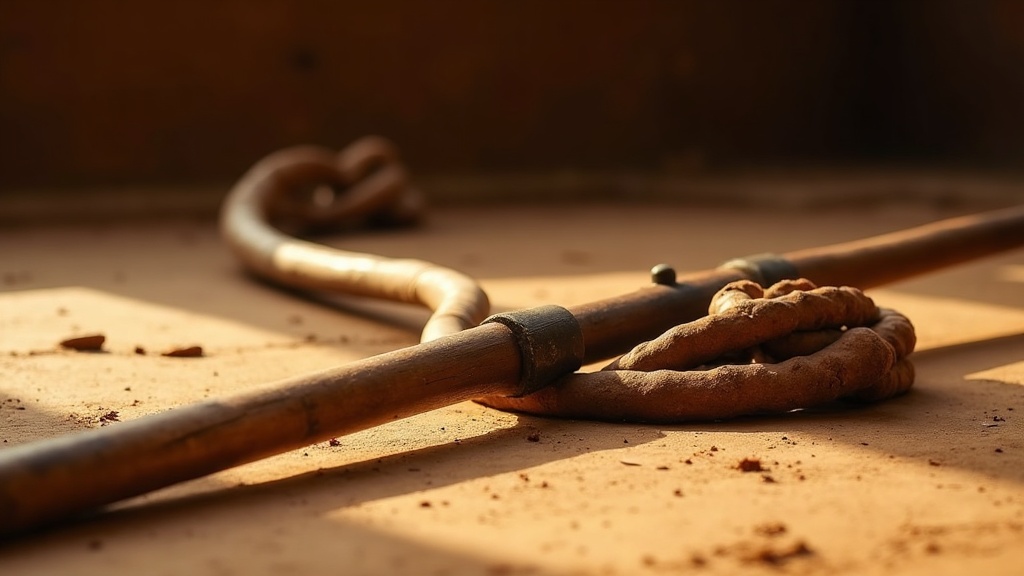
Kalaripayattu Disciplines and Weapons: The Four Stages Mapped
Kalaripayattu Disciplines and Weapons: The Four Stages Mapped
Most pages on this topic do one of two things. They list the weapons of Kalaripayattu — sword, stick, urumi — without saying when in the training a student first picks one up. Or they describe the four disciplines as a clean ladder without naming the actual implements that live inside each stage. The reader is left with two half-maps that never meet. This article welds them. Every weapon is placed inside the stage where you first meet it, and the stages are explained as a pedagogical progression, not a chronological fact. By the end you will know what is taught in each of the four disciplines, which weapons belong where, and — more importantly — why the order is what it is.
Kalaripayattu is structured around four sequential disciplines: meithari (body conditioning), kolthari (wooden weapons), ankathari (metal weapons), and verumkai (bare-hand combat). Roughly a dozen named weapons are distributed across the second and third stages — the long staff and short stick in kolthari; the sword and shield, dagger, spear, and flexible urumi in ankathari. The bare hand comes last, not first, because by then the body itself has become the weapon every prior stage was preparing.
Key Takeaways
- Kalaripayattu is taught in four sequential disciplines: meithari (body), kolthari (wooden weapons), ankathari (metal weapons), and verumkai (bare hand) — the order is structural, not arbitrary.
- Wooden weapons appear after roughly three to six months of body conditioning; metal weapons after a year of consistent training; the urumi and marma knowledge usually only after many years.
- The first wooden weapons are kettukari (long staff), cheruvadi (short stick), and otta (curved wooden weapon unique to Kalaripayattu) — each one teaches a different geometry.
- The main metal weapons are kataram (dagger), val and paricha (sword and shield), kuntham (spear), and the flexible urumi — taught in that approximate order of risk.
- Every weapon is a pedagogical tool, not just a fighting object: the otta teaches angles, the urumi teaches awareness in every direction, the sword and shield teach the symmetry of attack and defence.
- The bare hand comes last because by then the body has been built, the geometry of weapons has been absorbed, and the body itself can apply the lessons without needing an implement in between.
- Northern (Vadakkan) and Southern (Thekkan) lineages sequence the disciplines slightly differently, but the four-stage architecture exists in some form in every authentic kalari.
The Four Disciplines of Kalaripayattu at a Glance
Before walking through each discipline in detail, it helps to see the whole map at once. The table below is the version I use when explaining the structure to a new student in their first conversation about the practice.
| Stage | Name | Focus | Main weapons | Typical timeline for an adult learner |
|---|---|---|---|---|
| 1 | Meithari (also called meipayattu) | Body conditioning — stances, sequences, flexibility, breath | None | First 3–6 months |
| 2 | Kolthari | Wooden weapons — geometry, distance, partner work | Long staff (kettukari), short stick (cheruvadi / muchan), curved wooden weapon (otta) | Months 6–18 |
| 3 | Ankathari (also angathari, aayudhaabhyaasam) | Metal weapons — precision, real-edge timing | Dagger (kataram), sword and shield (val and paricha), spear (kuntham), flexible sword (urumi) | Year 2 onward |
| 4 | Verumkai (also verum kai) | Bare-hand combat and marma application | None — the body itself | Year 5+ in traditional lineages; marma prayoga often only after twelve years |
The first thing this map should make obvious is that "Kalaripayattu weapons" is not a list of objects somebody chose. It is a sequence of teachers, each one of which prepares the body for the next. A student who skips ahead does not just miss a weapon — they miss the lesson the weapon was put there to give.
The second thing the map shows is the broad timeline. Modern kalaris vary: some accelerate, some preserve the slow path. But across lineages, the order is more stable than the pace. We will walk each stage now.
For the wider context of where these stages sit inside the practice as a whole, see the complete practitioner's guide to what Kalaripayattu is.
Stage 1 — Meithari: The Body as the First Weapon
Every student begins here. Meithari (or meipayattu, "the practice of the body") is the foundation, and many traditional teachers will tell you the whole art is contained in this stage. If your meithari is sound, everything afterward falls into place. If it is rushed, every weapon you ever pick up will inherit the gaps.
What meithari trains
The work in meithari breaks into a handful of components, and a serious student returns to all of them every session for the rest of their training life.
- Low standing postures (chuvadu) and animal-named stances (vadivu) — horse, elephant, lion, serpent, peacock, fish, boar, rooster
- Long flowing sequences (meipayattu) that combine kicks, jumps, turns, and rapid changes of direction
- Floor work — rolls, leg sweeps, conditioning against the earth itself
- Flexibility work that opens hips, hamstrings, shoulders, and spine to depths most modern adult bodies have never approached
- Breath, allowed to drop into the belly rather than imposed by technique
- Traditional oil massage (uzhichil), often given by the teacher, which prepares the muscles for the depth of the postures
The point of all this is not strength in the gym sense. It is the readiness of the body to be honest with itself. A student in meithari is being taught, slowly, to feel where their weight is, how their joints stack, where their breath sits — long before any tool is added to the picture.
Why no weapons yet
A weapon, in the Kalaripayattu sense, is a longer arm. If you cannot move your own arm freely through space, a stick in your hand will not move freely either. The stick will reveal — not solve — the limitations of the body holding it.
This is why the discipline insists on the body coming first. Hand a beginner a kettukari in week two and you will see a confused tangle: the stick swinging where the body cannot follow it, the stances collapsing under the unfamiliar load, the breath held high in the chest. Hand the same beginner the same stick after six months of meithari and the picture changes. The stick goes where the body sends it, because the body now knows where it is.
In my own teaching, the students who struggle most with weapons are almost always the ones who pushed through meithari impatiently. The slowness of the first stage is not a delay before the real thing. It is the real thing, viewed from inside.
How long this stage lasts
For an adult beginner training twice a week, the active meithari phase typically lasts three to six months before a teacher will introduce the first wooden weapon. Some traditional teachers extend this much longer — a year, sometimes more — particularly if they sense the body is not yet ready to absorb what the stick will demand.
This does not mean the body work stops when kolthari begins. It deepens. The mature meipayattu sequences of a senior student are visibly more refined than those of a beginner, and most experienced practitioners spend the first portion of every training session in meithari movements regardless of what stage they have formally reached. The discipline is layered, not graduated past.
For what these first three months actually feel like from inside a Western adult body, see the honest beginner's guide to starting Kalaripayattu.
Stage 2 — Kolthari: Wooden Weapons
The second discipline introduces wood. Kol means stick, thari roughly means "with" — the practice with wooden weapons. This is the stage where the geometry of attack and defence becomes visible for the first time, because a longer object in your hand makes the geometry impossible to hide.
Three main weapons live inside kolthari. They are taught in the rough order below, though specific lineages vary.
Kettukari — the long staff
The kettukari is the long staff: about five feet of seasoned cane or bamboo, slightly tapered, light enough to move quickly but substantial enough to deliver real force. It is the first weapon nearly every student is given.
The staff teaches range. Where the body in meithari learns to occupy space, the kettukari extends that space outward by an arm's length plus the length of the stick. Sequences with the staff include strikes, parries, sweeps, and rapid changes between attack and defence. Partner work — two students exchanging staff techniques in choreographed patterns — usually begins inside this stage.
The staff is honest in a specific way. If your stance is too high, the staff cannot generate force because the stance has nothing to push against. If your shoulders are tight, the staff arrives at its target ahead of the rest of you, and any opponent (or sparring partner) reads it. If your gaze is unfocused, the tip of the staff drifts. The student spends months with the staff not because there is so much complicated material — the basic strikes can be listed in five minutes — but because the staff is teaching them, slowly, that the body is the weapon and the wood is only the extension.
Cheruvadi and muchan — the short stick
The cheruvadi (also called muchan in some lineages) is the short stick — roughly three handspans, often a piece of dense wood like tamarind. Where the staff teaches range, the short stick teaches close-range timing.
Sequences with the cheruvadi are faster and tighter than staff work. In the Kadathanadan tradition of northern Kerala, the short stick is sometimes described as delivering up to two hundred blows per minute in advanced practice — an exaggeration in literal terms but useful as a picture of the velocity the weapon trains. The student learns to read the opponent at close range, to recover the weapon between strikes without losing the centre, and to use the short tool against a longer one (the standard partner exercise is cheruvadi against kettukari, where the shorter weapon must close distance to be effective at all).
The short stick also begins to introduce something the staff cannot — angles into the body's softer regions. Where the staff is largely a striking and parrying weapon at long range, the short stick is wielded close enough that the targeting of specific anatomical zones starts to matter. This is the first quiet introduction to the marma (vital-point) knowledge that the practice will return to in the bare-hand stage years later.
Otta — the curved wooden weapon unique to Kalaripayattu
The otta (or ottakkol) is the strangest of the three and the most distinctive. It is a curved wooden weapon, often carved from a single piece of tamarind, shaped roughly like an elephant's tusk — a smooth curving shaft ending in a blunt knob. Outside Kalaripayattu, no other martial tradition uses anything quite like it.
The otta is treated as the bridge between wood and metal. Its sequences are denser, more technical, and significantly more demanding than those of the staff or short stick. The curve of the weapon allows it to strike around shields and into angles that a straight stick cannot reach — and, crucially, those angles correspond to marma points on the body. The student practising otta is being trained in vital-point targeting using a wooden tool, so that when the metal weapons arrive in the next stage, the targeting has already been absorbed without the risk of a real blade.
In many traditional schools, students are tested at the end of the otta sequences before being allowed to move on to ankathari. This is the moment the discipline turns from wood to metal, and the teacher needs to be sure the student is ready.
Why wood before metal
The reasoning is simple, and it is shared across nearly every Indian martial tradition that uses both wooden and metal weapons. A wooden blow can be received. A metal blow cannot. Wood teaches the geometry; metal inherits it.
Two students working slowly through a staff exchange can absorb errors — a misjudged distance, a slightly late parry — without serious consequence. The same two students working with sword and shield cannot. By the time a student arrives at ankathari, the geometry must already be a habit, not a calculation. Kolthari is the stage where the geometry becomes a habit.
For a complete summary of how the levels progress — and how long each one really takes — see the practical timeline of Kalaripayattu levels and training.
Stage 3 — Ankathari: Metal Weapons
The third discipline is the introduction of metal. Ankathari (also rendered angathari, aayudhaabhyaasam, or simply "metal weapons stage" in English-language schools) is where the lessons of the body and the wooden tools meet a real edge for the first time. Several distinct weapons are taught, usually in the rough order of risk.
Kataram — the dagger
The kataram (sometimes kadara) is often the first metal weapon a student is given. It is short, sharp on one or both edges, and used at close range. The student who has done their cheruvadi work has already learned to operate at this distance; the dagger asks them to do it with a tool that will not forgive contact.
Dagger work in Kalaripayattu includes thrusts, slashes, locks, disarms, and close-quarter clinching. The choreographed exchanges between two students with daggers are visually some of the most striking sequences in the art — fast, tight, and unmistakably grounded in real-world combat principles rather than performance aesthetics.
Val and paricha — sword and shield
The iconic pairing. Val is the sword — typically a single-edged curved blade in Kalaripayattu, though specific lineages train with variants — and paricha is the shield, a round leather or wooden disc held at the centre.
What the sword and shield teach is symmetry. The student must learn to attack and defend simultaneously — one hand offering, one hand denying — and neither hand can lead the other. This is harder than it sounds. Most beginners default into a striking hand and a passive hand. The sword and shield will not let that work for long; the shield must be active, the sword cannot defend itself.
Partner work with sword and shield is the form most often demonstrated in Kalaripayattu performances around the world. It is also one of the most pedagogically rich. The student learns not just to fight, but to think with both sides of the body at once.
Kuntham — the spear
The kuntham is the spear, a reach weapon that takes the long geometry of the kettukari and concentrates it into a sharp metal tip. Spear work includes thrusts at multiple ranges, swings using the full length, parries with the shaft, and ground-to-standing transitions where the spear becomes a planted support as well as a weapon.
The spear is sometimes treated as the most "practical" of the metal weapons, in the sense that historically it was the weapon a foot soldier was most likely to actually fight with. Inside the kalari today, it is also valued because it draws together so much of what came before — the range awareness of the staff, the targeting of the otta, the symmetry of sword and shield — into a single tool.
Urumi — the flexible sword
The urumi is the most-feared weapon in Kalaripayattu and arguably in any martial tradition that still teaches it. It is a flexible steel sword, both edges sharp, roughly the length of the practitioner's own body, sometimes constructed from multiple flexible blades attached to a single handle. When swung it flows like a whip, returns on its own arc, and can wound the wielder as easily as the opponent.
This is what makes the urumi a teacher. Every prior weapon in the curriculum has trained one quality of attention — range, timing, symmetry, reach. The urumi demands all of them at once, plus a complete awareness of three hundred and sixty degrees around the body, because the blade does not stop where the swing ends. It returns. A practitioner who has not built the awareness through every prior stage cannot survive a single sequence with this weapon.
Urumi training begins, in most traditional lineages, only after years of consistent work — often seven years or more. Even then, sequences are typically practised solo, with great space around the practitioner, before they are ever rehearsed with a partner present. The weapon is taught carefully because the cost of misjudging it is not theoretical.
Why urumi comes last among the metal weapons
The placement of the urumi at the end of the metal stage is the clearest illustration of the whole discipline's pedagogy. It is the only weapon in the curriculum that can wound the person wielding it as readily as the person being attacked. Every weapon before it has been preparing the awareness that this one requires.
The student arrives at the urumi with the floor sense of meithari, the range awareness of the staff, the close-quarter speed of the short stick, the angle-and-target precision of the otta, the close-edge timing of the dagger, the dual-side symmetry of sword and shield, and the long-reach commitment of the spear. The urumi asks them to integrate all of it. Skip any prior stage and the integration fails.
For a fuller treatment of why this weapon — and the language around it — has been so often misunderstood in popular accounts of the art, see our measured look at the "deadliest martial art" framing.
Stage 4 — Verumkai: The Bare Hand
The fourth and final discipline is verumkai — empty hand. Verum means bare or empty; kai means hand. The student who has worked through the body, the wood, and the metal now sets every implement down and returns to the body alone.
What verumkai covers
Bare-hand work in Kalaripayattu includes strikes, kicks, throws, locks, joint manipulations, foot-tricks (sweeps and trips), evasions, and the application of marma knowledge. The structural similarity to other Indian martial arts like Adi Murai and Silambam's empty-hand counterpart is significant — these traditions share a deep regional substrate.
The signature of Kalaripayattu verumkai, however, is the absorption of everything that came before. A strike is not just a strike: it is a strike issued from a stance refined in meithari, along an angle learned with the otta, with the timing of close-quarter weapon work, into a vital point identified by marmashastram. The empty hand is not the beginner's tool. It is the senior practitioner's distillation.
Marma — the vital points
The deepest part of verumkai is marma prayoga — the application of vital-point knowledge. Marma are the points on the body where life force is held to concentrate; the traditional count is one hundred and seven, plus the mind itself as the hundred-and-eighth. The systematic study of these points is called marmashastram, and it is shared between Kalaripayattu and Ayurveda, whose surgical text the Sushruta Samhita originally described them.
In Kalaripayattu, the same map is used for opposite ends. In combat, marma identifies where to strike to disable an opponent with minimal force. In healing, marma identifies where to apply pressure, oil, and treatment to release blocked energy and restore function. The teacher who carries the full lineage knows both.
For this reason, marma prayoga is traditionally taught only after roughly twelve years of consistent training. The reason is not mystical; it is ethical. A student who has not absorbed the discipline of twelve years has not earned the right to know where the strikes lie, because the same knowledge that disables can kill. Lineages that take this seriously withhold the marma teaching from students who have not demonstrated the temperament for it.
Why bare hand is last, not first
This is the question that comes up almost every time I introduce the four-discipline structure to a Western student. In karate, judo, and most other modern martial systems, the empty hand is where you start. Why does Kalaripayattu put it at the end?
The answer is in the previous three stages. The bare hand in Kalaripayattu is not the foundation; it is the result. By the time the student arrives at verumkai, the body has been built through meithari, the geometry of attack and defence has been absorbed through kolthari, the precision and stakes of real-edge timing have been internalised through ankathari, and the awareness has been tested by the urumi. The empty hand inherits all of it.
A bare-hand technique taught to a beginner is a beginner's bare-hand technique — useful, perhaps, but separate from the body's deeper capacities. A bare-hand technique taught to a student emerging from a decade of weapons work is something else entirely. The strike looks the same. What is behind it does not.
Northern, Southern, and Central Styles — How the Sequence Shifts
Kalaripayattu is not monolithic. Two main lineages exist, and a third less-codified central tradition is recognised by some teachers. They share the four-discipline architecture but differ in how strongly each stage is emphasised and in what order specific weapons appear.
Vadakkan — the northern style
Vadakkan is the form most outsiders mean when they say "Kalaripayattu." It originated in northern Kerala and is characterised by deep flowing sequences, animal-named stances, extensive weapon work, and the urumi as its signature blade. The four disciplines are present in their textbook form, and the progression is observed closely. The training pit (kalari) is typically dug into the earth and ritually consecrated.
Most international schools teach Vadakkan, partly because it was the first form to be revived publicly in the 1930s and the first to be documented in English. If you train Kalaripayattu anywhere outside the southern tip of India, you are almost certainly training Vadakkan.
Thekkan — the southern style
Thekkan developed in southern Kerala and Tamil Nadu, and shares deep roots with Tamil martial traditions like Adi Murai and Silambam. Structurally it diverges from Vadakkan in important ways: the movements are shorter and harder, the emphasis on flowing weapon sequences is reduced, and the central focus is on vital-point striking — sometimes called marma adi — from much earlier in the training.
The practical effect on the four-discipline structure is that Thekkan lineages often introduce hand-to-hand work earlier than Vadakkan. The empty-hand stage is not pushed to the end in the same way; marma concepts enter the training sooner. The four disciplines exist, but they overlap more than they sequence.
Central styles and modern variations
A third tradition, sometimes called Madhya, sits between the two and incorporates elements of both. In addition, modern teachers in different lineages adapt the order for practical reasons — adult learners with limited training time, schools that emphasise performance, programmes designed for international students. None of this invalidates the four-discipline architecture; it just bends it.
The key point is that meithari, kolthari, ankathari and verumkai exist, in some form, in every authentic kalari. The pace and the order of weapons inside the stages may shift. The architecture does not.
A Realistic Timeline — From Day One to the Urumi
The romantic version of Kalaripayattu training is "twelve years to mastery." The realistic version, for an adult learner training two or three times a week with a competent teacher, is more textured. Below is what an honest progression typically looks like.
- Months 1–6: Meithari only. Postures, sequences, floor work, breath. No weapons. By month three, the basic body conditioning starts to feel like a foundation; by month six, the teacher decides whether the body is ready for a wooden tool.
- Months 6–12: Long staff (kettukari) introduced. Partner work begins. Meithari deepens in parallel.
- Year 2: Short stick (cheruvadi), then otta. End of kolthari in many lineages. First metal weapon (kataram dagger) may be introduced toward the end of this year if the student is ready.
- Year 3 onward: Sword and shield (val and paricha), spear (kuntham). The body is now working with metal regularly; the precision demanded is significantly higher than anything before.
- Year 7 onward: Urumi, in most traditional Vadakkan lineages. Solo practice first; partner work only later.
- Year 12 onward: Marma prayoga — the deepest layer of verumkai, taught only when the teacher is satisfied the student has the temperament to carry it.
Modern variation matters here. Many adult students will train for years and never touch the urumi — not because they are deficient, but because they are practising for reasons other than the full traditional progression. Others will accelerate parts of the timeline because their starting body, frequency of training, and dedicated teacher allow it. The numbers above are an honest baseline, not a fixed measure.
For more on what actually transfers through a screen versus what needs a teacher in the same room, see the honest guide to Kalaripayattu training online.
Why the Order Matters (Even If You Never Touch a Weapon)
Here is the question that often goes unasked. Most people training Kalaripayattu today — including many of my own students — will never wield an urumi. Many will not advance past the wooden weapons. Some, by choice or circumstance, will spend years inside meithari and call it the practice.
Does the four-discipline structure still matter for them?
It does, and for one reason. Even the body-only stage of meithari is built around the assumption that a longer arm will eventually follow. That is why meithari feels like a martial art and not a yoga class. The low stances are oriented for striking distance. The sequences include the angles and the timing of weapon work, even when no weapon is in hand. The student practising meithari is being prepared for a stick they may never pick up — and the preparation is what gives the practice its specific character.
Strip the four-discipline structure away and meithari becomes a movement system, but not Kalaripayattu. The architecture is what makes the practice coherent, even for students who only ever inhabit its first room.
Common Misconceptions About the Disciplines and Weapons
A few persistent misunderstandings circulate about how Kalaripayattu is structured. Naming them directly is the cleanest way to clear them.
"There are eight or nine disciplines, not four." Some popular sources list every variation of meipayattu, kolthari and ankathari as separate disciplines, producing inflated numbers. The traditional and pedagogically meaningful structure is four. Subdivisions exist within each stage but are not separate disciplines.
"The urumi is the most important Kalaripayattu weapon." It is the most photographed, the most marketed, and the most feared — but inside a serious kalari, the kettukari and the otta are pedagogically more important. They are where the geometry of the entire art is laid down. The urumi is the test of the awareness those earlier weapons built.
"You can skip the body stage if you already train martial arts." No. Bringing a karate background, a BJJ background, or a boxer's conditioning into a kalari is useful in some ways, but the geometry of Kalaripayattu's low stances is so different from any other striking art's stance that the body has to be retrained. Meithari is not optional for anyone, regardless of prior training.
"Bare hand should be taught first because it is the most natural." This is the question that gets asked most often by students from striking backgrounds. The answer is in the body of this article: the empty hand in Kalaripayattu is not the foundation, it is the inheritance of everything the body has been built to absorb through the prior stages. Taught first, it is a different practice — useful, but separate from what Kalaripayattu is structured to teach.
"The weapons are just for performance." Some demonstration kalaris in Kerala emphasise the visual quality of weapon sequences for tourist audiences, which has fed the misconception. Inside a working kalari, the weapons are training tools first. The choreography exists because it teaches; the performance, where it happens at all, is downstream of the pedagogy.
Frequently Asked Questions
What are the four disciplines of Kalaripayattu?
The four disciplines, in fixed order, are meithari (body conditioning through postures, sequences, and floor work), kolthari (wooden weapons — long staff, short stick, curved otta), ankathari (metal weapons — dagger, sword and shield, spear, and the flexible urumi), and verumkai (bare-hand combat including marma application). The order is structural rather than arbitrary: each stage builds the prerequisites the next one assumes.
What weapons are used in Kalaripayattu?
Roughly a dozen named weapons are taught across the second and third disciplines. The wooden weapons are the kettukari (long staff), cheruvadi or muchan (short stick), and otta (curved wooden weapon unique to Kalaripayattu). The metal weapons are the kataram dagger, val and paricha (sword and shield), kuntham (spear), and the urumi (flexible sword). Specific lineages add variations — different sword shapes, additional staves, regional weapons — but this list is the core.
What is the order of weapons training in Kalaripayattu?
Wooden weapons come before metal weapons, and within each group the progression runs from simpler to more complex. The typical order is: long staff (kettukari) first, then short stick (cheruvadi), then curved otta — ending the wooden stage. The metal stage usually begins with the kataram dagger, followed by sword and shield (val and paricha), then spear (kuntham), and finally the urumi after several more years of training. The bare-hand stage (verumkai) comes last.
What is the difference between kolthari and ankathari?
Kolthari is the wooden weapons stage; ankathari is the metal weapons stage. They sit consecutively in the four-discipline structure, with kolthari preparing the geometry and ankathari applying it to real edges. The pedagogical reason for the separation is straightforward: a wooden blow can be received during training; a metal one cannot. Kolthari teaches the body to handle a tool extending it through space; ankathari asks the body to do the same thing with consequences.
What is the most dangerous weapon in Kalaripayattu?
The urumi — a flexible sword with both edges sharp, roughly the length of the practitioner's body — is widely considered the most dangerous weapon in any martial tradition that still teaches it. It is dangerous specifically because the blade returns on its own arc after every swing and can wound the wielder as easily as the opponent. It is taught only at advanced levels, only to senior students, and usually only after years of careful preparation through every prior weapon in the curriculum.
How long does it take to learn the urumi?
In most traditional Vadakkan lineages, students begin training with the urumi only after seven years or more of consistent practice. Even then, sequences are first practised solo, with significant space around the body, before any partner work is attempted. The training time is long because the urumi requires the integration of every prior weapon's lesson — range, timing, symmetry, angle, awareness in every direction — and any gap in the foundation is dangerous.
Are weapons taught to beginners?
No. The first three to six months of Kalaripayattu training (and often longer) are pure meithari — body conditioning with no weapons. The teacher introduces the first wooden weapon, typically the kettukari long staff, only when the body is ready. A school that puts a weapon in a true beginner's hand on day one is not following the four-discipline structure of the art, regardless of what they may call the practice.
What is verumkai in Kalaripayattu?
Verumkai (literally "empty hand" — verum meaning bare, kai meaning hand) is the fourth and final discipline of Kalaripayattu. It covers bare-hand combat including strikes, kicks, throws, locks, sweeps, evasions, and the application of marma (vital-point) knowledge. It comes last in the sequence — not because the empty hand is unimportant, but because by then the body has absorbed everything the prior weapons stages taught, and the bare hand inherits the integrated capacity.
What is meithari and why is it the first stage?
Meithari (also called meipayattu) is the body-conditioning discipline that begins every Kalaripayattu student's training. It includes low standing postures, animal-named stances, flowing sequences, floor work, flexibility training, and breath. It is first because a weapon is a longer arm — and an arm that cannot move freely cannot use a weapon well. The body has to know itself before it can know what to do with a tool. Most traditional teachers say the entire art is contained, in essence, in this stage.
What is the otta and why is it considered the bridge from wood to metal?
The otta (or ottakkol) is a curved wooden weapon unique to Kalaripayattu, often carved from a single piece of tamarind, shaped roughly like an elephant's tusk. It is the final weapon of the kolthari stage and the most pedagogically demanding. Its curve allows it to strike around shields and into angles that correspond to marma points on the body — so it trains vital-point targeting using a safe wooden tool before the metal weapons of ankathari arrive. In many lineages students are tested on otta sequences before being allowed to handle a real blade.
Are women trained in the same weapons as men?
Yes. Both Kalaripayattu lineages have a long tradition of training women, and notable historical women practitioners such as Unniyarcha are part of the tradition's folklore. The curriculum is the same: the four disciplines and the full weapon set apply to all students. In modern kalaris in Kerala, women routinely train sword and shield, urumi, and bare-hand work alongside men, and a number of senior teachers internationally are women.
How are northern and southern styles different in how they teach the disciplines?
The Vadakkan northern lineage observes the four-discipline progression in its textbook form, with the urumi as its signature weapon and a strong emphasis on deep flowing sequences. The Thekkan southern lineage, which shares deep roots with Tamil martial traditions, introduces bare-hand and vital-point work earlier — the empty-hand stage is not pushed to the end in the same way, and marma concepts enter the training sooner. Both styles use the four-discipline architecture; they just sequence the emphasis differently.
Sources & Further Reading
- Kalaripayattu — Wikipedia's comprehensive entry, covering the four stages, weapons, lineages, and modern revival.
- Indian martial arts — Wikipedia overview of South Asian martial traditions and how Kalaripayattu sits among them.
- Urumi (sword) — Wikipedia entry on the flexible sword, its construction, and its place in Kalaripayattu and other south-Indian traditions.
- Marma (Marma Adi) — Wikipedia entry on the vital-point knowledge shared between Kalaripayattu and Ayurveda.
- Ayurveda — Wikipedia entry on the medical tradition from which Kalaripayattu inherited the marma anatomical map.
- Martial art — Britannica's overview of the global martial-arts landscape, useful for situating Kalaripayattu among other traditions.
- Sword — Britannica's overview of swords as a weapon class, with context for understanding the urumi's unusual flexible design.
- Spear — Britannica entry on the spear as a martial weapon, useful for context on the role of the kuntham inside Kalaripayattu.
- Kerala — Wikipedia entry on the Indian state where Kalaripayattu was formalised.
- Sangam period — Wikipedia entry on the early Tamil literary period that contains the earliest references to proto-Kalaripayattu martial culture.
- Adi Murai — Wikipedia entry on the Tamil empty-hand tradition closely related to Thekkan Kalaripayattu.
- Silambam — Wikipedia entry on the Tamil staff-fighting art that shares deep roots with Kalaripayattu's kettukari work.
- Kalaripayattu — Kerala Tourism — the Kerala state government's official cultural-heritage page on Kalaripayattu.
- Kadathanadan Kalari — Wikipedia entry on the northern Kerala tradition known for fast short-stick work.
- Unniyarcha — Wikipedia entry on the celebrated female Kalaripayattu warrior of the Vadakkan Pattukal ballads.
Conclusion
The four disciplines of Kalaripayattu are not a syllabus invented to fill a course. They are a body of structured experience: meithari builds the body, kolthari teaches the geometry through wood, ankathari applies the geometry to real edges, and verumkai returns the practice to the empty hand once everything that came before has been absorbed. The weapons themselves are not a separate list. They are the teachers inside each stage — the kettukari showing range, the otta showing angle, the urumi testing awareness, the bare hand carrying the inheritance.
If you understand the order, you understand the practice. And the best way to begin understanding the order is to feel the first stage in your own body — to sit in a low chuvadu, to find the breath that does not lift into the chest, to discover what your hips have been protecting for years. The first lesson is free — no payment, no commitment. Create your account and start today →
About the Author
Raphael Gorschlüter — Co-Founder & Head Teacher, Kalari University
Raphael Gorschlüter has trained Kalaripayattu for more than twelve years and teaches internationally — at Kalari University's main school in Germany, in Spain, and on annual retreats in India. He has guided students through the full four-discipline progression from first meithari sessions to wooden and metal weapons work, and he is known among his students for developing the ability to feel movement rather than only perform it. His teaching is grounded in the Vadakkan northern lineage and informed by ongoing study with senior teachers in Kerala. The first Kalari University retreat under his direction takes place in Tiruvannamalai in August 2026.
