Kalaripayattu Levels and Training: How Long Each Stage Really Takes
Kalaripayattu Levels and Training: How Long Each Stage Really Takes
Last updated: 27 May 2026 · Reviewed by Raphael Gorschlüter, Co-Founder & Head Teacher, Kalari University
Almost everyone who searches for kalaripayattu levels training how long arrives at the same disappointment: the SERP either lists the four Malayalam names with no durations attached, or hands back the romantic "twelve years to master" figure as if it answered the question. Neither helps. The honest answer depends on something almost nobody writes about — how many sessions a week you can actually train. This guide gives you the realistic timeline for each of the four stages of kalaripayattu, mapped to two, four and daily training frequencies, based on what twelve years of teaching adult beginners has actually shown.
Kalaripayattu levels training refers to the four progressive stages of the traditional Kerala martial art:
meithari(body conditioning),kolthari(wooden weapons),ankathari(metal weapons) andverumkai(bare-hand combat). For an adult training two to four times per week, meithari takes six to eighteen months, kolthari one to two years, and the full curriculum ten to fifteen years. The often-cited "twelve years to mastery" figure assumes daily training from childhood under agurukkal— not the schedule most modern adult learners can keep.
Key Takeaways
- Kalaripayattu has four stages — meithari, kolthari, ankathari, verumkai — taught in fixed order; you do not skip stages or learn them out of sequence.
- For an adult training two to four sessions per week, the first stage (meithari) takes six to eighteen months and is where most students live for at least a full year.
- The traditional "twelve years to gurukkal" figure assumes daily residential training from childhood; adult part-time learners should expect the calendar to run two to three times longer to cover the same syllabus.
- Frequency of practice changes the timeline more than any other variable — two sessions per week and five sessions per week produce different bodies at the same calendar mark.
- Most adult students never reach ankathari and do not need to; the embodiment value of the practice is fully available within meithari and kolthari.
- Stage completion is judged by the teacher's eye on your body, not by a fixed exam or by months elapsed — embodiment runs on its own clock alongside the technical syllabus.
The Four Stages of Kalaripayattu — A Quick Map
Before any timeline makes sense, the four stages have to be in front of you in one place. Most existing pages on the SERP either list the Malayalam names with no content, or describe the stages in such detail that the structure gets lost. The structure is simple.
Kalaripayattu, the traditional martial art of Kerala in southern India, is taught in four sequential stages. Each stage prepares the body for the next. The order is non-negotiable in any traditional school, and there is a reason for it that becomes obvious the first time a student tries to skip ahead.
Meithari — body preparatives
The first stage. Also written meipayattu, meaning literally "body practice." Content: warm-up sequences, kicks (chuvadu or kaal), low postures named after animals (vadivu), and structured movement combinations called meipayattu that link them together. No weapons. No combat. No partner work. The entire stage is the student and the floor.
The point of meithari is not the kicks. It is to build the conditioning, joint range, breath capacity and structural awareness the rest of the curriculum will demand. A student who skips meithari to "get to the weapons faster" arrives at the weapons with a body that cannot hold them safely.
For a deeper look at what the first weeks of meithari actually feel like and what the body learns in them, see a teacher's honest guide to kalaripayattu for beginners.
Kolthari — wooden weapons
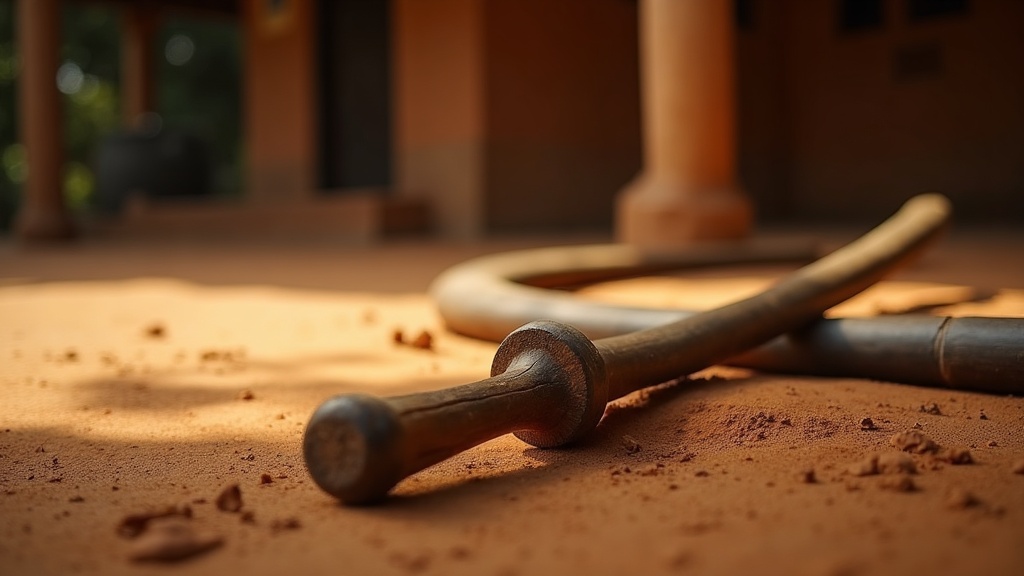
Stage two. Once the body is reliable, wooden weapons are introduced. The progression usually runs short stick (kettukari) → long staff (cheruvadi) → curved wooden weapon (otta, shaped to mimic the elephant's tusk and used for precise targeting of vital points). Some lineages add the gada (mace).
Kolthari is the first time the student moves with something in their hand. The body learns to maintain its own structure while managing an external object and an opponent's pressure. The vadivu postures from meithari are now held with a weapon in one hand. The chuvadu kicks become weapon combinations. Everything from stage one shows up again, carrying more.
Ankathari — metal weapons
Stage three. Sharp blades. The curriculum varies between lineages but typically includes the dagger (kadara), the sword and shield (val ennum paricha), the spear (kuntham), and the most distinctive weapon of the system — the urumi, a flexible whip-sword that is dangerous to the wielder before it is dangerous to anyone else.
By the time a student reaches ankathari, several years of training have built the precision required not to injure themselves. The urumi in particular requires years of preparation. There is a reason teachers do not let students near it early.
Verumkai — bare-hand combat and marma
Stage four. Only at the very end does the curriculum return to the empty hand — but the empty hand now carries everything that came before it. Verumkai includes locks (pidiyum othukkum), throws, strikes, and the targeted application of pressure to vital points on the body — marma prayogam.
This is the stage where the practice and the healing tradition meet. The same teacher who knows how to strike the marma points knows how to release them. In the southern lineages especially, marma study is woven into the verumkai material, and the boundary between fighter and healer dissolves.
For the cultural and historical claims sometimes made about this stage — including the famous "Bodhidharma taught Shaolin" line — see the honest answer to whether kalaripayattu is the mother of all martial arts.
How Long Each Stage Takes — Realistic Timelines
This is the question every search for kalaripayattu levels training how long is really asking. The honest answer is a table, not a single number, because the timeline depends on training frequency. Here is what each stage actually looks like in calendar time for an adult learner.
Meithari — six to eighteen months
The lower bound assumes four to five sessions per week of forty to sixty minutes, or daily residential training. The upper bound assumes two sessions per week of thirty to forty-five minutes, which is what most working adults realistically manage.
What "completing" meithari means: holding the basic vadivu (ashvavadivu, gajavadivu, simhavadivu, sarpavadivu, kukkutavadivu and the others your lineage works with) with structural integrity under fatigue, performing the full meipayattu sequences with breath synchronisation, and executing all four basic chuvadu cleanly without losing your line. The teacher decides when this is so. It is not a fixed test.
Adult beginners who train twice a week often stay in meithari for fifteen to twenty-four months before the teacher moves them on. This is not a failure of the student. The body simply needs more repetitions, and at two sessions a week those repetitions accumulate more slowly.
Kolthari — one to two years
Once the body is reliable, the first weapon. The short stick comes first, and most students take around six months to make it familiar. The long staff follows, then the otta. A four-session-per-week student typically clears the kolthari syllabus in twelve to eighteen months. A two-session-per-week student takes two to three years.
Kolthari is where many adult students choose to settle and stay for years rather than rush onward. The wooden weapons keep revealing new material long after the syllabus is "complete." The same form practised with the otta in year two of kolthari and year five of kolthari produces visibly different bodies.
Ankathari — two to five years (and often longer)
This is where the timeline opens out. Sharp blades require daily, supervised, in-person training with a teacher qualified in metal weapons — a combination that is rare outside India and impossible for most non-resident students.
For students who can train daily under a qualified ankathari teacher, the stage takes two to five years to cover the main weapons reliably. For part-time students, it takes far longer or never happens at all. There is no shame in this. The system does not require every student to reach ankathari any more than every musician needs to play concertos.
Verumkai and marma — lifelong refinement
The application stages are not a destination. Verumkai is a body of material that a student keeps practising for the rest of their life, with marma study running alongside it as a parallel discipline. Even gurukkal — teachers with twenty and thirty years of practice — describe verumkai as something they are still learning.
There is no calendar for verumkai. There is only continuing.
Why the "Twelve Years to Master" Figure Is Both True and Misleading
Almost every guide to kalaripayattu eventually says "it takes twelve years to master." The figure is real. It is also a calendar number cut loose from its original context, which is why it stops being useful when applied to modern adult learners.
The twelve-year figure comes from the traditional gurukula system — a residential training arrangement in which a child enters a kalari at age seven, lives in the teacher's household, and trains daily under their gurukkal. Twelve years of that produces a fully trained, formally graduated student around the age of nineteen. That student has done somewhere in the range of three to four thousand hours of training across the period.
A modern adult learner training two sessions per week of forty-five minutes covers about seventy-five hours of training per year. Four sessions per week brings that to roughly one hundred and fifty hours per year. To accumulate the gurukula-equivalent hour count of a traditional twelve-year student, a part-time adult learner needs twenty to forty years.
This is not a failure. It is a translation. The number twelve made sense as the answer to a question — "how long does a child apprenticed in residence take to reach gurukkal level?" — that nobody asking the question online today is actually asking. The question almost everyone is really asking is: how long until I can actually do this? And the answer to that question depends on what "this" means to the person asking.
Three useful sub-answers:
- Time to a body that knows the practice from the inside: six to twelve months at any honest training frequency. By the end of the first year of meithari, the body has reorganised.
- Time to confident handling of weapons: three to six years of consistent training, depending on frequency.
- Time to teach others: twelve years minimum under traditional rules, often longer for adult learners — and only with the explicit permission of your own gurukkal.
The twelve-year figure becomes useful again once it is unhooked from "mastery" — a word that does not really fit any contemplative practice — and replaced with "permission to teach." That is what the twelve years was always actually counting.
What the First Six Months Actually Look Like
The most-searched window of kalaripayattu training is also the worst-covered. Beginners want to know what the first six months will look like — not because they expect to master anything, but because they need to know whether the practice is worth committing to. Here is the honest arc.
Month 1 — confusion is the point
Sore hip flexors. Burning hamstrings. The vandanam (the salutation that opens and closes every session) still feels self-conscious. You can perform a recognisable version of the four basic chuvadu but your breath has not yet synchronised with the movement. You hold ashvavadivu (the horse posture) for fifteen seconds before your thighs give out. You finish each session sweating in a way that does not feel like cardio sweat — it feels deeper, more internal.
This is the standard month-one experience. Nothing has gone wrong. The body is meeting a movement vocabulary it has never been asked to use, and the discomfort is the meeting.
Month 2 — the patterns start to take
The basic kicks start to feel like a sequence rather than four isolated moves. Your hip range has measurably increased — you can see this in your daily life: putting on socks is easier, getting out of a car is easier, sitting on the floor is more comfortable. You hold ashvavadivu for forty-five seconds. The vandanam becomes automatic.
You probably notice something else in month two that is harder to name. You feel less in your head. The floor work and the breath patterns occupy the part of the mind that usually runs background commentary, and a quieter version of you appears in the gap. For more on this specific shift — what the practice does to your nervous system and your daily attention — see what body awareness actually changes through kalaripayattu.
Month 3 — the first vadivu becomes a place
This is the shift every teacher watches for. Up to month two, the postures are external — you arrange your body into a configuration. Around month three, the posture becomes internal — the configuration arranges itself and you feel its structure from the inside. The body stops being something you hold and starts being something you live in.
You have learned three to five vadivu and can transition between two of them. Your first short meipayattu sequence is taking shape. Your low stances are noticeably lower. You have probably had your first session where you came in tired or stressed and left clear-headed without thinking about it as a benefit — it just happened.
Month 4 to 6 — meithari starts revealing itself
Now the system begins to show its logic. You start to understand why the warm-up is the warm-up, why the vadivu come in the order they come in, why the chuvadu have a specific rhythm. The Malayalam vocabulary you absorbed in fragments starts forming a coherent map. You catch yourself moving through your day with better posture without trying.
By month six, two-session-per-week students typically have the full beginner syllabus in their body — eight to ten vadivu, all four basic chuvadu in reliable lines, and the first one or two meipayattu sequences. Four-session-per-week students are noticeably ahead and are starting to ask their teacher when they will begin stage two. The teacher's answer, almost always, is "not yet."
That "not yet" is correct. The body that has six months of meithari is not the body that needs to be handling a stick. The body that has eighteen months of meithari is. Patience here pays itself back across every later stage.
How Practice Frequency Changes Everything
The single biggest variable in any kalaripayattu timeline is how often you train. The same student at the same age with the same teacher at the same starting level will produce three very different timelines at three different frequencies. Here are the realistic numbers.
Two sessions per week
This is the realistic minimum for most working adults. At forty-five minutes per session, that is roughly seventy-five hours of training per year — about one and a half hours of practice per week, plus whatever short work you do at home.
What you get: steady, slow progress. The body adapts. You stay in meithari for fifteen to twenty-four months. You then move into kolthari and probably stay there for two to three years before any teacher considers ankathari. Over a decade of two-sessions-per-week training, you build a real practice — but you are unlikely to clear the full curriculum.
What you do not get: rapid progression, fluency with weapons, or the kind of body that residential students develop. Two sessions per week is enough to make kalaripayattu a serious lifelong practice. It is not enough to make you a fighter, and it does not need to be.
Four to five sessions per week
This is the level where the practice starts to compound on itself. Roughly one hundred and fifty hours per year. The body has enough exposure for the patterns to integrate and for fatigue to teach what fresh muscles cannot.
What you get: meithari in eight to twelve months. Kolthari in one to two years. By year three to five, depending on circumstances, you might be in the early years of ankathari — particularly if you can supplement weekly classes with retreats or intensives in India. The practice starts informing how you move outside the kalari.
This is the frequency at which kalaripayattu becomes a primary discipline in your life rather than a hobby alongside others. Most adult students who keep training at this level for five years end up reorganising the rest of their training around it. For practical guidance on how to fit four to five sessions per week into a working life — including what daily home practice adds and what it cannot — see how to practise kalaripayattu at home.
Residential or daily immersion
The traditional model. Daily training of one to three hours, often with a second session in the morning, under a resident gurukkal. This is the schedule the twelve-year-to-mastery figure was originally measuring.
What you get: meithari in three to six months. Kolthari inside the first eighteen months. Ankathari accessible from year two or three onward. The body changes at a rate that part-time students cannot match because the nervous system has nowhere else to go — it is in the practice all day.
For most non-Indian adults, residential immersion is not a full-time option but happens in concentrated blocks: a two-week retreat, a three-week intensive, a month in Kerala. These intensives are disproportionately valuable because they shift the body into a different rhythm than weekly classes can produce. One ten-day immersion can advance a student more than three months of two-session-per-week training. The Kalari University retreat in Tiruvannamalai is built around this principle.
What changes between frequencies
The interesting fact about training frequency is that the differences are not linear. A student who jumps from two sessions per week to four sessions per week does not just double their progress — they enter a different curve entirely. The body crosses an adaptation threshold around three to four sessions per week beyond which the practice starts changing the structure of the day rather than fitting into it.
This is why teachers consistently recommend that beginners commit to at least three sessions per week for the first three months, even if they drop back to two sessions afterwards. The initial period of higher frequency is what installs the practice into the body in the first place.
Starting as an Adult — Does the Timeline Still Apply?
Almost every published timeline for kalaripayattu — including the twelve-year figure — assumes a child starting at age seven. Adults starting in their thirties, forties or fifties read those timelines and wonder if they apply. The honest answer: the timelines need adjustment, but in less dramatic ways than most adults fear, and in some respects adults actually move faster.
The adjustments that matter:
Recovery time is longer. A child can train six days a week without injury. A forty-year-old who tries the same will be hurt within three months. The realistic ceiling for most adult beginners is four sessions per week with proper rest. This means the calendar runs slightly longer, but not catastrophically so.
Depth of low stances comes in slower. Children drop into a full gajavadivu in their first month. A forty-year-old beginner takes six months to a year to get the same depth, and that is fine. The teacher works with the depth you have, not the depth the curriculum diagram shows.
Joint preparation takes precedence. Adults need a longer, more careful warm-up than children. Cold hips and tight hamstrings do not respond to the same fast joint articulations that a child's body absorbs without thinking.
The adjustments that do not matter as much as people fear:
Memory and motor learning. Adults learn movement sequences as fast as or faster than children once their attention is focused. The myth that movement learning declines sharply with age is mostly a myth.
Body awareness. Adults actually have an advantage here. Children move with whatever attention is in the room. Adults can bring conscious focus to the felt sense of a movement — which is the actual content kalaripayattu is teaching. In the embodied dimensions of the practice, an attentive forty-year-old often progresses faster than a distracted twelve-year-old.
Long-term continuity. Adults who stay are far more likely than children to still be training in twenty years. Adult motivation is sturdier. Children practise because their parents bring them; adults practise because they have chosen to.
For a longer treatment of starting at different decades and what specifically changes with age, see starting kalaripayattu at any age.
Stages vs Embodiment — Why Time Alone Doesn't Make a Practitioner
A student who has spent two years in meithari, completed kolthari, and started ankathari has technically progressed through the stages. The technical progression and the felt progression are not the same thing, and one of the quiet truths of teaching this practice is that they sometimes diverge dramatically.
I have taught students who completed the meithari syllabus in fifteen months and whose bodies had genuinely absorbed it. I have taught other students who completed the same syllabus in the same time and whose bodies were performing the shapes from outside, technically correct, internally empty. Both passed the same teacher's eye on the same calendar. Only one had embodied the practice.
The difference is attention. Kalaripayattu is not primarily a syllabus of techniques. It is a method for training a specific quality of attention — outward, embodied, present — through structured movement. The technical syllabus is the vehicle. If a student moves through the syllabus chasing the next stage rather than meeting what is in front of them, the body completes the curriculum and the practice never lands.
Three signs that embodiment is keeping pace with technical progression:
- The first vadivu still teaches something. A student who can come back to ashvavadivu — the most basic posture from the first month of training — and still discover new structure in it after three years is embodying. A student who finds it boring is not.
- The kicks change in quality, not in speed. Year-three chuvadu and year-one chuvadu look superficially similar but feel different from the inside. The year-three kick has weight in it. The year-one kick is in the air.
- The practice carries into the day. An embodied student notices their gait, their posture in chairs, their reaction to stress shifting outside the kalari. The practice has gone into the body, not just into the calendar.
The implication for timeline: do not chase stage progression. Stay in stage one until you feel it from the inside. The calendar will sort itself out. A student who spends two years deeply in meithari moves into kolthari with a body that the rushed-through student will never have, and the gap only widens as the stages progress.
Northern and Southern Styles — Does the Timeline Change?
Two main regional styles of kalaripayattu survive: vadakkan kalari (the northern style, dominant in Malabar and northern Kerala) and thekkan kalari (the southern style, found in southern Kerala and adjacent regions of Tamil Nadu). The styles differ in emphasis, but the four-stage structure is shared. Timelines look broadly the same, with small variations in what each stage emphasises.
Vadakkan kalari is the style most travellers and tourism boards encounter — known for its flowing movement, low stances, the urumi, and elaborate weapon work. The meithari progression in vadakkan kalari is highly systematic and the postures are explicitly named after animals. Timeline shape: as described in the sections above.
Thekkan kalari has a stronger emphasis on verumkai and marma work, often introducing pressure-point study earlier in the curriculum than the northern style does. The technical syllabus through the four stages is the same but the relative time spent on the final stages can be longer. Timeline shape: meithari and kolthari similar to vadakkan kalari; ankathari sometimes shortened, verumkai expanded.
For most beginners outside India, the question of which style is largely moot — the teacher you have access to determines the style you learn. Both are complete systems. Both produce the same depth of practice at the end of a long training life. The timeline does not meaningfully change between them.
Common Misconceptions About Kalaripayattu Timelines
A few persistent assumptions deserve direct correction before they shape your expectations.
"You can learn kalaripayattu in a weekend workshop." No. A weekend workshop can introduce you to the practice, give you a felt sense of the salutation and the warm-up, and let you experience your first chuvadu. It is a doorway, not the room. Real progression requires repetition over months and years.
"YouTube videos can get me through meithari." Also no. The technical movements look simple from outside. Without a teacher correcting your breath, alignment, weight distribution and posture from the inside, you will groove errors that take far longer to undo than they took to acquire. Use video to study, never as the sole source of training.
"If I miss two weeks, I lose all my progress." No. The body holds the practice for much longer than a beginner thinks. A two-week break shows up as one or two stiff sessions, then resolves. A two-month break sets you back four to six weeks. A two-year break sets you back perhaps six months — but the foundations are still there to rebuild on.
"Online learning takes twice as long." Not necessarily. A well-structured online course with a real teacher and video correction can carry a beginner through meithari at approximately the same pace as a weekly in-person class. What online cannot do is replace the felt presence of training with a partner, which becomes essential at the end of meithari and through kolthari. For a fuller treatment, see the practical path through these stages.
"The traditional figure of twelve years is exaggerated for marketing." No — it is true within its original context. Twelve years was the realistic minimum for a child trained in residence to reach gurukkal status. It becomes misleading only when transplanted to part-time adult learners without adjustment.
What Adults Actually Should Aim For (A Practical Framing)
If the calendar of stages is one way to think about progression, here is another that more honestly matches what adult learners are actually building. Three milestones, decoupled from the formal stages, that most adult students can meaningfully aim for.
Milestone 1 — The foundation year
The first twelve months of consistent training. By the end of year one, the body has absorbed the meithari foundation and the practice has installed itself into daily life. You probably have not finished meithari technically, but you have done something more important: you have made kalaripayattu part of who you are.
For most adult beginners, this is the realistic first goal. Anything that happens after is built on this year.
Milestone 2 — The body that knows weapons
The point at which kolthari has been seriously studied and the body holds its structure under the weight of a stick or staff. Realistic timeframe: three to five years of consistent training. By this milestone, the practice has stopped being something you learn and started being something you carry.
Most adult students who reach this milestone keep training for life. They may or may not reach ankathari, but they have a complete practice already.
Milestone 3 — Teaching others
A milestone almost nobody who is not pursuing it consciously should aim for, but worth naming for context. Becoming a teacher in any traditional sense requires twelve to twenty years of continuous training, the formal permission of your gurukkal, and increasingly the recognition that you carry the lineage forward. For most adult learners, this is not the point. The practice is the point.
Sources & Further Reading
- Kalaripayattu — Wikipedia — encyclopedic overview including the four stages, regional styles and current practice
- Indian martial arts — Wikipedia — context for kalaripayattu within the broader landscape of Indian fighting traditions
- Kerala — Wikipedia — geography and cultural background of the region where the practice developed
- Kerala Tourism — Kalaripayattu — official Kerala government cultural overview, including initiation rituals and curriculum stages
- Marma adi — Wikipedia — background on the vital-point system that becomes central in the verumkai stage
- Gurukula — Wikipedia — the traditional residential teaching arrangement that the twelve-year mastery figure originally measured
- Sangam period — Wikipedia — historical context for the earliest references to martial training in southern India
- Kalaripayattu — Encyclopaedia Britannica — peer-reviewed encyclopedic entry on the practice and its history
- Martial arts of India — Encyclopaedia Britannica — encyclopedic entry on martial arts as a category, useful for placing kalaripayattu in comparison with other systems
- Vadakkan kalari — Wikipedia (Kalaripayattu, Northern style section) — overview of the regional style most commonly encountered by international students
- Urumi — Wikipedia — background on the flexible whip-sword introduced in the ankathari stage
- Nervous system — Cleveland Clinic — overview of the system that the early months of meithari quietly retrain
- Proprioception — Cleveland Clinic — clear medical explanation of the body-awareness sense the four stages develop
- Sangam literature — Encyclopaedia Britannica — context for the textual sources of early martial-arts references
- Kerala Folklore Akademi — institutional reference for traditional Kerala arts including kalaripayattu
- Delayed-onset muscle soreness — ACSM — sports-medicine explanation of the soreness adult beginners encounter in early meithari
Frequently Asked Questions About Kalaripayattu Levels and Training
How many stages are there in kalaripayattu?
Kalaripayattu has four progressive stages taught in fixed order: meithari (body conditioning), kolthari (wooden weapons), ankathari (metal weapons) and verumkai (bare-hand combat). You do not skip stages. Each one prepares the body for the next, and a student who jumps ahead arrives at the next stage with a body that cannot use it.
How long does it take to learn the first stage of kalaripayattu (meithari)?
Most adult beginners spend six to eighteen months in meithari. Two sessions a week will keep you there for at least a year. Four to five sessions a week shortens it to roughly eight to twelve months. Daily residential training compresses meithari further but is the exception, not the norm.
How long does kalaripayattu training take overall?
A serious adult student moving at two to four sessions per week takes ten to fifteen years to complete the full curriculum through to verumkai. The traditional figure of twelve years to become a gurukkal applies to children who began at age seven and trained daily under a master. For adults practising part-time, the calendar runs longer, and most never reach the final stages — which is fine, because the practice is not a race.
Can you become proficient in kalaripayattu in one year?
You can become competent in the meithari foundation in one year — the basic kicks, postures and movement sequences become reliable. You will not be a fighter, will not handle weapons, and will not have entered the application stages. But your body will know the practice from the inside, and that is the real one-year milestone.
How long does it take to become a kalaripayattu teacher (gurukkal)?
The traditional minimum is twelve years of continuous daily training, with permission granted by the gurukkal who taught you. The full path through all four stages plus the healing tradition (kalari chikitsa) often takes longer — fifteen to twenty years before a student is formally invited to teach. Becoming a gurukkal is not a certification you apply for; it is a recognition you receive.
Is it too late to start kalaripayattu as an adult?
No. Adults in their thirties, forties and fifties are common in modern kalaris, and adult beginners often progress faster through the felt aspects of the practice than children. The trade-off is that the body needs more recovery and the depth of low stances comes in slower. Patience and consistency outweigh age.
Do you have to learn the kalaripayattu stages in order?
Yes. The four-stage system is non-negotiable in traditional schools. The body must establish structure, breath and balance through meithari before it can hold a weapon under load. Anyone offering to teach you weapons before you have completed meithari is breaking the system the practice was built around.
How does training online change the kalaripayattu timeline?
Online training can carry a beginner through most of meithari at a normal pace if the course has a real teacher, structured progression and video correction. It cannot replace hands-on physical correction or partner work, which become essential from the end of meithari onwards. Most online students complete meithari online, then travel for in-person training at the kolthari stage.
What does it actually mean to complete a kalaripayattu stage?
Completion is judged by the teacher, not by a fixed exam. Meithari is considered established when the student can hold low stances with structural integrity, perform the full meipayattu sequences with breath, and execute all chuvadu cleanly under fatigue. The next stage is permitted when the body can carry the demands of the next stage, not when a calendar says so.
How long is kolthari (wooden weapons) training?
Kolthari typically takes one to two years for a student training four to five times per week. The first weapon — usually the short stick (kettukari) — takes around six months to become reliable. The longer weapons and the curved otta extend the stage. Adults who reach kolthari usually stay in it for a long time because the body keeps revealing more in the same weapons.
Do most adult students ever reach ankathari (metal weapons)?
In honest practice, no — and they do not need to. Most adult students stay within meithari and kolthari for their entire training life and get enormous benefit from doing so. Ankathari requires daily training under a teacher who is qualified in metal weapons, which is rare outside India and not necessary for the embodiment value of the practice.
What is the difference between learning the stages and embodying the practice?
Learning the stages is moving through the technical syllabus — kicks, postures, weapons, applications. Embodying the practice is feeling those movements from the inside, with breath, structure and presence. A student can technically know stage two and still not embody stage one. The calendar of stages is one timeline; embodiment runs on its own clock. For more on how this shows up across the practice, see kalaripayattu compared with yoga.
Conclusion — Start Where You Are, Not Where the Calendar Says
The most useful thing you can take from this article is permission to stop asking how long it takes. Ask instead what you want from the practice, then choose a frequency you can sustain, then show up. The calendar will sort itself out. Meithari will take what meithari takes. Kolthari, if you reach it, will take what kolthari takes. The students who progress most reliably are the ones who stop watching the calendar and start watching what their body learned this week.
If you are not yet sure whether the practice is for you — the lowest-stakes way to find out is to feel your first chuvadu, your first vadivu and your first vandanam in a guided session. The first lesson at Kalari University is free, with no equipment and no prior experience needed. It will not tell you whether you are ready for ankathari. It will tell you what stage one actually feels like, which is the only honest place to start measuring any timeline from. Start the free first lesson →
About the Author
Raphael Gorschlüter — Co-Founder & Head Teacher, Kalari University
Raphael has trained kalaripayattu for over twelve years, beginning his serious study under traditional teachers in Kerala and Tamil Nadu and continuing through annual immersive periods in India alongside teaching commitments in Europe. He is the co-founder of Kalari University, where he leads the international curriculum and works directly with adult beginners through every stage from foundational meithari into kolthari. He teaches publicly in Germany, Spain and India, and runs the annual Kalaripayattu retreat at the foot of Arunachala in Tiruvannamalai, Tamil Nadu.
His approach is grounded in a single conviction: that the practice teaches by being met, not by being copied — and that the calendar of stages matters far less than the quality of attention a student brings to each session. The realistic timelines in this guide come from watching several hundred adult beginners actually move through these stages over the past decade.
