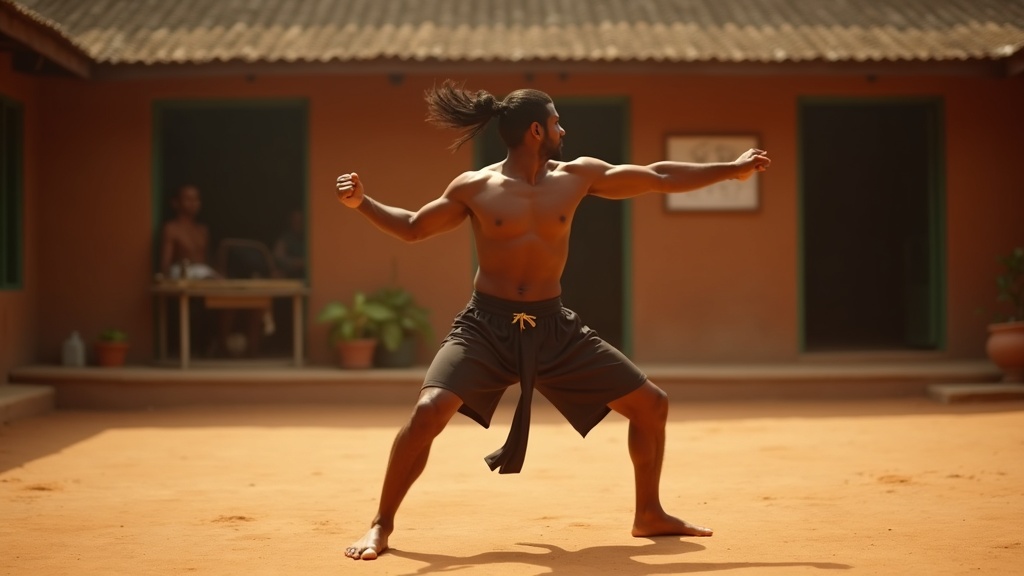
How to Learn Kalaripayattu: A Beginner's Honest Guide
How to Learn Kalaripayattu: A Beginner's Honest Guide
Last updated: 27 May 2026 · Reviewed by Raphael Gorschlüter, Co-Founder & Head Teacher, Kalari University
Most guides on how to learn kalaripayattu either tell you to fly to Kerala or hand you a YouTube playlist. Neither is the real answer for an adult beginner. The honest path sits between those two extremes — and it has a shape, a tempo and a set of decisions you can actually make this week.
I have spent twelve years on the kalari floor as a student and now as a teacher, and I have watched several hundred adults walk in on their first day. The pattern is so consistent it is almost comforting. This guide walks you through what those first thirty, sixty and ninety days actually look like, what your body will feel, what video training can and cannot give you, and how to choose a teacher you can trust.
By the end you will know how to start this week, what to look for, and what to ignore.
Kalaripayattu is a traditional martial art from Kerala, India, with roots reaching back over two thousand years and a curriculum structured in four progressive stages. To learn kalaripayattu, an adult beginner starts with
meithari— body conditioning through low stances, animal postures and floor sequences — and adds weapons only after the body is prepared. The practice can be learned anywhere with a real teacher and consistent practice; you do not have to live in India, and you do not have to be young, flexible, or strong to begin.
Key Takeaways
- The honest answer to how to learn kalaripayattu is a hybrid path: daily home practice for the body, plus a real teacher (live online, periodic workshop, or in person) for corrections you cannot see in yourself.
- Every adult beginner starts in
meithari, the first of the four stages of kalaripayattu. The first thirty days are kicks, vadivu postures, and breath — no weapons, no partner work. - Three sessions of twenty to forty minutes per week is the realistic minimum to feel real change. Two a week maintains. One a week barely registers.
- Online kalaripayattu classes are now a legitimate starting point for anyone outside Kerala. They cannot replace hands-on correction, but they can give you a real teacher's voice and daily structure that no local gym can match.
- Adult learners often progress faster in body awareness than children do, because they listen to the body more carefully — Kalari rewards attention, not youth.
- The decision is not "online versus in-person." It is "how do I get both, in the proportions I can sustain."
What It Means to Learn Kalaripayattu
To learn kalaripayattu is to learn a body practice before it is a martial one. The word itself tells you that. Kalari is the training space — traditionally a sunken clay floor oriented to the cardinal directions. Payattu is the practice, the exercise, the workout. The art is named after its training ground, which is the first quiet hint about what really happens here: the floor, the room, the relationship between body and ground does the teaching.
That matters for a beginner because it sets the right expectation. You are not signing up for a sequence of techniques to memorise. You are signing up for a relationship — with the floor, with low stances, with your own breath, eventually with a teacher who is called gurukkal in the tradition.
Kalaripayattu is widely cited as one of the oldest continuously practised martial arts in the world, with roots in the Sangam-period south of India. Kerala Tourism's official cultural page describes it as a system that integrates combat, fitness and healing — the same teacher who learns to strike also learns the body well enough to repair it. For a beginner, none of that healing or combat material appears in the first months. It exists, it is part of the lineage, and it will be relevant later. Right now, what is relevant is the body.
The first realistic question
Before you book a class or buy a course, answer one question honestly: what do you actually want from this practice?
There are three common answers, and each shapes the path:
- A way to feel grounded in your own body — you already train (yoga, gym, martial arts) and you can do the movements but you do not feel them. Kalaripayattu's slow, low, floor-oriented foundation is unusually good at this. (This is the body-awareness benefit the practice is best known for among adults who already train.)
- A serious martial art with depth and history — you want a real lineage, weapons eventually, a long road. Kalaripayattu absolutely delivers this, but it takes years and a teacher.
- Cultural reconnection — you have Indian roots or a deep relationship to the tradition, and Kalari is the door you have wanted to open for a long time. The early body work is the same; the meaning is different.
You do not have to pick one. But knowing which answer is closest to yours will save you months. Someone who wants depth and weapons should not start with a generic studio class. Someone who just wants to land in their body does not need to plan a year in Kerala.
How to Start Learning Kalaripayattu This Week
Starting does not require booking a trip. It requires three small decisions made in this order.
Decide your weekly minimum. Pick a number you can actually keep. Three sessions of thirty minutes a week is the sweet spot for the first three months. Two is the floor. Five is too much for most adults in their first month — the calves, hips and adductors need recovery time.
Decide your format. Three real options exist:
- Online course with a structured curriculum — best for daily practice volume, weakest for correction. Look for one that has live group sessions, not just video.
- A local school with a qualified gurukkal — best for correction, weakest for daily volume if the school only meets twice a week. Rare outside Kerala and a handful of European cities.
- Hybrid — daily online practice plus periodic in-person workshops or a retreat. For most adult beginners this is the realistic answer.
Decide your first lesson. Do not optimise this. Pick something low-stakes, do it this week, and notice how your body and your attention respond. A free first lesson, a single drop-in class at a local school, or the introduction module of an online course — anything that lets you step onto the floor and feel something.
The reason this third step matters is simple. Until you have done one real session, every decision about which course or school is theoretical. After one session, you know more about what suits you than ten reviews can tell you.
The Four Stages of Kalaripayattu Training
Knowing the stages is not a beginner concern — you will spend a long time in the first one — but the structure tells you where the road goes, and that is useful.
Stage 1: Meithari — body conditioning
Meithari is the body-only foundation. Kicks (chuvadu or kaal), animal postures (vadivu), low stances, floor sequences, breath linked to movement. No weapons. No partner contact. The body is the only equipment.
Every beginner starts here. Most adults spend six to eighteen months in meithari before moving on, depending on training frequency and prior body experience. There is no skipping this stage. A student who tries to rush through meithari into weapons work injures themselves; a student who respects meithari builds a body the later stages can be poured into.
If you take only one thing from this guide, take this: the foundation is the practice. The later stages do not replace meithari. They sit on top of it. Senior students at any traditional kalari continue to do meithari sequences every day for the rest of their training life.
Stage 2: Kolthari — wooden weapons
Kolthari introduces wooden weapons — long staff, short stick, the curved otta (a piece of wood shaped roughly like an elephant tusk), and the muchan (a small wooden cudgel). The student is no longer alone on the floor; partner work begins. Meithari continues underneath everything.
Kolthari typically begins after one to two years of consistent meithari practice. The body needs to be ready for the new demands — extended reach, rotational movement, partner-induced unpredictability.
Stage 3: Angathari — metal weapons
Angathari brings metal weapons — sword and shield, dagger, the famous urumi (the flexible metal whip-sword which is the image most associated with kalari in popular culture). The risk increases; so does the demand on precision, attention and breath. Many serious students never enter angathari, and that is not a failure — it is a clear decision.
Stage 4: Verumkai — bare-hand combat and marma
Verumkai is bare-hand combat, and crucially, it is also where the study of marma — the vital points of the body — enters in earnest. At this stage the practitioner studies the body deeply enough to both strike and treat. The same hand that knows the marma point knows how to repair the damage that would come from striking it.
Verumkai is the slowest, most internal stage. It is also where the connection between kalaripayattu and Ayurveda becomes most explicit through the related healing tradition called kalari chikitsa.
For a beginner reading this in week one: none of stage two, three or four is your concern right now. They exist; they are the road. You are in meithari, and meithari is the whole world for now.
Your First 30 Days — What Practice Actually Looks Like
This is the section every other guide skips. Here is what the first month of practice will feel like in your body if you actually train three to five times a week.
Week 1: introduction and unfamiliar geometry
Your first sessions will feel awkward. The stances are unusually low — the ashwa vadivu (horse stance) sits the pelvis far closer to the floor than most adults are accustomed to. The kicks travel through ranges of motion you have not visited recently. Your hip flexors will protest. Your calves will tighten by day three.
This is normal. Soreness in the adductors, the calves and the front of the hips is the expected price of week one and is not injury. The body is registering that something new is happening and is making the cellular adjustments to support it.
What you are working on in week one: - The kalari salutation (vandanam) — how you enter the practice - Two or three of the basic kicks (forward kick, side kick, low kick), performed slowly in straight lines - The basic ashwa vadivu (horse stance) and possibly gaja vadivu (elephant stance) - A simple warm-up sequence
You should not be sweating dramatically. You should be paying attention.
Week 2: footwork enters
In week two the practice acquires footwork — chuvadu sequences that link the postures together. Now you are moving from one vadivu to another, with kicks weaving through, and a short floor pattern beginning to form.
The first body shift usually arrives somewhere in week two. Most students describe it the same way: "I noticed that my feet are on the ground." That sounds small. It is not. For an adult who lives in shoes and chairs and screens, the conscious sensation of the floor under the feet is a meaningful change. This is the beginning of what could be called proprioception — your body's awareness of its own position in space — being trained as a felt experience rather than a concept.
Week 3: breath linked to movement
In week three, if the teacher is good, breath enters the work formally. Each movement gets a breath assigned to it — inhale on the rise, exhale on the descent, exhale through the strike. This is not just stylistic. The breath organises the nervous system around the movement and turns what felt like exercise in week one into something more like a small ritual by week three.
By the end of week three, the basic floor pattern (a short sequence of kicks, stances and footwork) should be familiar enough that your conscious mind is no longer reading it out loud. The body starts to do it. This is the first taste of what makes kalaripayattu addictive for adults — the moment when thinking drops away and the practice runs itself.
Week 4: the first sequence
Week four is usually when the first complete sequence comes together. It might be one of the foundational meithari sequences, or a short composition the teacher has assembled for beginners. Either way, you now have a single thing — call it a short choreography — that you can do from beginning to end.
This is the moment many students realise they have actually started the practice. Until you can do one full thing without stopping, kalaripayattu can feel like a pile of disconnected exercises. Once you have one full sequence, the practice has a shape, and you have entered it.
Days 30 to 60 — Depth, Not Speed
The second month is where the real practice begins. Week one to four was meeting the practice. Month two is staying in it long enough for it to start meeting you back.
The temptation in month two is to ask for more material — more kicks, more postures, the next sequence. The honest teacher slows you down here. The right move in days 30 to 60 is the opposite of new material: it is more depth in the same material.
You take the kicks you learned in week one and start asking different questions of them. Where exactly is your weight at the top of the kick? Are your shoulders still soft? Is your breath leading the movement or following it? You take the ashwa vadivu and start spending real time in it — minutes, not seconds — until the geometry of the stance reorganises your hips.
This is where most adult beginners either quit or commit. The people who want fast progress get bored. The people who want depth begin to notice that the practice has more to give than the surface form suggested.
The body changes in this period are not dramatic. They are quiet. Your hips feel different. Your ankles work differently. You stand differently when you are not training. People around you may notice before you do. That is the practice settling into the body.
Days 60 to 90 — A First Sequence and the First Honest Self-Assessment
Months three is when most teachers introduce a more demanding sequence — perhaps the first of the formal meithari sequences, or partner-mirroring work with no contact. The body now has enough conditioning to handle longer, faster, more sustained practice.
This is also the right moment for an honest self-assessment. Ask yourself three questions:
- Am I more grounded in daily life? Most students answer yes. Not always dramatically — but yes.
- Has my breath changed? The depth and steadiness of the breath usually shifts noticeably in this window, both during practice and outside it.
- Do I want to keep going? This is the most important question. If the answer is yes, you are no longer a beginner experimenting. You are a student. The shift from "trying it" to "doing it" usually happens somewhere between day 60 and day 90.
At ninety days of consistent practice, you are still firmly in stage one, meithari. You have not "learned" kalaripayattu in the sense of having mastered anything. But you have started, and starting properly is most of the battle. The next year is more of the same — depth, repetition, slow consolidation — with new material added carefully on top.
Online vs In-Person — The Honest Trade-Off
The single most common question I get from people who want to learn kalaripayattu and live outside Kerala is: can I really learn this online?
The honest answer is yes and no, and the trade-off is worth understanding clearly.
What you can learn from video
Video — meaning a well-structured online course with a real teacher, not a YouTube binge — can teach you:
- The form of the postures, kicks and sequences
- The order of the curriculum
- The discipline of daily practice
- The teacher's voice, language and pedagogical approach
- The sense of being part of a community, especially if the course has live sessions
This is more than nothing. For a beginner who lives in a town with no qualified kalari teacher, this is the difference between learning the practice and not learning it. The discipline of daily practice in particular is the single biggest factor in actual progress — and online is unusually good for daily practice because it is always available.
What you cannot learn from video
Video cannot give you:
- Hands-on correction of alignment you cannot see in yourself (the position of your shoulder blade as you reach, the subtle rotation of your standing leg as you kick, the line of your spine when you think you are upright)
- Partner work — the unpredictability of another body moving toward and around you
- The energetic field of a kalari with several students training together at once
- Subtle weapon transmission in the later stages
The cleanest rule I know: video is excellent for what you can see, and limited for what you cannot.
The realistic hybrid path
For most adult beginners outside India, the realistic path is hybrid:
- Daily practice via a structured online curriculum — three to five sessions a week of twenty to forty minutes, building the body and the patterns.
- Periodic real-teacher contact — live online sessions where you train on camera and a teacher gives you direct feedback (every two weeks is a reasonable cadence); workshops if a teacher passes through your city; a retreat once a year if you can.
- An honest internal contract: you will not pretend that watching videos alone is the same as having a teacher, and you will arrange real teacher contact whenever possible.
This is the path that actually works, and it is the path most serious adult students of kalari outside India are on, whether they admit it or not.
For people who want the full in-person immersion — and there is a real argument for one extended residential dose at the start of the journey — a structured residential program like a 15-day kalaripayattu retreat at the foot of Arunachala compresses what would be months of online practice into two weeks of training under direct teacher correction.
How to Choose a Teacher or School
Whether you train online or in person, the teacher matters more than any other variable. A bad curriculum with a good teacher works. A perfect curriculum with no real teacher does not.
Six things to look for:
Lineage. A real kalari teacher can name their gurukkal and that gurukkal's gurukkal. The chain matters — not as snobbery, but because it tells you the practice is being transmitted, not invented. Ask. The answer should be specific.
Years of practice and years of teaching. These are different. Twelve years of practice is meaningful. Twelve years of practice plus seven years of teaching adult beginners is what you actually want. Teaching is a separate skill from doing.
Willingness to correct posture. A good teacher corrects more than they praise, especially in the first months. If you finish six sessions and nobody has corrected your stance, your kick, or your shoulder position, the teacher is not paying attention or is afraid to teach.
Class size and structure. In person: no more than ten to twelve students per teacher for real correction. Online: live sessions should be small enough (under twenty) that the teacher sees individuals on camera, not a wall of thumbnails.
Honesty about what you cannot get from them. A teacher who tells you "this is what we can give you online; for this other thing, come in person or to a workshop" is a teacher who respects the practice. A teacher who promises you the whole tradition through a screen is selling, not teaching.
Cultural respect and clarity. Kalaripayattu comes from a specific culture, lineage, and religious context. The teacher does not need to be Indian — many real teachers outside India are not — but they should treat the tradition with the seriousness it deserves and be transparent about what they have studied and where.
Red flags: dramatic marketing language ("become a deadly weapon"), uniforms that look more like karate, no mention of meithari at all, weapons in the first month, no live correction even at the highest tier, and an unwillingness to name their teacher.
What to Wear, Where to Train, What You Need
The practical layer is short.
Clothing. Loose long shorts, light cotton trousers, or yoga pants. Anything that allows full hip and leg range of motion without binding at the knee. A t-shirt that does not ride up. Some traditional schools use a wraparound cotton garment called a kacha for advanced students; you do not need one to begin.
Footwear. None. Kalaripayattu is trained barefoot, indoors and out, on every surface from clay to wood to mat. Your feet will adapt. They are meant to.
Space. Roughly two by two metres of clear floor is enough for the first months. Wood, smooth tile, a yoga mat, or a clay floor are all fine. Carpet is workable but slows footwork. Outdoor practice on grass or smooth stone is excellent in good weather.
Equipment. None for the first six to twelve months. Weapons enter in stage two, not on day one. Any program that asks you to buy a stick or sword in week one is selling, not teaching.
Time of day. Traditionally before sunrise. Realistically, whenever you can be consistent. Early morning is unmatched for many practitioners, but a regular practice in the evening beats an idealised practice you never do at dawn.
Common Mistakes Beginners Make
The errors I watch adult beginners make are not random. They cluster into five patterns. Knowing them in advance saves months.
Rushing past meithari. This is the classic. Three weeks in, the student wants to know when they get to do the cool things — the weapons, the urumi, the fast sequences. The honest answer is later, and the right answer to that disappointment is to fall in love with the foundation. The students who love meithari are the ones still training in five years.
Comparing your speed to advanced students. Watching an advanced kalari practitioner on Instagram and asking "why am I not doing that yet" is the fastest way to leave the practice. They started somewhere too. The path goes through where you are, not around it.
Skipping the warm-up. The early body work is not warm-up theatre. It is the practice, doing the conditioning that allows the rest of the practice to be safe. Skipping it means accumulating small wear in the hips, calves and lower back that will eventually become injury.
Training without rest. Five sessions a week is plenty for an adult beginner. Daily is too much in the first months. The body needs the days off to consolidate the changes. Resist the urge to grind. Consistency beats intensity in kalari, and recovery is part of the practice.
Trying to learn alone with no real teacher ever. Video alone is not learning. Use video for daily practice; use a real teacher — live, periodic, in person, whatever you can arrange — for correction. The student who refuses any teacher contact at all will eventually plateau and quietly stop.
What the Practice Actually Does to an Adult Body
This is the question that does not often get answered honestly in marketing material. What changes, concretely, when an adult learns kalaripayattu and stays with it for six months?
The most consistent shifts I see, across hundreds of adults, are these:
- Hip range opens. The low stances do what stretching alone cannot — they teach the hip to organise itself under load.
- Ankle and foot strength returns. A lifetime of shoes weakens the small stabilising muscles of the foot. Barefoot floor work rebuilds them. People often notice their balance improves outside of practice.
- Breath deepens. Not because anyone instructed you to "breathe deeper" but because the practice asks the breath to organise the movement, and the breath adapts.
- A felt sense of the floor. Sounds abstract. It is not. Most students describe it as a quiet awareness that the ground is there, supporting them — even when they are walking down a street, not training.
- Less reactivity. This is the subtlest and most consistent change. The nervous system, trained by sustained low-stance breath work, settles. Many adults describe being less easily knocked off-centre by daily life.
This is also why people who already train in other disciplines often arrive at kalari frustrated. They have spent years building strength, mobility, flexibility — and still feel disconnected from their own body. Kalaripayattu builds the connection, more reliably than any other movement practice I have taught. (If this resonates, the deeper essay on what body awareness actually changes in you traces this shift in more detail, and the wider somatic movement practice category gives context for where kalari sits among related approaches.)
Sources & Further Reading
For readers who want to verify, deepen, or cross-check what is here.
- Kalaripayattu — Wikipedia — solid summary of history, stages, regional styles, and weapons.
- Indian martial arts — Wikipedia — broader context for where kalari sits in the family of South Asian martial traditions.
- Kerala — Wikipedia — geographic and cultural context for the practice's home region.
- Kerala Tourism — official Kalaripayattu page — government-published cultural overview, useful for the tradition's place in Kerala identity.
- Martial art — Britannica — neutral encyclopedic framing of the broader martial arts category.
- Marma — Wikipedia — for the vital-points system encountered in stage four (verumkai).
- Ayurveda — Wikipedia — the related healing tradition that kalari chikitsa draws on.
- Proprioception — Cleveland Clinic — what the felt sense of body position actually is, in clinical terms.
- Interoception — Cleveland Clinic — the inward-facing sense that pairs with proprioception in practices like kalari.
- Sangam period — Wikipedia — the historical period kalaripayattu's roots are usually traced to.
Frequently Asked Questions
How long does it take to learn kalaripayattu?
Basic familiarity with the first stage, meithari, takes most adult beginners three to six months of three sessions per week. Solid competence in meithari — meaning the kicks and vadivu postures move on their own without thinking — takes one to three years. The whole curriculum across all four stages is a multi-year practice. There is no shortcut, and there does not need to be one.
Can I learn kalaripayattu at home?
Yes for the foundation — kicks, vadivu postures, the basic warm-up sequence — with a clear video curriculum and consistency. No for the corrections you cannot see in yourself, and no for partner work. Home practice and teacher contact are not competitors. They are two halves of the same path, and the students who do best combine them.
Can I learn kalaripayattu online?
Yes. Online cannot replicate hands-on correction or partner contact, but it can give structured progression, a real teacher's voice, and daily access to material that no school within driving distance would offer. For most adult beginners outside India, online is the realistic starting point — often paired with a periodic in-person workshop or retreat.
Can I learn kalaripayattu without a teacher?
You can begin without a teacher in the room — many people do — but learning the practice with no teacher at all is unwise. Subtle alignment errors compound over years and become injuries. Use video curricula to practise daily; use periodic teacher contact (live online sessions, workshops, or a retreat) to catch what you cannot see in yourself.
What is the best age to start kalaripayattu?
Traditional schools in Kerala accept children from around age seven. Adults can begin at any age — students starting in their thirties, forties and fifties are common. The practice rewards body awareness and consistency, not raw youth. If you can walk and squat with reasonable comfort, you can start.
Can I learn kalaripayattu after 30 or 40?
Yes, and many of the most attentive students start exactly in that decade. The early meithari work is precisely what an adult body needs — slow hip opening, ankle and calf conditioning, breath linked to movement. Adults often progress faster in the felt sense of the movement than children do, because they listen to the body more carefully.
Is kalaripayattu hard for beginners?
It is demanding but not technically difficult to begin. The early phase asks for repetition, not athleticism. The hard part is patience — beginners spend months on the same kicks and postures before adding anything new. If you can show up three times a week and not chase complexity, you can learn it.
Do I need a teacher (gurukkal) to learn kalaripayattu?
Yes, eventually and ideally from the start. The teacher in the tradition is called gurukkal, and the relationship is not optional decoration — it is how alignment is corrected and how the practice is transmitted. The form that contact takes can vary: live online with a real teacher counts; a periodic workshop or retreat counts; a fully unsupervised video binge does not.
What do I need to start — equipment, clothing, space?
For the first months: bare feet, loose clothing that allows full hip and leg range, and roughly two by two metres of floor. Wood, mat, or smooth tile is fine. No weapons. No props. The first stage is body-only. Equipment enters in stage two, not on day one.
What is the first stage of kalaripayattu training, meithari?
Meithari (also spelled meypayattu) is the first of the four stages of kalaripayattu. It is the body-conditioning phase — kicks, vadivu postures, low stances, breath, and floor sequences — without weapons or partner combat. Every beginner spends six to eighteen months in meithari before moving to stage two, and senior students continue meithari sequences for the rest of their training life.
How is kalaripayattu different from yoga?
Yoga primarily holds shape and turns attention inward. Kalaripayattu primarily moves through space and extends attention outward into the room, the floor and a real or imagined opponent. They share a deep relationship with breath and alignment but train different qualities. Many practitioners do both, and the two complement each other well.
Do I have to travel to India to learn kalaripayattu?
No. You can build a real foundation with a structured online curriculum, periodic live-online corrections, and a teacher you can reach. A trip to India is wonderful and clarifying for those who can do it, but it is not a prerequisite. The practice itself can come to you long before you go to it.
Where to Start Today
If you have read this far, you already know more about how to learn kalaripayattu than most people who walk into their first class. The remaining question is small: what is the lowest-friction way to find out whether this practice is for you?
The free first lesson is built for exactly that. It walks you through one foundational kalaripayattu movement, in your own time, on your own floor — no payment, no commitment, no equipment. By the end of the lesson you will know two things you cannot know from reading: what it feels like in your body, and whether you want a second lesson. The first lesson is free — no payment, no commitment. Create your account and start today →
If you want a deeper map of what the first month looks like from inside the practice, the companion guide on what your first month of training actually feels like walks through the same period with more detail on the first-class experience itself. And if you want the immersive route — a single concentrated dose of teacher contact and daily practice — the August retreat in Tiruvannamalai opens applications now.
Whatever path you choose, choose one. The practice can only meet you on the floor.
About the Author
Raphael Gorschlüter — Co-Founder and Head Teacher, Kalari University
Raphael has practised kalaripayattu for over twelve years and teaches internationally — in Germany, Spain and India. He is the co-founder of Kalari University and one of Europe's most experienced kalari teachers, known for developing students' ability to feel their own movement rather than copy outer form. His teaching draws on years of training across Kerala and Tamil Nadu under traditional gurukkals, and his focus with adult learners is the slow, foundational work that makes the rest of the practice possible.
