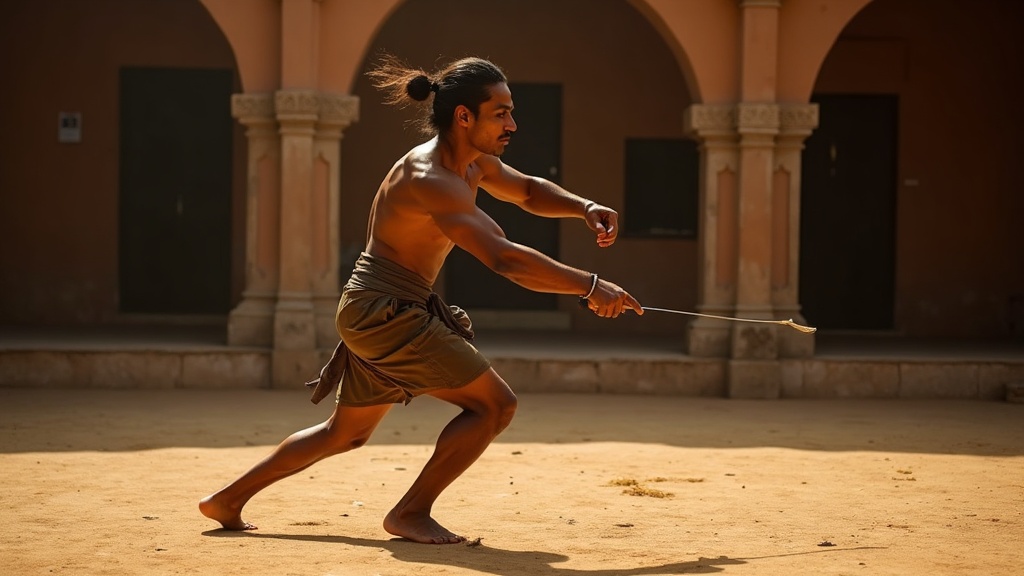
Starting Kalaripayattu at 30, 40 or 50: Honest Guide
Starting Kalaripayattu at 30, 40 or 50: Honest Guide
Last updated: 27 May 2026 · Reviewed by Raphael Gorschlüter, Co-Founder & Head Teacher, Kalari University
The real question behind "can I start kalaripayattu at 30, 40 or 50" is rarely the literal one. It is the quiet one underneath: am I too late?
The honest answer is no. Adults regularly start this practice in their thirties, forties and fifties, and a significant number begin in their sixties and seventies. What changes between decades is not whether you can start, but what to realistically expect, how to train, and what you will gain that a younger beginner often won't.
I have spent twelve years on the kalari floor as a student and now as a teacher, and roughly four out of five adults I have taught walked in for the first time after their thirtieth birthday. The pattern of how their first six months unfold is consistent enough that I can describe it by decade.
This guide does that. It treats 30, 40 and 50 as three distinct starting points, names what each decade brings (and asks for), shows you what a first lesson actually looks like, and ends with the single most important thing for an adult beginner: how to start without injuring yourself.
Kalaripayattu is a traditional martial art from Kerala, India, with roots reaching back over two thousand years and a curriculum structured in four progressive stages. The practice begins with
meithari— body conditioning through low stances, slow kicks, animal postures and floor sequences — and adds weapons only after the body is prepared. Adults can start at any age; kalaripayattu rewards body awareness and consistency, not raw youth, which is why thirty-, forty- and fifty-year-old beginners often progress faster in the felt sense of movement than children do.
Key Takeaways
- Adults regularly start kalaripayattu at 30, 40 and 50; the traditional starting age of seven is a cultural convention, not a physiological cut-off.
- The most-cited concern among new adult students is flexibility, but body awareness is the bigger long-term gain — and the one kalaripayattu builds best.
- A realistic adult schedule is two to three sessions of forty-five to sixty minutes per week, with patient progression and proper recovery between sessions.
- Adults at 30 to 50 often progress faster than children in the felt sense of the movement because they listen to the body more carefully and bring trained attention.
- The first weeks are body-only — no weapons, no partner work — starting with foundational meipayattu body sequences and slow kicks.
- The lowest-friction way to find out whether kalari is for you is one foundational lesson, done at home, with no equipment.
Is There an Age Limit for Kalaripayattu
Officially, no. Traditionally, sort of — but not in the way most people assume.
The conventional starting age in a Kerala gurukula is around seven, and there are practical reasons for it. Children's bodies adapt quickly, they are unburdened by adult posture habits, and the master-student relationship has time to form across a decade or more. None of that means the practice was designed only for children. It means the tradition formed around a society where young children entered training because the family decided to begin them there.
Adult beginners are now common everywhere kalaripayattu is taught — in Kerala, across India, in Europe and increasingly online. Kerala Tourism's official kalaripayattu page describes a tradition that integrates combat, fitness and healing across the whole adult lifespan; it is not a children's pursuit that adults are intruding on.
The clearest example is the senior teacher Meenakshiamma, who was still teaching kalaripayattu in her seventies and demonstrated the urumi (the flexible sword) at 76. She is unusual, but not freakishly so. Across the south Indian schools and increasingly outside India, students continue training into their fifties, sixties and seventies. The age limit is the body's individual condition, not the calendar.
The relevant question for any adult considering this is therefore not am I too old? — but what should I realistically expect at my age, and how do I start safely?
The rest of this guide answers exactly that. Below, the same path is broken down by decade, because the body at 30 is not the body at 40, and neither is the body at 50.
Starting Kalaripayattu at 30
Thirty is, in my teaching experience, the single most common age at which adults walk into kalaripayattu for the first time. Two reasons.
First, the body at 30 is still strikingly adaptable. Hip mobility, calf elasticity, neuromuscular learning — the motor-learning systems that allow you to acquire a new movement pattern — are all still functioning close to their peak. You may not be as fast as you were at 20, but you can still pick up a new physical skill remarkably quickly when you give it the time.
Second, 30 is when many people start to notice that the training they have been doing isn't quite landing. They lift, they run, they do yoga — and they still don't feel quite in their body. Kalaripayattu's slow, low, foundation work directly addresses that, which is why adults who already train (gym, BJJ, yoga, climbing) often find their way to it around now.
What to expect physically in your first month at 30
The first month at 30 is mostly muscular surprise. The low ashwa vadivu (horse stance) and the slow kicks travel through ranges your body has not asked for in years. The calves, adductors and hip flexors are the loudest complainers. None of it is injury — it is the cellular adjustment of muscle and connective tissue to a new load.
By week three you will usually notice two things: your balance is quietly better in daily life, and the basic floor sequence is starting to run itself, with conscious thinking dropping out of the movement.
Realistic progression from 30 to intermediate
Most adult beginners starting at 30 with two or three sessions per week reach a recognisable foundation in meithari within six to twelve months. By the eighteen-month mark, they are usually doing introductory weapon work in kolthari if their school progresses that way, or deepening meithari further if it doesn't.
There is no shortcut, and there does not need to be one. (For a detailed map of the four stages and how long each one actually takes, the dedicated guide to the four kalaripayattu training stages and their timelines covers the full curriculum.)
What your 30-year-old body has that older beginners don't
Speed of adaptation. The first three months at 30 produce more visible body change than the first three months at 50. The hips open faster. The squat depth comes back faster. The cardiovascular load of a forty-minute session is absorbed faster.
That is the gift of starting at 30, and it is real. But it is not the gift that matters most in this practice. The gift that matters most — body awareness — is available to you at any age, and adults who arrive later often acquire it more attentively.
Starting Kalaripayattu at 40
Forty is where the body's bargain begins to shift. Not dramatically. Quietly. Recovery takes a day or two longer. The first ten minutes of a session matter more than the last ten. Old training injuries make themselves known earlier in a movement than they used to. The body still adapts — beautifully — but it asks to be listened to more carefully.
This is also, for many adults, exactly the age at which the question "what is this all for?" gets louder. Forty is the decade where a lot of men and women stop being satisfied with training that only adds to a fitness inventory and start looking for training that changes how they inhabit their body. Kalaripayattu is unusually well-positioned to answer that question, which is one reason its adult intake increasingly skews to this age band.
The flexibility question at 40
Flexibility is the single most-raised concern from forty-year-old beginners, and it is largely a misframing.
You do not need flexibility before you start. The practice builds it. The low stances, slow kicks and floor sequences of meithari are themselves a long-form mobility programme — they are how kalari practitioners maintained hip and ankle range across decades long before "mobility" became a fitness category.
What is true is that you should not skip the warm-up at 40 the way you might have at 25. The foundational warm-up sequence in kalaripayattu (often called the basic meipayattu) takes ten to fifteen minutes and is not optional. It is the practice within the practice.
Why already-trained 40-year-olds often plateau before kalari
If you already train at 40 — yoga, gym, BJJ, running, climbing — you have probably hit a quiet ceiling. You have the strength and the mobility, but the body still feels disconnected from your attention. Movement happens; it just doesn't fully land.
This is the experience kalaripayattu addresses more directly than any other practice I know. The foundational work is designed to rebuild the connection between attention and body, not to add another physical capacity on top of the ones you already have. (For a deeper essay on what that shift actually looks like, the body awareness movement practice pillar traces the same change across multiple movement traditions, and the focused guide to what kalaripayattu specifically changes in adults who already train walks through the day-by-day shifts in the first months.)
Recovery and weekly cadence at 40
For a 40-year-old adult beginner, the realistic weekly cadence is:
- Two to three sessions per week of forty-five to sixty minutes
- At least one full rest day between sessions in the first three months
- Honest warm-up every session — not optional, ever
- One lighter "exploration" session per week where you slow down rather than push
Five hard sessions per week is too much. Daily is too much. The body needs the days off to consolidate the changes. Adults who try to grind through this period usually injure themselves around month two.
According to Harvard Health Publishing on mid-life fitness, the consistent pattern for adults building a new physical practice after 40 is gradual progression, lower volume than the body thinks it can handle, and longer warm-ups. Kalaripayattu's traditional structure follows that pattern almost exactly.
Starting Kalaripayattu at 50
Fifty is not too late. It is, in fact, an excellent age to begin — provided you adapt depth and frequency to what your body actually offers today, not what it offered fifteen years ago.
What changes at 50 is not the body's ability to learn; it is the body's tolerance for ego pacing. The 50-year-old who tries to keep up with a class of 30-year-olds in week one injures something in week two. The 50-year-old who walks in willing to work at their level usually progresses steadily for years.
What to adapt at 50 — and what not to adapt
What to adapt:
- Depth of stance. The low ashwa vadivu can be approached over months, not on day one. A half-depth horse stance held with good alignment is more useful than a full-depth one with collapsed hips.
- Kick range. Start low. Side kicks at hip height, front kicks slightly above the waist. The full range comes; it just doesn't come in week three.
- Session length. Forty minutes is enough in the first three months. Sixty becomes available once the body has adapted.
- Recovery. Two full rest days between sessions in the first weeks. The connective-tissue adaptation timescale at 50 is real.
What not to adapt:
- The principles. Stances, kicks, footwork, breath, sequences — the structure of the practice doesn't change with age. Only the depth and frequency do.
- Attention. This is the variable that increases with age, not decreases. A 50-year-old's training attention is often sharper than a 30-year-old's because life has trained it.
- The role of meithari. Don't try to skip the foundation. It is more important at 50, not less.
The advantage a 50-year-old has over a younger beginner
Proprioception and patience.
A 50-year-old who has lived in a body for five decades has accumulated, whether they realise it or not, a vast amount of proprioceptive experience — the felt sense of where the body is in space. Kalaripayattu's slow foundational work doesn't ask you to learn proprioception from scratch; it asks you to bring conscious attention to it. The 50-year-old usually has more raw material to work with than the 20-year-old, and often more interest in actually using it.
Patience is the second advantage. The single biggest predictor of long-term progress in kalari is the willingness to stay with the foundation for months at a time. Younger beginners often want the cool material — the urumi, the leaping sequences, the partner work — and quit when they realise it takes years. Older beginners are more willing to do the slow work. That is not a small thing. It is most of the practice.
The teacher question at 50
If you start at 50, the teacher matters more than at any other age. You want someone who understands progressive conditioning — meaning they will not have you doing what the 25-year-olds in the room are doing in week one, and they will explain why. A teacher who treats "adult beginner" as one undifferentiated category and runs you at the room's pace is the wrong teacher.
This is not just a comfort point. According to the Cleveland Clinic on exercise safety for adults over 50, the principal injury vectors for new adult physical training are excessive intensity, inadequate warm-up, and progression that outruns the body's adaptation. A teacher who paces you correctly removes all three.
The other side of this: many of the best teachers for adult kalari beginners are themselves over 40. They have lived in their own bodies long enough to know what an adult body needs.
What an Adult Beginner's First Lessons Actually Look Like
This is the section most articles skip. Here is what your first lessons will actually contain, regardless of whether you are 30, 40 or 50.
The salutation and the entry
Every kalaripayattu session opens with the kalari salutation, called vandanam. It is short — a sequence of moves that touch the floor, the head, and acknowledge the space and the teacher. It marks the threshold between ordinary movement and practice.
For a complete beginner, this is the first lesson within the first lesson: there is a way to step onto the floor, and the practice begins before any "exercise" starts.
The basic warm-up
Then a basic warm-up sequence. This is what the body needs to be ready for the low stances and the slow kicks. It typically includes:
- Ankle and foot rotations
- Hip-opening movements
- Light spinal articulation
- A short sequence preparing the calves and adductors
Ten to fifteen minutes, performed slowly, with the breath. At 40 and 50 this section is not optional and should not be rushed. At 30 it is also not optional, but the body forgives more if you cut it short.
The first vadivu and the first kicks
After the warm-up, the first animal posture (vadivu) is introduced. Usually ashwa vadivu, the horse stance — feet wide, knees over toes, pelvis dropped toward the floor. This single position is the most important thing in your first lessons. It is the geometry on which everything else sits.
Then a slow kick. Not a high kick. A slow, straight-line forward or side kick, performed in front of you, at whatever height your hip currently allows. The slowness is deliberate. Speed comes later, and only when the slow version is clean.
A short floor pattern
At the end of the first lesson, the teacher often puts together a very short floor pattern — usually a few kicks linked by simple footwork, returned to the starting position. Maybe thirty seconds of movement, repeated three or four times.
By the end of a good first lesson you should feel attentive, slightly worked, and clear about one thing: the body, not the technique, is what you are working with. (For a more detailed walk through what your first month of training actually feels like, the companion guide on what kalaripayattu beginners actually experience in their first weeks covers the same ground from a teacher's perspective.)
What you should NOT expect in your first lessons
- Weapons. Weapons enter in stage two (
kolthari), typically after one to two years of meithari. - Partner work. Partner contact arrives later.
- High intensity. A first lesson should not exhaust you.
- "Combat" in any recognisable sense. The combat dimension of kalari is taught only after the body is built.
If you walk into a first kalaripayattu class and the teacher hands you a stick, sets you sparring, or runs you to exhaustion — you are in the wrong class.
How to Start Without Injuring Yourself
This is the practical heart of the article, especially for the 40- and 50-year-old reader.
The injury risk for an adult beginner is real but small, and it is almost entirely a function of three variables you control.
Warm up properly, every time
The biggest single predictor of injury in adult-onset martial-arts training is skipped or rushed warm-up. The body at 30, 40 and 50 has accumulated tissue adaptations from years of sitting, shoes, and partial-range movement. Asking it to drop into a deep stance or fire a kick cold is asking for trouble.
The foundational meipayattu warm-up — those ten to fifteen minutes the teacher takes you through at the start — is the practice's built-in solution. Do it every time. Do it slowly. Do not skip it because you feel warm.
Two to three sessions per week, not more
The single most counterproductive thing adult beginners do is over-train in the first month. Five or six sessions a week sounds like commitment; it actually slows progress because the connective tissue does not have time to adapt.
Two to three sessions per week with full rest days between them is the sweet spot for the first three months. By month four, if the body is responding well, you can add a fourth session. By month six, some people are training five times a week — but rarely beginners.
Work at your level, not the room's level
The fastest way to get injured is to try to match what the 25-year-old next to you is doing. You won't. Their body is in a different place. Yours is in your place. A good teacher protects you from this; a less-good teacher does not. Either way, the responsibility ultimately sits with you.
The right depth of stance, the right kick height, the right session length — all of these are individual. The number on the wall clock is the same for everyone; the rest is yours to calibrate.
Listen to pain signals — but distinguish them from soreness
Muscular soreness in the adductors, calves, and hip flexors in your first month is normal. Sharp, localised pain in a joint — knee, hip, lower back — is not. The first you train through (lightly). The second you stop and consult a teacher or physiotherapist.
This sounds obvious. It is not. Most adult beginners ignore the second category for too long because they don't want to look weak. Don't. The cost of one day off is small; the cost of a six-month injury is enormous.
Cleared by your doctor if you have specific concerns
If you have a history of heart issues, blood pressure issues, joint replacement, or chronic back problems, get cleared by your doctor before you start any new physical training. This is true for kalaripayattu and it is true for any new movement practice.
This article is general guidance; it is not medical advice. The Cleveland Clinic guidance on starting exercise after 40 and Harvard Health's advice on building exercise capacity in mid-life are good baseline reading.
Online vs In-Person at 30, 40 and 50
The realistic option for most adult beginners outside Kerala is some form of online training, at least to start. Here is how the trade-off looks at each decade.
Online at 30
Excellent fit. The 30-year-old body picks up movement from video relatively well, recovers quickly from solo practice, and benefits from the discipline of daily access to a structured curriculum. The risk is over-pacing — a 30-year-old can grind into injury through enthusiasm. Pair online practice with periodic live correction.
Online at 40
Strong fit, with a small caveat: in-person correction matters more at 40 than at 30, because subtle alignment errors translate to wear faster. Online for daily practice; live correction (live online sessions, or a workshop, or a retreat) at least once every few weeks.
Online at 50
Useful but not sufficient on its own. At 50 you need a teacher's eye on you regularly — not necessarily in the same room, but in real time. Pure video learning at 50 is the highest-risk profile because the wrong stance held for months produces injury that the right correction would have prevented in seconds.
The pattern across all three decades is the same: online builds the body, a real teacher protects it. The proportions shift as the decade does.
For a fuller treatment of how online training actually works for kalaripayattu and where its limits lie, the kalaripayattu online training pillar walks through the trade-offs in detail.
Common Mistakes Adults Make Starting Kalaripayattu
The mistakes I watch adult beginners make cluster into five patterns. Knowing them in advance saves months.
Rushing the foundation. Three weeks in, the student wants to know when the "real" practice starts — the weapons, the fast sequences, the cool material. The foundation is the real practice. The students who fall in love with meithari are the ones still training in five years.
Comparing your progress to younger students. A 50-year-old looking at a 25-year-old and asking why their squat isn't as deep is asking the wrong question. The 25-year-old's squat is not your reference point. Your reference point is yourself last month.
Skipping the warm-up. Especially at 40 and 50. The warm-up is not optional theatre; it is the conditioning that makes the rest of the session safe.
Training too often. Five sessions a week as a beginner is too much. Daily is too much. The body needs the days off.
Hiding pain from the teacher. If something hurts, say so. A teacher who knows about your knee adapts the kicks. A teacher who doesn't know runs the class as normal and the knee gets worse.
Why Adults Often Progress Faster in What Matters
Here is the thing most articles about "starting kalaripayattu as an adult" never say: adults often get to the most important part of the practice faster than children do.
That sounds counterintuitive. It isn't.
Children in a traditional gurukula will outpace adults in raw flexibility, raw speed and raw acquisition of technique. That is real. But the deepest layer of kalaripayattu — body awareness, the felt sense of movement, the ability to feel what you are doing rather than just perform it — depends on attention. And attention is the variable that increases with adult experience, not decreases.
A 40-year-old who has spent two decades in a body has more raw material for body awareness than a 7-year-old who has spent five years in one. The 7-year-old will be more agile; the 40-year-old will, when they finally land in the practice, often feel more.
This is why I tell adults considering this practice that age is not the obstacle they think it is. The obstacle they should think about is consistency — whether they will actually train two or three times a week, every week, for six months. If yes, the body will respond at any age. If no, age was never the real problem.
Sources & Further Reading
For readers who want to verify, deepen, or cross-check what is here.
- Kalaripayattu — Wikipedia — overview of the tradition, four stages, regional styles and weapons.
- Kerala — Wikipedia — geographic and cultural context for the practice's home region.
- Indian martial arts — Wikipedia — broader category in which kalaripayattu sits.
- Kerala Tourism — official Kalaripayattu page — government-published cultural overview.
- Motor learning — Wikipedia — the systems by which adults acquire new movement patterns.
- Adult skill acquisition and aging — PMC — peer-reviewed overview of how motor learning is preserved into adulthood and older age.
- Proprioception — Cleveland Clinic — clinical definition of the body's sense of its own position.
- Interoception — Cleveland Clinic — the inward-facing sense that complements proprioception in practices like kalari.
- Exercise and your arteries — Cleveland Clinic — clinical guidance on starting new physical training in mid-life.
- Fitness after 50 — Harvard Health Publishing — Harvard-published guidance on building exercise capacity safely in middle and later age.
- Exercise for older adults — MedlinePlus — US National Library of Medicine resource on adult and older-adult training.
- Sangam period — Wikipedia — historical period to which kalaripayattu's roots are traced.
- Marma — Wikipedia — the vital-points system encountered in the later stages of the curriculum.
- Ayurveda — Wikipedia — the related healing tradition kalari chikitsa draws on.
- Tiruvannamalai — Wikipedia — Tamil Nadu town where Kalari University's August retreat is held.
- Britannica — Martial art — neutral encyclopedic framing of the broader category.
Frequently Asked Questions
Is there an age limit for starting kalaripayattu?
No. Traditional Kerala schools accept children from around age seven, but adult beginners are now common at every age into the seventies. The senior teacher Meenakshiamma was still teaching kalaripayattu and demonstrating the urumi at 76. If you can walk, squat with reasonable comfort, and follow a teacher's pace, you can start the practice.
Can I start kalaripayattu at 30?
Yes. Thirty is, in my teaching experience, the single most common age adults walk into the practice for the first time. The body is still highly adaptable, recovery is fast, and the first six months of meithari produce visible changes. Two to three sessions per week of forty-five to sixty minutes is a realistic starting load.
Can I start kalaripayattu at 40?
Yes. At forty the body asks for a longer warm-up and a day or two more recovery, but it is exactly the age where many people first feel the need for body-awareness training rather than another fitness routine. Already-trained forty-year-olds often progress faster than complete beginners because their attention is already trained — even if their hips are stiffer.
Is 50 too old for kalaripayattu?
No. Fifty is not too old. The practice asks you to adapt depth and frequency, not skip stages. With patient progression, two sessions per week, and a teacher who understands progressive conditioning, students in their fifties build a real meithari foundation within twelve months and often continue for many years afterwards.
How long does it take an adult to learn kalaripayattu?
Basic familiarity with the first stage (meithari) takes most adult beginners three to six months of two or three sessions per week. Solid competence — where kicks and vadivu postures move without conscious thinking — takes one to three years. The full curriculum across all four stages is a multi-year practice. Adults who train consistently progress steadily and there is no shortcut.
Do I need to be flexible before I start kalaripayattu?
No. Flexibility is built by the practice, not required before it. The low stances and slow kicks of meithari open the hips, ankles and calves over months. Most adult beginners are stiff in their first month and noticeably more mobile by month three. If you can squat at all, you can begin.
Is kalaripayattu safe for older beginners?
Yes, when training is progressive and frequency is honest. The risks for older beginners are the same as any new physical training: overuse, skipped warm-up, and ego pacing. A teacher who understands adult-onset training adapts depth and intensity to your body, not the other way around. If you have heart, joint, or blood-pressure concerns, get cleared by your doctor first.
Can I start kalaripayattu after a previous injury?
Often yes, but tell your teacher first and have your doctor or physiotherapist clear you. The slow, low, foundational meithari work is generally well tolerated by previously injured knees, hips and lower backs because intensity is built gradually. Avoid jumping straight into kicks or weapon work — those come later in the curriculum anyway.
What does a first kalaripayattu lesson look like for an adult?
A first lesson is body-only and gentle. Expect a short salutation, a basic warm-up of ten to fifteen minutes, an introduction to one or two animal postures (vadivu), one or two slow kicks performed in straight lines, and a short floor pattern at the end. No weapons. No partner contact. You should leave attentive, not exhausted.
Is kalaripayattu suitable for women over 40?
Yes. Some of the most senior kalari teachers alive today are women, including Meenakshiamma in Kerala. The practice has no inherent gender threshold. Women over forty often arrive with stronger body awareness from yoga or dance and tend to integrate the meithari foundation faster than men starting in the same age band.
How often should an adult beginner train kalaripayattu?
Two to three sessions of forty-five to sixty minutes per week is the realistic minimum for noticeable progress. Three is the sweet spot in the first three months. Five sessions per week is too much for most adults in their first months — the body needs rest days to consolidate the changes and avoid overuse injury.
Can I start kalaripayattu online if I am over 30?
Yes, and for most adults outside Kerala this is the realistic starting point. A structured online curriculum with a real teacher gives you the daily practice volume that builds the body, paired ideally with periodic live correction sessions. Online cannot fully replace hands-on teacher work, but it is more than enough to begin — especially in your thirties.
Where to Start Today
If you have read this far, you have already done the hard part: the honest reading. The remaining question is small. What is the lowest-friction way to find out whether kalaripayattu suits the body you have today?
The free first lesson is built for exactly that. It walks you through one foundational kalaripayattu movement, in your own time, on your own floor — no payment, no commitment, no equipment, and no minimum fitness level. By the end of the lesson you will know two things you cannot know from reading: what it feels like in your body, and whether you want a second one.
The first lesson is free — no payment, no commitment. Create your account and start today →
If you want a fuller picture of what your first month of training will actually feel like, the companion guide on what a kalaripayattu beginner experiences in their first weeks walks through the same period in more detail. And if you want the deeper map of why this practice builds the kind of body awareness most adults notice is missing, the body awareness movement practice pillar traces that shift across the early months.
Whatever path you choose, choose one. Age is a parameter. It is not a barrier. The practice can only meet you on the floor.
About the Author
Raphael Gorschlüter — Co-Founder and Head Teacher, Kalari University
Raphael has practised kalaripayattu for over twelve years and teaches internationally — in Germany, Spain and India. He is the co-founder of Kalari University and one of Europe's most experienced kalari teachers, known for developing students' ability to feel their own movement rather than copy outer form. His teaching draws on years of training across Kerala and Tamil Nadu under traditional gurukkals, and his focus with adult learners — most of whom begin between 30 and 50 — is the slow, foundational meithari work that makes the rest of the practice possible at any age.
