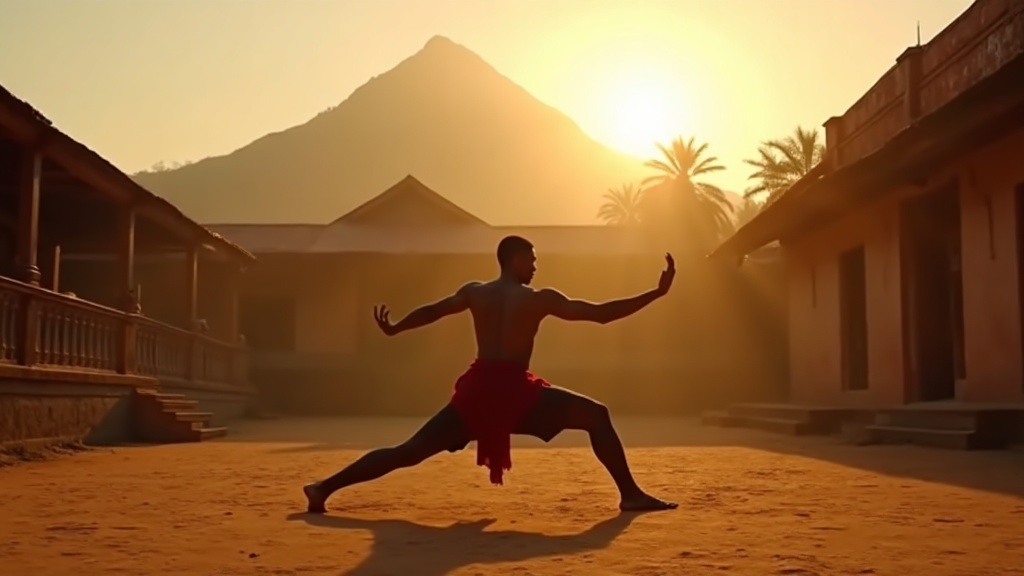
Kalaripayattu Retreat India — The Complete Guide (2026)
Kalaripayattu Retreat India — The Complete Guide (2026)
Last updated: 27 May 2026 · By Raphael Gorschlüter, Co-Founder & Head Teacher, Kalari University
Two questions sit behind almost every search for a kalaripayattu retreat in India. The first is practical — where, when, how long, how much. The second is harder — should you actually go, and if so, what would it change. Most pages on the open web answer only the first one, because most pages on the open web are sales pages for a single school. The result is a search experience that feels like reading ten brochures and learning nothing.
This guide is written from inside the practice, by a teacher who runs a residential retreat in India every year. It compares regions, durations and price brackets honestly — not in the abstract, but in the way a teacher would explain it to a friend over chai. It also separates two readers who tend to arrive at this search from very different directions, and who need very different things from the same trip. By the end, you will know which retreat shape fits which goal, what to ask before you wire a deposit, and whether India is the right answer at all for the question you are actually carrying.
A kalaripayattu retreat in India is a residential, training-first immersion in the traditional South Indian martial art of Kalaripayattu — usually seven to thirty days, held in or beside a traditional kalari, with two daily training sessions, vegetarian food and accommodation included. It is not a wellness holiday with a side of culture. The teacher matters more than the postcode, the body adapts in observable stages, and a fortnight is the honest minimum for a first stay.
Key Takeaways
- A kalaripayattu retreat in India is residential daily training under a single teacher in a traditional kalari — usually two sessions per day, almost always vegetarian, almost never combined with weapons in the first stay.
- Costs span a wide range: roughly INR 25,000–90,000 for a budget Kerala ashram fortnight, EUR 1,500–2,500 for a curated international retreat of ten to fifteen days, all-inclusive of accommodation, meals and teaching.
- Kerala is the heartland — most teachers, most programs, the traditional sunken kuzhi kalari — but credible retreats run in Tamil Nadu, Karnataka and Pondicherry; the teacher matters more than the region.
- Duration should match the goal: three to five days for a taste, fifteen days for a real foundation, thirty days and beyond for structural change in how your body moves.
- No prior martial arts experience is required for most retreats; basic mobility and a willingness to train daily on a hard earthen floor is enough.
- The right retreat depends on which question you are carrying — a Western mover seeking depth and a person of Indian roots returning to a practice that belongs to them need very different programs.
- Teacher vetting outweighs every other variable: years teaching foreigners, lineage, group size and a clear pedagogical method should decide your booking, not the brochure photography.
What a Kalaripayattu Retreat in India Actually Is
A kalaripayattu retreat is a block of residential time — typically one to three weeks — during which you train, eat and sleep around a single teacher and a single floor. It is not the same thing as a kalari demonstration on a stage, a one-hour workshop in a hotel ballroom or an Ayurveda holiday with a kalari taster bolted on. The defining feature is that the training is the centre of the day, every day, and everything else is built to support it.
The training itself follows the four classical stages of kalaripayattu — meithari (body conditioning), kolthari (wooden weapons), ankathari (metal weapons) and verumkai (empty-hand combat) — but a beginner retreat almost always lives entirely inside the first stage. You will spend most of your hours on the floor in low stances, working through animal-inspired sequences called meypayattu, basic stance transitions called chuvadu and conditioning kicks. Weapons do not enter the first stay. Anything that promises them does in week one is a marketing decision, not a pedagogical one.
The setting is part of the practice. A traditional kalari is a sunken earthen training pit, around forty-two by twenty-one feet, dug a few feet below ground level, with a packed red-earth floor and a low ceiling. The geometry concentrates heat, attention and humidity around the practitioner. Programs that do not have access to a true kuzhi kalari work in a covered courtyard or a thatched hall instead. The architecture changes the felt sense of the work; not having it is not disqualifying, but it is worth knowing what is missing.
The retreat day is deliberately uneventful. You wake before sunrise. You drink water. You step into the kalari, salute the floor and the teacher, and begin. The morning session is the long one, usually two to three hours, and focuses on conditioning. The middle of the day is for breakfast, rest and sometimes a short oil massage. The evening session is shorter, an hour or two, and adds movement patterns and sequences. By ten in the evening the lights are out, because the body has to repair before tomorrow's session. The pattern repeats. That repetition is the point.
Why People Travel to India for Kalari Specifically
Kalaripayattu is local in a way most martial arts are not. It was born in Kerala, shaped over centuries by the geography of the Malabar coast, almost extinguished by the British colonial ban of 1804, and revived by a small handful of teachers — including C. V. Narayanan Nair in the 1920s — who kept the lineage alive long enough for it to recover. The result is a practice that still carries the soil it grew on. Training it outside India is possible, and the foundational body work transfers cleanly; training it on the soil where it was preserved adds a layer that no studio in Berlin or Brooklyn can replicate.
There are two distinct reasons people make the trip, and they almost never describe themselves the same way.
The first is the trained-but-stuck mover. You already practice something — yoga, BJJ, the gym, climbing, dance — and you have noticed that you keep getting better at the form without anything actually landing inside you. You execute the movement; you do not feel the movement. You suspect there is something underneath your training that you have not yet touched. Kalaripayattu, with its insistence on slow body conditioning before any technique, is one of the few traditional systems built to address exactly that gap. India is where the work is densest and where the teacher pool is deepest. (If this is the question you are carrying, our companion piece on grounding through movement and the deeper body awareness piece describe what the felt change actually looks like.)
The second is the heritage-returner. You grew up Indian — in India or living abroad — and somewhere in your background the words kalaripayattu, kalari, meypayattu were said by an uncle, a grandfather, a school friend. You may have practiced yoga for years. You have never actually done kalaripayattu. Returning to it on Indian soil — the earth floor, the Malayalam or Tamil instructions, the smell of sesame oil — closes a loop that no online introduction can. India is not a destination for you; it is a return.
These are different motivations, different conversations on day one, sometimes different retreat choices entirely. A serious teacher knows which one you arrived with and works with you accordingly. The rest of this guide names the choice in front of each.
Where in India Kalari Retreats Happen
Almost every kalaripayattu retreat in India sits in one of four broad geographies. They are not interchangeable.
Kerala — Wayanad, Thrissur, Ernakulam, Northern Malabar
Kerala is the heartland. The state's official tourism board lists kalaripayattu under its cultural heritage, the densest cluster of working kalaris sits within its borders, and the four stylistic streams (Northern, Central, Southern) are all alive there. The well-known schools include CVN Kalari in Thiruvananthapuram (the institutional anchor of the modern revival) and Kadathanadan Kalari in Wayanad (one of the most foreigner-experienced training centres). Meenakshi Amma, often called the grandmother of kalaripayattu, teaches into her eighties at her school in Vadakara — the existence of a teacher of her stature is itself a marker of how seriously Kerala still takes the lineage.
What Kerala gives you: the most teachers per square kilometre, the strongest Ayurveda integration (kalari chikitsa and Ayurveda share roots and most Kerala programs offer both), traditional sunken kuzhi kalari spaces, and a humid green setting that traditionally was treated as the deepest training season. What to watch for: the tourist version of Kerala (backwater houseboats, kalari demonstrations, Ayurveda spa) is everywhere — make sure the program you book is training-first and not a culture package with two hours of kalari per day.
Tamil Nadu — Tiruvannamalai, Auroville, Chennai
Tamil Nadu holds a smaller but credible kalari presence, with deep cultural roots — the practice's earliest documented references sit in Sangam-period Tamil literature. Retreats here are rarer and tend to use surface-style training spaces in dryer climates than Kerala's monsoon-heavy interior.
The standout location for an English-speaking beginner is Tiruvannamalai, a small contemplative town at the foot of the sacred mountain Arunachala. It is best known as the home of the 20th-century non-dual teacher Ramana Maharshi, whose ashram still draws an international community of practitioners. The pairing of a fiery body-first martial practice with a town built around stillness creates a particular kind of internal pressure that experienced students often describe as the most useful condition for the felt work to land. This is where the Kalari University residential retreat is held; the full venue-specific picture is described in our Tiruvannamalai retreat overview.
Auroville, the international township near Pondicherry, hosts occasional kalaripayattu training as part of its broader body-practice programming. Chennai has a handful of teaching kalaris, mostly serving local students rather than residential international participants.
Karnataka, Pondicherry and Beyond
A small number of kalaripayattu schools operate in Karnataka, particularly around Bangalore and Mysore. Pondicherry and Goa see occasional traveling teachers running short retreats. These programs are smaller, often less consistent year to year, and require more verification before booking. If a program outside Kerala or Tamil Nadu interests you, ask explicitly which lineage the teacher trained in, how many years they have taught full retreats, and whether their school exists year-round.
Outside India
A handful of credible programs run outside India — Italy, Germany, Spain, occasionally Brazil. These exist mainly because Indian teachers travel to teach long-term European students. For someone who cannot make the trip to India, a European retreat with a recognised Indian gurukkal is a legitimate alternative; for someone who can, the Indian setting adds something the European version cannot.
How Long a Kalaripayattu Retreat Should Be
Duration is the single most over-discussed and under-thought variable in the booking decision. Match it to the goal honestly, and the rest gets easier.
Three to Five Days — A Taste
A three-to-five day program will introduce you to the kalari, give you the basic salutation and a few foundational stances, and let you feel what twice-daily training in low postures does to your body. It will not change you. The first three days of any kalaripayattu retreat are the hardest physically; your hamstrings, hip flexors and calves will be the loudest things in your awareness for most of the trip. Short programs end exactly when the body starts cooperating with the work instead of resisting it.
Useful for: people who want to verify that kalaripayattu is the practice for them before committing further; people combining the trip with a longer travel itinerary; people who already practice and want a refresher rather than a foundation.
Seven to Fifteen Days — A Foundation
The seven-to-fifteen day window is where most first-time foreign participants land, and where most teachers will tell you to start. Seven days lets the body absorb the first shock and begin to receive the work. Fifteen days lets the basic sequences start to live in your nervous system rather than your conscious memory, and a clear before-and-after begins to register. Fifteen days is the honest minimum for what most people are actually looking for when they search "kalaripayattu retreat India."
Useful for: serious first retreat, returning after a long absence, people with movement backgrounds who want a real foundation rather than a sampler. For the full day-by-day shape of this arc, see our companion guide on what to expect at a kalaripayattu retreat.
Thirty Days and Beyond — Structural Change
A month or more is where structural change becomes possible. The body has adapted to the floor. The sequences are no longer being memorised; they are being inhabited. Sleep, digestion, attention and posture begin to shift in ways that persist after the trip ends. The traditional gurukula model, in which a student lives at the teacher's school for months or years, is the historical baseline; thirty days is a reasonable modern echo of that.
Useful for: experienced practitioners, people on sabbatical or career break, students considering teaching long-term, anyone who has done at least one shorter retreat already. We cover the longer formats in detail in how to choose a residential training program.
What a Kalaripayattu Retreat in India Costs
The honest answer to "how much" is "it depends on which tier" — and the open web tends to be vague about which tier their program belongs to. The three tiers below are real categories, not marketing positioning.
Budget Ashram Path
Roughly INR 770 to INR 3,000 per night (EUR 8 to EUR 33), or INR 15,000 to INR 50,000 for a typical fortnight. This is the traditional gurukula-style stay at a Kerala kalari — basic accommodation, vegetarian food cooked at the school, twice-daily training, no frills. Communication may be partly in Malayalam. Long-term seriousness is the assumption; short-term tourism is not the model. This is the cheapest legitimate route and, for the right student, the most authentic. It is also the option with the most variance: some are excellent, some are tired, and the website is often not the best signal.
Curated International Retreat Path
Roughly EUR 1,500 to EUR 2,500 for a 10–15 day all-inclusive program, which means accommodation, three meals, twice-daily training, the kalari space, oil and (depending on program) one or two introductory uzhichil sessions. Run by teachers with significant experience teaching foreigners. Better accommodation than the ashram path, structured English-language instruction, smaller groups, more attention per student. This is the typical bracket for the kalaripayattu retreat you are most likely to find via an English-language search. The Kalari University retreat in Tiruvannamalai (EUR 1,800–2,200 for 15 training days) sits in this bracket.
Hybrid Wellness Retreat Path
Roughly EUR 2,500 to EUR 5,000 for a 10–14 day program that bundles kalaripayattu with significant additional content — Ayurveda treatments, yoga, philosophy, cultural excursions. Often run by retreat aggregators rather than kalari schools. The kalari training itself is usually two hours per day rather than four to six, and the teacher is sometimes a visiting instructor rather than the program's anchor. For someone who wants a broader Indian experience and is happy with a lighter kalari dose, this can be the right choice. For someone who wants to actually train kalaripayattu, it is the wrong one.
Hidden Costs to Plan For
International flights from Europe or North America (EUR 700–1,400 return), tourist visa (EUR 30–80 depending on country), travel insurance (EUR 50–150 for two to three weeks), local transfers if not included (INR 3,000–8,000 from the nearest airport), kalari oil for home practice (EUR 15–40 per bottle), additional uzhichil sessions if you want more than the included one or two (INR 1,500–4,000 per session), tips for kitchen and housekeeping staff (a small but real category in India).
What a Typical Retreat Includes
Most legitimate residential programs include the same core elements. The variations live at the edges.
Always included: two daily training sessions, accommodation for the full retreat length, three vegetarian meals per day, drinking water, the kalari training space, basic training oil, the teacher's time.
Often included: one or two introductory uzhichil (kalari oil massage) sessions, an introduction to kalari chikitsa (traditional healing as developed inside the kalari), one or two theory or philosophy sessions, simple cultural exposure to the setting (a local temple visit, a short walk through the surrounding landscape), airport transfers from the nearest airport.
Sometimes included: Ayurveda treatments (especially in Kerala programs with an in-house Ayurveda clinic), weapons demonstration (note: demonstration, not training, in a first retreat), guided meditation or pranayama, a closing certificate or attendance acknowledgement.
Almost never included: international flights, visa fees, personal travel inside India before or after the retreat, additional uzhichil beyond the included sessions, certification in kalaripayattu (which takes years of training to earn legitimately), individual private lessons outside the group schedule.
The diet question deserves its own line. Almost every kalaripayattu retreat serves vegetarian food, usually Kerala-style or South Indian Ayurvedic-influenced cooking — rice, lentils, vegetables, coconut, simple chutneys, fresh fruit. The reasoning is partly traditional and partly practical: a light, plant-based diet supports recovery and digestion during heavy training. Strict allergies and gluten intolerance can usually be accommodated if you communicate in advance. Strict vegan can be a problem in some Kerala programs that rely heavily on dairy; ask in writing.
How to Choose the Right Retreat for You
The teacher is the variable that overwhelms every other variable. Region, price, accommodation tier and Instagram aesthetic all matter less than who is in front of you on the floor. Vet the teacher first; vet everything else after.
Questions to Ask Before You Book
Send these in writing to the school. The quality of the response is itself a signal.
- How many years has the lead teacher been teaching residential retreats?
- How many years specifically teaching international beginners?
- What is the maximum group size for this retreat?
- Will the lead teacher teach every session, or assistant teachers some sessions?
- What lineage and which gurukkal did the lead teacher train under?
- What is the cancellation and refund policy?
- Is there a separate same-sex therapist for uzhichil massage if needed?
- What pre-arrival preparation does the school recommend?
- What is a realistic best-case and worst-case scenario for someone with my background?
- Who else is currently registered for this retreat (numbers, not names — age range, experience range, nationalities)?
What to Look for in a Teacher
A senior kalaripayattu teacher is called a gurukkal in Kerala or, less formally, asan elsewhere. There is no single recognised certification body for kalaripayattu — the field is older than any modern accreditation system. Real markers of seriousness include direct lineage from a recognised teacher (the school will name the teacher and the years), a documented public teaching history (workshops, retreats, articles, books), the ability to teach in a language you understand at the level the work requires, students who have studied with them for multiple years (not just multiple weeks), and an honest sense of who their teaching is for and who it is not for.
Red Flags to Avoid
- Weapons promised in week one of a beginner program (pedagogical error or marketing).
- The phrase "ancient killing art" used as a selling point (positioning that does not fit how a serious teacher describes the practice).
- No clear answer on group size, or a much larger group than the kalari space can hold.
- Marketing copy that emphasises spectacle over practice — leaping students, swords, fire.
- A teacher whose public reputation is exclusively on tourist platforms rather than within the practitioner community.
- A program that bundles five disciplines (kalari, yoga, Ayurveda, cooking, meditation) into ten days — none of them will get adequate time.
- Inability to put you in contact with a previous student who completed the same program.
For first-time travellers who want to feel out the practice before committing to a retreat, our beginner's guide to kalaripayattu walks through the realistic first month — most of the same vetting principles apply to picking a teacher anywhere.
When Is the Best Time of Year to Go
The Indian climate divides the year into three useful blocks for kalari travel.
November to March — the comfortable mainstream season. Dry weather, cool mornings (especially in Kerala's hill country and Tiruvannamalai), no monsoon risk. This is the peak booking period, prices are highest, popular programs fill three to six months in advance. Best for first-time travellers to India, families combining the retreat with sightseeing, and anyone uncomfortable with extreme heat or humidity.
April to May — the hot dry pre-monsoon. Temperatures can reach forty degrees Celsius (over 100°F) in much of South India. Programs continue, prices drop, fewer participants. Cooler regions like Wayanad in Kerala's hills and Tiruvannamalai in the Tamil Nadu interior are more bearable than the coast. Best for travellers used to heat, shorter stays, and tighter budgets.
June to September — the southwest monsoon. This is, traditionally, the deepest kalari training season. The body is warm and supple, uzhichil oil work is most effective, the air carries an intensity that the dry season does not. It is also genuinely harder — humidity, rain, road delays, occasional flight disruption. Some Kerala programs close entirely. The ones that stay open in monsoon do so deliberately, for the practitioners who want exactly that. Best for serious returning students, monsoon enthusiasts and anyone willing to trade comfort for depth.
The Kalari University retreat in August intentionally sits in the monsoon window in Tamil Nadu — Tiruvannamalai gets significantly less monsoon rain than Kerala while still inheriting the warm-body advantage that monsoon brings.
Who a Kalaripayattu Retreat in India Is Actually For
This is the section the brochures leave out. Two distinct readers tend to arrive at this guide carrying very different questions; the right answer is different for each.
For the Western Mover Seeking Depth
You already train. You have done years of yoga, or martial arts, or strength work, or all of the above. You are competent in your body — and you have started to notice that competence is not the same thing as feeling. You go through the postures, the rounds, the reps. The form gets cleaner; the inner thing you cannot name is not getting any closer. You suspect there is a layer underneath all the training you have done that you have not yet touched.
A kalaripayattu retreat in India is one of the few traditional settings built to put you exactly into that layer. The practice begins with body conditioning so basic that it cannot be performed cleverly — there is no way to fake a low horse stance held for several minutes. The sequences are slow enough that you have to feel them; if you only think them, your body falls out of the shape. The setting (the earthen floor, the unfamiliar food, the early mornings, the absence of distraction) compounds the effect. This is the question Kalari University's August retreat in Tiruvannamalai is built to answer, and you can read more about the body-awareness work itself in our benefits piece and the longer embodiment piece for men who already train.
For the Person of Indian Roots Returning
You grew up Indian — in India or living abroad. Kalaripayattu was part of the cultural background noise of your childhood; your grandmother or an uncle or a neighbour mentioned it. You may already practice yoga seriously. You have never actually trained kalaripayattu. The fact that this practice belongs to you and you have never touched it sits somewhere in your awareness as an unfinished sentence.
A retreat in India closes the loop in a way no online introduction can. The teacher's first language is likely Malayalam or Tamil; the instructions carry words you may already half-know; the food, the smell of sesame oil, the geography all do part of the work before training even starts. The right program for you may be the same one chosen by a Western mover or it may be different — sometimes the most useful retreat for a returning Indian student is a serious Kerala ashram with a senior gurukkal rather than a foreigner-focused program, because the cultural integration matters more than the English-language ease. The question to sit with is which environment will let your first real meeting with the practice be on its own terms.
Who It Is Not For
Plain naming, because the brochures will not.
People looking for a soft wellness break. People who want a cardio workout (kalaripayattu's training is intense but not cardiovascularly built like a CrossFit class). People with acute knee, hip or lower-back injuries that have not been cleared by their doctor for hours of low-stance work daily. People who need air conditioning and Western diet to function in a foreign country. People hoping to add another certification to a CV. People who want to learn to fight quickly. If you recognise yourself in any of those, the answer is to do something else first.
How to Prepare for a Kalaripayattu Retreat
The preparation that actually matters is physical and mental, not logistical. Both sit in the four to six weeks before the trip.
Physical preparation. Begin walking thirty to sixty minutes a day if you do not already. Add ten to fifteen minutes of basic mobility work for the hips, hamstrings, calves and shoulders — anything that gradually opens those joints will help. If you can hold a quarter-squat or low horse stance for thirty seconds today, work toward two minutes by departure. None of this needs to be heroic. The body adapts faster than your mind tells you; the point is to arrive having already begun the conversation.
Mental preparation. Decide before you fly that you will not negotiate the schedule on day three when soreness peaks. The retreat is built to deliver something specific, and the something specific lives on the other side of the early days. Decide that you will not check work email. Decide that you will eat what the kitchen serves. Decide that you will follow the teacher's instructions even when they make no sense, because they will start making sense by day six.
What to pack. Cotton training clothes in dark colours, at least two full sets (sesame oil oxidises into a permanent brown stain on white fabric — do not bring white). Easy sandals for outside the kalari. Refillable water bottle. Sun protection. Mosquito repellent. Simple toiletries. A basic first-aid kit. Any chronic medication you take. Leave bulky athletic shoes, white clothes and tight synthetic gym wear at home; none of them survive the floor or the oil.
The full pre-arrival schedule and the day-by-day arc of a retreat itself live in our companion piece on what to expect at a kalaripayattu retreat.
Common Misconceptions About Kalaripayattu Retreats
A few false beliefs travel widely on the open web. Worth naming, briefly.
"You need to be flexible already to start." No. Most beginners arrive with hamstrings that protest the first stance. The opening week is built around that fact.
"It is a yoga retreat with weapons." No. The shared elements with a yoga retreat are early mornings, vegetarian food and simple accommodation. The training is more intense, more outward-directed, and almost never includes seated meditation or extensive pranayama. For the longer comparison see our piece on kalaripayattu and yoga.
"Kalaripayattu is the deadliest martial art in the world." This phrase is marketing copy, not a practitioner description. Kalaripayattu is one of the oldest continuously practised martial systems in the world, with documented roots in Sangam-period Tamil literature, but the claim of being deadliest or oldest-globally is contested and we have written about it honestly in our mother of all martial arts piece.
"A retreat will fix my back." No. A retreat is not a medical intervention. Kalaripayattu training under a careful teacher may, over time, support better posture and movement quality, but no honest teacher will promise therapeutic outcomes for a specific condition. Treat any program that does as a red flag.
"Two weeks is too much for a first trip." It is not. Two weeks is the honest minimum for a first kalaripayattu retreat. A week is enough to taste, not enough to feel the shift the retreat is built to deliver.
Frequently Asked Questions
How much does a kalaripayattu retreat in India cost?
A kalaripayattu retreat in India usually costs between roughly INR 25,000 and INR 90,000 for a budget-style two-week residential stay at a traditional Kerala ashram, and between EUR 1,500 and EUR 2,500 for a 10–15 day curated international retreat with accommodation, meals and an experienced teacher included. The Kalari University retreat in Tiruvannamalai runs from EUR 1,800 to EUR 2,200 depending on room type, all-inclusive except flights. Hidden costs to plan for include international flights, visa, kalari oil for home practice and any optional uzhichil sessions.
Where in India are kalaripayattu retreats held?
The vast majority of kalaripayattu retreats are held in Kerala — especially around Wayanad, Thrissur, Ernakulam and the northern Malabar coast — because Kerala is the historical heartland of the practice. A smaller number run in Tamil Nadu, including Tiruvannamalai and Auroville, and a handful sit in Karnataka and Pondicherry. Region matters less than the teacher; what defines a real retreat is who is in front of you on the floor.
Do I need experience to attend a kalaripayattu retreat in India?
No. Most kalaripayattu retreats in India accept complete beginners and build the first week around basic body conditioning that meets you where you are. You do not need to be flexible, athletic or familiar with any martial art beforehand. What helps far more than prior experience is honest reporting of injuries and a willingness to start at the bottom of the system.
When is the best time of year to attend a kalaripayattu retreat in India?
November to March is the comfortable mainstream season, with dry weather and cooler mornings — and the highest prices. The traditional kalari calendar treats June to September, the monsoon, as the deepest training window because the body is warm and supple and uzhichil massage is most effective; conditions are intense and the experience is more demanding. April and May are hot and quieter, and work for shorter stays in cooler regions like Wayanad or Tiruvannamalai.
How long should a kalaripayattu retreat in India be?
Two weeks is the honest minimum for a first kalaripayattu retreat. The body needs three to four days to absorb the initial soreness, another few days to start cooperating, and the felt shift most participants come for tends to arrive in the second week. A three-to-five day stay is a useful taste; fifteen to seventeen days is where most first-timers report a clear before-and-after; thirty days or more is where structural change begins.
Is a kalaripayattu retreat safe for women?
Yes, when the program is chosen with normal care. Most kalaripayattu retreats are mixed-gender, women have practiced kalaripayattu publicly for decades — Meenakshi Amma in Kerala is one of the most respected gurukkals alive — and reputable retreats provide private accommodation options and same-sex therapists for uzhichil. The usual travel-in-India common sense applies: read recent reviews, confirm room arrangements before booking, and prefer programs run by teachers with a public reputation.
What is the difference between a kalaripayattu retreat in Kerala and Tamil Nadu?
Kerala is the heartland — most teachers, the traditional sunken kuzhi kalari, the densest cluster of programs, the strongest connection to Ayurveda and kalari chikitsa. Tamil Nadu retreats are rarer and tend to use surface-style training spaces in dryer climates; the cultural surround is different — temples, contemplative towns like Tiruvannamalai instead of green Kerala backwaters. The training itself is the same; the rest of the day is what changes.
Are kalaripayattu retreats suitable for people over 40?
Yes — age is rarely the deciding factor. We regularly see participants in their forties, fifties and beyond complete a residential retreat. What matters more than age is honest reporting of pre-existing knee, hip, lower-back and shoulder conditions so the teacher can scale the work. Many older adults actually find body awareness faster than younger participants because they listen to their body more carefully.
What is included in a typical kalaripayattu retreat?
A typical kalaripayattu retreat package includes two daily training sessions with a qualified teacher, accommodation for the full retreat length, three vegetarian meals per day, the kalari space itself and basic training oil. Many programs add an introduction to kalari chikitsa, one or two uzhichil massage sessions, philosophy or theory sessions and simple cultural exposure. International flights, visa, personal travel inside India, additional massage and certification are almost never included.
Can I combine a kalaripayattu retreat with Ayurveda treatment?
Yes, and many people do — kalaripayattu and Ayurveda share roots and the two are often offered side by side, especially in Kerala. A common pattern is to do a serious training-first retreat for two weeks, then add a short Panchakarma or rejuvenation program at a separate Ayurveda hospital afterwards. Doing both at once dilutes both — the body cannot integrate heavy training and intensive purification in the same window.
How is a kalaripayattu retreat different from a yoga retreat?
A kalaripayattu retreat is closer to a residential martial arts training camp than to a yoga holiday. There are no candles, no music in class, and the daily workload is significantly higher than a typical asana-focused retreat. The shared elements are early mornings, vegetarian food and an immersive setting; the difference is that kalaripayattu trains attention outward into space, conditions the body more intensely per session, and almost never includes pranayama or seated meditation as a core element.
Can foreigners attend a kalaripayattu retreat in India?
Yes — kalaripayattu retreats in India have welcomed foreign students for decades, and several programs are built specifically around international beginners. You will need a standard tourist visa, basic travel insurance, and ideally a program that runs in English or another language you understand. Choose a retreat where the teacher has direct experience with foreigners, not only Indian students — pedagogy differs significantly between the two audiences.
Sources and Further Reading
- Kalaripayattu — Wikipedia — historical, technical and lineage overview of the practice.
- Indian martial arts — Wikipedia — the broader category in which kalaripayattu sits, with the Sangam-period record.
- Kerala — Wikipedia — geographic and cultural background for the kalari heartland.
- Kerala Tourism — Official Site — the state tourism board's cultural and wellness positioning, useful for trip-planning context.
- Tamil Nadu — Wikipedia — geographic and cultural background for the secondary kalari geography.
- Tiruvannamalai — Wikipedia — the contemplative town that hosts the Kalari University retreat.
- Arunachala — Wikipedia — the sacred mountain at the centre of Tiruvannamalai.
- Ramana Maharshi — Wikipedia — the 20th-century teacher whose presence shaped modern Tiruvannamalai.
- Sri Ramana Ashram — Wikipedia — the still-active community at the foot of Arunachala.
- Meenakshi Gurukkal — Wikipedia — one of the most senior living kalaripayattu teachers, in her eighties at her Kerala school.
- C. V. Narayanan Nair — Wikipedia — the 20th-century teacher central to the modern revival of kalaripayattu.
- Sangam period — Wikipedia — the era of the earliest documented references to martial training in South India.
- Monsoon of South Asia — Wikipedia — the seasonal context for "monsoon training season" in kalaripayattu.
Conclusion — Choosing Your First Kalari Retreat in India
A kalaripayattu retreat in India is not a generic wellness experience. It is a training-first immersion in a specific traditional practice, in the part of the world where that practice was preserved, under a single teacher whose pedagogy and lineage matter more than the brochure photography. The right retreat for you depends on which question you are carrying — depth that has not yet landed despite years of training, or a return to a practice that has always belonged to you — and on matching duration and tier honestly to that question.
If the practical answer is "fifteen days, foreigner-friendly, English-language, the body work first":
The August retreat in Tiruvannamalai is open for applications — 15 training days, all-inclusive from €1,800 →
Dates: 1–17 August 2026. Venue: Shivalaya Boutique Guesthouse, Tiruvannamalai, Tamil Nadu — at the foot of Arunachala. Room options: shared (€1,800), double (€1,950), single (€2,200). All-inclusive except international flights. Group capped at twenty. Apply by email to [email protected] or WhatsApp +91 8137037856.
About the Author
Raphael Gorschlüter — Co-Founder & Head Teacher, Kalari University
Raphael Gorschlüter is one of Europe's most experienced kalaripayattu teachers. He has trained for more than twelve years in the lineage and teaches internationally — in Germany, Spain and India — with a focus on developing the ability to feel movement rather than only perform it. He runs Kalari University's annual residential retreat in Tiruvannamalai at the foot of Arunachala and works with both Western practitioners new to the tradition and people of Indian roots returning to it.
