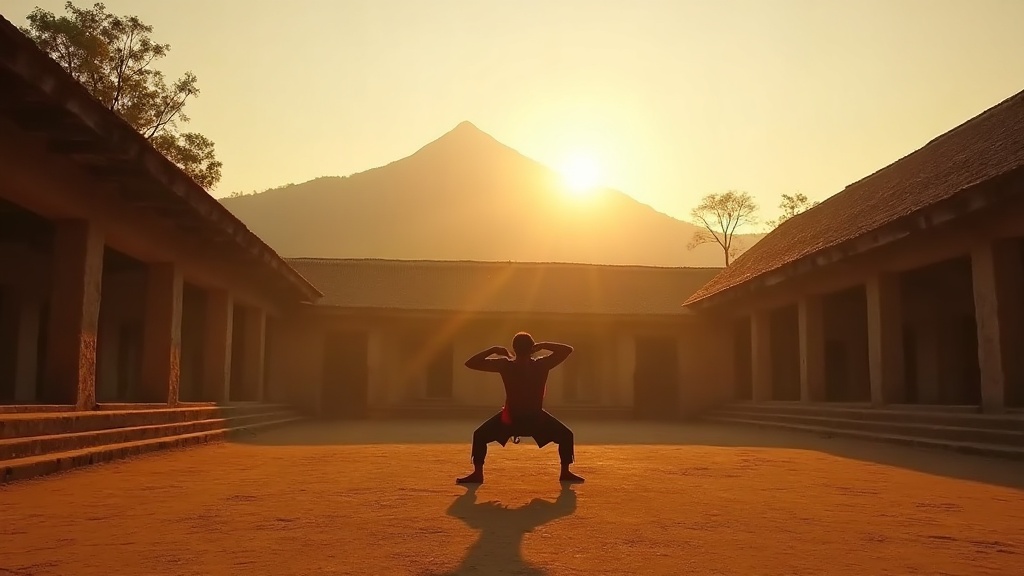
What to Expect at a Kalaripayattu Retreat — Honest Guide
What to Expect at a Kalaripayattu Retreat — Honest Guide
Last updated: 27 May 2026 · By Raphael Gorschlüter, Co-Founder & Head Teacher, Kalari University
Most "what to expect at a kalaripayattu retreat" articles on the internet are sales pages in disguise. They tell you the dates, the room types, the inclusions, and they show you a sunset over a coconut palm. None of them tell you that on day two your legs will feel gelatinous, that sesame oil oxidises into a permanent brown stain on white cotton, that you will not learn weapons in week one, or that the felt difference most people sign up to chase tends to arrive somewhere around day eight.
This guide is written from inside the kalari, by a teacher who has watched dozens of first-time participants move through the same fifteen-day arc. The shape of that arc is what the rest of this article is about: the day, the soreness, the food, the rituals, the small things nobody warns you about, and the work it actually takes to arrive at a body that is no longer just executing movement.
A kalaripayattu retreat is an immersive, residential training period — usually one to three weeks — in which you learn the traditional South Indian martial art of Kalaripayattu through two daily training sessions, a vegetarian diet, simple accommodation near the practice space, and a single teacher. It is not a wellness vacation. The work happens on a hard floor in low stances, the body adapts in observable stages, and the closing days are usually when the felt shift arrives — not the opening ones.
Key Takeaways
- A kalaripayattu retreat is residential daily training, not a wellness vacation — typically two sessions per day under a single teacher in a traditional kalari training space.
- Expect strong muscle soreness in the first three days, then a noticeable adaptation around day four — by day eight the body begins cooperating with the work instead of resisting it.
- No prior martial arts experience is required, but baseline mobility in the hips, hamstrings and shoulders helps you absorb the conditioning faster.
- Pack cotton clothes in dark colours: sesame training oil oxidises into a permanent brown stain that even repeated washing will not remove.
- Vegetarian Kerala or South Indian food is standard; strict dietary needs (gluten, severe allergies) can usually be accommodated with advance notice.
- The "felt shift" most participants come for tends to arrive in the second week — a fifteen-to-seventeen day retreat is the honest minimum for a first immersion.
- Weapons are not on the curriculum in your first retreat — the body must be conditioned first, which is the entire purpose of the opening stage of training.
The Short Answer — What a Kalaripayattu Retreat Actually Is
A kalaripayattu retreat is a residential block of training inside or beside a traditional kalari, the sunken earthen training pit that gives the practice its name. You wake before sunrise, you train twice a day, you eat what the kitchen serves, and you sleep early. There is no swim-up bar, no meditation gong, no live tabla in the corner. The signal-to-noise ratio of the day is unusually high — a single teacher, a single floor, a single body of work.
The training space is small by design. A traditional kalari measures about forty-two by twenty-one feet, dug roughly three to five feet below the surrounding ground, with a low ceiling and a packed red-earth floor. That geometry concentrates heat, attention and humidity around the practitioner. The first time you step down into it your body reads something the architecture is telling you before your mind catches up: this is a place for work.
The retreat is built around two training sessions per day, with the middle of the day reserved for food, rest and — depending on the program — recovery work like a short oil massage. The morning session is the long one (two to three hours, sometimes longer) and focuses on conditioning. The evening session is shorter (one to two hours) and adds movement patterns, kicks and sequences. Between them, the day is deliberately uneventful.
This is the part most retreat sales pages obscure: the practice is the day. There is no programmed cultural sightseeing, no rotating menu of workshops, no parallel "embodiment journey" curriculum. You are there to do one thing for fifteen days and let the cumulative repetition do its work. That is also why it works.
A Typical Day at a Kalaripayattu Retreat
A real day at a kalaripayattu retreat has a strong shape. The version below is built from how my own retreats run in Tiruvannamalai at the foot of Arunachala, and it lines up almost identically with how serious schools run in Kerala — the rhythm is older than any of us.
Morning Session — Body Conditioning and Stances
Most retreats wake the group between 5:00 and 5:30. The first morning session starts before the heat does, typically at 6:00. You arrive at the kalari, leave your sandals at the edge, and step down into the pit. There is usually a brief opening — a touch of the right hand to the threshold, a quiet greeting to the teacher, a moment at the western corner where the puttara (a small altar built into the wall) holds the lineage symbols.
The session itself follows a fixed sequence. Joint mobilisation and a long, low-stance warm-up. Then meypayattu — body-conditioning sequences that are the closest thing kalaripayattu has to a foundational vocabulary. Kicks (forward, side, hooking, jumping). The basic chuvadu (stances) drilled in repetition until the legs stop debating with you. By the time you finish, the inside of the kalari is dense with humidity, your training cloth is dark with sweat, and the sun is fully up.
You walk back to the accommodation, shower the oil and sweat off, and arrive at breakfast somewhere between 8:30 and 9:30 with a kind of hunger most adults have not felt in years.
Midday — Rest, Food, Sometimes Massage
Breakfast at a kalari retreat is unremarkable on purpose. Rice porridge, idli or dosa, fresh fruit, a coconut chutney, sometimes a banana stew. Lunch lands around 12:30 — rice, two vegetable dishes, a lentil curry (sambar or dal), curd, pickle. The fat is coconut, the flavour is simple, the volume is generous. The point is not gastronomy. The point is recovery fuel that does not sit heavy in your gut at 16:30 when the evening session starts.
In between, you sleep. Most participants underestimate how much they will sleep on a retreat. A 60–90 minute midday nap is normal and recommended. On a rest day, or after a particularly heavy morning, this is when an oil massage might be scheduled — either a short chavutti uzhichil (foot pressure massage) by a trained therapist or a self-applied oil rub with sesame oil before a short rest. We will come back to the oil routine below; it is more central to the practice than most beginner guides admit.
If you wake up early enough or have energy left, the late afternoon is also when most participants take a short walk, sit at a local chai stand, write in a journal, or read. The internet is usually weak. That is, again, not an accident.
Evening Session — Movement and Sequences
The evening session starts around 16:30 or 17:00 and runs into early dusk. The work shifts from raw conditioning to pattern. Vadivu — animal postures (elephant, lion, horse, snake, cock, fish, peacock, boar) — are taught not as a zoo but as a vocabulary of shapes the body learns to flow between. Short sequences (longer combinations of stances, kicks and turns) start to enter the work in the second week.
This is also the session where the teacher does most of the correcting. The morning is for sweat; the evening is for sight. Expect to be moved manually — a hand on the knee to deepen the stance, a foot tapped to widen the base, the spine drawn upward with a single finger between the shoulder blades. Verbal correction in kalaripayattu is sparse on purpose. The body learns the shape from being placed in the shape.
By the time the session ends — around 18:30 — the temperature has dropped, the cicadas are loud, and the air outside the kalari is cooler than the air inside.
Evenings — Recovery, Talk, Sleep
Dinner is light — often a soup or a thin curry with rice or chapati — and lands by 19:30. Afterwards the day winds down quickly. Some retreats hold a short evening session of theory, chanting, or a fireside conversation with the teacher on the philosophy of practice. Others leave the evening completely free. Either way, by 21:30 most participants are heading to bed.
You will sleep more deeply than usual. The body is repairing. The day was simple. The mind, after the first three or four days, stops cycling. By 22:00 the lights are out.
What You Actually Practice in the First Week
Most beginners arrive at a retreat with a low-resolution idea of what they will be doing. "Some kind of Indian martial art with low stances and kicks." That is not wrong, but it leaves out the structure. Here is what your first week is actually built from.
Meypayattu — Body Conditioning
Meypayattu is the foundation. The word breaks down roughly as body practice — the conditioning sequences that prepare the body to do everything else. These are flowing patterns of stances, leans, twists, kicks and recovery steps, repeated in mirrored sets so both sides of the body are trained equally. In the first week, this is most of your training.
What it feels like in the body: you are constantly shifting weight from one leg to the other, dropping into a wide low stance, rotating the spine, throwing a kick from a position the gym never asked you to be in. By the end of a single sequence your hamstrings, hip flexors and quadriceps are burning in a way that yoga and running rarely produce. By the end of the morning session you have done several sequences. That is where the soreness comes from.
Chuvadu — The Stances That Underpin Everything
Beneath every movement in kalaripayattu sits a stance — a chuvadu. The basic stances include the horse stance (a wide, low square with both knees deeply bent), the lion stance (a longer, lower stance with the back leg extended), and the elephant stance (a narrow, high position with the weight on the heels). There are eight to ten classical stances depending on the lineage. In the first week you will mostly meet the horse and the cat stance, because everything else builds from them.
A stance is not a posture. A stance is a body position with intent — pressure pushing into the floor, breath actively engaged, eyes ahead. Holding the horse stance for ninety seconds the first time is unpleasant. Holding it for ninety seconds the tenth time is a different kind of unpleasant: the legs have started to organise around the work.
Vadivu — Animal Postures
The vadivu (animal forms or postures) extend the stance vocabulary into shape and intention. Each animal form encodes a way of moving — the cock for sharp, low, aggressive footwork; the elephant for grounded power; the lion for direct attack; the snake for low, sinuous, evasive movement; the horse for the foundational broad-base stance; the peacock for upright, expanded carriage; the boar for short, low, charging force; the fish for fluid recovery.
You will not be asked to "be the lion" in any New Age sense. You will be asked to hold a specific shape — feet placed exactly here, knees bent exactly there, hands held at exactly that height — and to move in and out of it. The animal name is a teaching shortcut older than the words for the muscles involved.
Kicks and Sequences
Kalaripayattu has eight to twelve classical kicks — straight, side, hook, jumping, knee-lift, sweep. They are introduced from the second or third day and drilled in repetition. The body learns them less by being told and more by being made to throw them several hundred times across the retreat. In the second week, short sequences begin to thread the kicks, stances and animal postures into a connected flow — a fragment of what an experienced practitioner does for the length of a full form.
What Is Not on the Menu in Week One
No weapons. No staff, no short stick, no dagger, no sword, no urumi (the famous flexible sword that gets all the YouTube views). The traditional curriculum places weapons in the second stage of training, kolthari, which a serious teacher will not let a body that has never been conditioned in meithari approach. If you arrive at a retreat that hands you a sword on day three, you have arrived at the wrong retreat. (For the full four-stage map, see our overview of how the disciplines and weapons fit together and our honest look at the "mother of all martial arts" question.)
No sparring. No partner drills until the body has its own shape. No "self-defence applications" in the YouTube sense. The first week is about you and the floor.
How Hard It Is — The Honest Physical Picture
This is the section most retreat sales pages skip. Here it is in three windows.
Day 1–3: The Soreness Most Beginners Get Wrong
You will be sore. Specifically, you will experience delayed-onset muscle soreness (DOMS) concentrated in the hamstrings, hip flexors, gluteus medius (the outer hip muscle that holds the horse stance), calves, and lower back. The peak is usually 24 to 48 hours after the first morning session — which means it hits hardest on the morning of day two, not day one.
One past participant described his legs as "gelatinous" — a word I have heard variations of from at least twenty different students over the years. Walking down a stair is a small project. Squatting to put on shoes makes you reassess your life decisions. This is normal. This is also temporary.
What I have seen new students get wrong: they assume the soreness means they are doing the work badly, that they should hold back in the second session to "let the muscles recover", or that they should skip a session entirely. None of that helps. The most reliable adaptation pattern, watched across dozens of first-timers, is to keep moving — at a lower intensity if needed, but moving. The body adapts faster when it is not allowed to seize up.
What helps: hot showers, plenty of water (more than you think), sleep, the oil rub at midday, and trusting that the second session will, paradoxically, leave you feeling looser than the first.
Day 4–7: The Body Starts Cooperating
Somewhere between day three and day five, the soreness drops below the threshold where it dominates your attention. The stances stop feeling like punishments and start feeling like positions. The kicks have less hesitation. You start being able to follow the teacher's sequence without your brain narrating every step.
This is the window in which the practice begins to teach you something the gym does not: the floor as a partner. Most adults who have only trained in gyms or on yoga mats relate to the ground as a passive surface. In the kalari, the ground is something you press into, something that pushes back, something you draw power from. By day six most first-timers can feel that exchange for the first time. It is a small shift in attention, and it changes everything that comes after.
The first time I noticed this happen — for me, in my own first long retreat in Kerala — was on the morning of day six. The stance I had been struggling with for five days suddenly had a floor underneath it. I had been performing the shape for a week; that morning I felt it.
Day 8–15: When the Pattern Starts Sticking
The second week is where the felt difference lives. The body has adapted to the load, the daily rhythm has stopped feeling unusual, and the sequences are no longer something you copy from the teacher but something your body has started to remember. You begin to notice your breath without trying. You start landing in a stance instead of arriving in it.
This is also when participants commonly report that something settles. The word that comes up most in our closing interviews is "grounded" — a word that has been overused in the wellness industry but which keeps surfacing on its own in our debriefs because it is, structurally, what the practice trains. A nervous system that has spent fifteen days sending most of its bandwidth downward, into the legs and the contact with the earth, behaves differently from one that has not.
The closing two or three days are usually the most enjoyable. The body is doing the work; the mind has caught up; the pain is gone. This is also the cruel irony of a fifteen-day retreat: just as the practice starts to land, it is time to leave. (This is the structural reason most teachers recommend at least two weeks for a first immersion. A seven-day retreat lets you taste the practice but rarely lets you arrive at this window.)
The Things No One Tells You About
The bullet-list inclusions on the retreat page do not capture the small daily details that define the experience. Here are the things I now warn first-timers about in advance, because nobody warned me.
The Oil Routine
Kalaripayattu uses sesame oil as its training oil — often medicated with herbs in the classical Kerala recipe (kuzhambu preparations or simpler combinations of warming herbs). The oil is rubbed lightly into the limbs and torso before a hard session or applied more thoroughly as part of a midday rest. It is not a cosmetic detail. The oil softens connective tissue, opens pores, helps the body absorb heat, and supports the muscles through repeated impact with the floor.
Two practical consequences for you:
- Your training cloth will be unsalvageable by the end of the retreat. Sesame oil oxidises in light and air — within a week of repeated application, white or pale fabric turns a deep, irreversible brown. Pack dark colours. Pack at least two sets so one can air out while you wear the other. Hand-wash with cold water and bar soap as soon as possible after a session; do not let oil-soaked fabric sit overnight.
- Your skin will smell of sesame for two weeks. This is not unpleasant once you adjust, but it is real. Some participants embrace it; others bring an unscented natural soap to neutralise some of the residue before social interactions outside the kalari.
The Floor and the Rituals
The kalari is not a gym. It is a consecrated space. There is a threshold you do not step on. There is a corner that holds the puttara, the small altar dedicated to the deities of the lineage. The teacher (the gurukkal) is greeted in a specific way at the start of a session. Before a serious movement, particularly a weapon form later in your training, the practitioner touches the floor with the right hand and brings it to the forehead.
These rituals are not decorative and they are not religious in a way that requires you to share the tradition's faith. They are orientation devices. They tell the body that what happens here is a different category of activity from everything else in the day. If you ignore them, the practice still works, but it loses some of the boundary that helps the work land. Watch what the teacher does. Do as the teacher does.
(For more on what the word kalaripayattu actually says about the practice and why it is named after the space, the Wikipedia entry on the kalari is a useful starting point.)
The Laundry Problem
Connected to the oil point above: laundry on a retreat is its own minor problem. Most retreat accommodations do not have washing machines that handle oil-saturated cotton well, and commercial laundry services in Tamil Nadu or Kerala will sometimes return your training clothes mysteriously cleaner than you left them and irreversibly damaged. The practical move is hand-washing your training cloth in a bucket every evening, hanging it on the line, and wearing the second set the next day. After three weeks you will have developed a small competent rhythm around this. The first week, it will feel like one more thing.
What the Retreat Does NOT Include
Worth being explicit about, because the brochures rarely are:
- No daily massage. Kalari massage (uzhichil) is a real and serious part of the tradition, but most retreats include one or two sessions, not one per day. If you are imagining a thai-massage-style daily kneading, you have the wrong picture.
- No spa. No sauna, no plunge pool, no hammam. The recovery is sleep, food, hydration, and the oil rub.
- No sightseeing programme. A reputable kalari retreat is not a cultural tour. You will have free time, and you can walk the local area on your own, but the schedule is not built around external activities.
- No phone life. WiFi is usually weak and intermittent. This is a feature.
- No promise that you will "find yourself". What you will find is your hips. The rest is your business.
Accommodation, Food and the Daily Logistics
Where You Sleep
Accommodation at a serious kalari retreat ranges from spartan to mid-range comfortable, depending on the program. The reliable common denominator: a clean bed, a fan, a private or shared bathroom, mosquito netting if needed, and walking distance to the kalari. You will not find air-conditioned luxury rooms; you also will not find anything close to roughing it.
Our August 2026 retreat in Tiruvannamalai runs out of Shivalaya Boutique Guesthouse, with rooms looking onto the slope of Arunachala. Three room types are offered (shared 3- or 4-bed, double, single) at three corresponding price points (€1,800 / €1,950 / €2,200, all-inclusive of accommodation, meals and local transfers). For comparison, comparable residential kalari programs in Kerala run from roughly €1,200 to €2,500 for a two-week stay depending on amenities and teacher seniority.
What matters more than room category: walking distance to the kalari (you will be doing this twice a day, often pre-dawn, sometimes oiled and tired), and the quality of the kitchen (more on that below).
What You Eat
The diet at almost every serious kalari retreat is vegetarian. There are two reasons for this. The traditional reason is that vegetarian food is considered sattvic — light, easy to digest, supportive of training. The practical reason is that you cannot run a residential training program with five different dietary preferences on a single kitchen.
A typical day's food:
- Breakfast: rice-based porridge, idli with sambar, dosa with chutney, fresh fruit, sometimes a banana stew or upma. Black coffee or chai.
- Lunch: rice (often parboiled red Kerala rice), one or two vegetable curries (often coconut-based), a lentil dish (sambar, rasam or dal), curd, pickle, papad.
- Dinner: lighter — chapati with a vegetable, a soupy curry, or a simple rice-and-curd combination. Often a herbal tea afterwards.
Strict allergies (nuts, gluten) and chronic conditions (diabetes) can usually be accommodated with two weeks of advance notice. Vegan is harder than vegetarian, since dairy (especially curd and ghee) is integrated into the cooking; let the kitchen know early.
Climate, Mosquitoes, Water
Tiruvannamalai in August sits in the high twenties to low thirties Celsius (75–90°F), with humidity moderated by the southwest monsoon. Kerala in the same season is hotter and wetter. Plan for: light cotton everything, a wide-brim hat or scarf, mosquito repellent (DEET-based or natural picaridin), a refillable water bottle (most retreats provide filtered water — never drink straight from a tap), and a small first-aid kit with rehydration salts.
The most common preventable problem on a first retreat is dehydration. You will sweat substantially more than you think during a morning session. A rough target: three to four litres of water per day on top of what comes through food. If you wait until you feel thirsty, you have already waited too long.
What to Pack — and Why
A working packing list for a fifteen-day kalaripayattu retreat in India:
Training: - Two sets of dark-coloured cotton training clothes (loose shorts or kachakettal-style wrap, fitted top). Dark navy, dark brown, dark grey, dark green. Not white. Sesame oil will permanently brown anything pale. - A small towel for the kalari (sweat is heavy). - A small bottle of unscented oil if you have a personal preference (most retreats supply training oil). - Bare feet are standard inside the kalari; bring easy slip-on sandals for the walk to and from.
Everyday: - Light cotton clothes for outside the kalari (long-sleeve options for sun and mosquitoes). - Sandals you can walk in (Tevas or similar). - A scarf or sarong (sun, temple visits, sudden cool evenings). - A wide-brim hat or cap.
Health and hygiene: - Your usual toiletries in travel sizes (most things are available locally if you forget them). - Mosquito repellent. - Sunscreen (SPF 30+). - A small first-aid kit: plasters, antiseptic wipes, rehydration salts, paracetamol, immodium for the first-week gut adjustment, your chronic medications (in original packaging with prescription if asked at customs). - A reusable water bottle (1L minimum).
Documents: - Passport with at least 6 months validity. - Indian e-visa (apply 1–4 weeks before travel). - Travel insurance documents — print and digital. - A photocopy of your passport kept separately.
What to leave at home: - White or pale-coloured clothing for training. - Bulky athletic shoes (you will not use them). - Synthetic gym wear (traps oil and heat). - A full pharmacy of supplements (let the food do its work). - High expectations of how clean your favourite training pants will look when you go home.
How to Prepare in the Weeks Before You Arrive
The participants who get the most out of a retreat are not the most athletic. They are the ones who have done some quiet preparation in the four to six weeks before flying out.
Mobility Baseline
Three areas matter more than anything else: hips, hamstrings, and shoulders. A daily ten-to-fifteen-minute mobility routine in the month before the retreat — anything that gets your hips into deep flexion, your hamstrings into a working stretch, and your shoulders into full overhead range — will pay back several days of acclimation on the floor.
If you already have a movement practice (yoga, mobility work, sports stretching), the simplest move is to add deep-squat sit time. Five minutes of just sitting in a flat-footed deep squat, every day, for the month before you arrive. It will look ridiculous in your living room. It will make your second day in the kalari significantly less brutal.
For our existing readers, our piece on how to start kalaripayattu as a beginner covers the broader on-ramp in more depth.
A Daily Body-Awareness Practice
This is the less visible piece. Kalaripayattu is, structurally, a body-awareness practice — see our deeper look at the body-awareness benefits the practice actually builds for why. The work transfers faster if you arrive with a baseline ability to feel your body, not just move it.
A simple pre-retreat practice: once a day, for ten minutes, do a slow body scan — feet to head — while sitting or lying down. Notice without changing. The point is not relaxation; the point is to install the habit of attending to the body as a felt thing, not a thought. By the time you arrive at the kalari, this will not be a new skill. (For a deeper grounding in the why, see our broader treatment of why people practise kalaripayattu in the first place.)
Mental Preparation — Dropping the Multi-Tasking Brain
This is the preparation most readers underestimate. The retreat will ask you to do one thing at a time, for fifteen days. If your normal life involves three browser tabs, two messaging apps and a low-grade hum of unfinished decisions, the first three days at a kalari are not just physically demanding — they are mentally disorienting. The boredom hits harder than the soreness.
The simplest preparation: in the two weeks before you fly, do at least one daily activity without a second screen — eat a meal without your phone, walk without earphones, sit through a coffee without scrolling. Practise dropping into the moment voluntarily. The retreat will then ask you to do it for sixteen hours a day, which is much easier when your nervous system has already met the request.
Who a Kalaripayattu Retreat Is For
A kalaripayattu retreat is for a specific kind of person, and being honest about that helps both the people who will benefit most and the people who will quietly hate it.
It is for people who are willing to commit to one thing for two weeks. People who can handle discomfort without dramatising it. People who already train and are frustrated that nothing is landing — the trained-but-not-feeling pattern that brings most of our retreat participants to the front door. People who would rather be in their body than think about being in their body. People with a baseline level of physical and mental health, who do not expect a retreat to fix what therapy or medicine should be handling.
It is not for people who want a wellness vacation with optional movement. It is not for people who need a flexible schedule. It is not for people who expect the teacher to motivate them out of bed. It is not for people in acute injury (a kalari retreat will make a chronic knee injury worse if you push through it). And it is not, despite the marketing of some operators, a single-modality therapy for trauma — a serious somatic process belongs in a therapy container, not a martial arts training camp, and any retreat that promises otherwise is overreaching.
If you are unsure which side of the line you fall on, the honest test is this: are you arriving to do the work, or are you arriving to have an experience? The first works. The second will be disappointed.
For a closer look at our specific August retreat — including the location, the geometry of training at the foot of Arunachala, and what we have learned from previous Tiruvannamalai immersions — see our dedicated guide to the Kalaripayattu retreat in Tiruvannamalai.
Common Mistakes First-Timers Make
A short list of the recurring patterns I have watched first-time participants run into. None of these will ruin the retreat — but avoiding them will make it land harder.
Overpacking for India, underpacking for the kalari. First-timers bring a wardrobe and not enough training clothes. Two days in, they realise the laundry rotation does not work with one pair of cotton shorts. Bring more training cloth and fewer "going out" outfits.
Treating the first three days as a test of will. The soreness is not a test. Pushing through it at full intensity on day two is the fastest way to give yourself an avoidable injury. Scale down, stay in the movement, trust the adaptation.
Trying to learn with the brain. Most adults default to memorising the sequence — counting the steps, narrating the moves in their head. Kalaripayattu is taught by repetition and by physical correction. The brain catches up after the body has done it twenty times, not before.
Skipping meals to "feel lighter" for the evening session. Do not. The work depletes you faster than you think. A skipped lunch is a worse afternoon session and a worse next morning.
Asking the teacher for the philosophy too early. The philosophy is in the practice. Teachers in this tradition share context, lineage and meaning gradually, usually when a student has earned the attention by showing up consistently. Trust the timing.
Booking only seven days. As covered above: the felt shift most people sign up for arrives in the second week. A one-week immersion is a taste, not an experience. If a fifteen-day commitment feels too much, the honest move is usually to wait until it does not.
Sources & Further Reading
- Kalaripayattu — Wikipedia — the standard encyclopaedic overview, useful for historical timeline and stage structure.
- Kalari (the training space) — Wikipedia — details on the architecture, geometry and consecration of the traditional training pit.
- Indian martial arts — Wikipedia — broader context, including Kalaripayattu's place alongside other systems.
- Tiruvannamalai — Wikipedia — the temple town in northern Tamil Nadu at the foot of Arunachala where many practitioners now hold immersive retreats.
- Arunachala — Wikipedia — the sacred mountain that defines the town and frames the retreat experience.
- Ramana Maharshi — Wikipedia — the twentieth-century sage whose ashram still anchors the spiritual character of Tiruvannamalai.
- Ayurveda — Wikipedia — context for the dietary logic and the connection between kalari massage and traditional South Indian healing.
- Delayed-onset muscle soreness — Wikipedia — the physiological basis for the day-two soreness peak described above.
- Proprioception — Cleveland Clinic — the body-sense the retreat is, structurally, training.
- Kerala — Wikipedia — the southern Indian state where the practice originated and where many traditional kalari schools still operate.
- Visa policy of India — Wikipedia — official starting point for the e-visa most retreat participants will use.
Frequently Asked Questions
Do I need prior martial arts experience for a kalaripayattu retreat
No prior martial arts experience is required. Most first-time retreat participants arrive with backgrounds in yoga, the gym, climbing, dance, or no training at all. The opening week is built around body-conditioning sequences that meet your body where it is. What matters is willingness to stay with discomfort and follow simple instructions, not a fighting resume.
How physically demanding is a kalaripayattu retreat
A kalaripayattu retreat is physically demanding but not athletic in the gym sense. You will train roughly four hours a day across a long morning and a shorter evening session, mostly in low stances, on a hard earth floor, often barefoot and lightly oiled. Expect strong muscle soreness for the first three days — especially in the hips, hamstrings, calves and lower back — and a noticeable adaptation around day four.
What is a typical day at a kalaripayattu retreat like
A typical day at a kalaripayattu retreat starts before sunrise with a brief ritual at the entrance of the kalari, followed by a two-to-three-hour morning session of warm-up, body conditioning and stances. The middle of the day is for breakfast, rest, sometimes a short oil massage. The evening session adds movement patterns, kicks and sequences. By 22:00 the lights are out so the body can repair before the next morning.
How sore will I be after the first day at a kalaripayattu retreat
Most first-timers describe their legs as gelatinous for the first 48 hours — even climbing stairs becomes a small project. The soreness concentrates in the hamstrings, hip flexors, calves and the outer hip from holding the low horse stance. It peaks on day two, eases on day three, and by day four the body usually starts cooperating with the work instead of resisting it.
What should I pack for a kalaripayattu retreat in India
Pack cotton training clothes in dark colours (sesame oil stains pale fabric permanently), at least two full sets, easy sandals for outside the kalari, a refillable water bottle, sun protection, mosquito repellent, simple toiletries, a basic first-aid kit, and any chronic medication. Leave bulky athletic shoes, white clothes and tight synthetic gym wear at home — they will not survive the oil or the floor.
Will I learn weapons at a beginner kalaripayattu retreat
No — weapons are not part of a first retreat. Kalaripayattu trains the body itself for months or years before introducing the first weapon, which is the staff. A serious teacher will keep beginners inside body conditioning, stances, animal postures and short sequences. If a program promises swords or daggers in week one, that is a marketing decision, not a pedagogical one.
Is the food vegetarian only
Almost all kalaripayattu retreats serve vegetarian food — usually Kerala-style or South Indian cooking with rice, lentils, vegetables, coconut, simple chutneys and fresh fruit. The reasoning is partly traditional and partly practical: a light plant-based diet supports recovery and digestion during heavy training. Strict allergies, gluten intolerance and most other dietary needs can usually be accommodated if you communicate them in advance.
Is there a dress code for training
Yes — traditional kalaripayattu training is done in a kachakettal, a long cotton wrap worn around the hips, often paired with a fitted top. Most retreats accept dark cotton shorts and a t-shirt as a practical substitute. The skin needs to breathe and the fabric needs to move with you — synthetic gym wear traps oil and heat and is best left in the suitcase.
Can I attend if I am over 40 or over 50
Yes — age is rarely the deciding factor at a kalaripayattu retreat. Participants in their forties, fifties and beyond regularly complete a residential immersion. What matters more than age is an honest report of pre-existing knee, hip, lower-back and shoulder conditions so the teacher can scale the work. Many older adults actually develop body awareness faster than younger participants because they listen to their body more carefully.
What is kalari massage and is it included
Kalari massage — uzhichil — is a deep, oil-based bodywork done with hands or feet, developed inside the kalari to keep practitioners' bodies supple for training. Some retreats include one or two sessions; others offer it as an optional add-on. It is not a daily wellness perk: uzhichil is intense and is usually scheduled on rest days or after particularly heavy training, not as a relaxation treat.
How long should my first kalaripayattu retreat be
Two weeks is the honest minimum for a first kalaripayattu retreat. The body needs roughly three days to absorb the initial shock, another four days to start cooperating, and only in the second week do patterns start to stick. A seven-day program is enough to taste the practice but not enough to feel the shift. Fifteen to seventeen days is where most first-timers report a clear before-and-after.
Is a kalaripayattu retreat the same as a yoga retreat
No — a kalaripayattu retreat is closer to a residential martial arts training camp than to a yoga holiday. There are no candles, no music in class, and the per-session workload is significantly higher than a typical asana-focused retreat. The shared elements are early mornings, vegetarian food and an immersive setting. The difference is that kalaripayattu trains attention outward into space and works the body harder per session.
A Different Kind of Trip
If you have read this far, you are probably one of two people. Either you are scoping a serious immersion and want to know what you are walking into. Or you have been training for years in some shape — gym, yoga, martial arts, a sport — and you have started to suspect that what you keep training is not what you came to train. The body executes; the felt thing never lands. You are looking for an experience that finally asks you to drop into your body, not perform it.
A real kalaripayattu retreat does that. Not by magic, and not by intensity for its own sake — but by removing the noise from the day, putting one teacher and one practice in front of you, and giving you the fifteen-day arc the body needs to actually adapt. The first three days will hurt. The middle days will rearrange your idea of what training is. The closing days are usually when you notice that something underneath has settled.
The August 2026 retreat in Tiruvannamalai is open for applications — 15 training days at the foot of Arunachala, all-inclusive from €1,800. Small group (maximum 20), single teacher, fifteen full training days from 1 to 17 August 2026. To apply or ask the questions this article did not answer, write to [email protected] or WhatsApp +91 8137037856. We treat the application as a real conversation, not a checkout — a short call, an honest read of whether you and the retreat are a fit, and then the booking.
Read more about the retreat location and what it means to train at the foot of Arunachala →
About the Author
Raphael Gorschlüter — Co-Founder & Head Teacher, Kalari University
Raphael Gorschlüter is the co-founder of Kalari University and one of Europe's most experienced Kalaripayattu teachers. He has trained and taught the practice for more than twelve years, with primary lineage work in Kerala, and teaches internationally — in Germany, Spain, and India. His teaching is known for developing the ability to feel movement, not just perform it, and his retreats in Tiruvannamalai have hosted participants from a dozen countries since 2022. He is the lead teacher for the Kalari University Level 1 curriculum and the annual residential retreat at the foot of Arunachala.
Cultural and lineage references in this article reviewed against the author's own training notes from Kerala and Tamil Nadu, 2014–2026.
