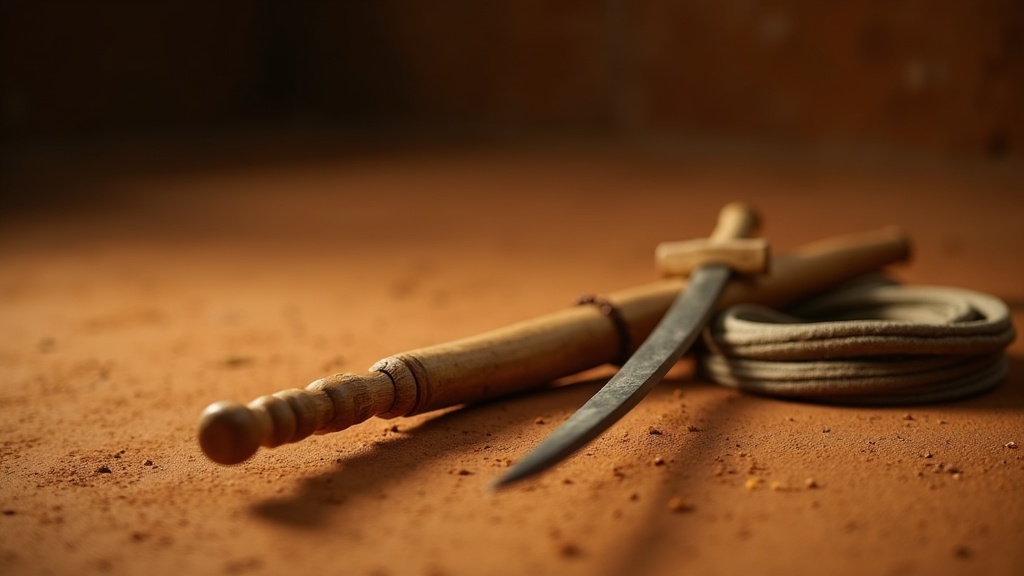
Kalaripayattu Weapons: The Complete Guide to Every Tool
Kalaripayattu Weapons: The Complete Guide to Every Tool in the Tradition
Most pages on this topic give you a list. Long staff, short stick, sword, urumi — a paragraph each, a Wikipedia-flavoured sentence about what they look like, and that is the end of it. The reader walks away knowing the names but not knowing where any of these objects came from, what they were originally designed to teach, or whether they are still trained today. That gap is what this article is built to close. Every Kalaripayattu weapon is treated here as three things at once: a piece of history, a specific tool with characteristics no other martial tradition uses in quite the same way, and a teacher that shaped the body of the warrior who carried it. By the end you will know every weapon by name, by hand, and by purpose.
Kalaripayattu weapons are the named training implements used in the wooden (kolthari) and metal (ankathari) stages of Kalaripayattu, the traditional martial art of Kerala. The core set comprises roughly nine weapons — the kettukari long staff, cheruvadi short stick, otta curved wooden weapon, kataram dagger, val sword and paricha shield, kuntham spear, the flexible urumi, and the vetukathi battle knife — each preserved through living teaching lineages today.
Key Takeaways
- Kalaripayattu uses a defined set of roughly nine core weapons, each with its own history, geometry, and pedagogical role inside the practice.
- Wooden weapons (kolthari) are taught first because a wooden blow can be received in training; metal weapons (ankathari) follow because the geometry must already be a habit before a real edge enters the room.
- The urumi is the only flexible-bladed sword still trained in any living martial art — its presence is the single most distinctive feature of Kalaripayattu's weapon catalogue.
- The otta — a curved wooden weapon shaped like an elephant's tusk — exists in no other martial tradition on earth and is treated as the bridge between wood and metal.
- Some weapons (mace, large battle knives in certain regional forms) are no longer actively trained and survive only ceremonially or in temple display.
- Every Kalaripayattu weapon was a teacher first and a fighting object second: the kettukari taught range, the otta taught angle, the urumi taught awareness in every direction at once.
- Most of these weapons can still be seen today — trained in working kalaris in Kerala, demonstrated in performances, and held in museums across the state.
The Logic of Kalaripayattu Weapons
Before the names, the logic. The reason Kalaripayattu's weapon catalogue is structured the way it is — wooden first, metal next, certain blades reserved for years later — is not historical accident. It is pedagogy worked out over centuries of teaching warriors who would actually fight with these objects.
The principle is simple. A weapon, in this tradition, is treated as a longer arm. If the body cannot move freely without an implement, no implement will move freely in its hand. Every wooden weapon is therefore an extension exercise — a way of training the body's geometry through a tool that can be received without serious harm. Every metal weapon is the same training, applied to an edge that does not forgive contact.
Inside that logic, each weapon was assigned a specific lesson. The long staff teaches range; the short stick teaches close-quarter timing; the curved otta teaches the angles that correspond to vital points on the body; the dagger teaches close-edge timing; the sword and shield teach the symmetry of attack and defence; the spear concentrates the staff's geometry into a single sharp point; the urumi tests every prior lesson at once. There is no weapon in the curriculum that exists only because it is a weapon. Each one is also a teaching tool.
This is why the order of the weapons matters as much as the weapons themselves. For the full treatment of how the weapons sit inside the four-stage training architecture, see the complete map of Kalaripayattu's disciplines and weapons progression.
Wooden Weapons — Kolthari
The wooden weapons stage is called kolthari. Kol means stick; thari roughly means "with." Three weapons live here as standard, plus one rarer fourth that survives only in certain lineages.
Kettukari — the long staff
The kettukari is the long staff: roughly five feet of seasoned cane or bamboo, slightly tapered toward one end, light enough to move quickly and substantial enough to deliver real force. It is the first weapon almost every Kalaripayattu student is given.
History. Staff fighting is the oldest form of weaponed combat documented anywhere in South Asia. The earliest Sangam-period Tamil poetry refers to staff warriors centuries before the formal name "Kalaripayattu" enters the record, and the discipline of stick fighting was likely absorbed into Kalaripayattu from the same regional substrate that produced Silambam, the Tamil staff-fighting art still practised today. The staff entered the kalari as the natural first weapon: cheap to produce, easy to replace, safe enough for two students to exchange blows in training.
Unique characteristic. What distinguishes the kettukari from any other martial staff is not its length — many traditions use a roughly five-foot stick — but the geometry of the stances from which it is wielded. Kalaripayattu's low vadivu stances place the body much closer to the ground than karate's or kung fu's standing staff forms, which means the staff is generated from the hips and the floor rather than from the shoulders. The result is a strike that carries the weight of the whole body, not just the arm. A practitioner who has trained the staff inside its proper stance can put noticeably more force into a single blow than one who has trained the same weapon in a higher posture.
How it trained the body. The staff teaches range above all else. Where the body in early meithari training learns to occupy a one-arm radius, the kettukari extends that radius by the length of the stick — and the body must learn to feel where the tip is at all times without looking at it. The staff also reveals every gap in the prior body work. If the stance is too high, the staff cannot generate force; if the shoulders are tight, the staff arrives before the body does; if the gaze drifts, so does the tip. The student spends months on the staff because the staff is, slowly, retraining the body itself.
Status today. The kettukari is the most-trained weapon in every working kalari in Kerala. International schools teach it as the first weapon students encounter, and partner exchanges with the long staff are the standard intermediate-level demonstration form. It is the most alive weapon in the catalogue.
Cheruvadi and Muchan — the short stick
The cheruvadi, also called muchan in some lineages, is the short stick: roughly three handspans long, often a piece of dense wood like tamarind. It is the second wooden weapon a student typically receives, sometimes alongside the staff and sometimes after it.
History. Short-stick fighting in Kerala has its own deep lineage, associated particularly with the Kadathanadan tradition of northern Malabar. The short stick was historically the everyday self-defence weapon of villagers, dancers, and travellers — small enough to carry without obstruction, dense enough to deliver a disabling strike at close range. Its absorption into Kalaripayattu's formal weapon curriculum reflects this practical heritage rather than a battlefield origin.
Unique characteristic. Where the kettukari operates at distance, the cheruvadi operates inside the opponent's reach. The exchanges trained with this weapon are tighter and faster than anything in the long-staff curriculum — practitioners in advanced sequences move the stick through dozens of strikes per minute without losing the centre. The dense wood also means the cheruvadi targets specific anatomical zones in a way the staff does not, which is why it is the first weapon to begin quietly introducing marma (vital-point) awareness.
How it trained the body. The short stick teaches close-quarter timing. The student learns to read the opponent at conversation distance, to recover the weapon between strikes without dropping the centre of gravity, and to fight a longer weapon by closing in — the standard partner exercise is cheruvadi against kettukari, which the shorter weapon can only win by getting inside the longer weapon's range. The body learns a kind of compressed quickness that the staff alone cannot teach.
Status today. Still actively trained in nearly every kalari. The cheruvadi sees heavy use in performance choreography because its visual speed is dramatic, but its training use is more substantial than its performance reputation suggests.
Otta — the curved wooden weapon unique to Kalaripayattu
The otta, sometimes called ottakkol, is the strangest of the wooden weapons and the most distinctive. It is a curved wooden weapon, traditionally carved from a single piece of tamarind, roughly the length of the practitioner's forearm, shaped like a smooth-curving elephant's tusk that ends in a blunt knob. No other martial tradition on earth uses anything quite like it.
History. The otta appears to have emerged inside Kalaripayattu itself, with no clear external parallel. Some traditional sources trace its design to the elephant tusks once carried by warriors of the Kerala courts, where the natural curve and weight of ivory were transposed into wood for training purposes. Whether the tusk origin is literal or symbolic, the otta is recognised by historians of South Asian martial culture as one of the few weapons that exists nowhere outside the Kalaripayattu tradition.
Unique characteristic. The curve. Every other wooden weapon in the world's martial systems is essentially straight. The otta's curving shaft allows it to strike around a shield, around a parry, and into angles a straight weapon cannot reach — and those angles, not coincidentally, correspond to specific marma points on the human body. The knob at the end concentrates force into a small surface area, which is what makes the weapon capable of vital-point work even though it is made of wood.
How it trained the body. The otta teaches angle and vital-point targeting using a tool the student cannot kill with. The choreography for otta sequences is denser and more technically demanding than anything in the staff or short-stick curriculum — partly because the angles are unusual, partly because the wielder must learn to read the curve of the weapon as it moves. In many lineages, students are formally tested on otta sequences before being allowed to handle any metal weapon. The reasoning is direct: if the marma angles cannot be controlled with the curved wooden weapon, they should not be attempted with a real blade.
Status today. Still actively trained, but seen less in performance than the staff and short stick because its choreography is harder to demonstrate visually to an audience. Inside the kalari, however, the otta is treated as one of the most important weapons in the curriculum — the gate the student must walk through to reach the metal stage.
Gada — the mace
The gada is the mace: a wooden or metal-headed club, typically about three feet long, with a heavy weighted end. In the broader Indian martial culture the mace is iconic, associated above all with the figure of Hanuman and with the discipline of gada yuddha (mace combat) described in the Mahabharata.
History. The mace was a standard weapon of the broader Indian battlefield for many centuries. Inside Kalaripayattu it appears as a peripheral training tool rather than a central one — some northern lineages preserved mace work into the twentieth century, others did not. The weapon's primary survival today is not in the kalari but in the pehlwani wrestling tradition of north India, where the gada is swung in long arcs as a conditioning tool for the shoulders, back, and grip.
Unique characteristic. The mace's weight distribution. Unlike a staff or stick, where the mass is roughly even along the shaft, the gada's weight is concentrated at one end. This forces the wielder to learn rotational control from the hips, because no amount of arm strength can dominate a swinging weight at the end of a lever. A practitioner who masters the mace develops a particular kind of grounded shoulder mobility that is hard to acquire any other way.
How it trained the body. Where it was taught, the mace was used as a conditioning tool as much as a combat weapon — its swinging arcs built rotational power through the trunk and grip strength through the hands and forearms. As a combat weapon it taught the practitioner to commit fully to a strike, because the momentum of the weighted head cannot be cancelled mid-swing.
Status today. Rarely trained in modern Kalaripayattu schools. Most international students will never encounter mace work, and even in Kerala only a handful of traditional teachers preserve the curriculum. The mace survives more vigorously outside the kalari, in the Indian wrestling tradition, than inside it.
Metal Weapons — Ankathari
The metal weapons stage is called ankathari — also written angathari or aayudhaabhyaasam depending on the lineage. Five core weapons are taught here, in rough order of risk.
Kataram and Katari — the dagger
The kataram, sometimes called kadara or katari in spelling variants, is the dagger: short, sharp on one or both edges, used at close range. It is typically the first metal weapon a student is given.
History. The dagger is one of the oldest weapons in the human catalogue, and Kerala's dagger tradition has both indigenous and external roots. The katari style dagger, with its distinctive H-shaped grip (sometimes confused in Western sources with the better-known katar of north India), entered the regional weapon vocabulary through centuries of trade and conflict along the Malabar coast. Inside Kalaripayattu, the dagger functions as the natural first introduction to metal because the cheruvadi short-stick work has already trained the body to operate at this distance.
Unique characteristic. The Kalaripayattu dagger is wielded inside a body that has already trained extensively for close range. The student does not come to this weapon as a novice to short-distance combat — they come to it as someone who has spent months exchanging blows with a wooden tool at exactly this same distance. The metal version simply removes the room for error.
How it trained the body. Dagger work in Kalaripayattu includes thrusts, slashes, locks, disarms, and close-quarter clinching. The choreographed exchanges between two students with daggers are visually some of the most striking sequences in the art — fast, tight, and unmistakably grounded in real-world combat principles rather than performance aesthetics. The dagger teaches the body that metal has a different weight, a different sound, and a different consequence than wood.
Status today. Still trained in every traditional kalari. In international schools, the dagger may be introduced later in the syllabus or substituted with a wooden equivalent for safety reasons, but in Kerala the metal dagger remains a standard part of the ankathari curriculum.
Val and Paricha — sword and shield
Val is the sword; paricha is the shield. The pairing is the iconic image of Kalaripayattu, the form most often photographed and most often demonstrated to international audiences. The sword is typically a single-edged curved blade, though specific lineages train with variants. The shield is a round disc, roughly twelve to eighteen inches across, made of leather or wood, held at its centre by a single grip.
History. Sword and shield fighting is documented in Kerala from at least the medieval period, with the weapon featuring prominently in the ballads of the Vadakkan Pattukal — the heroic songs of north Malabar that celebrate warriors like Unniyarcha and Aromal Chekavar. Sword and shield were the standard kit of the chekavar warrior caste, who served as professional duellists in the regional courts. The form was nearly extinguished by the British colonial weapons ban of 1804 and survived only because a handful of teachers preserved it underground until the twentieth-century revival.
Unique characteristic. Symmetry. The student must learn to attack and defend simultaneously, with one hand offering and one hand denying, and neither hand can lead the other. Most beginners default into a striking hand and a passive hand — the sword and shield will not let that work for long. The shield must be active, the sword cannot defend itself. This is technically much harder than either weapon alone, and it is the reason this form is treated as one of the most pedagogically rich in the curriculum.
How it trained the body. The sword and shield train the practitioner to think with both sides of the body at once. The cross-body coordination this builds is unusual even among other martial arts that train two weapons simultaneously, because in Kalaripayattu the two hands are doing genuinely different things — one striking, one absorbing — rather than the same thing on two sides. The neural patterning is distinctive.
Status today. Heavily trained, heavily demonstrated. The sword-and-shield form is the centrepiece of nearly every Kalaripayattu performance worldwide. Inside the kalari it remains a serious training discipline, not a performance piece.
Kuntham — the spear
The kuntham is the spear: a long-shafted thrusting weapon, typically six to seven feet, with a sharp metal head. Some traditional variants are double-pointed.
History. The spear is the most-used infantry weapon in human history, and Kerala's spear tradition reaches back to the same Sangam-period martial culture that produced staff fighting. Inside Kalaripayattu the kuntham sits as the natural extension of the kettukari — the long-staff geometry, applied to a weapon with a sharp metal tip. The spear was the weapon a foot soldier was most likely to actually fight with in the regional warfare of medieval Kerala, which gave it a permanent place in the curriculum even after the colonial weapons bans reduced training to ceremonial purposes for some decades.
Unique characteristic. The Kalaripayattu spear is wielded from low stances that drop the body well below the height of the weapon's tip, which is unusual in the global spear tradition. The result is a thrust that comes from underneath the opponent's guard rather than across their centre — a geometry that other spear-fighting traditions, including European pike work, do not consistently train.
How it trained the body. The spear concentrates the lessons of the staff into a single sharp point, while adding the demand for absolute commitment in the thrust. A spear thrust cannot be half-given; the body must commit fully, then recover. This teaches a particular kind of all-or-nothing precision that the staff, which can deliver a partial blow, cannot. The spear also trains long-distance footwork — the wielder must close, thrust, withdraw, and reset across longer distances than any other weapon in the catalogue.
Status today. Trained in most working kalaris, but less heavily than sword and shield. International schools sometimes substitute a longer staff for the spear during introductory training, with the metal-tipped version reserved for senior students.
Urumi — the flexible sword
The urumi is the flexible sword, and it is the single most distinctive weapon in any living martial tradition on earth. The blade is roughly the length of the practitioner's own body — typically four to five and a half feet — both edges sharp, made of a flexible tempered steel that flows like a whip when swung. Some constructions are single-bladed; advanced versions have multiple flexible blades attached to a single handle. When at rest, the urumi is coiled around the wielder's waist like a belt.
History. The urumi's documented history reaches at least to the medieval Kerala courts, where it was associated with elite warriors and women fighters of the chekavar caste. The weapon is mentioned in the Vadakkan Pattukal ballads and was carried by warriors like Unniyarcha, whose mastery of the urumi is celebrated in the songs. The weapon survived the colonial period largely through the same underground transmission that preserved the rest of Kalaripayattu, and re-emerged with the twentieth-century revival.
Unique characteristic. It is the only flexible-bladed sword still trained in any martial art. Whip-like weapons exist in other traditions — the European urumi-influenced fustibalus, the Chinese jiujiebian (nine-section whip), various flail variants — but a sword whose blade itself is flexible, with sharp edges along its entire length, exists nowhere else as a living martial form. The weapon can wound the wielder as easily as the opponent; it returns on its own arc; it is unpredictable in a way no other sword is.
How it trained the body. The urumi is the integration test of every prior weapon in the curriculum. The student arrives at this blade with the floor-sense of meithari, the range awareness of the staff, the close-quarter speed of the short stick, the angle precision of the otta, the close-edge timing of the dagger, the dual-side symmetry of sword and shield, and the long-reach commitment of the spear. The urumi demands all of it at once, plus the awareness of three hundred and sixty degrees around the body, because the blade does not stop where the swing ends — it returns. A practitioner who has not built the awareness through every prior stage cannot survive a single sequence with this weapon.
Status today. Still actively trained, but only at senior levels. In most traditional Vadakkan lineages a student begins urumi training only after seven years or more of consistent practice. Solo practice precedes any partner work, and even then the partner work is conducted with great spatial caution. Some international schools demonstrate the urumi in performance but do not actively train it. A handful of teachers in Kerala still hold the full urumi curriculum.
Vetukathi — the battle knife
The vetukathi is the battle knife: a heavy single-edged blade, larger than a dagger, smaller than a sword, sometimes resembling a machete or short hunting knife. The name combines vettu (to cut) and kathi (knife) — literally, "cutting knife."
History. The vetukathi and its variants belong to Kerala's everyday utility-and-defence weapon tradition rather than its formal battlefield arsenal. Forms similar to the vetukathi were carried by hunters, farmers, and travellers as multi-purpose tools that could also serve as defensive weapons. Its absorption into the Kalaripayattu curriculum is regional and uneven — some northern lineages preserved formal vetukathi sequences, others did not.
Unique characteristic. The vetukathi is the most "practical" weapon in the catalogue in the everyday sense. Where the urumi and the sword-and-shield are battlefield or duelling weapons, the vetukathi is a tool a person might actually have to hand. Its training reflects this — sequences emphasise quick draw, single decisive strikes, and recovery into ready position rather than extended choreographed exchanges.
How it trained the body. The vetukathi trains a different mental posture than the duelling weapons. Where sword and shield assume a prepared, balanced opponent, the vetukathi assumes the kind of sudden close-distance threat that does not give the wielder time to set up. The training builds reactive close-quarter response rather than choreographed exchange.
Status today. Rarely trained. Most modern Kalaripayattu students will never encounter the vetukathi in formal training, and the weapon survives in only a few traditional lineages. International schools almost never teach it.
Weapons No Longer Trained
A few weapons that historically belonged to the broader Kerala martial vocabulary have effectively disappeared from active Kalaripayattu training. They are worth naming because they appear in older sources and in museum collections, and a student doing serious reading on the tradition will encounter them.
The trident (shoolam). The trident was a battlefield and ceremonial weapon in medieval Kerala, with strong religious associations through its connection to Shiva. It was trained in some forms of Kalaripayattu but is no longer part of the standard curriculum in either Vadakkan or Thekkan lineages. Surviving tridents are seen in temple display and in a small number of regional museum collections.
The bow (villu). Bow and arrow training was a recognised part of the broader Kerala warrior tradition and is mentioned in regional martial literature. Inside Kalaripayattu specifically, the bow was always peripheral — Kerala's terrain and combat style favoured close-range weapons — and active bow training has not survived the modern period in any major lineage.
Large two-handed swords. Some regional variants of the Kerala straight sword were two-handed and considerably larger than the standard val. These weapons survive in temple display and in a few private collections but are no longer trained anywhere as far as the documented record shows.
The mace (gada), partially. As noted above, the gada is preserved in some northern lineages but has largely migrated out of Kalaripayattu and into the pehlwani wrestling tradition of north India. A modern Kalaripayattu student is more likely to see a mace in a wrestling akhara than in a kalari.
The disappearance of these weapons is not a sign of decline. Every living martial tradition prunes its curriculum to what its current teachers can transmit and its current students can absorb. The weapons that remain are the ones a thousand years of teaching kept worth teaching.
Where to See Kalaripayattu Weapons Today
For a reader who wants to actually see these weapons — not just read about them — there are a handful of reliable options across Kerala and beyond.
Working kalaris in Kerala. The most direct way to see the weapons in use is to visit a working kalari. The largest and oldest is the CVN Kalari Sangham in Thiruvananthapuram, founded in 1956, which trains the full curriculum daily. Other prominent working kalaris include the ENS Kalari in Ernakulam and several traditional schools in Kannur and Kozhikode districts. Visitors are generally welcome to observe training; some kalaris run regular public demonstrations.
Performance venues. Several venues in Kerala stage daily or weekly Kalaripayettu performances aimed at travellers — Fort Kochi has a regular evening show, and several Ayurvedic resorts and cultural centres in the state offer scheduled performances. These shows emphasise the visually dramatic weapons (sword and shield, urumi, cheruvadi exchanges) and typically include verbal introductions for international audiences.
Museums. The Kerala state museum collections include traditional weapons in their cultural heritage sections, and the Pazhassi Raja Museum in Kozhikode holds weapons associated with the eighteenth-century warrior king Pazhassi Raja, who fought the British Mahabharata campaigns and was himself a trained Kalaripayattu practitioner. Several smaller regional museums display urumi, sword, and dagger specimens.
International schools. Outside India, a growing number of Kalaripayattu schools in Europe and North America hold weapon training as part of their curriculum. The teaching is generally restricted to wooden weapons and some metal forms; the urumi is rare even in serious international schools because the safety overhead is so high.
For what it is actually like to begin training in person — including which weapons you would first meet — see the honest beginner's guide to starting Kalaripayattu.
Frequently Asked Questions
Which is the deadliest Kalaripayattu weapon?
The honest answer is that "deadliest" is a misleading frame. Any sharp-edged metal weapon in trained hands is lethal, and the comparative danger between, say, a spear and a sword has more to do with the situation than the weapon. That said, the urumi — a flexible sword roughly the length of the practitioner's body, with both edges sharp — is the weapon most likely to wound its own wielder as well as the opponent. It is for that reason often called the most dangerous weapon to train, regardless of how it compares in actual combat. For a fuller discussion of why the "deadliest" framing tends to obscure more than it reveals, see our measured look at the misunderstood-martial-art framing.
Which Kalaripayattu weapon is hardest to learn?
The urumi, without serious dispute. It requires the integration of every lesson taught by every prior weapon in the curriculum — range, timing, angle, symmetry, commitment, and three-hundred-and-sixty-degree awareness — plus an absolute confidence in the body's ability to know where the flexible blade will return. Most traditional lineages begin urumi training only after seven years of consistent practice with all the prior weapons. The otta is the second-hardest in most teachers' estimation, because its curved geometry is genuinely unusual and its sequences are technically dense.
Is the urumi a real weapon or just a performance prop?
It is a real weapon, with a documented history of use in medieval Kerala combat and a continuous teaching lineage to the present day. It is also the most spectacular weapon in the catalogue, which is why it appears so prominently in modern performances — but the performance use is downstream of the training tradition, not a substitute for it. Practitioners who handle the urumi seriously bleed during the learning process more often than not, which is the clearest evidence that the weapon is not a stage prop.
Can I buy a Kalaripayattu weapon?
You can. Authentic wooden weapons — kettukari, cheruvadi, otta — are sold by traditional craftsmen in Kerala and through international Kalaripayattu schools. Metal weapons including swords, daggers, spears, and urumis are produced by a small number of specialised smiths in Kerala. The recommendation from most serious teachers is the same: do not buy a metal weapon, especially an urumi, without first having trained with the wooden equivalent under a teacher. The object is genuinely dangerous and the cost of misjudging it is not theoretical.
What is the legal status of these weapons in different countries?
Legal status varies considerably. In India, traditional martial weapons are largely legal for training purposes, with practical restrictions on public carrying. In the United Kingdom, the Offensive Weapons Act and prior legislation restrict the sale and import of certain bladed weapons; flexible bladed weapons like the urumi may fall under specific restrictions and should be checked individually. In Germany, the Waffengesetz permits possession of most edged weapons but restricts carrying. In the United States, regulations vary by state. The practical advice is to check current national and local law before importing or carrying any of these weapons across borders.
Why is the urumi the only flexible sword in any martial art?
The honest answer is that nobody knows for certain, but the most credible explanation lies in Kerala's metallurgical tradition. The flexible steel required for the urumi's blade — strong enough to hold an edge, supple enough to coil — was a specific regional craft, and the pedagogical infrastructure (years of preparatory training across multiple other weapons) was necessary to make the weapon teachable. Other cultures may have experimented with flexible blades and abandoned them; Kerala's combination of a metallurgical capability, a teaching tradition long enough to prepare students for the weapon, and an unbroken transmission lineage is what preserved the urumi as the singular survivor.
What weapons did women warriors of Kalaripayattu carry?
The same weapons as the men. The most celebrated women practitioners — Unniyarcha, Aromal Unni, and others honoured in the Vadakkan Pattukal ballads — are specifically remembered for their mastery of the urumi and the sword and shield. Modern kalaris in Kerala routinely train women in the full weapon curriculum, and several senior teachers internationally are women. The tradition has never restricted weapons by gender.
Do international Kalaripayattu schools teach all the weapons?
Most do not. The standard international curriculum includes the wooden weapons (kettukari, cheruvadi, otta) and a subset of the metal weapons (typically dagger and sword-and-shield). The urumi is rarely taught outside India because the safety overhead is so high and the teacher must be confident in their own command of the weapon before guiding a student through it. The spear, mace, and vetukathi are also uncommon in international curricula. A serious student who wants the full weapon catalogue typically travels to Kerala for an extended period of in-person training.
How long does it take to train any Kalaripayattu weapon properly?
The progression varies by weapon. The long staff (kettukari) can be introduced after roughly three to six months of body conditioning and produces functional competence within a year of dedicated practice. The short stick and otta take another six to twelve months each. The metal weapons (dagger, sword and shield, spear) require an additional year or two of consistent training to handle responsibly. The urumi, in traditional lineages, is reserved for seven years or more. These are not arbitrary numbers — they reflect what the body and nervous system actually need to absorb each weapon's geometry.
What is the difference between the urumi and other whip-like weapons?
The urumi is a sword whose blade itself is flexible and sharp along its entire length. Other "whip-like" martial weapons — the Chinese nine-section whip, various Japanese chain weapons, the Indian aara — use a flexible connecting element between rigid striking sections, or use a flexible shaft with a rigid head. The urumi is different in kind: the blade is the whip. This makes it both more cutting-capable than the chain weapons and considerably more dangerous to the wielder than weapons with a rigid striking surface.
Are there modern reproductions of these weapons or only traditional craftsmanship?
Both. Traditional weapon craftsmanship survives in Kerala, with a small number of specialised smiths producing genuine urumi, val, and other metal weapons by hand. Modern reproductions of varying quality are also produced for the global martial-arts market — some of these are training-grade, some are display pieces only. For serious training the recommendation is to source the weapon through a known teacher or directly from a verified traditional craftsman; reproductions intended for display can be unsafe in training contexts because the metallurgy is not always battle-grade.
How are the weapons named in different regional dialects?
Kalaripayattu's weapon vocabulary is primarily Malayalam, with significant overlap with Tamil for the southern lineages. The same weapon may appear under different names in different sources: cheruvadi and muchan refer to the short stick, kataram and kadara and katari are spelling variants for the dagger, ankathari and angathari and aayudhaabhyaasam are all names for the metal weapons stage. International English-language sources sometimes anglicise the names ("long staff," "battle knife," "flexible sword") which can make the same weapon appear under multiple names in the same article. The Malayalam names are the most stable reference points.
Sources & Further Reading
- Kalaripayattu — Wikipedia's comprehensive entry, including the full weapons list with regional variations.
- Urumi (sword) — Wikipedia entry on the flexible sword, its construction, and its place in south Indian martial culture.
- Indian martial arts — Wikipedia overview situating Kalaripayattu's weapons within the broader South Asian tradition.
- Silambam — Wikipedia entry on the Tamil staff-fighting tradition that shares deep roots with the kettukari curriculum.
- Kadathanadan Kalari — Wikipedia entry on the northern Kerala tradition known for short-stick work.
- Kerala — Wikipedia entry on the Indian state where Kalaripayattu was formalised.
- Sangam period — Wikipedia entry on the early Tamil literary period that contains the earliest references to proto-Kalaripayattu martial culture.
- Pazhassi Raja — Wikipedia entry on the eighteenth-century Kerala warrior king associated with the traditional weapons.
- Unniyarcha — Wikipedia entry on the legendary female urumi and sword-and-shield practitioner.
- Martial art — Britannica's overview of the global martial-arts landscape, useful for situating Kalaripayattu's weapons.
- Sword — Britannica's overview of swords as a weapon class, with helpful context for understanding the urumi's unusual flexible design.
- Spear — Britannica entry on the spear as a martial weapon, useful for context on the role of the kuntham.
- Mace — Britannica entry on the mace as a weapon class, useful context for the gada.
- Pehlwani — Wikipedia entry on the north Indian wrestling tradition that preserved the mace after it largely migrated out of Kalaripayattu.
- Kalaripayattu — Kerala Tourism — the Kerala state government's official cultural-heritage page on Kalaripayattu and its weapons.
- CVN Kalari Sangham — Wikipedia entry on one of Kerala's foremost working kalaris, founded in 1956.
- Vadakkan Pattukal — Wikipedia entry on the heroic ballads of north Malabar that document the medieval use of Kalaripayattu weapons.
- Katar (dagger) — Wikipedia entry on the related Indian push dagger, useful for distinguishing it from the Kerala katari.
Conclusion
A Kalaripayattu weapon is never only a fighting object. It is a piece of history — the staff that absorbs the oldest South Asian stick-fighting tradition, the urumi that survives nowhere else as a living martial form, the otta that exists in this tradition alone. It is a specific tool with a specific characteristic — the staff's range, the dagger's close-edge timing, the curve of the otta, the return of the flexible blade. And it is a teacher — each one designed, over centuries of refinement, to build a particular capacity in the body that carried it.
The best way to start understanding what these objects actually train is to feel the body they are designed to be wielded from. Before any weapon, every Kalaripayattu student spends months in meithari — the body-conditioning stage that turns an ordinary adult body into a body that can use a tool well. The first lesson is free, no payment, no commitment, and it lives entirely in the body itself. Create your account and start with Lesson 1 →
About the Author
Raphael Gorschlüter — Co-Founder & Head Teacher, Kalari University
Raphael Gorschlüter has trained Kalaripayattu for more than twelve years and teaches internationally — at Kalari University's main school in Germany, in Spain, and on annual retreats in India. He has guided students through the full wooden and metal weapons curriculum, including the long staff, short stick, otta, dagger, sword and shield, spear, and the flexible urumi. His teaching is grounded in the Vadakkan northern lineage and informed by ongoing study with senior teachers in Kerala. The first Kalari University retreat under his direction takes place in Tiruvannamalai in August 2026.
