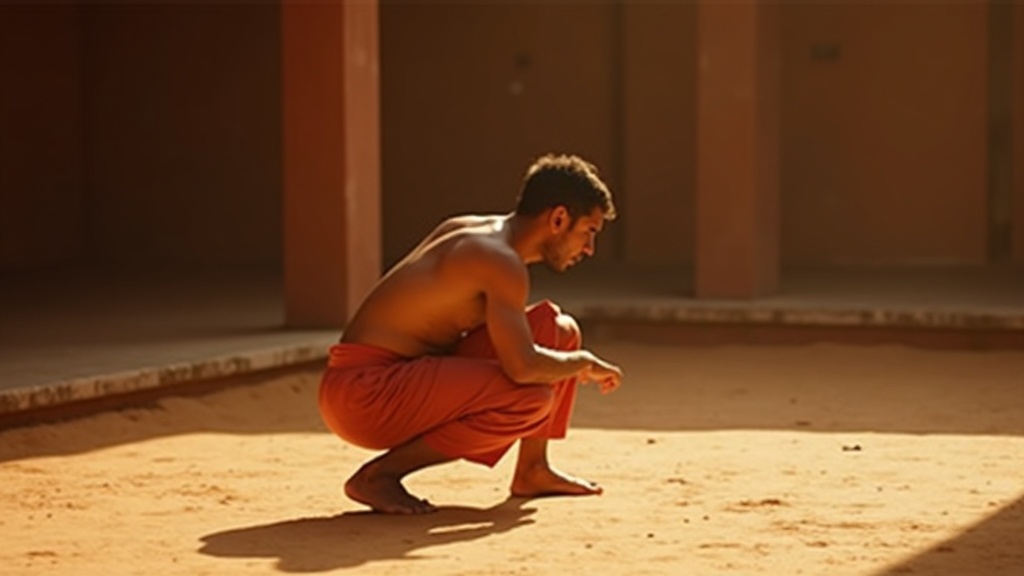
Proprioception Training Martial Arts — Why Most Miss It
Proprioception Training Martial Arts — Why Most Miss It
Last updated: 27 May 2026
The people who train hardest are often the worst at proprioception. That sentence runs against everything the sports-science articles imply, but it is what shows up on the floor again and again. The fighter with a decade of mat hours, the climber with a hundred clean sends, the runner with five marathons in the legs — they all know how to make the body do the thing. Whether they can actually feel it doing the thing while it happens is a different question, and the honest answer is usually no.
This guide takes proprioception training in martial arts out of the Bosu-ball, single-leg-balance, Turkish-get-up frame that dominates the SERP. Those drills are not wrong — they just do not name the real lever. Proprioception is not a fitness variable to be loaded. It is the difference between performing a movement and inhabiting one. By the end of this article you will know what proprioception actually is in the body, why traditional martial arts trained it for centuries before the word existed, why most modern proprioception drills miss the felt centre of it, and what to do instead.
Proprioception training in martial arts is the deliberate development of your body's internal sense of position, motion and effort — the felt map you use to know where your limbs are, how your weight is distributed, and how each movement is actually landing inside you. It runs deeper than balance work: it is the sensory infrastructure that lets a strike, a stance or a step be felt from the inside rather than only watched from the outside. Traditional systems like Kalaripayattu trained this sense through slow weight-shifting sequences for two thousand years before sports science gave it a name.
Key Takeaways
- Proprioception is the body's internal sense of joint position, motion and effort — distinct from balance, distinct from coordination, and trainable in its own right.
- Most martial-arts proprioception drills (Bosu balls, single-leg stance with eyes closed, Turkish get-ups) train the performance side of the sense while leaving the felt side largely untouched.
- The people who train hardest often score worst on proprioception because repetition without attention builds movement habits without the inner map underneath them.
- Traditional martial arts — Kalaripayattu's meipayattu, kata in Japanese systems, taolu in Chinese internal arts — were proprioceptive curricula by design, centuries before the term existed.
- Floor-based, slow, weight-shifting work develops proprioception more reliably than equipment-driven instability work for most martial artists past the beginner stage.
- A daily five-minute slow stance practice with eyes closed at the halfway point trains proprioception more than thirty minutes of fast pad work.
- A working proprioceptive sense is the missing input behind "I keep training but nothing is landing" — the exact pattern most stuck martial artists describe.
What Proprioception Actually Is
The word gets thrown around in fitness writing as a vague synonym for balance or coordination. It is more specific than that, and the specificity matters because it points at what to train.
The textbook definition
Proprioception is the sense of self-movement, body position and effort, generated by specialised receptors in muscles, tendons, joint capsules and skin. The Cleveland Clinic describes it as the body's spatial GPS — the system that lets you touch your nose with your eyes closed, climb a stair without looking down, or know which way your hand is rotated under your jacket sleeve.
It is one of three closely linked internal sensory systems. The other two are the vestibular system (inner-ear balance), and the broader somatosensory system (touch, pressure, temperature, pain). Proprioception is sometimes counted as part of somatosensation; either way, it is the channel specifically dedicated to the body knowing itself in motion.
The receptors involved are well-mapped. Muscle spindles report length and rate of stretch. Golgi tendon organs report tension. Joint mechanoreceptors report position and movement at the joint capsule. Skin receptors contribute through stretch and pressure. All of this feeds into a real-time map in the somatosensory cortex that updates continuously as you move. The accuracy of that map is what is meant by "proprioceptive acuity," and it is what proprioception training in martial arts should be aiming at.
Why it is not the same as balance
Balance is the outcome — staying upright. Proprioception is one of the inputs. The vestibular system and your eyes are the other two. You can have decent balance with weak proprioception if your eyes and inner ear are doing the heavy lifting. Close your eyes on one leg and you find out fast — that is the proprioceptive system being asked to do the job alone, with no visual or vestibular help.
This is why the eyes-closed single-leg test became the standard quick-look at proprioception. It strips out the easier inputs and forces the harder one to perform. Useful as a diagnostic, narrower as a training tool, and we will come back to why.
What it actually feels like
The textbook definition does not tell you what to feel for. Three concrete examples that practitioners can verify in their own body:
The first is the foot under load. Stand barefoot, shift your weight slowly from the right leg to the left. Can you feel which part of the foot is bearing the load at any moment — the heel, the outer arch, the ball, the inner edge? That continuous, granular read on weight distribution is proprioception in real time. Most people who have not trained the sense can tell roughly which side; the inner arch versus the outer arch under the same foot is usually a blur.
The second is the joint between movements. In a slow squat, can you feel the precise moment your hip starts to load before your knee bends? Or does the descent feel like one undifferentiated event? The closer the read on the sequencing of joints, the better the proprioceptive map.
The third is the spine in micro-adjustment. Stand still. Eyes closed. Notice the tiny tilts and corrections happening around the spine to keep you upright. They never stop. A trained proprioceptive system feels them as discrete events; an untrained one feels nothing — the body is just "standing."
Why Martial Artists Need Proprioception More Than Anyone
The sports-science case is well established. Proprioception affects reaction time, balance recovery, joint stability, technique consistency, and injury prevention. Anyone who throws strikes, takes falls, holds stances, or loads joints under uncertainty benefits from a sharper internal map. The standard articles cover this well, so this section is brief on the performance side and longer on the side the standard articles miss.
Reaction, balance, self-correction
A 2015 review in the Journal of Sports Science & Medicine summarises the evidence that targeted proprioceptive training improves balance and reduces injury rates across multiple sports. For martial arts specifically, the carry-over shows up in three places.
Reaction shifts because proprioception is part of the closed loop that tells you a strike has landed off-target before the eyes confirm. The cleaner the loop, the faster the next movement can adjust mid-flight. Balance recovery shifts because falling, being thrown or stumbling all force the body into positions it has not pre-planned — and the speed of the proprioceptive read is what determines whether you recover or collapse. Self-correction across rounds shifts because trained proprioception lets you notice a stance drifting or a guard dropping without a coach pointing it out.
Injury prevention and joint stability
Ankles are the classic case. After a sprain, proprioception in the joint drops measurably, and the ankle becomes more likely to roll again — not because the ligaments have stayed weak, but because the receptors and the neural map have lost resolution. Rehabilitation explicitly retrains proprioception through balance work, with documented reduction in re-injury rates.
The principle generalises. Joints with sharper proprioception stay better organised under load. Shoulders that "know where they are" mid-throw are less likely to drift into impingement positions. Hips that read their own rotation are less likely to track the knee inward under a heavy stance. Most chronic martial-arts injuries are not single-event failures; they are accumulated drift the proprioceptive system never flagged because it was never trained sensitive enough to notice.
The point most articles miss — the inner experience
Here is where the SERP goes silent. Every guide on proprioception training in martial arts frames the sense as an external performance variable: train it to fight better, to punch harder, to react faster, to not get hurt. All true. All incomplete.
The deeper benefit is what proprioception does to your experience of training itself. With a sharp proprioceptive map, a movement becomes legible from the inside. You feel the shift of weight, the loading of the leg, the rotation of the hip, the position of the shoulder, the path of the strike — not as separate facts to monitor, but as one continuous felt event. Without that map, the same movement is something the body does while you watch.
This is the precise gap most experienced martial artists describe when they say "I'm doing the work but it's not landing." The work is the movement. The landing is the proprioceptive read. The articles that treat proprioception only as a performance variable miss the side that matters most to the practitioner — the side that turns training from a series of executions into a series of inhabited movements. We unpack that gap in detail in the body awareness benefits of Kalaripayattu, which is the sister piece to this one.
Why Years of Training Can Still Leave You Disconnected
This is the part most articles refuse to say out loud. Doing martial arts for ten years does not automatically build proprioception. Doing them for twenty years can leave the same gap. The reason is structural, and naming it is the first step out of it.
The trap of repetition without attention
The brain refines its proprioceptive map only when attention is actually on the sensation. Repetition with attention elsewhere — on the opponent, on the count, on technique correction, on aesthetics, on the camera, on the next move — refines the motor program without refining the felt map underneath.
This is why a thousand jabs with the mind half-tracking the trainer's call can leave the proprioceptive resolution of the shoulder almost untouched, while fifty very slow jabs with attention parked inside the shoulder, hip and floor change the map noticeably. The difference is not the number of reps. It is where attention was.
Motor learning research backs the practical observation: attentional focus has a measurable effect on which neural systems strengthen during practice. External focus (the target, the result) strengthens different patterns than internal focus (the felt body during execution). Most modern training defaults to external focus and gets the corresponding result: high external skill, low internal resolution.
Strong does not mean sensed
A heavily muscled body can have a clouded proprioceptive map. Chronic tension dampens the receptors. Hypertrophy without proprioceptive work can mean more muscle to carry around with fewer accurate signals coming from it.
The reverse also holds. A lean, trained yogi who has never lifted heavy can have a sharper proprioceptive read than a deadlifter twice their size — not because thin is better, but because attention spent inside the body over years builds the resolution muscle alone does not.
For the martial artist this matters because the natural training instinct is to add: more strength, more conditioning, more rounds, more drills. None of that automatically adds proprioception. Adding strength to a vague proprioceptive map gives you a stronger version of vague.
What students notice when the gap closes
The reports are consistent across the practitioners I have taught over the last twelve years. They say things like: "I felt my hip for the first time today." "I noticed my left foot was lifting before my right foot landed." "The same kick I have done a thousand times suddenly had a centre I could feel." These are not mystical statements. They are descriptions of a proprioceptive map finally lighting up the part of the body that had been doing the work without being felt.
Almost every one of those reports comes from slowing the same movements down by a factor of three to five, removing distractions, and parking attention inside the body that was about to move. None of them come from adding equipment.
How Traditional Martial Arts Train Proprioception
This is the section the modern proprioception literature skips entirely. Long before sports science named the sense, traditional martial systems built curricula that trained it as the centre of the practice, not as a warm-up add-on.
Forms, kata and sequences as proprioceptive curricula
The kata in Japanese karate, the taolu forms in Chinese martial arts, the chuvadu sequences in Kalaripayattu — all do similar work. They are long, ordered sequences of movements practised slowly and repeatedly, with attention required to remember the sequence and to land each position cleanly. The repetition is not for muscle memory in the gross sense; it is for the gradual refinement of the felt map underneath the technique.
A practitioner repeating a kata for the thousandth time is not learning the kata. They are learning the inside of their own body, using the kata as the structure that requires attention to stay on the body. Sensitive teachers see the practitioner change shape over years of the same form — not because the form changed, but because the body became more transparent to itself through it.
Internal Chinese arts make the proprioceptive intention explicit. Tai chi and qigong name internal sensation, breath, and weight-shift as the actual content of the practice; the slow, repetitive form is the delivery mechanism. The modern SERP rediscovers this principle and calls it "somatic movement," but the engineering is two thousand years old.
The Kalaripayattu approach — meipayattu and "the body becomes all eyes"
Kalaripayattu, the traditional martial art of Kerala, built proprioceptive training into its foundation stage from the start. The first of the four stages is meithari — body conditioning — and its core unit is meipayattu, the body-sequence: long flowing patterns of low stances, weight-shifts, kicks and arm extensions, practised slowly and repeated for years before any weapon is touched.
There is a traditional saying in the kalari: meyyu kannakanam — "the body becomes all eyes." It points at exactly the sense modern sports science calls proprioception, named from the inside of the practice rather than from the outside. The body that has done meipayattu for years reads its own position, weight, and motion the way ordinary vision reads space.
The pedagogy is unambiguous. A new student spends the first months almost entirely in slow weight-shifting work — low stances, repeated transitions, foot-on-the-ground awareness. Speed comes later. Application comes later still. The early stage is structured explicitly around the proprioceptive map; everything else rests on it.
This matters for the modern reader because it answers a practical question: what is the most efficient way to train martial arts proprioception? The traditional answer is also the answer the research now points at. Slow, weighted, ground-contact movement, repeated with attention parked inside the body. Floor work and stances train proprioception more reliably than any equipment-based drill.
Why floor work and weight-shifting beat balance boards
The Bosu ball, the wobble board, the foam pad — all of them generate instability the body has to respond to. They produce real proprioceptive challenge, and they have a place in rehab and athletic conditioning. But for the martial artist past the rehab stage, three structural limitations apply.
First, the instability is unfamiliar. The body has to spend most of its attention on managing the unstable surface, leaving less attention available for the felt read of the joints, weight and breath underneath. The proprioceptive system gets activated, but mostly in damage-control mode.
Second, the geometry is wrong. Fighting, falling, taking and giving throws, holding stances — none of this happens on a wobble board. The proprioceptive map being trained on the unstable surface is one step removed from the map being used on the floor where the actual practice lives.
Third, equipment-based drills tend to be short, intense, and discrete — a set of single-leg stands, then move on. Traditional sequence work is long, slow, and continuous. The continuous form is what gives attention time to land deeply inside the body rather than skipping along the surface of a balance challenge.
This does not mean throw the Bosu ball away. It means do not mistake the warm-up tool for the actual training of the sense. The actual training is slow, ground-based, repeated, attentive sequence work — the thing kata, taolu and meipayattu have been since the start.
Five Ways to Train Proprioception That Actually Land
These are the five approaches I run with students who arrive describing the "I keep training but nothing is landing" pattern. Most of them already have plenty of strength and skill. What they lack is the inner map.
Slow it down before you add load
The single most reliable upgrade to proprioception is to take a familiar movement and do it three to five times slower than you normally would. Not in your warm-up. Not for a single set. As a deliberate, repeated practice — ten to twenty slow reps of the same fundamental movement, several times a week.
The slowness opens a window for attention to land inside the joints, the weight transfer, the breath. The familiarity removes the cognitive load of learning a new pattern, so the attention can go entirely to the felt read. A slow lunge, a slow squat, a slow weight-shift between two stances, a slow shadow-strike — any foundational movement becomes a proprioceptive trainer when slowed below the threshold where it can run on autopilot.
Close your eyes during familiar movement
Vision dominates the input stack. As long as the eyes are open, the brain leans on them. Close them, and the proprioceptive and vestibular systems have to do the work alone.
This is the principle behind the eyes-closed single-leg stance, but the same principle generalises. Try a slow stance transition with the eyes closed. Try ten slow steps with the eyes closed in a safe space. Try a familiar form with the eyes closed once you know the sequence cold. The felt map that was hiding behind visual input has nowhere to hide. You will discover holes in it. That discovery is the training.
Train barefoot on varied surfaces
The foot is the part of the body in direct contact with the ground in almost every standing martial-arts movement, and its proprioceptive density is high. Shoes, especially cushioned ones, dampen the input from the sole and reduce the resolution of the read.
Train barefoot on at least one varied surface — wooden floor, packed earth, grass, sand if available. Walk slowly with attention parked in the soles. Stand and shift weight slowly across different surfaces. The traditional kalari floor is packed red earth for exactly this reason: it gives the foot a clean, slightly responsive surface that fills the proprioceptive channel without overwhelming it.
This is also why our Tiruvannamalai retreat trains on the traditional earthen floor — the surface itself is part of the proprioceptive teaching.
Single-leg stance with full attention
The classic drill still works, but only if attention is genuinely inside the standing leg the whole time. Most people do single-leg work with their eyes wandering and their mind on the timer. That trains balance survival more than proprioception.
Do it differently. Stand on one leg. Soften the eyes or close them after twenty seconds. Bring attention to the foot — heel, outer edge, inner edge, ball, toes — and let it travel slowly up: ankle, calf, knee, thigh, hip. Notice the micro-adjustments. Notice what is bracing and what is releasing. Two minutes of this is worth ten minutes of distracted single-leg work.
A daily five-minute felt-body scan in motion
This is the simplest one and the one most people skip. Pick one slow movement — a weight-shift between two stances, a slow squat, a slow forward step. Do it for five minutes a day, every day, with attention parked inside the body and nothing else allowed to enter the frame.
Three weeks of this, even with no other change to training, will shift the proprioceptive resolution noticeably. The shift is felt, not measured: the same techniques start to feel more inhabited, the same training feels more present, the body starts to send signals that were not coming through before.
If you want a structured version of this approach with one foundational kalari movement per day, that is exactly what the 7-day course is built around. More on that at the end.
Common Mistakes in Proprioception Training
These are the patterns that keep proprioceptive work from delivering, even in people who are doing the right exercises.
Treating it as a warm-up add-on
Three minutes of balance work at the start of a session is not proprioceptive training. It is a tick-box. The sense needs sustained, attentive input to update its map — not a quick tap at the start before the real work begins. The proprioceptive work has to be treated as the work, not the warm-up, at least sometimes, for the gains to land.
Chasing instability without awareness
More wobble does not equal more proprioception. If the surface is unstable enough that all attention goes to survival, the proprioceptive map gets noisy input rather than refined input. The sweet spot is challenging enough that attention is required, stable enough that attention can land. Most traditional ground-based work sits in that sweet spot naturally. Most equipment-based instability work tips past it.
Skipping the "feel it" pause
The most common technical mistake is racing through the movement without giving the body a moment to register what just happened. Each transition, each weight-shift, each completed slow rep wants a half-second pause for the felt sense to catch up. That pause is what lets the map actually update. Skip it consistently and the same hour of practice delivers a fraction of the proprioceptive gain.
Mistaking strength for sense
Strength training builds muscle. It does not, by itself, build proprioception. The two need to be trained alongside each other, with the proprioceptive work treated as a separate channel that needs its own time and its own attention. The fittest body in the room is not necessarily the most sensed body. Conflating the two is the most common reason heavy trainers stay disconnected from what they are doing.
Going for novelty instead of repetition
Variety is overrated for proprioception. The brain refines the felt map through repetition of the same input under the same conditions, not through constantly changing drills. Pick three movements and stay with them for months. The depth of the map you build inside those three is worth more than the surface of fifty different exercises.
Frequently Asked Questions About Proprioception Training in Martial Arts
What is proprioception in martial arts
Proprioception in martial arts is the trained ability to feel where your body is, how it is moving, and how it is loaded — without looking. It covers stance balance, joint position, weight distribution, and the precise read of how a technique is landing inside your own body. It is the inner map that lets a fighter adjust mid-strike, recover mid-fall, and self-correct without being told.
How do martial artists train proprioception
The standard modern approach uses balance work, single-leg drills, unstable-surface training, and exercises like the Turkish get-up. The traditional approach — used by Kalaripayattu, karate, tai chi and others for centuries — uses long slow weight-shifting sequences, low stance work, and barefoot ground contact. Both work; traditional sequence work tends to produce deeper resolution because attention can land longer.
Does martial arts improve proprioception
Yes, but unevenly. Slow, attention-based arts (tai chi, traditional Kalaripayattu, internal Japanese arts) reliably build it. Fast competitive arts (modern MMA, boxing, sport BJJ) build it to a point and then plateau, because attention tends to shift outward to the opponent. The arts that train it most reliably are the ones that demand internal attention as a core part of the practice.
What is the best exercise for proprioception
There is no single best exercise — but the most efficient one for most martial artists is a slow weight-shift between two stances, performed barefoot, with the eyes closed for at least part of the practice. Five minutes a day for three weeks of this single movement, done with full attention, shifts proprioceptive resolution more than thirty minutes of mixed drills. Simplicity beats variety here.
How long does it take to improve proprioception
The first noticeable shift in proprioceptive resolution usually arrives between days ten and twenty of daily focused practice, even with five-minute sessions. Earliest markers are sharper foot-floor contact and clearer joint sequencing. Deeper changes — feeling a strike from the inside, sensing micro-adjustments in the spine without thinking about them — take two to three months of consistent work to land.
Can you train proprioception every day
Yes, and daily training is more effective than longer sessions twice a week. The proprioceptive map updates through repetition, not duration. Short, slow, attentive sessions every day build the map faster than intense weekly drills. The risk with daily training is not overuse — the work is low-load — it is going through the motions and losing attention. Better to do five real minutes than fifteen distracted ones.
Why is proprioception important for fighters
For three reasons that matter in a fight. Faster reaction recovery when a strike lands off-target or a sweep takes the legs. Better joint stability under unexpected load, which translates directly to fewer injuries. Cleaner self-correction across rounds, so technique does not silently drift as fatigue builds. Behind all three is the same mechanism — a sharper internal map of where the body is and how it is loaded.
Is proprioception the same as balance
No. Balance is the outcome — staying upright. Proprioception is one of the three inputs that make balance possible (the other two are the vestibular system and vision). You can have decent balance with weak proprioception if your eyes and inner ear are doing the work. Close your eyes on one leg and the difference shows up immediately.
Does yoga improve proprioception
Yes, when practised slowly and with internal attention. Held postures, slow transitions, and breath-led movement all train the proprioceptive map. Fast power-yoga focused on shape and aesthetics trains less of it because attention stays external. The same applies to martial arts: it is the quality of attention during the movement, not the movement itself, that builds the sense.
Can you have too much proprioception
In practical terms, no. There is no documented downside to a sharper internal map. The closest thing to a risk is becoming so attention-heavy in slow practice that the ability to act fast under pressure suffers — but this is not the sense being too sharp; it is the practitioner not also training the fast, reactive side. A complete training mix uses both.
Why is proprioception so often missed in modern training
Because modern training defaults to external attention — the mirror, the target, the timer, the coach's call, the next rep, the camera. Proprioception only updates when attention is parked inside the body. The training architecture of most modern gyms is structured around outputs, not inputs, and the proprioceptive map quietly stays where it was. Traditional systems built attention-on-the-body into the form itself, which is why they trained the sense even without naming it.
What is the connection between proprioception and "feeling grounded"
"Grounded" is the felt sense that comes from a well-organised proprioceptive map plus reliable foot-floor contact. When you can feel your weight clearly through your feet, the joints know where they are, and the spine reads its own micro-adjustments in real time, the experience the body reports back is grounded. It is not a vibe. It is a trained felt state — and it is the outcome our students name most consistently after working with the practice.
Sources & Further Reading
- Proprioception — Wikipedia — Foundational definition, history of the term, and the receptor systems involved.
- Cleveland Clinic — Proprioception — Accessible medical-grade overview of the sense and how it is tested clinically.
- Vestibular system — Wikipedia — Background on the inner-ear balance system that works alongside proprioception.
- Somatosensory system — Wikipedia — The wider sensory category proprioception sits within.
- NIH / PMC — Proprioceptive training and injury prevention review (2015) — Peer-reviewed summary of proprioceptive training effects across sports.
- NIH / PMC — Attentional focus in motor learning — Research on how internal vs external focus shapes what motor practice trains.
- Indian martial arts — Britannica — Broader context for the traditional Indian martial arts discussed in the Kalaripayattu section.
- Kalaripayattu — Wikipedia — Background on the Kerala martial art and its four training stages.
- Tai chi — Wikipedia — Background on the slow Chinese internal art used as a comparison case for traditional proprioceptive training.
- Qigong — Wikipedia — Companion practice to tai chi, sharing the slow attentive movement architecture.
- Taolu — Wikipedia — The Chinese martial-arts form/sequence tradition referenced as a parallel to kata and chuvadu.
- Sports science — Wikipedia — Reference for the modern field that gave proprioception its current name.
Conclusion — From Executing Movement to Feeling It
Proprioception training in martial arts is not a fitness sub-category. It is the felt sense that turns trained movement from something the body executes into something the practitioner inhabits. The Bosu balls and Turkish get-ups have a place, but the deeper work is older and quieter: slow, repeated, attentive sequence work done barefoot on a stable surface, with attention parked inside the body while it moves. The traditional martial systems knew this. Modern sports science is rediscovering it under a different name.
For the martial artist already putting in the hours and still describing the "doing the work but it's not landing" pattern, the missing input is almost always here. Adding load, intensity or volume on top of an under-trained proprioceptive map gives you a stronger version of the same disconnection. Slowing down, parking attention inside the body, and treating the felt map as the actual training — not the warm-up — is what closes the gap.
If you keep training but nothing is landing: the 7-day course is built for exactly that. Seven days, one foundational Kalaripayattu movement per day, all of them designed to train the proprioceptive map from the inside out — slow, weighted, ground-based, attention parked inside the body. You will feel the difference by day three.
Start the 7-day Kalaripayattu foundations course — €24.90 →
(If the 7-day course page is not yet live: the first lesson of the full Level 1 curriculum is free — no payment, no commitment. Create your account and start today →)
About the Author
Raphael Gorschlüter — Co-Founder & Head Teacher, Kalari University
Raphael Gorschlüter is the co-founder of Kalari University and one of Europe's most experienced Kalaripayattu teachers. He has trained and taught the practice for over twelve years, with regular work in Germany, Spain and India — including the annual Tiruvannamalai retreat. His teaching focus is the somatic side of the tradition: developing the ability to feel movement rather than only perform it. Almost everything in this guide has come out of teaching students who already trained hard for years but still described the same gap — the body moving without being felt from the inside. The proprioceptive work in the kalari is the answer he has watched land in those students again and again.
→ More about Raphael and Kalari University
