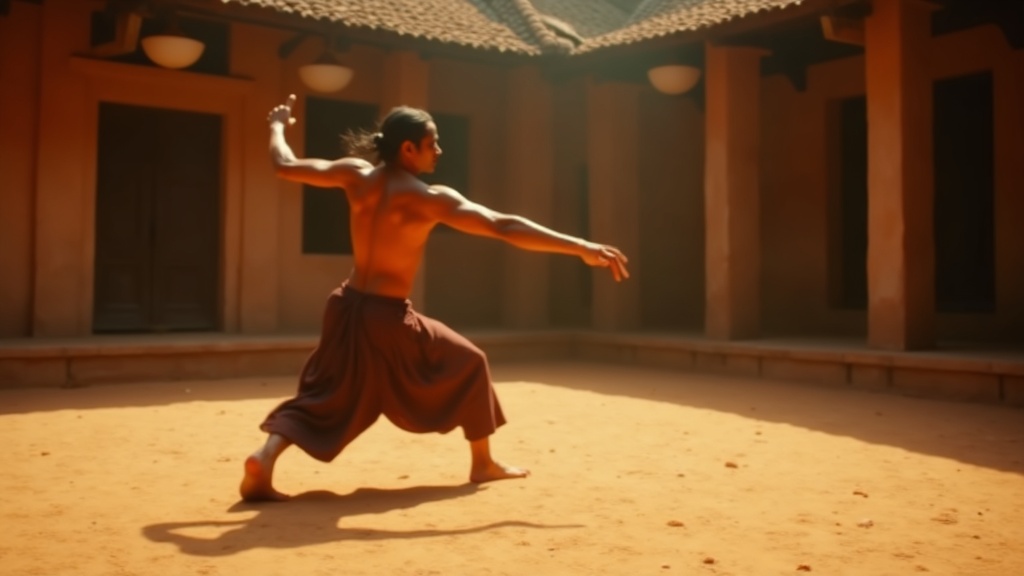
Ankam and Poithu: Kalaripayattu's Judicial Duels
Ankam and Poithu: Kalaripayattu's Judicial Duels
For eight hundred years, the kingdoms of Kerala settled their most serious legal disputes without going to war. They sent two men into a courtyard, gave them weapons, and let them fight. Whoever survived had won the case. The outcome was binding. The kingdom moved on.
The practice was called ankam. Its more intimate variant — fought between individuals rather than on behalf of kingdoms — was called poithu. Both relied on a class of professional duellists known as the Chekavars, trained from childhood in Kalaripayattu and engaged by disputing parties the way a modern litigant would engage a barrister. The men who fought were not amateurs. They were specialists. The duel was not a brawl. It was a courtroom.
This article is the story of that system — how it worked, who fought, what they trained, why it lasted as long as it did, and why scholars at the Lieber Institute at West Point now study it as one of the earliest non-European precedents for what we today call International Humanitarian Law.
Ankam is a formalised judicial duel from medieval Kerala used from roughly the tenth century through the eighteenth to settle disputes that local governmental assemblies could not resolve. Each side appointed a champion — typically a Chekavar professional warrior trained in Kalaripayattu for up to twelve years — and the duel's outcome was legally binding on the parties. Its close variant, poithu, served the same function for personal or intra-family disputes.
Key Takeaways
- Ankam was a state-sanctioned judicial duel in medieval Kerala that substituted individual champion combat for mass warfare when local assemblies could not resolve a dispute.
- Poithu was the related personal-duel variant — fought between individuals, often within a family, governed by lighter procedure than the public ankam.
- The practice was active from roughly the early medieval period through the eighteenth century — about eight centuries of continuous use across what is now Kerala.
- Combatants — overwhelmingly drawn from the professional Chekavar warrior caste — were typically given up to twelve years of dedicated Kalaripayattu training before the actual duel.
- Famous Chekavars are preserved in the Vadakkan Pattukal ballad cycle of northern Malabar — most notably Aromal Chekavar, Chandu Chekavar, and the female warrior Unniyarcha.
- The system functioned as a conflict-resolution mechanism — sparing entire populations the cost of conventional war by concentrating violence in two designated combatants.
- The Lieber Institute at West Point has published academic analysis treating ankam as proto-International Humanitarian Law — a non-European precedent for the modern legal principle of limiting combat to designated participants.
- The practice ended under British colonial rule in the nineteenth century, when duelling was outlawed and Kalaripayattu itself was suppressed in the wake of the 1804 ban and the 1809 Velu Thampi uprising.
When Combat Was the Court — How Ankam Worked
Medieval Kerala was politically fragmented. The territory now covered by the modern state was divided across multiple kingdoms — Travancore, Cochin, the Zamorinate of Calicut, the Kolathunadu in the north — and within each kingdom, real authority sat with a layer of naduvazhis (district chieftains), desavazhis (village headmen), and the local assemblies of landholding Nair families. Most disputes were resolved at one of those layers without ever reaching the king. Most disputes were about land, boundaries, marriage alliances, debts, inheritance, or honour.
When a dispute could not be resolved at any layer — when the assemblies hit deadlock, when neither party would accept arbitration, when the king's court declined to intervene — the kingdom had a fallback. It called for an ankam.
The Procedural Stages
The medieval ankam was not improvisation. It was a procedure, and the procedure had recognisable stages:
- Failure of ordinary settlement. The dispute had to be exhausted at the local level. Bringing an ankam over a trivial matter was treated as bad faith by the kingdom.
- Formal challenge and acceptance. One party formally declared the dispute would be settled by combat. The other accepted. Both signed witnesses.
- Appointment of champions. Each side hired a Chekavar — usually through a senior Chekavar family or a guru of a known kalari lineage. The contracted fighter was given a fee, sometimes land tenure, and often a long-term retainer with the family.
- Training period. The contracted Chekavars then trained — often for years — specifically for the appointed duel. The opponent was known. Their style was studied. Counter-techniques were drilled.
- Public proclamation of date and venue. The kingdom announced the ankam well in advance. The venue — almost always a dedicated ankathattu (ankam-platform) near a temple — was prepared. Witnesses were summoned.
- The ankam itself. The combatants fought before officials, priests, witnesses, and the public. The duel ended when one combatant was killed or rendered unable to continue.
- Binding outcome and reconciliation. The kingdom recognised the result. The losing side paid agreed reparations. Ritual reconciliation followed — meals shared, formal apologies exchanged, the dispute legally closed.
The system worked because every layer accepted its authority. A Chekavar's fee was significant — fighting an ankam was the highest-paid contract a martial-arts specialist could take. A losing party paid not only the immediate reparations but also the survivor's family compensation for the fallen champion. The kingdom collected fees for adjudication. The temple received offerings. The local economy of an ankam was a small industry in itself.
Why Combat Was Treated as a Court
To a modern reader the substitution looks irrational — why settle a land dispute by killing someone? The mediaeval answer was practical. The alternatives were worse.
The first alternative was protracted feud. A dispute between two landholding families, left unresolved, could lead to years of violence — ambushes, retaliatory raids, escalating reprisals, drawn-in allies, and eventually open war between chieftains. A feud unsettled by formal procedure could cost dozens of lives across many years and damage productive agricultural land. The ankam compressed that violence into a single afternoon between two volunteers.
The second alternative was actual war between kingdoms — armies in the field, looted villages, civilian casualties, agricultural collapse, refugee flows. Kerala's geography (narrow strip between the Western Ghats and the Arabian Sea) made full-scale war economically catastrophic. The ankam offered a kingdom a face-saving way to settle a dispute without mobilising soldiers.
The third alternative was acceptance of injustice — letting the powerful party simply prevail. The ankam, in principle, gave the weaker party a fighting chance: it could hire the better Chekavar.
Champion combat as legal procedure is not a peculiarly Kerala idea. Forms of it appear in medieval Europe (trial by combat), in pre-Islamic Arabia, in early Germanic legal systems, in some Japanese contexts. What distinguished the Kerala system was its sophistication: the long preparation period, the dedicated warrior caste, the codified procedure, the post-duel reconciliation ritual, and the length of time the system remained in continuous use.
The Chekavars — Kerala's Professional Duellists
The Chekavars were the technical specialists who made the ankam system possible. Without a class of full-time, trained, hereditary combatants, the procedure could not have functioned. You cannot hire a casual fighter to settle a property dispute that has been litigated for years. The seriousness of the legal stake required equally serious technique.
Caste and Community
Chekavars were drawn historically from the Thiyya and Ezhava communities of northern Malabar — toddy-tapping and agricultural castes whose social position was below the Nair warrior-administrator caste but who maintained their own martial traditions in parallel. Within these communities, certain families specialised in producing Chekavar warriors generation after generation. The Aromal and Chandu of the ballad tradition belonged to two such families — related by blood, trained in adjacent kalaris, expected from childhood to take ankam contracts.
The Nair caste also produced ankam combatants, particularly in the central and southern kingdoms, where the dispute structure ran more often through Nair landholding families. Some sources reserve the term "Chekavar" specifically for the Thiyya/Ezhava professional class, while others use it more broadly for any contracted ankam fighter. Both usages appear in the historical and folkloric record.
What They Were Hired To Do
A Chekavar's professional life had three core engagements:
- Ankam contracts. The defining work — fighting judicial duels on behalf of disputing parties. A single ankam contract could secure a family's economic position for a generation.
- Personal protection retainers. Wealthy families and chieftains kept Chekavars on long-term retainer as armed guards and bodyguards. The position was hereditary; a Chekavar family might serve the same landholding family across centuries.
- Teaching the next generation. Senior Chekavars ran kalaris that trained the next generation of warriors. The teaching role and the fighting role were not separate careers — they alternated and overlapped through a Chekavar's life.
The fee for fighting a major ankam could equal years of agricultural income. Combined with the social honour attached to victory, the contract was sought after — even though the mortality rate among working Chekavars was, unsurprisingly, very high. The ballad tradition is honest about this. Most Chekavar songs include the death of the protagonist.
The Honour Code
Chekavars operated under a strict professional code. The known elements include:
- No refusal of legitimate challenge. A Chekavar who refused a properly issued challenge lost professional standing.
- No deception in declaring training or technique. Falsely claiming a skill level you did not possess was a serious violation.
- Loyalty to the contracting family until the contract closed — but no obligation past the contract.
- Respect for the opponent's body and family after combat. Mutilation of corpses or harm to the loser's family was prohibited.
- No private revenge for an ankam loss. Once the duel was over and the outcome accepted, retaliation by the losing family was treated as breach of the entire system and could trigger collective sanction.
These rules look unfamiliar in their detail but recognisable in their function — they are the same kind of constraints any professional combatant class develops to make the work sustainable. Without the constraints, the system collapses into ordinary violence.
Twelve Years of Preparation — What the Training Looked Like
The single most surprising fact about ankam to a modern reader is the preparation time. When a Chekavar was contracted for a specific upcoming ankam, the training period before the duel could extend up to twelve years. Even allowing for some folk exaggeration in the figure, the documented periods are striking — multi-year, in some cases nearly a decade, of dedicated work toward a single appointment with a single named opponent.
The training was not generic Kalaripayattu. It was Kalaripayattu sharpened against the known profile of a known enemy.
The Foundation — Meipayattu Intensified
Every Kalaripayattu practitioner today begins with meipayattu — the body-preparation phase covering stances, kicks, jumps, floor work, and the long sequences that knit them together. For a casual modern student, meipayattu is the first year or two of training. For a contracted ankam Chekavar, meipayattu was the daily morning baseline — three to four hours every day, every year, of the entire preparation period. It was the foundation that kept the body capable of executing weapon work under combat duress years later.
Meipayattu intensification before an ankam included specific work on:
- Sustained low-stance endurance — the ability to operate in deep stances for the full duration of a duel without losing structure.
- Recovery work — pivoting, falling, rising, regaining position after being pushed off balance.
- Breath control under fatigue — maintaining usable pranayama through long exchanges.
- Conditioning of the impact-receiving areas — shins, forearms, hands, soles of the feet.
Weapons — Stick, Blade, and the Urumi
Once the body was ready (in modern terms: end of year one), weapons training advanced. The Chekavar curriculum covered the full traditional Kalaripayattu arsenal: short stick (muchan), long stick (kettukari), dagger (kaduthala), spear (kuntham), sword and shield (val-paricha), and — for the most advanced — the urumi flexible sword. A complete breakdown of the traditional Kalaripayattu weapons and their place in the four-stage curriculum sits in our companion piece.
The urumi deserves its own paragraph. It is a long, thin, flexible steel blade — sometimes worn as a belt around the waist when not in use — that whips and curls around obstacles, making it both extraordinarily dangerous to opponents and easy to injure oneself with. Mastery is the work of years; many practitioners never use it at all. For a Chekavar facing an ankam against a known urumi-trained opponent, drilling defensive responses to the urumi was a survival imperative. For one facing an opponent who did not know it, becoming an urumi user oneself was a tactical advantage.
Partner Drills Against the Specific Opponent
The most distinctive element of ankam preparation was the practice of training specifically against the known style of the named opponent. Chekavar gurus had memory of every working Chekavar's repertoire — what stances they favoured, what openings they were known to take, what their preferred weapons were, which sequences they had won past duels with. A contracted Chekavar would be trained against a simulated version of the actual opponent for years before the duel.
The Vadakkan Pattukal ballads record this in detail. The Aromal–Chandu story includes years of preparation where each man studied the other's training, his teachers, his record. The duel itself was, in the medieval Kerala conception, the surface of a deep and patient preparation that had been visible to both communities for years.
Marma — The Body as Target Map
Marma work — the system of vital points used in both combat and traditional healing — was integral to advanced Chekavar preparation. The Kalaripayattu marma map identifies roughly 108 major vital points where strikes can cause incapacitation or death and where pressure or massage can restore function. A combat Chekavar trained both halves: the offensive map (where to strike to end a fight quickly) and the defensive-healing map (how to treat injuries, his own and others').
This is the unbroken link between the warrior tradition and the healing tradition. The same gurukkal who taught you to find the lethal points taught you to revive someone who had been struck on them. The two were one body of knowledge.
Lifestyle — Diet, Sleep, Oil
The final element of preparation was lifestyle. A Chekavar preparing for an ankam was effectively a professional athlete. Diet was monitored — heavy traditional Kerala diet emphasising rice, ghee, eggs (for Chekavars whose caste permitted them), specific oils and tonics from the Ayurvedic pharmacopoeia. Sleep was disciplined. Daily oil massage (uzhichil) was a central part of the regimen — both to maintain musculoskeletal health under the load of training, and to keep the marma points soft and responsive.
Twelve years of this preparation produced a body and a nervous system fundamentally different from a casually-trained fighter's. The ankam combatant on duel day was not improvising. He was executing the conclusion of a programme that had been running, daily, for as long as a modern medical student spends in formal training.
Famous Ankam Stories from Vadakkan Pattukal
The Vadakkan Pattukal — literally "Northern Ballads" — is a corpus of oral folk songs from northern Malabar, dating from roughly the fourteenth to eighteenth centuries, that preserve the ankam tradition in narrative form. The ballads are sung to this day, and have been adapted into Malayalam films, theatre and literature throughout the twentieth and twenty-first centuries. They are the primary cultural record of how the system actually felt to the people inside it.
Three figures dominate the tradition.
Aromal Chekavar and the Betrayal
The most retold ankam story in Kerala folk tradition is the duel between Aromal Chekavar and his cousin Chandu Chekavar. The two were trained in adjacent kalaris, were related by blood, and were considered the two most accomplished Chekavars of their generation. A dispute — whose exact nature varies between ballad versions — eventually brought them into formal ankam against one another.
The ballad tradition records that Chandu, sensing he could not beat Aromal in a fair duel, secretly damaged Aromal's sword the night before the ankam. In the duel itself, Aromal's weapon failed at a critical moment and he was killed. Chandu's name became, and remains, a Kerala folk synonym for betrayal — the way "Brutus" functions in the European tradition.
What makes the story important historically is not whether the sabotage really happened (the ballad's truth is symbolic as much as factual) but what it reveals about the system. The fact that the deception worked tells us that ankam-grade equipment was indeed individually selected and that tampering with an opponent's blade was both technically possible and a major taboo. The fact that Chandu's name became permanently associated with treachery tells us how seriously the honour code was enforced — by community memory long after the duel was over.
Tacholi Othenan
Tacholi Othenan is the other major Chekavar figure of the Vadakkan Pattukal cycle. His ballads recount a series of duels and combats across his life, with his own death also coming in combat. His ballads include not only formal ankams but also numerous individual fights, raids, and personal feuds — illustrating how the ankam-Chekavar tradition existed inside a broader culture of martial conflict in which formal duels were one mode among several.
Unniyarcha — The Female Warrior
The figure who most challenges modern stereotypes of medieval Indian gender roles is Unniyarcha — Aromal Chekavar's sister, herself a fully trained Kalaripayattu warrior and urumi user. The ballads describe her fighting off attackers in a famous episode at the Nallur Kavu temple festival, with her urumi flashing through a crowd. She is depicted as a complete combatant, technically the equal of her male contemporaries, and she remains today one of the most celebrated figures in Kerala's folk imagination.
Whether women regularly fought formal state-sanctioned ankams or whether their combat episodes were primarily self-defence and personal honour is a matter of scholarly debate. The Vadakkan Pattukal preserves both kinds of episode without sharply distinguishing them. What is not in doubt is that the kalari tradition trained women — Unniyarcha was a real type, not a unique exception — and that some of them were technically capable of ankam-grade combat.
Poithu — The Personal Duel
If ankam was the public, state-sanctioned procedure for serious inter-party disputes, poithu was its more intimate cousin. The terminology is not perfectly consistent across regions and centuries — different sources use the two words in overlapping ways — but the dominant distinction is:
- Ankam: public, state-recognised, settles disputes between landholding families or kingdoms, full procedural apparatus, contracted Chekavars as champions.
- Poithu: more personal, often within a family or between individuals, lighter procedure, may be fought by the principals themselves rather than hired champions, often concerned with personal honour rather than property or jurisdiction.
A poithu might arise from an insult between two men of similar standing, from a romantic conflict, from a personal feud within a Chekavar family, or from honour issues that the protagonists wanted resolved privately rather than through the full machinery of ankam. The combatants in a poithu were not necessarily Chekavars by caste; they could be any two trained men who agreed to settle the matter by combat.
The lighter procedure did not necessarily mean a less serious fight. Poithus were often lethal. What was lighter was the legal apparatus — fewer witnesses, no kingdom adjudication, no formal contract for a Chekavar. The fight itself was as real.
Why the Distinction Mattered
Maintaining the distinction between ankam and poithu mattered to the kingdom because the two had different legal status. An ankam outcome was binding on the kingdom — it closed a case in the official record. A poithu outcome was binding only on the parties — the kingdom did not necessarily recognise it for inheritance, land-tenure or other legal purposes.
The two also had different cultural valences. Ankam was the seriousness of state procedure; the Chekavar was a professional, the duel was a kind of public theatre with legal consequences. Poithu was closer to the European concept of the duel of honour — a private settlement between gentlemen-fighters, with its own etiquette and its own intensity.
Both shared the underlying technique: Kalaripayattu, the four-discipline curriculum, the weapons, the marma knowledge, the long training. The two are best thought of as the public-law and private-honour halves of the same combat tradition.
Why Modern Scholars Study Ankam as Proto-International Humanitarian Law
In recent years, an unexpected institution has taken serious academic interest in the ankam tradition: the Lieber Institute for Law and Warfare at the United States Military Academy at West Point. The Lieber Institute is one of the leading global research centres on the law of armed conflict — the body of international rules that governs how wars may legally be fought, codified primarily in the Geneva Conventions and the Hague Conventions.
The Lieber Institute's analysis treats ankam as an early non-European precedent for the core principle that defines International Humanitarian Law: that combat should be confined to designated participants, that violence should be proportionate to legitimate objectives, and that non-combatants should be spared the consequences of war wherever possible.
The Structural Argument
The argument is structural rather than direct. Nobody claims that the Geneva Conventions descend genealogically from Kerala ankam law. The point is that the same protective logic shows up in both systems, separated by a thousand years and a hemisphere — which suggests the logic is in some sense natural to societies that have to manage the cost of inter-group violence.
Both systems are doing the same thing:
- Limiting who fights. Ankam confined violence to two designated champions; IHL confines violence to lawful combatants distinguished by uniform and chain of command.
- Limiting how the fight proceeds. Ankam had codified rules about weapons, venue, witnesses, and conduct; IHL has the laws of armed conflict governing means and methods of warfare.
- Protecting non-combatants. Ankam achieved this by substitution — the champions absorbed the violence so the population did not; IHL achieves it by prohibition — civilians and civilian objects are protected from direct attack.
- Defining post-conflict obligations. Ankam had reparations and reconciliation rituals; IHL has post-conflict treatment of prisoners, wounded, and civilians.
Why It Matters
The Lieber Institute's interest in ankam is part of a broader scholarly movement to recover non-European legal traditions that prefigured what is now treated as a uniquely Western contribution to international order. The dominant narrative of IHL is European — Henry Dunant and the founding of the Red Cross, the 1864 Geneva Convention, the Hague Conferences. That narrative is correct as far as it goes, but it leaves the impression that the protective logic of IHL is a peculiarly modern Western invention. Studying systems like the Kerala ankam — and the analogous traditions in pre-Islamic Arabia, medieval Europe, classical China, pre-colonial west Africa — shows that the underlying principle is much older and much more widely distributed.
For a modern Kalaripayattu practitioner, the implication is meaningful. The tradition you are stepping into is not merely a martial art that happens to be ancient. It is the technical core of a legal system that, in its own way, was solving the same problem the Geneva Conventions later solved on a global scale.
How British Rule Ended the Ankam Tradition
The classical ankam system declined sharply through the eighteenth century and effectively ended under British colonial administration in the early nineteenth. The end had three intertwined causes.
Colonial Legal Sovereignty
The British East India Company, as it consolidated control across the Malabar coast in the late eighteenth century, imposed English-law principles on the territory it administered directly. Under English law, duelling — including consensual duelling between adults — was a felony, regardless of the legal context. Killing a man in a duel, even one he had agreed to, was treated as murder.
The Company's courts did not recognise ankam outcomes as legally binding. A property dispute settled by ankam in a Travancore village in 1750 would have been recognised, recorded, and enforced. The same dispute settled by ankam in British-administered Malabar in 1820 would have produced a murder prosecution against the victorious Chekavar and would have left the underlying dispute legally unresolved.
Without the kingdom's legal recognition of the outcome, the entire procedural logic of ankam collapsed. Why fight a duel if its result has no legal force?
The 1804 Kalari Ban and Its Consequences
The British restriction on public Kalaripayattu training rolled out gradually from 1804 onward in British-controlled Malabar — the colonial response to recurring Kerala uprisings, including the campaign of Pazhassi Raja (killed 1805) and, four years later, the mass uprising led by Velu Thampi Dalava in 1809. The ban targeted the kalari infrastructure itself — public training was prohibited, weapons confiscated, and the gurukkals who continued to teach were subject to flogging and property confiscation.
The effect on ankam was indirect but devastating. Without functioning public kalaris, the long preparation pipeline that produced ankam-grade Chekavars dried up. Within two generations of the ban, the supply of professionally trained ankam combatants was gone. Even where the legal recognition might have continued in the princely states of Travancore and Cochin, the practical capacity to mount an ankam disappeared.
The Centralisation of Justice
A third cause was the broader nineteenth-century centralisation of legal administration across British India. Disputes that had previously been resolved at the local-assembly level were increasingly routed through Company courts. The kinds of disputes that historically generated ankams — boundary disagreements, marriage controversies, inheritance — were now decided by British magistrates applying codified colonial law. The local discretion that had made ankam a legitimate fallback no longer existed.
By the mid-nineteenth century, ankam was over. By the early twentieth, even the memory of its procedural detail was fading — preserved primarily in the Vadakkan Pattukal song tradition and in fragmentary scholarly accounts. The Kerala that produced Aromal and Chandu had ceased to exist.
What Ankam Means for Modern Kalaripayattu Practice
I have taught Kalaripayattu for twelve years — first as a student in Kerala, now as a teacher to students in Germany, Spain and across the Indian diaspora. The question that arrives early in serious students, and almost universally in students who have just learned about ankam for the first time, is: what does any of this mean now?
We are not fighting ankams. There is no professional Chekavar caste any longer in any functional sense. The kingdoms whose disputes the ankam settled are gone. The dispute-resolution function of the system has been taken over by modern courts in modern Kerala. So what is the practical link between the medieval duelling tradition and the practice that students do, today, in studios from Berlin to Bengaluru?
The honest answer involves three layers.
The Curriculum Was Built for Real Combat
Every element of the Kalaripayattu curriculum that we still teach today — the deep stances, the long body sequences, the stick and blade and bare-hand work, the marma map, the partner drills, the breath training — was developed by practitioners whose work, at the high end, was ankam. They were not designing a fitness method. They were designing a system that could keep a man alive in a public, lethal, witnessed duel against another fully trained specialist after years of preparation.
That origin shapes the curriculum's coherence. The sequences are not random aesthetic patterns; they are technique chains that work against a thinking, trained opponent. The breath training is not decoration; it is the difference between collapsing in a long exchange and continuing. The marma work is not folklore; it is the strike map of a system that needed to be able to end a fight when ending the fight mattered.
A modern practitioner training for embodiment and body awareness — which is most of what serious modern Kalaripayattu is, including everything we teach at Kalari University — is using a curriculum built for lethal combat. The depth of the work comes from that origin even when the modern student never enters a duel.
The Ethical Weight
Knowing that the practice was once life-or-death changes how a serious student handles it. The weapons phase is not roleplay. The marma is not party trick. The full Kalaripayattu curriculum carries the weight of what it was originally for, and a mature practitioner trains it with that weight in mind — even when the weight is no longer functional.
This is not a romanticisation. It is honest acknowledgment of the discipline's source. Yoga today is mostly practised for health and embodiment, but a thoughtful yoga practitioner knows it descends from a renunciate tradition concerned with liberation from suffering, and that knowledge shapes how they treat the practice. Kalaripayattu today is mostly practised for body awareness, movement, and personal development. But it descends from ankam, and a thoughtful practitioner knows that.
The Lineage Question
For students who come to Kalaripayattu specifically to connect with what is, in many cases, their own cultural heritage — particularly students whose families are originally from Kerala — knowing the ankam tradition matters in a different way. The practice carries a weight of community memory that does not survive the translation to a fitness modality. Aromal and Chandu and Unniyarcha are not just names. They are the human faces of the tradition the student is touching.
For students coming from outside the tradition, the ankam story serves a different function. It establishes that Kalaripayattu is not a freshly invented system. It is the surviving technical core of a thousand-year-old institution. That is worth knowing as you decide whether to take the practice seriously.
Sources & Further Reading
- Ankam — Wikipedia — overview of the medieval Kerala judicial-duel tradition.
- Chekavar — Wikipedia — the professional warrior caste at the centre of the ankam system.
- Chandu Chekavar — Wikipedia — biographical-folkloric record of one of the two best-known ankam combatants.
- Aromal Chekavar — Wikipedia — the celebrated Vadakkan Pattukal figure whose death by sabotaged sword shaped Kerala folk memory.
- Vadakkan Pattukal — Wikipedia — the northern Malabar ballad cycle that preserves the ankam tradition in narrative form.
- Kalaripayattu to IHL: The Ancient Roots of Legal Warfare Practices in Malabar — Lieber Institute, West Point — academic treatment of ankam as proto-International Humanitarian Law (search the institute's Articles of War archive for the full piece).
- Kalaripayattu — Wikipedia — the martial-arts tradition that supplied the technical core of ankam.
- Trial by Combat — Wikipedia — the analogous European judicial-combat tradition, useful for structural comparison.
- International Humanitarian Law — Wikipedia — the modern body of law that the Lieber Institute analysis links back to systems like ankam.
- Geneva Conventions — Wikipedia — the codified core of modern IHL.
- Unniyarcha — Wikipedia — the female Chekavar warrior of the Vadakkan Pattukal.
- Malabar region — Wikipedia — the geographic and political context in which ankam was concentrated.
- Travancore — Wikipedia — the southern Kerala kingdom whose legal system recognised ankam until the British era.
- Kerala Folklore Akademi — Kerala Government institution preserving Vadakkan Pattukal and related oral traditions.
Frequently Asked Questions
What was an ankam
An ankam was a formal judicial duel fought in medieval Kerala to settle disputes that local governmental assemblies could not resolve. Two combatants — usually professional Chekavar warriors hired by the disputing parties — fought a public duel under fixed rules. The outcome was legally binding on the kingdoms or families involved.
Did Chekavars really train for twelve years before an ankam
Yes. Combatants engaged for an ankam were typically given up to twelve years of dedicated Kalaripayattu preparation before the actual duel. The training included full mastery of body conditioning, weapons including the urumi flexible sword, marma vital-point work, and partner drills against a specific opponent's known technique. The long preparation reflected how seriously the legal outcome was treated.
Were ankams fought to the death
In most cases, yes. The duel typically ended only when one combatant was killed or rendered incapable of continuing. Some variants and individual duels ended on first serious wound, but the historical default for a full ankam settling a major dispute was lethal combat. Post-duel ritual then reconciled the surviving parties under the kingdom's authority.
Did women fight in ankam duels
Female Chekavars are recorded in the Vadakkan Pattukal ballads, with Unniyarcha being the most famous. She is described as a fully trained Kalaripayattu warrior who used the urumi in combat. Whether women regularly fought formal judicial ankams or whether their combat episodes were primarily self-defence and personal honour is a matter of ongoing scholarly debate.
Who were the Chekavars
The Chekavars were a hereditary warrior caste of medieval Kerala, historically associated with the Thiyya and Ezhava communities of northern Malabar. They served as professional combatants — fighting in ankams as paid representatives of disputing parties, and providing martial labour to local chieftains. They were trained in Kalaripayattu from childhood and were the technical specialists of the judicial-duel system.
Are there historical records of specific ankam outcomes
Yes — though the records survive mostly in oral and ballad form rather than in formal state archives. The Vadakkan Pattukal song cycle preserves detailed accounts of named ankams, the most famous being the Aromal–Chandu duel. Some colonial-era observers also recorded specific cases. Direct state archives from medieval Kerala kingdoms covering ankam law are fragmentary.
Is ankam related to medieval European trial by combat
Structurally yes. Both ankam and European trial by combat substituted individual champion combat for collective violence to settle legal disputes. Both used trained professional fighters as proxies. Both declined as centralised legal systems replaced them. The Kerala system was more elaborately codified and persisted longer in its developed form than most European equivalents.
When did the last ankam take place
The classical ankam tradition declined sharply through the eighteenth century and effectively ended under British colonial rule in the early nineteenth century. Duelling became illegal under British law from the 1800s, and the broader suppression of Kalaripayattu after 1804 removed the trained-combatant infrastructure that ankam required. No formally recognised state-sanctioned ankam is documented after the British takeover.
Why is West Point studying this
The Lieber Institute at West Point has published analysis treating ankam as a proto-International Humanitarian Law system. The argument is that substituting champion combat for mass war achieves the same protective goal as modern IHL — sparing non-combatants and limiting violence to designated participants. Studying medieval Kerala's legal-duel framework offers a non-European precedent for principles later codified in the Geneva Conventions.
What is the difference between ankam and poithu
Ankam was the public, state-sanctioned judicial duel settling disputes that local assemblies could not resolve. Poithu was a related but more intimate variant — typically a personal duel between two individuals or within a family, governed by lighter procedure and concerned with personal honour rather than inter-kingdom or inter-clan disputes. Both used Kalaripayattu-trained combatants and overlapping technique.
Where did ankams actually take place
Ankams were fought in designated open ankam-grounds called ankathattu — raised platforms or marked arenas in front of temples or public spaces. The location was agreed in advance as part of the dispute settlement. Spectators included witnesses for both sides, kingdom officials, temple priests, and the wider community. The ground itself had ritual significance, not merely practical function.
How does ankam relate to modern Kalaripayattu practice
Modern Kalaripayattu is not practised for combat outcomes — there are no ankams today — but the ankam tradition shapes the ethical weight of the discipline. The full curriculum of body, stick, blade, and bare-hand was developed for life-or-death judicial duels. Knowing that history changes how a serious practitioner treats the weapons phase and the marma vital-point work, even when training is purely for embodied practice today.
Conclusion
The ankam tradition is one of those facts about Kalaripayattu that, once known, reorganises how you think about everything else. The deep stances, the long sequences, the four-stage weapons curriculum, the marma map, the breath work — none of it was invented for fitness classes or for cultural performance. It was the technical infrastructure of a legal system that, for eight centuries, let the kingdoms of Kerala settle their hardest disputes without going to war. The men who fought were professionals. The training took twelve years. The outcome was binding. And the underlying principle — concentrating violence in designated combatants so that the wider population could be spared — is the same principle the Geneva Conventions later codified for the modern international system.
Knowing the story does not make a modern student a duellist. It does change how you handle the practice. If any of this has made you curious about what the curriculum itself actually feels like — the body work, the stances, the way the sequences are built — the first lesson is free. No equipment, no commitment, just an honest first encounter with the practice the Chekavars trained in. Start with Lesson 1 →
About the Author
Raphael Gorschlüter — Co-Founder and Head Teacher, Kalari University
Raphael is one of Europe's most experienced Kalaripayattu teachers, with over twelve years of training and teaching across Germany, Spain and India. He has worked with students from the Kerala diaspora and from outside the tradition, and he is known for developing the ability to feel movement, not just perform it. His approach treats Kalaripayattu as a living tradition with a real history — the kind of history that includes the ankam duels, the Chekavar caste, and the long centuries during which the practice was the technical core of Kerala's most serious legal procedure.
