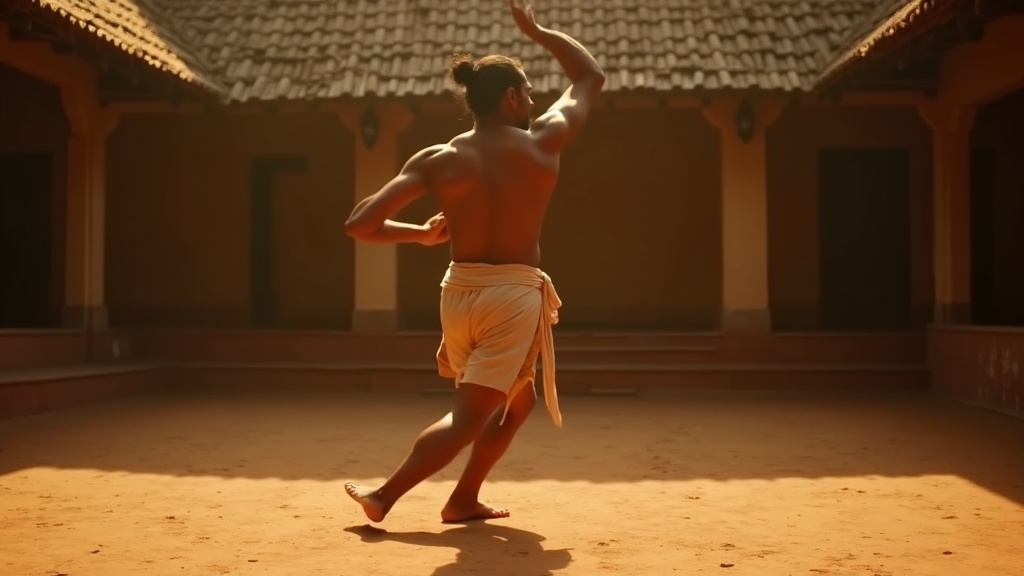
The Best Books on Kalaripayattu — A Teacher's Reading List
The Best Books on Kalaripayattu: A Teacher's Reading List
Last updated: 27 May 2026 · Reviewed by Raphael Gorschlüter, Co-Founder Kalari University
Search for a Kalaripayattu book online and you get the same wall every time. Amazon listings of self-published guides nobody has read. Generic top-five lists written by people who clearly have not opened any of the books they recommend. Tourism brochures dressed up as histories. The honest truth — which nobody seems to say out loud — is that the serious English-language literature on Kalaripayattu is small, uneven, and dominated by a single academic work.
This list is what I would actually hand a student who asked me what to read. It names the one book that earns the cover price, the one historical work that helps you think clearly about origin myths, the Malayalam tradition that most non-Indian readers will never reach, and the books I quietly tell people to skip. The point is not to pad a list. The point is to save you time and money.
A Kalaripayattu book worth reading is one that respects the practice enough to be specific — naming the four stages, the difference between meithari and kolthari, the role of the kalari as a training space, and the South Indian context the art was shaped by. There is exactly one English-language book that does this with the depth of a serious scholar who has trained inside the system — Phillip Zarrilli's When the Body Becomes All Eyes (Oxford University Press, 1998). Everything else either supplements it, contextualises it, or repeats it more thinly.
Key Takeaways
- The one essential English-language Kalaripayattu book is Phillip B. Zarrilli's When the Body Becomes All Eyes (Oxford University Press, 1998) — academic but unmatched in depth.
- Meir Shahar's The Shaolin Monastery (University of Hawaii Press, 2008) is the best single source for understanding why the Bodhidharma–Kalaripayattu transmission story does not hold up historically.
- Most short coffee-table books and Amazon self-published guides are not worth your money — they repeat tourism slogans without sources.
- The richest tradition of writing about Kalaripayattu exists in Malayalam, not English, and most of it is not translated.
- No book teaches you to train. Photographs cannot replace a teacher correcting your stance in real time — books supplement practice, they do not replace it.
- The best free starting point is the Kalaripayattu Wikipedia entry, followed by selected chapters of Zarrilli through a university library.
The One Book You Must Read — Zarrilli's When the Body Becomes All Eyes
If you only ever read one book on Kalaripayattu, this is it. When the Body Becomes All Eyes: Paradigms, Discourses and Practices of Power in Kalarippayattu, A South Indian Martial Art was written by Phillip B. Zarrilli, an American theatre scholar who first encountered Kalaripayattu in the early 1970s and went on to train for years under teachers in Kerala. Oxford University Press published the book in 1998. It is the only English-language academic study of Kalaripayattu by a Western author who has actually done the work, and almost every serious citation in the field traces back to it.
What Zarrilli does that nobody else does is treat the practice on multiple levels at once. He maps the historical record without dismissing the legendary one. He describes the architecture and ritual of the kalari, the four-stage training progression, the relationship between fighter and healer, the lineage system, the role of the gurukkal. He quotes his own teachers in their own words. He places Kalaripayattu in the context of Kerala political history, including the Pazhassi Raja rebellion and the 1804 British ban that nearly killed the tradition. And he does all of this in language that is academic enough to satisfy a scholar and personal enough that you can feel his own training behind the prose.
The book is not light reading. It runs about 240 pages of dense academic English with extensive footnotes and a long bibliography. The opening chapters lay out the theoretical frame — power, paradigm, discourse — in the vocabulary of late-1990s cultural studies, which can feel heavy if you came for a martial arts manual. The middle of the book is where it opens up. Chapters on the daily structure of training, on the relationship between the kalari and the body, on the integration of marma knowledge into the practice — these chapters reward a slow reading and a notebook.
What makes Zarrilli irreplaceable is that he was given access to teachers and material that no Western researcher had received before, and likely none will receive again in the same way. The teachers he names — particularly his primary teacher in Thiruvananthapuram and his second teacher in northern Kerala — speak through the text with authority. You are not reading a tourist's summary. You are reading a student who became a scholar without ceasing to be a student.
What it gets right: the geography of the four stages (meithari, kolthari, angathari, verumkai), the distinction between northern and southern styles, the place of marma within Kalaripayattu, the political and religious context of Kerala. What it gets less right, for some readers, is the somatic dimension of the practice — Zarrilli is rigorous about what training does to the body, but the language sometimes stays at a remove from the felt experience. That is the limitation of every academic book on a practice. You cannot put the floor under the reader's feet through a paragraph.
Who should read it first: anyone serious about understanding Kalaripayattu in any depth. If you are an academic, a journalist, a serious student deciding whether to commit to training, or a teacher of another tradition who wants to learn from a parallel system — Zarrilli is the book. The cost is real (a hardback can be expensive used; some libraries hold it as an ebook), but no other single resource will save you more time. If money is tight, request it through your local university library on interlibrary loan and read the chapters on training and on history first.
One practical note. The book uses the spelling Kalarippayattu with a double-p, following an older transliteration convention. Modern usage has largely settled on Kalaripayattu. These are the same word, spelled by different conventions. Do not assume the older spelling means an older or different practice — it does not.
For Historians and Origin-Myth Debunkers — Shahar's The Shaolin Monastery
If you have ever heard someone claim that Bodhidharma carried Kalaripayattu from Kerala to China in 522 CE, and you wanted to know whether that story actually holds up, the book to read is Meir Shahar's The Shaolin Monastery: History, Religion, and the Chinese Martial Arts (University of Hawaii Press, 2008).
Shahar is a historian of Chinese religion at Tel Aviv University, and the book is the result of years working through Chinese textual sources on the Shaolin tradition. What makes it essential for a Kalaripayattu reader is the way he handles the Bodhidharma legend. He does not dismiss it from outside the tradition; he traces it from inside. The famous story of Bodhidharma teaching exercises at Shaolin first appears in a Chinese text called the Yijin Jing, dated to 1624 CE — over a thousand years after Bodhidharma is said to have lived. The Kalaripayattu connection specifically was added in the twentieth century. Shahar lays out the textual evidence so cleanly that the legend collapses on its own weight.
The book is not about Kalaripayattu. It is about Shaolin. But for a serious reader who has been told that Kalari is the mother of all martial arts, no other source does as much to clarify what that phrase can and cannot mean. After reading Shahar, you will know that the kung fu came from India story is not history — it is twentieth-century narrative built on a seventeenth-century text. You can still love Kalaripayattu without that story. In fact, the practice gets cleaner once the marketing layer comes off it.
If you have read our piece on whether Kalaripayattu is the mother of all martial arts, Shahar is the academic backbone of that argument. Pair the two and you will be able to hold your own in any conversation about origins.
The book runs roughly 280 pages. It is academic but readable — Shahar writes with a historian's discipline and a curious reader's energy. You do not need a background in Chinese history to follow it. You do need patience with footnotes.
For Cultural Context — Kerala History and Performance Traditions
Kalaripayattu does not exist in a vacuum. It grew inside the political, religious, and performance traditions of Kerala. To understand what the practice is, you eventually need to understand the place. There is no single perfect book here, but a few directions are worth your time.
For Kerala history broadly, A. Sreedhara Menon's A Survey of Kerala History is the standard one-volume introduction. It is dated in places and academic in tone, but it gives you the timeline that the practice sits inside — including the role of feudal warriors, the Travancore and Cochin kingdoms, the Pazhassi Raja revolt, the colonial encounter with the British, and the 1804 ban that pushed Kalaripayattu underground. Read alongside Zarrilli, the political context becomes much sharper.
For performance traditions, the literature on Kathakali is unexpectedly useful. Kathakali, the classical dance-drama of Kerala, shares deep historical and technical roots with Kalaripayattu — many Kathakali performers train in Kalari for the body conditioning. Phillip Zarrilli has also written extensively on Kathakali, and his book Kathakali Dance-Drama: Where Gods and Demons Come to Play (Routledge, 2000) is worth knowing about, even though it is not a Kalaripayattu book. The connection it draws between martial training and theatrical embodiment in Kerala is illuminating.
For the broader frame of Indian martial arts, Indian Martial Arts and Sports by P. C. Manoj and similar volumes give a survey. They tend to be uneven and lean on the same secondary sources Zarrilli covers more carefully, but they help locate Kalaripayattu within the wider field including Silambam, Gatka, and Thang-Ta. If you want one book on Indian martial arts generally, Manmath Manas Mohanty's edited collections or articles in the Journal of Asian Martial Arts are more reliable.
If your goal is to understand what shaped the kalari as a space and the gurukkal as a figure, look for ethnographic work on Kerala village structure and on the nair warrior class. There is no single book that does this perfectly, but the chapters in Zarrilli on the social context will give you names to follow.
Books in Malayalam — The Tradition Most Readers Will Never Reach
The richest writing on Kalaripayattu is in Malayalam, not in English. This is worth saying clearly because most international readers will simply never reach it, and pretending otherwise is dishonest.
Several Kerala-based authors have written extensively from inside the tradition. C. V. Govindan Nair is one name that appears repeatedly in references — his writings on Kalaripayattu address technique, ritual, and the regional variations between northern and southern styles. Chirakkal T. Sreedharan Nair, one of the major twentieth-century gurus, wrote on the practice in Malayalam. D. Chandran Gurukkal and others have produced Malayalam-language works on the history and practice. There are also older textual fragments — references in Malayalam manuals and lineage records that have been studied by Kerala scholars but rarely translated.
Practical reality: most of these books are difficult to obtain outside Kerala. They are published by small Kerala presses, often in limited runs, sold mainly within the state, and rarely listed on international booksellers. Translations into English range from non-existent to partial. Some Kerala universities and the Kerala Sangeetha Nataka Akademi hold copies in their libraries.
If you read Malayalam — or are willing to work with a Malayalam-speaking friend — the depth of detail in these tradition-internal sources is on a different level from anything in English. They name techniques, sequences, lineages, and healing applications that academic English-language work mentions only in passing. If you do not read Malayalam, your best practical access to this layer is through Zarrilli, who worked with Malayalam sources directly and cites them throughout his footnotes.
The honest reader should know what they are missing and not pretend the English-language picture is the whole picture. It is the foreigner's portion of the picture.
Pattole Palome and Older Textual References
A small note for completeness. Some online sources mention Pattole Palome as a source on Kalaripayattu. This is a collection of Kodava folk literature from the Coorg region, compiled in the early twentieth century. It contains references to martial practices and warrior traditions, but its focus is Coorg and the Kodava people, not Kerala Kalaripayattu specifically. Treat any source that cites Pattole Palome as a definitive Kalaripayattu reference with care — the connection is regional and indirect.
Older textual references to South Indian combat traditions appear in Sangam-era Tamil literature, dated roughly between 600 BCE and 300 CE. These are not Kalaripayattu manuals — they are heroic poetry that mentions combat. Scholars use them to establish that organised martial practice existed in South India in that period. They are not how-to books.
If you ever encounter a citation to Dhanurveda — the "science of the bow," sometimes called a sub-Veda — be aware that this is a broad tradition of Indian military science, not a Kalaripayattu text. Kalaripayattu draws on Dhanurveda principles, especially in weapons training and in the marma system, but the Dhanurveda corpus is older and wider than the Kerala tradition.
Books You Can Skip
This is the section that nobody else writes because it costs them affiliate revenue. I am going to be specific without naming authors who do not deserve a public callout — but if you have searched Amazon for "Kalaripayattu book" and seen a list of self-published guides under €15 with stock-photo covers, you have seen what I am about to describe.
Most short Kalaripayattu books in English fall into three categories. First, the coffee-table volume — beautiful photography, two paragraphs per topic, no sources, repeats the tourism line about the mother of all martial arts. Useful as a gift, not as a reference. Second, the self-published "complete guide" — usually under 100 pages, often poorly edited, structured like a generic martial arts how-to with stock content patched in. Avoid these. Third, the wellness-adjacent rewrite — Kalaripayattu folded into a yoga or healing book, presented as a feature rather than a subject, with the actual practice flattened into "ancient warrior wisdom."
What gives these books away on inspection: no footnotes, no bibliography, no Malayalam terms used precisely, no acknowledgement of regional variation between northern and southern styles, no mention of historical sources, no original photography from inside a kalari. The phrase unlock your inner warrior is a near-perfect signal that the author has not trained.
This is not to say that no short book on Kalaripayattu is useful. A short, honest introduction by a respected practitioner can be valuable — especially in a language with no academic book of its own. The test is specificity. Does the author name their teacher? Their lineage? The northern or southern style they trained in? The year they began training? If the answers are vague, the book is vague.
Save your money for Zarrilli, for Shahar if you care about origins, and for the cost of an actual class. The total spend will be lower and the return will be higher.
Academic Articles and Journal Papers — The Deeper Rabbit Hole
If Zarrilli is the main course, the academic article literature is the side dishes that make the meal complete. This is also where the most current scholarship lives, since new English-language books on Kalaripayattu are rare and new journal articles appear every few years.
The journals worth following:
- Martial Arts Studies — open-access journal published by Cardiff University Press. Cross-tradition, theoretically aware, publishes work on Indian martial arts including Kalaripayattu. Most articles are available as free PDFs from the journal site.
- Asian Theatre Journal — published by the University of Hawaii Press. Strong on the performance dimensions of Kalaripayattu and its overlap with Kathakali.
- TDR: The Drama Review — published by MIT Press. Has carried Zarrilli's own essays and adjacent work.
- Journal of Asian Martial Arts — broader Asian focus, occasional Kalaripayattu coverage. Uneven quality, but worth a search.
Authors worth following in addition to Zarrilli: Arya Madhavan and others working on Kerala performance, Sreenath Nair on embodiment in Indian performance, and the growing group of scholars writing on martial arts and the body at the intersection of phenomenology and ethnography. A Google Scholar search for "Kalarippayattu" (Zarrilli's spelling) returns the densest set of academic results; "Kalaripayattu" returns a wider, lower-signal set.
For a free starting point, Zarrilli's older essays in TDR from the 1980s and early 1990s are available through JSTOR and through many university libraries. They cover material that later became part of When the Body Becomes All Eyes and are an excellent way to taste his work before committing to the book.
Documentary and Video Resources
This is technically outside the question of books, but readers who search "Kalaripayattu book" are often really searching for good information about Kalaripayattu in long form. The best documentary-style resources sit alongside the book list rather than replace it.
The 1988 documentary Kalarippayatt directed by Sankhajit Biswas and produced by the Films Division of India is a useful historical document — short, dated, but shows real training in Kerala. For more recent footage, a handful of Kerala-based schools have produced their own video introductions, ranging from genuinely informative to lightly promotional. The Channel 4 segment from the early 2000s and various BBC features have given Kalaripayattu Western television exposure but should be watched for atmosphere, not detail.
YouTube is a mixed bag. There is real footage of senior teachers in northern and southern Kerala, alongside a great deal of decontextualised demonstration clips and tourist footage. Look for videos that show full sequences and training inside an actual kalari with an earthen floor, rather than stage demonstrations under lights.
A practical reading-plus-watching combination: read the first three chapters of Zarrilli, watch the Films Division documentary, then go back to Zarrilli with the visuals in your head. The text will land differently.
How to Read These Books — A Practical Reading Order
If I were sitting with a student asking me where to start, this is the order I would give them.
-
The Kalaripayattu Wikipedia entry — free, well-sourced, and the right shape for someone who knows nothing yet. Read it carefully and follow two or three footnote links.
-
One short, honest article — something like a longform piece by a respected practitioner. Our own history and origin piece and the what is Kalaripayattu pillar are written for exactly this stage.
-
Zarrilli, chapters 1 and the chapter on training structure — borrow the book through a library if possible. Read selectively first. The introduction and the chapter on the four stages are where most of the practical understanding lives.
-
Begin training — at this point, the gap between reading and doing has to close. A single month of practice with a teacher will make every page of Zarrilli land more clearly than another month of reading.
-
Return to Zarrilli, this time in full — six months into training, the book reads completely differently. The footnotes start to matter. The political and ritual chapters start to matter. This is when the work earns its cover price.
-
Shahar on the origin myths — once you have a body memory of training, you are equipped to think clearly about where it does and does not sit in the global martial arts story.
-
Academic articles and Kerala-specific reading — only if your interest deepens into research or teaching. Most students never need to go this far.
The pattern is the same as any serious practice. A little reading, a lot of training, then deeper reading, then more training, then specialist sources if the curiosity demands them. Books at every stage, but always behind the actual work, never ahead of it.
Frequently Asked Questions
What is the best book on Kalaripayattu for beginners?
There is no perfect beginner book in English. The closest match is Phillip Zarrilli's When the Body Becomes All Eyes, but it is academic in style and demanding to read. For a true beginner who wants context before training, start with the Kalaripayattu Wikipedia page, then read Zarrilli's introduction and conclusion chapters. The body of any real practice is learned on the floor, not from a book.
Who wrote the definitive academic book on Kalaripayattu?
Phillip B. Zarrilli, an American theatre scholar who trained in Kerala for years, wrote the definitive English-language academic study. When the Body Becomes All Eyes, published by Oxford University Press in 1998, remains the single most cited reference work on the practice in English.
Where can I buy Zarrilli's When the Body Becomes All Eyes?
The book is published by Oxford University Press and available through Amazon, university libraries via interlibrary loan, and second-hand academic booksellers. Used hardback copies can range widely in price. Many university libraries have it as an ebook through institutional access. Google Books offers a preview of select chapters.
Are there Kalaripayattu books in Malayalam?
Yes. C. V. Govindan Nair, Chirakkal T. Sreedharan Nair, and other Kerala-based authors have written extensively on Kalaripayattu in Malayalam. These works are the primary tradition-internal sources but are difficult to obtain outside Kerala and have limited or no English translation.
Are there Kalaripayattu books in German, Spanish, or French?
Very few. A handful of European practitioners have written introductory texts in German and French, mostly self-published and short. There is no German or Spanish equivalent of Zarrilli's academic work. Most serious European students read in English.
Is there a Kalaripayattu book that teaches you how to train?
No book teaches you to actually train Kalaripayattu. Photographs and step-by-step descriptions cannot replace a teacher who corrects your posture in real time. Some books include sequences with images, but treat them as historical documentation, not as instructional content. The practice has to be transmitted body-to-body.
What does the Shaolin Monastery book by Meir Shahar say about Kalaripayattu?
Shahar's book systematically examines the Bodhidharma origin myth that connects Kalaripayattu to Shaolin Kung Fu. He shows the story first appears in a Chinese text from 1624 CE and treats the transmission claim as legend, not history. It is the essential reference for anyone evaluating the "mother of all martial arts" claim.
Are there any new Kalaripayattu books coming out?
New English-language scholarly work on Kalaripayattu is rare. Most fresh writing appears in academic journals and edited volumes on Indian martial arts or Kerala performance traditions. As of 2026, no major new English monograph has been announced. Readers wanting current scholarship should follow journals such as Martial Arts Studies.
Can I find Kalaripayattu books as a PDF?
Some academic articles are available as open-access PDFs through journals such as Martial Arts Studies. Zarrilli's book is not legally free as a PDF. Pirated copies circulate online but are unauthorised. The ethical paths are university libraries, interlibrary loan, or buying a used copy.
Are tourism-marketing books on Kalaripayattu worth reading?
Most are not. Short coffee-table books published by Kerala-based publishers tend to be image-heavy with thin text, often repeating tourism slogans about the mother of all martial arts without sources. They have value as cultural snapshots but are not serious reference works. Save your money for Zarrilli.
What academic journals publish work on Kalaripayattu?
Martial Arts Studies, Asian Theatre Journal, the Journal of Asian Martial Arts, and TDR: The Drama Review have all published peer-reviewed articles on Kalaripayattu. Phillip Zarrilli, Arya Madhavan, and other scholars working at the intersection of performance and martial arts are the names to follow.
Should I read about Kalaripayattu before I start training?
A short introduction helps you know what you are walking into, but heavy reading before the body has any reference can be misleading. Read enough to recognise the four stages, the words meithari and kalari, and the Kerala context. Then start training, and let the books make sense in light of what you are feeling.
Sources & Further Reading
- Kalaripayattu — Wikipedia — the best free overview, well-cited and broadly accurate.
- Phillip Zarrilli — Wikipedia — background on the author of the canonical academic book.
- When the Body Becomes All Eyes — Oxford University Press — the publisher page for Zarrilli's book, with ISBN and ordering information.
- The Shaolin Monastery — University of Hawaii Press — publisher page for Meir Shahar's history of Shaolin and the Bodhidharma legend.
- Martial Arts Studies Journal — open-access peer-reviewed journal carrying current scholarship on Indian and other martial arts.
- Indian martial arts — Wikipedia — overview of the broader field within which Kalaripayattu sits.
- Kerala — Wikipedia — geographic and historical context for the practice.
- Bodhidharma — Wikipedia — the legendary figure at the heart of the origin-myth debate.
- Films Division of India — producer of the 1988 documentary Kalarippayatt.
A Last Note Before You Order Anything
The reason Kalaripayattu has so few good books in English is the same reason it has so much depth in person. The practice was kept alive through teachers, not through publishing. For most of its history, the people who could write about it best were not interested in writing — they were interested in training the next generation in the kalari. The handful of texts we have were either written by Western scholars who earned their access through long training, or by Kerala-based teachers writing primarily for a Malayalam-speaking audience.
This is not a complaint. It is a fact about the tradition. Reading is useful. Reading well is more useful. But the practice itself does not live in any book, in any language. It lives in low stances on an earth floor, in the way a teacher places their hand on your hip to correct your balance, in the moment your spine finds a position it has never held before.
If you have read this far, you are clearly serious about the subject. The honest next step is not another book. It is one session of actual training, so the books you do read afterwards have somewhere to land. The free first lesson at Kalari University is the lowest-stakes way to put a body memory under the reading — no equipment, no prior experience, no commitment beyond an account. Start the free first lesson →
About the Author
Raphael Gorschlüter — Co-Founder & Head Teacher, Kalari University
Raphael Gorschlüter has been training and teaching Kalaripayattu for over twelve years across Germany, Spain, and India. He co-founded Kalari University to make the practice available to serious students worldwide and teaches the somatic, body-awareness side of the tradition — what he calls the ability to feel your movement, not just perform it. He has read the books on this list. He keeps Zarrilli within reach.
