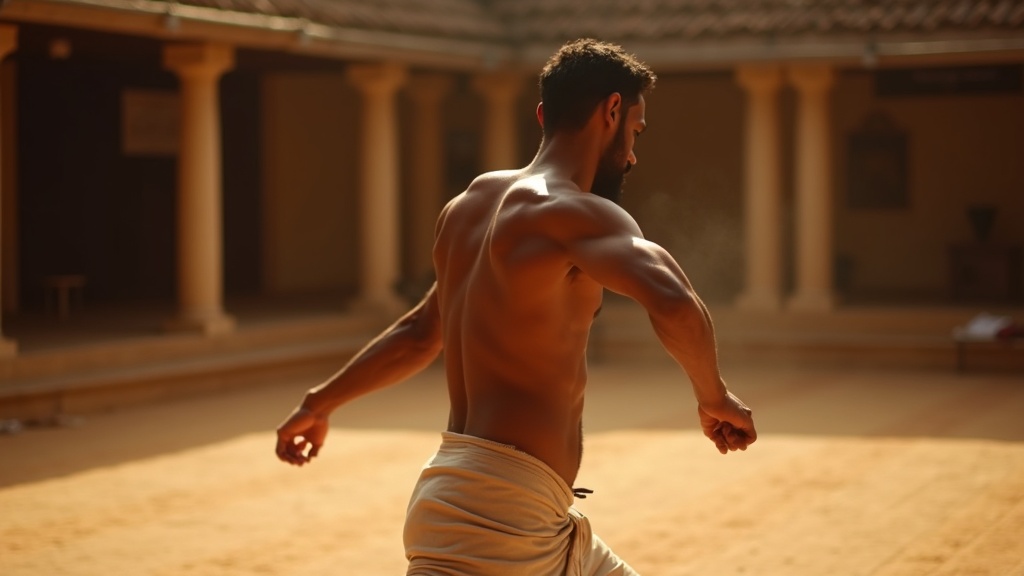
Kalaripayattu and Theyyam: The Sacred Performance Bond
Kalaripayattu and Theyyam: The Sacred Performance Bond
Last updated: 29 May 2026 · Reading time: about 22 minutes
Most travel articles treat Theyyam and Kalaripayattu as two separate Kerala curiosities — one a fierce night-time dance, the other an old martial art. That separation is the modern view. Inside the villages of North Malabar, where both traditions actually live, they were never separate at all. The same men who fought a duel for the village at dawn returned at night as gods. The body that learned the weapon learned the costume. The ground that held the duel held the shrine.
This article is for the practitioner, the heritage seeker and the cultural traveller who wants the real picture. You will see exactly how Theyyam and Kalaripayattu are connected — geographically, anatomically, mythologically — and why understanding one changes how you understand the other.
The kalaripayattu theyyam connection is the structural overlap between Kerala's oldest martial art and its oldest ritual possession-performance form. Both traditions share the geography of North Malabar (Kasargod, Kannur, Wayanad), the same performing families and castes, and a shared bank of weapon skills — footwork, stance, sword and shield work. Many Theyyam performers undergo Kalaripayattu training to meet the physical demands of night-long ritual, and many Theyyam origin myths deify historical kalari warriors.
Key Takeaways
- Theyyam and Kalaripayattu both originate in the same region — northern Kerala's Kolathunad belt, today's Kasargod and Kannur districts — and have shared performers, shrines and family lineages for centuries.
- Many Theyyam performers train in Kalaripayattu because the ritual demands stamina, weapon handling, low stances and explosive transitions that only a martial conditioning regime can build.
- Several Theyyam forms dramatise the lives of historical kalari warriors who were deified after death, including Othenan, Aromal Chekavar and Kathivanoor Veeran.
- Theyyam often includes ritual sword-and-shield sequences (puliyankam) that are technically Kalaripayattu movement performed as worship rather than combat.
- The Theyyam-performing castes — Vannan, Malayan, Velan, Mavilan — and the families that ran the village kalaris have historically lived in the same neighbourhoods and intermarried.
- For a serious Kalaripayattu student, seeing one Theyyam performance in North Malabar reveals what the practice meant before it was reframed as a fitness or heritage discipline.
What Theyyam Actually Is
Theyyam is a ritual possession-performance form unique to the northern districts of Kerala. The word comes from devam or thaivam, meaning god. The premise is the premise: through fasting, costume, drumming and trained discipline, a performer becomes the literal embodiment of a deity for the duration of the ritual. He is not playing the god. He is the god, for as long as the performance lasts.
More than four hundred distinct Theyyam forms have been documented. Each one is tied to a specific shrine, a specific origin story and a specific performing lineage. Some are forms of Shiva, Kali or Bhagavathi. Many are deified ancestors — local heroes, warriors, women wronged by feudal lords, members of marginalised communities whose dignity was restored after death by being raised to godhood. The Theyyam stage is in this sense one of the few places in traditional Hindu practice where the lowest castes embody the highest gods, and the upper-caste audience must bow.
The ritual unfolds at small village shrines called kavus — sacred groves that have served as worship spaces in Kolathunad for centuries. A performance typically begins the night before, with a stripped-back form called thottam in which the performer sings the deity's origin song in a near-conversational state. As the night turns, the makeup deepens, the costume is built piece by piece, the drums rise. By dawn the deity has arrived. He blesses the devotees. He speaks. He fights. He dances. He may continue, with breaks, for a full day or longer.
The geography is precise. Theyyam is essentially a North Malabar phenomenon — overwhelmingly found in present-day Kasargod, Kannur and parts of Wayanad, Malappuram and Kozhikode. South of this belt the form effectively disappears. Anywhere you find living Theyyam, you are inside the historic Kolathunad cultural zone. Anywhere you find historic Kolathunad cultural zone, you find old village kalaris.
Why this geography matters for Kalari
That same belt — Kasargod, Kannur, Wayanad, the older Malabar coast — was the densest concentration of Kalaripayattu practice in pre-modern Kerala. The Vadakkan or "Northern" style of kalari took its name from this region. Almost every village of meaningful size had its own kalari — the training pit dug into the earth — and its own asan (teacher). The Theyyam performer and the kalari student were often the same person, taught by the same uncle, in the same compound, by the same lamp.
You cannot understand one without the other.
Why Theyyam Performers Train Kalaripayattu
A full Theyyam performance is one of the most physically demanding ritual forms in living Indian culture. The performer wears a costume that can weigh fifteen to twenty kilograms — towering headpieces (mudi) of palm fronds, wood, mirrors and silver, sometimes rising two metres above the head. He wears red ochre paint over much of the body, layered cloth and ornaments, and holds props including swords, shields, torches and arrows.
Inside that costume, in some forms for ten or fifteen hours, he is expected to dance, jump, sit on his heels, drop to the ground, rise, spin, run barefoot over coals in some lineages, swing weapons in patterned sequences, and address devotees with steady speech.
That body cannot be built by costume rehearsal alone. It has to be conditioned. And the conditioning system available in the same village, taught by the same families, was Kalaripayattu.
The specific kalari skills a Theyyam performer uses
Walk into a Theyyam performance with the eye of a kalari practitioner and you start recognising the source of every movement.
- Footwork (chuvadu). The compact circular patterns inside Theyyam — small steps around an invisible axis, weight always low — are the same chuvadu patterns a kalari student learns inside the first few months. The ankle-bend, the knee-tracking, the silent transfer of weight onto a flat sole are all kalari.
- Stance work (vadivu). Many Theyyam moments hold the performer in low animal stances directly recognisable from the eight kalari vadivu — the elephant, the horse, the lion. In some forms the performer drops into and rises out of these stances dozens of times in a single hour.
- Weapon handling. The sword-and-shield (puliyankam) sequences inside Theyyam are not theatrical mime. They are reduced, ritualised versions of real kalari sword work. The grip is kalari grip. The cut paths are kalari cut paths. The shield-arm carriage is the same one a Vadakkan-style kalari teaches in the kolthari (stick) and angathari (blade) stages.
- Breath control (vayu sadhana). A man who is going to chant, dance and embody a deity for hours without losing his voice has been taught — usually inside the kalari, often before he was twelve — how to breathe into the belly, hold the breath at the chest, lengthen the exhale. Kalari breathwork is the same breathwork.
- Marma awareness. The performer who knows where the body's vital points sit knows how to land a jump without injury, how to fall without striking a marma, how to hold a weapon near the body of a co-performer without harm. That awareness comes from the kalari, where students learn vital-point sensitivity from the asan who is also the village healer. A separate KU article goes deeper into the healing knowledge inside kalaripayattu.
The simple test: take a sequence from a Veera Theyyam — a "hero" form — and remove the costume, the makeup and the drum. What is left is a kalari demonstration.
"I have trained next to men who became Theyyams"
In Kerala I have shared kalari ground with men whose families have performed Theyyam for generations. The asan introduces them not as students but as cousins of the tradition. They train the same vadivus, drill the same forms, sweat in the same pit. The difference is what they do with the body afterwards. We use it to fight, to teach, to heal. They use it to disappear inside a god.
I have watched a man warm up for a kalari class in the morning and dress for a Veera Theyyam in the same village the same night. He was not switching identities. He was using one preparation for two outputs.
The Mythological Overlap — Kalari Heroes Become Theyyam Deities
Theyyam mythology is not abstract. A large share of Theyyam forms commemorate specific historical or legendary individuals from northern Kerala — and a striking number of them were Kalaripayattu warriors.
The most famous body of song that records these heroes is the Vadakkan Pattukal — the Northern Ballads — a cycle of medieval Malayalam folk songs. The ballads describe duels (ankam), feuds, women warriors, betrayals and the way kalari skill was applied in life and death. Many of the human protagonists of these ballads eventually became Theyyam deities at the shrines built where they died.
Othena Theyyam
Othenan — the central hero of the Vadakkan Pattukal — was a kalari warrior from Putooram in present-day Kannur district. The ballads recount his training, his early ankam-fights, his life-long rivalry with the warrior Chandu and his eventual death by treachery. After death he was deified, and the Othena Theyyam (sometimes spelled Othenan Theyyam) is performed in shrines associated with his lineage.
Watching this form, you are watching a man who was a kalari student in the ballads being honoured by a man who is a kalari student today. The continuity is not metaphorical.
Aromal Chekavar and Kathivanoor Veeran
Aromal Chekavar was another Vadakkan Pattukal hero — a duelling champion of the Chekavar warrior community, deified after his death in an ankam he was treacherously prevented from winning. Theyyam forms associated with Aromal preserve his story.
Kathivanoor Veeran is the most popular Theyyam form built on a warrior story — a young man from Kathivanoor whose journey to a new village, his courtship, his betrayal by his uncles and his death in battle are all narrated through the ritual. The form requires extensive sword and shield work and is held in particularly high esteem for the level of kalari competence it demands of the performer.
The pattern
Look across a few dozen Theyyam forms with warrior mythology and a pattern emerges. The hero was a real or legendary kalari practitioner. He fought, he was wronged, he died. His community refused to let his memory disappear, so they built a shrine where he fell and asked his lineage — or a related performing caste — to bring him back, one night per year, as a god.
The Theyyam is therefore not separate from the kalari. The Theyyam is what the village did with the kalari warrior after the kalari warrior died. The training that built him in life builds the man who embodies him after death. The community keeps both threads alive at the same time. To kill either is to kill the other.
Shared Geography — North Malabar as the Cradle
The geographic overlap is total. There is no living Theyyam outside North Malabar. There is no historical heartland of Kalaripayattu outside (or significantly larger than) North Malabar. The two traditions occupy exactly the same map.
The northern districts that matter are:
- Kasargod — Kerala's northernmost district, traditionally the strongest Theyyam belt, with hundreds of active kavus. Kasargod also preserved one of the oldest unbroken kalari teaching traditions through the British ban.
- Kannur — the heartland of both forms. The Kerala Folklore Academy is based here. The Vadakkan Pattukal heroes were Kannur men. The Putooram lineage of Othenan trained in Kannur. Most of the famous Vadakkan kalari schools that survived into the modern era are in this district.
- Wayanad — the forest interior of the same cultural zone. Wayanad has its own variations on both Theyyam and kalari, often with tribal community influences.
- Northern Malappuram and Kozhikode — the southern edge of the Theyyam-and-kalari belt. South of this line, Theyyam dies out almost completely and the southern style of kalari (Dronampally / Thekkan) becomes dominant.
This is one cultural unit. The same families perform Theyyam in their village shrine in December and train kalari in their family pit in April. They harvest in the monsoon. They marry within walking distance.
A KU article on the misunderstood martial heritage of Kerala goes deeper into how this regional concentration shaped the practice you encounter today.
Shared Castes and Family Networks
To understand the connection you have to look honestly at caste — which traditional Kerala scholarship cannot avoid even when the modern conversation prefers to.
Theyyam performance is the hereditary right and obligation of a specific group of communities, almost all of them historically classified as lower-caste in the Kerala social order. The main performing castes include:
- Vannan — washermen by traditional occupation, but the foremost performers of many of the most prestigious Theyyam forms.
- Malayan — another major performing community, particularly associated with forest-deity Theyyams.
- Velan — astrologer-priests historically connected to ritual performance.
- Mavilan, Pulayar, Munnoottan — smaller performing communities, each tied to specific forms.
These men did not perform because anyone else would let them. They performed because they were considered the only people qualified by birthright to do so — and because the gods they embodied had asked, in mythological terms, for them specifically. The same upper-caste audience that excluded them from temple sanctums knelt at their feet when they were in costume.
The Kalaripayattu side of the picture is broader by caste. Asan families came from several communities — the Nair warrior caste was the most visible, but Thiyya (Ezhava), Chekavar, Asari, Mappila Muslim and Brahmin Nambudiri teaching lineages all existed. In the same northern villages where Vannan and Malayan men were the Theyyam performers, Thiyya / Chekavar men were often the dominant kalari students and asans.
The two networks overlapped in space, in family, in ritual calendar. A village would have its kalari asan (often Thiyya, sometimes Nair), its performing-caste families (often Vannan or Malayan), its kavu, its annual Theyyam festival, its ankam tradition. The asan and the performer's father were neighbours. They had been at each other's marriages. The children played in the same lane.
When the kalari student of one family eventually died fighting an ankam for the village, the performing family of the neighbour up the lane became the Theyyam who would bring him back each year. That is the network. That is why the connection has lasted six hundred years.
The Body That Both Traditions Build
This is where the kalari student really sees it. Two traditions, two outputs, one body.
The Theyyam body and the kalari body are built by the same demands:
- Sustained low stance — the ability to hold weight for long periods near the floor, knees bent, spine erect, without the legs collapsing.
- Soft-foot weight transfer — moving from one foot to the other through the whole sole, silently, without lifting and dropping the body.
- Slow-to-explosive transitions — long held postures interrupted by a sudden jump, kick, weapon strike or drop. This is the rhythm of both kalari forms and the most dramatic Theyyam sequences.
- Breath that drives the trunk — the diaphragm doing the work the arms cannot do, the breath setting the pace of the movement, never the other way around.
- Awareness of the centreline — the spine treated as the column from which all movement radiates, never collapsed forward, never thrown back, always aligned with gravity.
- Tolerance for repetition — the same vadivu held a hundred times, the same chuvadu walked a hundred times, the same swing repeated until it is silent. Both traditions reward grinding, ungratifying repetition more than they reward talent.
When you watch the warm-up of a senior Theyyam performer in the hour before he dresses, you are watching a kalaripayattu session in compressed form. He is loosening hips. He is checking that his knees track his toes. He is testing his sword arm. He is breathing low.
I have spent thirty years near both traditions, twelve teaching kalari. The first time a Kerala asan walked me to the back of a Theyyam during the hour before the deity arrived, the only word I had was recognition. There was no separate skill in that warm-up. It was kalari, going somewhere else.
Theyyam as applied kalaripayattu
You can think of Theyyam, anatomically, as one of the field-applications of kalari conditioning. The other classical applications were ankam (the formal duel), the militia of the Nair militaries, the body knowledge of the kalari chikitsa healer, and the everyday self-defence of the village. Theyyam is the ritual application — the kalari body, given to the gods.
This reframing matters for modern students. If you have only met Kalaripayattu as a fitness or heritage practice in a sanitised studio, you have met one tenth of what it was. The full picture is the body trained inside the pit, used in life, deified after death and brought back inside the costume.
How to See a Theyyam Performance Today
Theyyam is freely accessible. The season runs from the Malayalam month of Thulam (roughly mid-October to mid-November) through Edavam (mid-May to mid-June), with the peak from December to February. There is no central booking system. The kavus operate on their own festival calendars.
Practical guidance
- Region. Base yourself in Kannur or Kasargod town. Both have hotels and road access. Day trips from Kozhikode are possible but inconvenient if the performance runs through the night.
- Finding a performance. The Kerala Tourism Theyyam pages maintain a partial calendar. Local autorickshaw drivers, your guesthouse host and the Kerala Folklore Academy in Kannur all know what is on. Many performances are not on any English website at all.
- What time to arrive. If you want to see the full arc, arrive in the late afternoon. The makeup and costume-building is a meditative spectacle in itself. The deity usually arrives between midnight and dawn, depending on the form.
- What to wear. Modest clothing — covered shoulders, long trousers or skirt. Be ready to remove shoes near the shrine.
- What to bring. Water, cash for donations, a torch if the shrine is remote, a folded cloth to sit on. Mosquito repellent.
- What not to do. Do not interrupt the performer once he has entered the deity state. Do not block the line between him and the shrine. Do not use flash photography. Do not insist on a posed portrait.
Recommended shrines for first-time visitors
- Parassinikkadavu Muthappan Temple (near Kannur) — the famous shrine of Muthappan, where Theyyam is performed twice daily for most of the year, making it the easiest place for a visitor to see a Theyyam at any season.
- Mannampurathu Kavu (Nileshwar, Kasargod) — major Bhagavathi shrine with classical Theyyam forms.
- Kathivanoor Veeran shrines in Kannur district — for the warrior Theyyam most directly tied to kalari mythology.
If you are visiting as a serious Kalaripayattu student, ask the kavu organisers respectfully if you may also visit a local kalari while in the area. In most North Malabar villages the answer is yes, and the asan will be honoured by your interest.
What This Connection Means for Modern Kalari Students
If you train Kalaripayattu seriously — whether in Kerala, in Europe with one of the small number of teachers we have, or online with us at Kalari University — there is one thing the Theyyam connection asks of you.
It asks you to remember that this was never just a martial art.
The modern presentation of Kalaripayattu has two dominant frames. The first is heritage — a museum-piece practice from ancient Kerala, preserved by tourism boards, displayed at cultural festivals for an applauding audience. The second is fitness — a flexibility-and-strength regime alongside yoga, sold to wellness travellers as a slightly more exotic option. Neither is wrong. Both are incomplete.
The full frame is this. Kalaripayattu was the body practice of a society in which the same body that fought was the body that healed, the body that danced, and the body that gave itself to the gods in ritual. The kalari pit and the kavu shrine were the two ends of one rope. The warrior who trained at fifteen, fought at thirty, was deified at fifty after his death in an ankam, and came back at sixty inside a Theyyam costume, was not a stranger to himself across those identities. He was the same person, with the same conditioning, applied in different rooms of the same house.
You cannot reconstruct that whole world in a video class. But you can carry awareness of it. The next time you drop into your low vadivu, remember that the same posture, held by the same kind of man, four hundred years ago in the same patch of red Kerala earth, was being used to honour the gods.
That awareness changes how you train. It moves the practice from athletic into ceremonial. It does not require belief — only attention. And it brings you closer to one of the reasons people return to this practice over years rather than weeks.
A practical recommendation
If you can afford one trip in your kalari life, the trip is this: go to North Malabar in the high Theyyam season — late December through early February — and book yourself one week. Train kalari with a local asan for the mornings. Attend two or three Theyyam performances in the evenings. You will understand more about the practice you do at home in those seven days than in two years of disciplined solo training.
Sources & Further Reading
- Theyyam — Wikipedia — the most accessible overview of the ritual form, with regional and lineage detail.
- Kalaripayattu — Wikipedia — for the martial art's structure, stages and history.
- Kerala Folklore Academy — the state institution based in Kannur that documents Theyyam and related performance traditions; their publications and museum are essential for deeper study.
- Kerala Tourism — Theyyam — official state tourism source with performance calendars and shrine information.
- Sahitya Akademi — India's national academy of letters; publishes scholarly translations and studies of regional traditions including Vadakkan Pattukal.
- Kolathunadu — Wikipedia — historical context for the North Malabar cultural region that produced both traditions.
- Vadakkan Pattukal — Wikipedia — the cycle of medieval Malayalam ballads that records the lives of the kalari heroes who became Theyyam deities.
- Kathakali — Wikipedia — Kerala's other great performance tradition, useful for comparison with Theyyam.
- Vannan community — Wikipedia — background on one of the principal Theyyam-performing castes.
- North Malabar — Wikipedia — the cultural-historical region inside which both forms developed.
Conclusion
The kalaripayattu theyyam connection is not a curiosity for cultural tourists. It is the missing context most Westerners — and most younger Indians — never receive when they meet kalari for the first time. The martial art lived inside a society in which the same trained body fought, healed, danced and embodied gods, and the same villages of North Malabar held both traditions in their hands for centuries. Strip one away and you lose a piece of the other.
If you are reading this because you are starting to take Kalaripayattu seriously, the practical step is small. Begin with the body. The first lesson at Kalari University is free — no payment, no commitment — and it teaches you the foundational stance that, four hundred years ago in a Kannur village, the same man would have used in the kalari at dawn and inside a Theyyam costume at midnight. Create your account and start the first lesson here →
About the Author
Raphael Gorschlüter — Co-Founder & Head Teacher, Kalari University. Twelve-plus years of Kalaripayattu training and teaching. Studies and teaches in Germany, Spain and India, with regular extended training periods in Kerala and Tamil Nadu. Known for developing students' ability to feel movement rather than only perform it, and for connecting traditional Indian body practices to the everyday lives of modern Western trainees.
