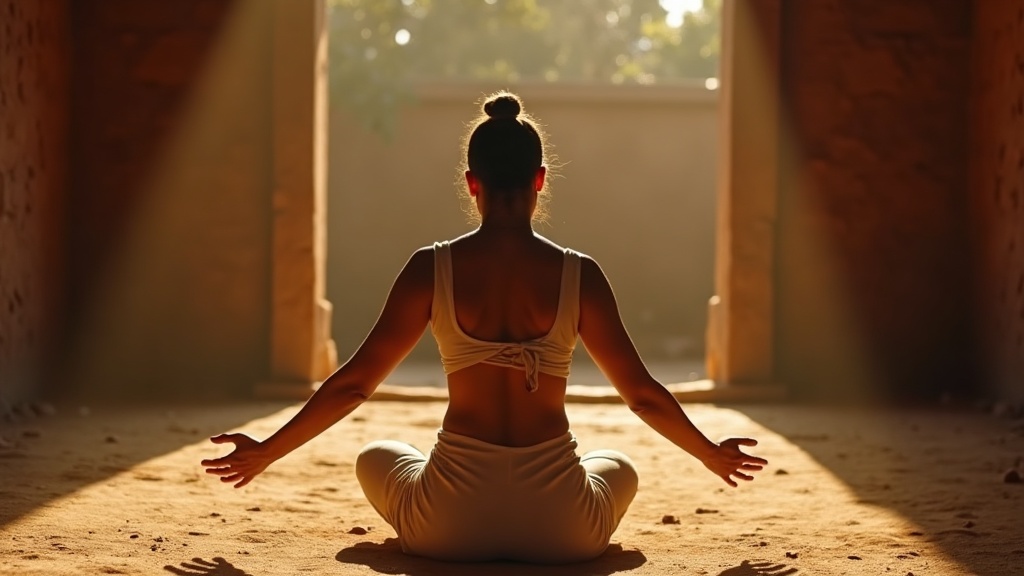
Kalaripayattu and Yoga: The Spiritual Connection
Kalaripayattu and Yoga: The Spiritual Connection
Search any article on the spiritual link between kalaripayattu and yoga and you will get the same list. Same gurus. Same chakras. Same Sanskrit vocabulary. Same vague nod at "ancient wisdom" that does not quite say what it means.
The list is not wrong. But it misses the part of the relationship that actually matters to someone trying to make sense of it: kalaripayattu and yoga share their spiritual roots, and then they go in opposite directions. Yoga turns the practitioner's attention inward, toward stillness, the breath, the witness behind thought. Kalaripayattu extends the practitioner's attention outward — into space, into the ground, into another moving body. They arrive at a similar place. They get there by inverse paths.
This guide names that one structural difference clearly, and then walks through where the two practices visibly overlap, where they genuinely diverge, and what it actually feels like, in the body, to train one with knowledge of the other.
The kalaripayattu yoga spiritual connection is real and structural: both practices grew out of the same Indian knowledge ecosystem, share the vocabulary of prana, marma, nadi and guru-shishya parampara, and treat the body as the primary site of inner work. The difference that matters is directional. Yoga draws the practitioner's attention inward toward stillness; Kalaripayattu extends the practitioner's attention outward into space, ground and another body. They arrive at related destinations — a clearer, quieter, more present practitioner — by inverse paths.
Key Takeaways
- Kalaripayattu and yoga share the same Indian knowledge soil — prana, marma, nadi and the guru-shishya relationship — and were never separate traditions to begin with.
- The one structural difference is the direction of attention: yoga draws it inward toward stillness, kalari extends it outward into space, ground and relation.
- Both practices function as a kind of meditation, but they hold attention differently — yoga through stillness of body, kalari through unbroken outward presence in movement.
- The visible overlap is real (shared postures, breath-as-engine, salutation rituals, lineage transmission) but the deeper overlap is the assumption that breath, movement and attention shape the practitioner from the inside out.
- You can practise kalaripayattu honestly without adopting any metaphysical framework; the tradition is robust enough to be carried as physical training, as a martial discipline, or as a contemplative practice.
Same Soil, Different Directions
Both kalaripayattu and yoga grew up in the same intellectual and spiritual climate. The same culture that produced the Vedas, the Upanishads, Ayurveda, and the literature of yoga also produced the broader category of dhanurveda — the science of weaponry and martial preparation — within which kalaripayattu eventually took shape in Kerala.
That common origin matters more than the lists of shared elements usually quoted. It explains why someone trained in one practice tends to recognise the other almost immediately. Same anatomical vocabulary. Same understanding of breath. Same assumption that the body is where the inner work actually happens.
What divides them is not the soil. It is the direction the practitioner is pointed in.
A yoga practitioner sits down. The eyes close, or settle softly on a point. The breath is watched. The attention is drawn back from the senses, from the limbs, from the chatter of thought — drawn inward, toward whatever is found at the centre of that withdrawal. The physical asanas in classical yoga were preparation for that long inward turn. The postures became the practice in their own right much later.
A kalari practitioner steps onto the floor. The eyes are open, alert, fixed on the field of practice. The breath is loud and audible, paired with the strike. The attention extends outward — into the floor under the foot, into the air around the limbs, into the position of the imagined or actual opponent across the room. The whole point of the work is to remove the gap between the practitioner and what is happening around them.
Both practices produce a similar end state: a quieter, more present, more available person. They get there in opposite ways.
The Shared Roots of Kalaripayattu and Yoga
To see how strange this opposite-direction symmetry actually is, you have to look at how much the two practices share at the level of vocabulary and assumption. The kalari yoga relationship is not a coincidence. It is structural.
One knowledge system, two disciplines
The Indian tradition does not split body, breath, mind and spirit the way Western thinking tends to. It treats them as facets of a single human structure that can be approached from many angles. Yoga is one angle. Ayurveda is another. Kalaripayattu — and the wider category of Indian martial arts it belongs to — is a third.
The category of dhanurveda, often translated as "the science of the bow" or "martial knowledge", is mentioned in the classical literature alongside Ayurveda and the Vedas. It was understood as a legitimate field of study, sometimes called the fifth Veda. Inside that category, regional traditions developed — northern wrestling, southern weapon arts, Kerala's kalaripayattu — each grounded in the same anatomical and philosophical assumptions.
Yoga grew up in the same broader landscape, drawing on the Upanishads for its contemplative core and on Samkhya and Tantra for its philosophical scaffolding. The Yoga Sutras of Patanjali — the foundational systematisation of classical yoga — date to somewhere between 200 BCE and 200 CE, and assume a practitioner already embedded in this larger Indian philosophical and bodily vocabulary.
When kalaripayattu and yoga use the same words, then, they are not borrowing from each other. They are drawing from a common upstream source.
The common vocabulary — prana, marma, nadi, chakra
The most concrete overlap is the language for the inner body. Both practices speak in terms of prana, the nadi system, the chakras, and the vital points called marma.
Prana is the principle of life force carried by the breath. In yoga it is the explicit object of pranayama — the regulation of breath that is one of the eight limbs of the classical system. In kalaripayattu, prana is regulated through the breath patterns that accompany the strikes and the long low postures; the same understanding, applied to a different kind of work.
Nadi are the channels through which prana is understood to move. Both traditions name the three principal nadis — ida, pingala and sushumna — and the broader network of subtle channels they belong to. Yoga uses the nadi map as the explicit framework for its contemplative work, especially in hatha yoga and tantric lineages. Kalari uses the same map more lightly, but it is present in the teacher's explanation of why the breath, the posture and the strike have to align.
Chakras — the energy centres along the central channel — appear in both traditions, but again with different weight. The chakras are the spine of yogic contemplative work. They are mentioned in kalari, especially in the southern lineages, but they are not the working map.
Marma are the vital points the tradition holds to be junctions of muscle, vessel, ligament, bone and joint. The classical Ayurvedic count gives 107 marma, set down by Sushruta in the Sushruta Samhita. In yoga the marma are referenced sparingly. In kalari the marma are central: they are how the body is taught, how the strike is aimed, how the healing branch of the practice does its work.
So the two traditions share the vocabulary but accent it differently. Yoga foregrounds the nadi-chakra system. Kalari foregrounds the marma system. Same body, different overlays.
Guru-shishya parampara — the relationship that carries the practice
The other deep shared structure is the guru-shishya parampara — the teacher-student lineage relationship through which knowledge is transmitted.
In both traditions, the practice is not understood to be self-taught from books. It is understood to live inside a relationship. The teacher carries the method, has been carried in turn by their own teacher, and accepts the student into that line of transmission. The bow at the start and end of a session, the chanted salutation, the small daily rituals of respect — these are not decorations on top of the technique. They are part of how the method stays alive.
In yoga this is most visible in the older Indian lineages and in the more serious modern schools that have preserved the lineage structure. In kalari the gurukkal — the teacher of the kalari — is the figure around whom the whole practice organises. A student belongs to a particular kalari, with a particular gurukkal, in a particular lineage. That is not a credential; it is an identity.
This shared assumption matters more than it looks. It is the reason both practices can be carried across generations without dilution. Without the lineage relationship, the practice degenerates into technique, and technique alone does not survive.
Why Kalaripayattu Is Often Called a Moving Meditation
The phrase "moving meditation" is overused in wellness writing and tends to mean "an exercise practice that feels nice." That is not what is meant when teachers inside the kalari say it. The phrase points to something specific about how attention behaves during a kalari sequence — and it is the place where the kalari yoga relationship becomes most interesting.
Attention drawn inward versus attention extended outward
The classical eight limbs of yoga, as set out by Patanjali, name pratyahara — the withdrawal of the senses from their objects — as the gateway between the outer practices and the inner ones. Pratyahara turns the practitioner away from the world and toward the inner field where dharana (concentration), dhyana (meditation) and samadhi (absorption) become possible.
The whole arc of classical yoga is structured around that inward turn. The asanas prepare the body. The pranayama prepares the breath. Then the attention can be drawn back from the senses, and the inner work begins.
Kalaripayattu does the opposite. The practitioner trains to extend attention outward, to keep it extended for long stretches, and to make that extension stable enough that the body can act inside it.
Consider what is happening in a long meypayattu sequence — the bodyform sequences of the kalari, sometimes nineteen minutes of continuous movement without break. The eyes are tracking. The breath is paired to the limbs. The feet are reading the floor. The hands are moving through specific positions, sometimes mirroring the imagined opponent's. Attention is held out across the whole field of practice and is not allowed to collapse inward toward thought.
This is meditative in a strict sense: the mind has nowhere to wander, because every fraction of attention is committed elsewhere. The result, after long sessions, is the same kind of clarity that a long seated yoga practice produces. Different doorway, same room.
Breath as the bridge — pranayama in kalari and yoga
Both traditions use breath as the engine of the work, but in different rhythms.
In a classical pranayama session, the breath is the explicit object. The practitioner sits, often with eyes closed, and shapes the breath through specific patterns — nadi shodhana (alternate nostril breathing), ujjayi, kapalabhati, bhastrika — each pattern carrying a different effect. The breath is the practice.
In kalari, the breath is the power source for the movement. Each strike is delivered on a specific phase of breath. Each long low posture is stabilised by a specific breath pattern. The breath is not contemplated; it is used. Hard exhalation through the mouth on the impact, deep inhalation on the recovery, a low sustained breath during the sequences that demand structural patience.
Despite the different framing, the physiology overlaps. The kalari breath patterns engage the same diaphragmatic and intercostal work as the yogic ones, train the same capacity for sustained controlled exhalation, and over time produce the same kind of low resting breath rate and steady autonomic regulation that a serious pranayama practice does.
The most honest way to describe it: kalari is pranayama embedded in movement, where yoga can isolate pranayama as its own discipline. Both build the same machine; one builds it inside motion, the other builds it inside stillness.
What "moving meditation" actually feels like in a kalari session
After twelve years inside the practice, the kalari version of moving meditation is recognisable from the body, not from any concept about it. There is a specific quality to a session in which the attention has fully extended into the work — a kind of held openness, where the practitioner is present at the floor, at the limbs, at the breath, and at the surroundings all at once, and there is no centre of self left over to comment on it.
In Sanskrit philosophical vocabulary this would be a kind of ekagrata — one-pointedness — but pointed outward into the practice rather than inward toward an inner object. The mind is not absent; it is fully busy with the task. The room is quieter, even when nothing has changed in the room.
People who come from a seated meditation background often recognise this state immediately when they first taste it in a kalari sequence. People who come from a fitness background sometimes mistake it for "the zone." Inside the tradition it is treated as the ordinary working condition of training — what kalari training is supposed to produce.
This is the meaning of "moving meditation" inside the kalari. Not a marketing label. A specific, trainable, recognisable state.
Where the Practices Visibly Overlap
The shared vocabulary and the shared meditative quality lead to a set of concrete overlaps a careful observer can see in a single session of either practice. These are the surface points that everyone notices first — and they are real.
Meypayattu and the yoga asanas hidden inside it
Walk into a kalari and watch a meypayattu sequence, and you will recognise asanas. Aswa vadivu — the horse posture — is the deep low warrior stance shared with several yoga traditions, particularly in hatha yoga. Gaja vadivu — the elephant posture — is closely related to the forward-folded squat sometimes called malasana. The cobra-like prone position used in the kalari for transitions is structurally the same as bhujangasana. The lion posture, the snake, the fish — animal postures appear in both vocabularies and often look almost identical.
This is not coincidence and it is not borrowing. Both traditions developed their bodywork from observation of the same animals and the same Indian human bodies, refined inside their respective pedagogies. The postures emerge from the same underlying biomechanics and are named in the same poetic Indian style.
What kalari does that yoga generally does not is link these postures into long, fluid, attack-and-recovery sequences. What yoga does that kalari generally does not is hold the posture for long stretches in stillness as the practice itself. Same shapes, different durations and intentions.
Marma points and the nadi-chakra system
The deeper anatomical overlap is in the inner-body maps. The marma points central to kalari and the nadi-chakra system central to yoga are not the same map, but they are mutually intelligible.
Both maps assume a body shot through with channels of subtle activity. Both maps identify certain locations as more significant than others. Both maps were developed inside the same Indian medical and contemplative tradition, especially under the influence of tantric thought.
The difference is what each map is for. The chakra system is a contemplative map — designed to guide inner work along the central channel from the base to the crown. The marma map is a functional map — designed to guide combat, training and treatment. They use overlapping vocabulary because they are surveying the same territory for different purposes.
A serious student of both traditions often ends up with a layered view. The chakras give the longitudinal axis of inner work. The marma give the precise junctions where structure can be supported or disrupted. The two maps do not contradict; they answer different questions about the same body. The wider marma point system inside kalaripayattu is treated as its own subject in the tradition, with its own teachers and its own restrictions on transmission.
The ritual frame — salutation, offering, threshold
The most visible overlap is in the ritual frame of the practice itself.
A kalari session begins at the threshold of the practice space. The student touches the earth with their hand and brings it to the forehead — an acknowledgement of the floor as sacred ground. The student then salutes the lineage (the parampara), the teachers, and the deities of the kalari — often Shiva in his form as the destroyer of obstacles, and the local kalari devata of the school. The weapons are saluted before they are picked up. The teacher is bowed to at the start and end of each session.
A traditional yoga session, in its serious forms, has the same shape. The space is entered deliberately. The lineage is acknowledged. The breath is set. The practice begins, runs its arc, and is closed with a returning bow. The forms differ — the kalari includes the salutation to the weapons and to the puthara (the seven-stepped shrine inside the kalari floor) — but the structure is the same.
The ritual is not decoration. It is what marks the practice as a serious undertaking rather than an exercise routine. Both traditions take this very seriously. Both lose something important when the ritual is stripped out.
Where Kalaripayattu and Yoga Diverge
The overlap is real and worth naming. The divergence is where the kalari yoga relationship becomes genuinely useful — because the points of difference are precisely where each practice gives the other something it does not have on its own.
Stillness practice versus movement practice
Classical yoga is, at its core, a practice of stillness. The arc of the eight limbs moves toward sitting — asana originally meant "seat" — and the deepest work happens when the body is held still long enough for the mind to do its own work.
Kalari, at its core, is a practice of movement. Even the long postures are dynamic — held under load, with breath, with intent toward the next movement. Stillness in kalari is preparation; it is not the work itself.
This is not a defect in either system. It is a difference of design. A yoga practitioner trains the capacity to sit with what arises in stillness. A kalari practitioner trains the capacity to act with full presence in motion. Both capacities are valuable. Most practitioners benefit from access to both, though most do not get it.
Solitary inner work versus relational awareness
A yoga practice is typically solitary. Even in a packed studio, the practitioner closes the eyes, turns inward, and does their own work. The teacher's voice is a guide, not a partner. The other practitioners in the room are doing their own version of the same inward turn.
Kalaripayattu is relational at its root. The practitioner trains in relation to the floor, the weapons, and another person. Even the solo meypayattu sequences are structured around an implied opponent whose movements you are responding to. Partner work — the strikes, the locks, the falls, the blade exchanges — is central to the curriculum from the intermediate stages onward.
This is the difference that most often surprises a yoga practitioner who tries kalari for the first time. The attention does not get to draw inward. It has to extend, hold and respond. That is a different muscle of attention than yoga generally trains, and it is the reason many yoga practitioners describe their first months of kalari as humbling in an unexpected way.
It is also the reason kalari can be such a useful complement to a long inward practice. The relational, outward attention kalari trains plugs precisely the gap a contemplative practice can leave — the gap between deep inner clarity and the capacity to bring it into ordinary, moving, related life.
Why this matters for what you actually train
A practical implication follows from all of this. If you train only yoga, you will develop a refined capacity for inward attention and breath, but the outward, spatial, relational capacity will be left undertrained — unless your particular school works against the grain of the tradition.
If you train only kalari, you will develop a refined capacity for relational, embodied, present attention, but the inward, stilled, contemplative capacity will be left less developed — again, unless you take specific steps to build it.
Most lifelong practitioners of either tradition eventually find their way to some version of the other, precisely to fill out what the primary practice does not directly train. The fact that the two traditions arrive at related destinations by inverse paths means each one is good medicine for the other.
You can also stay with one and not feel a lack — both practices are complete on their own terms. The complementarity is an option, not an obligation.
Practising Both Together — What Changes
For someone already settled in a yoga practice who is curious what kalari adds, and for someone settled in a kalari practice who is curious what yoga adds, a few honest observations from teaching across both communities.
For yoga practitioners adding kalari, the most consistent shift is in the asana itself. The shapes stop being held positions to settle into and start being structures that have to be supported actively from the inside. The deep low postures in kalari teach the same hip openness and adductor strength that yoga asana asks for, but train them under continuous load instead of in stillness. After a few months of kalari, a sun salutation feels noticeably different — more grounded, more present, more honest.
The other shift is in the relationship to the floor. Yoga asana sits on the floor or stands on the floor but does not generally interact with the floor as a force. Kalari is unrelenting in its insistence that the floor is the source of everything — every strike pushes from the floor, every recovery returns to it, every transition negotiates with it. Practitioners with years of asana behind them often report that their relationship with gravity quietly reorganises after kalari.
For kalari practitioners adding yoga, the gain is different. The capacity to sit still and watch the breath — to hold the field of attention without an external task to give it form — is something the kalari does not directly train. A regular short seated practice, or a slower yin-style asana practice, gives the kalari practitioner access to the inner side of the same capacity. Most experienced kalari practitioners hold some version of this without making a public show of it.
What does not work well is treating the two as the same practice. They are not. Sequencing matters. Most practitioners find that a strong kalari session benefits from a brief seated cool-down rather than from immediate vinyasa, and that yoga and kalari training schedules need to leave each other room.
The reframing that helps most: yoga and kalari are not competitors and they are not redundant. They are complementary lenses on the same human being.
The Honest Limit — Can You Practise Kalaripayattu Without the Spiritual Frame?
Yes. And naming that clearly matters more than most kalari schools are willing to admit.
A significant share of serious kalari practitioners worldwide engage with the practice on largely physical and martial terms, with appropriate respect for its cultural origin but without adopting its metaphysical claims. They practise the meypayattu sequences for what they do to the body. They study the weapon forms for the discipline and structure they require. They take the salutation rituals as part of the practice rather than as something they have to believe.
This is treated inside serious lineages as legitimate. The tradition is robust enough not to require belief from every student. The kalari floor itself does the work; the practitioner is changed by what the practice asks of the body, the breath and the attention, whether or not they hold a particular philosophical frame.
This matters for two reasons. First, it is honest. If a teacher tells you that you must adopt the cosmology to train the practice, that teacher is overselling. Many of the most respected lineage holders in Kerala do not press metaphysical claims on visiting students; they let the work speak for itself.
Second, it is what makes the practice accessible to thoughtful practitioners who are uncomfortable with spiritual language without good reason. A serious modern student who does not want vague mystical claims can train kalari fully and honestly, take the cultural framing on the tradition's terms, and let the spiritual dimension of the practice — if it is there for them — emerge from the work itself rather than from anything they were asked to believe upfront.
The same applies to yoga. You can train asana and pranayama as physical and respiratory disciplines, with respect for their origin, and the contemplative dimensions will either emerge or not. The seriousness of the practice is not measured by the volume of metaphysical claims attached to it. It is measured by the quality of attention brought to the work.
For both traditions, the spiritual dimension is best treated as an emergent property of long honest practice rather than as a prerequisite for it.
Common Misconceptions About the Kalaripayattu Yoga Relationship
Five recurring confusions about the relationship between the two practices, worth naming because each one shapes how new readers approach the question.
One — kalaripayattu is a form of yoga. It is not. They are distinct traditions with different goals, different histories, and different working frameworks. They share an Indian philosophical inheritance, which is not the same as belonging to the same system.
Two — kalari is older than yoga and yoga came from it. The textual record does not support this. Yoga is documented earlier in the classical literature; kalari is documented later. Both clearly draw from older, deeper currents of Indian body knowledge, but neither is the parent of the other.
Three — the chakras and marma points are the same thing. They are not. Both belong to the broader Indian inner-body model and use overlapping vocabulary, but the chakra system is a contemplative map of the central channel and the marma system is a functional map of anatomical junctions. They survey the same body for different purposes.
Four — kalari salutation rituals are decorative. They are not. The opening and closing salutations are part of the practice; they mark the work as serious, acknowledge the lineage, and frame what happens between them. The same is true of the corresponding rituals in serious yoga lineages.
Five — you have to be spiritual to practise kalaripayattu. You do not. The practice is honest enough to work as physical, martial and contemplative training without requiring metaphysical commitments. Many serious practitioners take the cultural framing respectfully and leave the cosmology alone, and that is treated as normal inside the tradition.
Frequently Asked Questions
Is kalaripayattu a form of yoga?
No. Kalaripayattu is a martial tradition from Kerala and yoga is a contemplative tradition with roots across northern and central India. They share a common Indian philosophical and anatomical vocabulary — prana, marma, nadi, guru-shishya — but they are distinct disciplines with different goals. Kalari trains a body that can fight, fall and heal; yoga trains a practitioner who can sit still long enough for stillness to reveal something.
How are kalaripayattu and yoga spiritually connected?
Both practices grew out of the same Indian knowledge ecosystem and share the same underlying understanding of the body — that breath, attention and movement together shape the inner state. Both treat the practitioner as the laboratory and the teacher as the carrier of the method. The deepest connection is not a shared cosmology but a shared assumption: how you move, breathe and pay attention changes who you are.
Which is older, kalaripayattu or yoga?
Yoga, in textual record, is older. References to yogic practice appear in the Vedas and are systematised in Patanjali's Yoga Sutras around 200 BCE to 200 CE. Kalaripayattu has Sangam-period roots from roughly the same era but is documented later, mostly through medieval references. The popular claim that kalari is older than yoga is not supported by the textual record, though both clearly draw from a shared ancient pool of Indian body knowledge.
Do kalaripayattu and yoga work with the same chakras?
Both traditions use the broad Indian model of nadis and the chakra system, but they use it differently. Yoga, especially in its tantric and hatha lineages, treats the chakra system as the explicit map of contemplative work. Kalari uses the same vocabulary loosely, but the working map inside the kalari is the marma point system — anatomical junctions that govern strike, fall and treatment. The two maps overlap but are not identical.
Is kalaripayattu a moving meditation like vinyasa?
It can become one, but it is meditative in a different sense than vinyasa. Vinyasa links breath to posture in a flowing inward sequence; kalari links breath to relational and spatial attention — to the floor, the opponent, the weapon. The meditative quality in kalari comes from the demand for total outward presence over long minutes, which leaves no room for the mind to wander. Both are forms of moving meditation; they hold attention differently.
Can practising kalaripayattu deepen your yoga practice?
Most yoga practitioners who add kalari describe the same effect: the asana stops being a shape and starts being a structure. Kalari work on the floor, in transitions and in long low postures sharpens the felt sense of weight, root and joint that yoga also asks for but rarely trains as directly. Many also report that their seated practice settles more easily afterwards, because the body has spent its outward energy and is glad to be still.
Do kalari practitioners chant or meditate?
Yes, though more sparely than in most yoga traditions. The kalari opens and closes with a salutation that includes a short chant to the lineage, the teachers and the deities of the space. Some lineages keep a longer set of invocations. Formal seated meditation in the yogic sense is not part of the practice itself; the meditative work happens inside the movement.
What rituals does kalaripayattu share with yoga?
Three: the salutation at the threshold of the practice space, the bow to the teacher at the start and end of training, and the orientation of the practice toward something larger than the practitioner. The forms differ — kalari includes salutation to the weapons and to the pit-floor of the kalari itself — but the underlying structure is the same: enter the space deliberately, acknowledge the lineage, do the work, close cleanly.
Can a yoga practitioner start kalaripayattu easily?
Yes, with one honest caveat. The flexibility, breath control and body literacy from yoga transfer directly and shorten the learning curve in the first weeks. The caveat is that kalari demands sustained relational and spatial attention in a way a long seated or inward-focused practice does not always train; that part is new for most yoga practitioners and is precisely the gift kalari brings back to a yoga practice.
Does kalaripayattu involve pranayama?
Yes, but woven into the movement rather than practised as a separate set of exercises. Kalari uses specific breath patterns to power strikes and stabilise long postures, and most lineages teach explicit breath training as part of the conditioning stage. It is closer to the way pranayama is integrated into a serious hatha practice than to standalone seated breathwork.
Do I need to be spiritual to practise kalaripayattu?
No. You can practise kalari as physical training, as a martial discipline, or as a movement art, and benefit fully from it on those terms. The spiritual framing exists in the tradition and is held by lineage teachers, but the practice is honest enough not to require it of every student. Many serious kalari practitioners take the tradition on respectfully while leaving the metaphysics alone, and that is treated as normal.
Are kalaripayattu and yoga part of the same philosophical system?
Both grew out of the broader Indian philosophical landscape that includes the Vedas, the Upanishads, Samkhya, Tantra and Ayurveda. They share that ecosystem rather than belonging to a single doctrinal school. The shared elements — prana, the subtle body, the disciplined practitioner under a teacher — are common Indian inheritance, not exclusive property of either tradition.
Sources & Further Reading
- Kalaripayattu — Wikipedia — encyclopedic overview of the Kerala martial tradition
- Yoga — Wikipedia — broad reference for the Indian contemplative and physical tradition
- Patanjali — Wikipedia — the systematiser of classical yoga in the Yoga Sutras
- Yoga Sutras of Patanjali — Wikipedia — the foundational text of classical yoga
- Pranayama — Wikipedia — the yogic discipline of breath regulation
- Prana — Wikipedia — the broader Indian concept of life-breath shared by both traditions
- Marma (Marmam) — Wikipedia — concise reference for the Indian vital-point tradition central to kalari
- Chakra — Wikipedia — the inner-body energy-centre system foundational to yoga
- Nadi (yoga) — Wikipedia — the channels through which prana is said to move
- Tantra — Wikipedia — the philosophical current that shaped both later yoga and the inner-body maps shared with kalari
- Bhagavad Gita — Wikipedia — the classical text in which yoga is set within the broader Indian contemplative landscape
- Guru-shishya tradition — Wikipedia — the teacher-student lineage structure shared across Indian disciplines
- Hatha yoga — Wikipedia — the physical-yogic stream most often compared with kalari postures
- Dhanurveda — Wikipedia — the classical martial-knowledge category to which kalari belongs
- Indian martial arts — Wikipedia — broader context for kalari among other Indian fighting traditions
- Samkhya — Wikipedia — the dualist philosophical system underpinning classical yoga
- Ayurveda — Wikipedia — the classical Indian medical tradition that shares anatomy with both yoga and kalari
- Kerala Tourism — Kalaripayattu — official Government of Kerala cultural overview of the practice
- Vedas — Wikipedia — the foundational layer of Indian sacred literature from which both traditions descend
Conclusion
The honest summary of the kalaripayattu yoga spiritual connection is shorter than most articles want to admit. The two practices share a soil and a vocabulary. They share an assumption about the body. They share the lineage relationship that carries the work across generations. And then they go in opposite directions.
Yoga draws the practitioner inward, toward the stillness in which the inner work becomes visible. Kalari extends the practitioner outward, into the space and the floor and the relational field in which presence becomes possible. Both arrive at a similar person — quieter, clearer, more available — by inverse paths. Both are complete in their own right. Both can deepen the other if a practitioner has the time and attention to hold both.
For most readers of this article the practical implication is the same as the practical implication of any thoughtful piece on contemplative practice: do something honest with your body, do it consistently, do it under someone who knows more than you, and let the rest emerge. The metaphysical language can wait. The work cannot.
If you want to feel the kalari version of this directly — what attention extended outward into a single foundational movement actually does in the body — the free first lesson at Kalari University is the lowest-stakes way to find out. No payment, no commitment, just one movement done with attention. If the body answers, the rest of the tradition is there to meet you. For the broader picture of the practice itself, what kalaripayattu actually is covers the full ground. Start the free lesson →
About the Author
Raphael Gorschlüter — Co-Founder and Head Teacher, Kalari University.
Raphael has trained and taught kalaripayattu for over twelve years, working internationally between Germany, Spain and India. He co-founded Kalari University with Paulus to make the traditional Kerala practice accessible to serious students worldwide — without losing what makes it serious. His teaching focuses on the development of body awareness through traditional kalari forms, and he leads annual residential retreats in Tiruvannamalai, Tamil Nadu, at the foot of Arunachala. He is known in the kalari community for an instruction style that develops the ability to feel movement, not just perform it.
This article is a cultural and educational guide to two traditional Indian practices. It is not religious instruction or medical advice. Descriptions of how each tradition uses its vocabulary reflect how the tradition speaks of the practice — they are not metaphysical claims this article asks the reader to accept. For any health concern related to either practice, consult a qualified medical doctor first.
