Unniyarcha: The Kalaripayattu Woman Warrior of Kerala
Unniyarcha: The Kalaripayattu Woman Warrior of Kerala
Last updated: 29 May 2026 · By Raphael Gorschlüter, Co-Founder, Kalari University
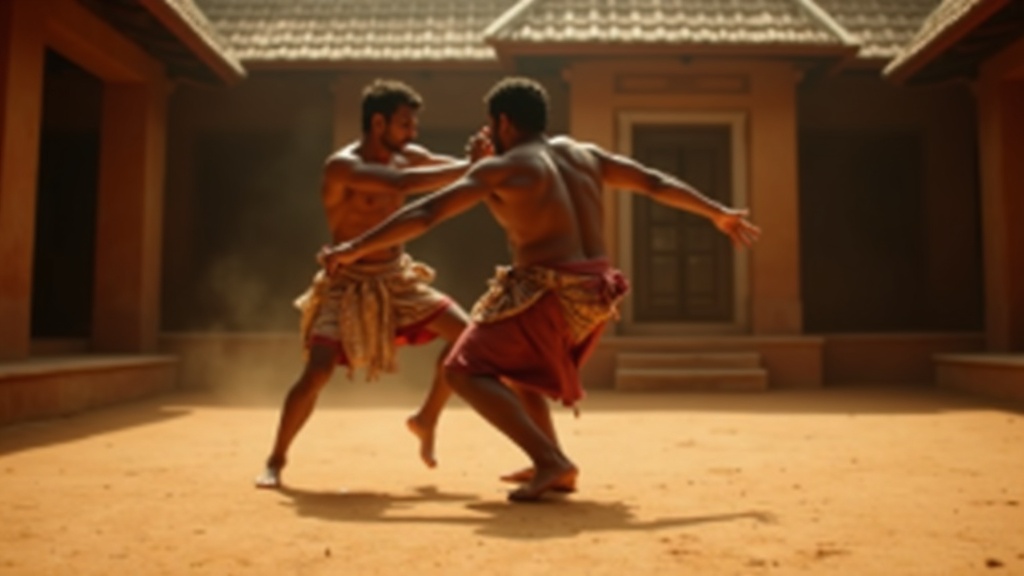
A woman walks into a temple festival in 16th-century North Malabar carrying a folded sword no thicker than a leather belt. A group of armed men block the path and demand she be handed over. Her husband does not move. Her uncle has not yet arrived. She unhooks the urumi from her waist, lets it uncoil to the ground, and clears the temple steps alone.
That is the scene at the centre of the most-loved cycle of songs in the entire Malayalam folk tradition. The woman is Unniyarcha. The songs are the Vadakkan Pattukal. And the reason you have probably never read a serious English account of her is that almost every page that mentions her treats her as a footnote — "Kerala also had a famous woman warrior" — and moves on.
This guide does not move on. It tells the story properly, names the family, names the weapons, addresses the historicity question without ducking it, and explains why a 16th-century ballad still matters to a living martial tradition.
Unniyarcha is the most celebrated woman warrior of the Vadakkan Pattukal — the Northern Ballads of medieval Malayalam — placed in the 16th century in North Malabar, Kerala. She belonged to the Puthooram family of the Chekavar (professional duellist) tradition, trained Kalaripayattu from childhood, and is remembered for fighting off a group of Jonakar attackers at a temple festival, alone, with the urumi flexible sword.
Key Takeaways
- Unniyarcha was a 16th-century Kalaripayattu woman warrior of North Malabar, born into the Puthooram family of the Chekavar (professional duellist) sub-group of the Thiyya community.
- Her most famous episode is the Nedumkotta temple fight, where she defended her family against a group of armed Jonakar attackers using the urumi flexible sword.
- She is the central female figure of the Vadakkan Pattukal — the Northern Ballads of Malayalam, sung across North Malabar from roughly the 14th to the 19th centuries.
- Her brother was the legendary Aromal Chekavar; her husband Kunhiraman is shown in the ballads as cautious where she is decisive.
- Scholars disagree on whether she was one literal woman or a composite — what is undisputed is that the ballad tradition consistently remembered women fighters in this region.
- Women continue to train Kalaripayattu today, including senior teachers like Meenakshi Amma (Padma Shri 2017) and international practitioners across Europe and the Americas.
The Nedumkotta Temple Incident
The Vadakkan Pattukal does not begin Unniyarcha's story with her birth. It begins with the fight.
A temple festival is announced near Nedumkotta. Unniyarcha wants to go. Her husband Kunhiraman is reluctant; the route passes through Mappila settlements with whom her family has running disputes. She insists. They walk.
The ballad slows down here. It describes the dust on the road, the gold she is wearing, the polished hilt of her dagger, the brass tip of her uncle's stick. Then a group of Jonakar fighters — the medieval Malayalam word for the regional Muslim communities of the Malabar coast — step out of the trees and stop them. The number varies between renditions. Most singers settle on between seven and fourteen men. They demand that the women be handed over.
Kunhiraman does what a man often does in these songs: he weighs the odds and falters. Some versions have him explicitly turn his back. The uncle has been delayed on the road behind them and has not yet caught up.
Unniyarcha steps forward. The ballad lingers on the moment she reaches for the urumi — a flexible, whip-like sword carried wrapped around the waist like a belt, three to seven blades, each thin enough to cut on contact. She lets it drop, lets it sing, and moves into the group.
The fight itself is told in image more than count. Blades, blood, the sound of a body falling. The ballad does not glorify the number she kills. It glorifies the fact that she does not freeze.
When her uncle Kandachan finally arrives, the work is done. He carries her wounded — sometimes lightly, sometimes more seriously — back to the family kalari. Her husband walks behind in silence.
What makes the episode central is not the body count. It is the contrast: the family man who hesitates, the trained woman who does not. The Vadakkan Pattukal does not sing this contrast bitterly. It sings it as fact.
Who Was Unniyarcha?
Unniyarcha was born into the Puthooram Veedu — veedu simply meaning "household" — one of the major Chekavar lineages of the North Malabar region of Kerala. The Puthooram family appears repeatedly across the Vadakkan Pattukal alongside the Aaromal and Kandachan lines.
The Chekavar were a professional sub-group inside the Thiyya community. Their job in medieval North Malabar was specific: when two families had a blood feud they could not resolve, they hired a Chekavar to fight the other side's Chekavar in an ankam — a publicly staged single combat, governed by rules, witnessed by the village. The winning family's case stood. The losing Chekavar was usually dead.
That is the world Unniyarcha was born into. Kalaripayattu was not a hobby in her household; it was the family business.
She had a brother, Aromal Chekavar, who would become the most celebrated male hero of the entire Vadakkan Pattukal corpus. Their childhood training under shared teachers in the family kalari is referenced repeatedly in the ballads — short scenes of stick fighting, marma point recognition, scaling the wall of the kalari, weight-bearing in the low stance.
She married Kunhiraman. The ballads paint him with affection but no illusions: a decent man, a present husband, not a Chekavar in temperament. Their marriage is not unhappy. It is uneven. He is comfortable; she is dangerous. The tradition does not judge him for it. It just notices.
Her uncle Kandachan is the elder she trusts. In the Nedumkotta scene he is the one who arrives in time to carry her home. In other songs he advises her, trains her in finer points, vouches for her with the wider family network.
This is the picture: a woman in her twenties or thirties, in a martial family of North Malabar, fully trained, recognised inside her lineage as a fighter, married to a quieter man, sister to a brother whose fame will grow until it eclipses hers in the wider tradition — though never inside the songs themselves.
How Vadakkan Pattukal Tells Her Story
To understand Unniyarcha you have to understand how the Vadakkan Pattukal works as a literary form. It is not a single epic. It is a body of independent ballads — each a few hundred lines long — sung by professional and semi-professional singers at festivals, weddings, harvest gatherings, in private homes.
The corpus was carried orally for centuries. The first scholarly transcriptions and printings begin in the late 19th century. The most significant 20th-century editor was Chelanat Achutha Menon, and later collectors at the Kerala Folklore Akademi expanded the archive. The standard scholarly figure who organised and published much of the Unniyarcha cycle was T. H. Kunhiraman Nambiar.
Each ballad in the cycle stands alone. There is no single canonical "Unniyarcha story" — there is a network of songs, some focused on her childhood and training, some on her marriage, some on the Nedumkotta fight, some on her later years and the fate of her brother. The singer chooses which to tell on a given night.
What the songs consistently emphasise, across versions, is this:
Skill in weapons. The urumi is the headline weapon — appropriate, because it is the most difficult Kalari weapon to master and is historically associated in Kerala with women fighters and bodyguards. But she is also shown with the short dagger, the long stick, and trained in the meithari (body-conditioning) and kolthari (stick) stages first.
Marital tension without melodrama. The songs are honest that her husband does not match her in courage. They do not turn this into tragedy. They sing it as how the household actually was.
Family loyalty. Almost every Unniyarcha song frames the action in terms of family honour — her brother, her uncle, the standing of the Puthooram name. She does not fight for abstract principles. She fights for the lineage that trained her.
Movement and stance. The songs are full of body description. When she draws the urumi, the singer often pauses to describe how she shifts her weight, how the blades fall, where her left hand goes. This is not poetic ornament. It is what an audience of trained ears wanted to hear, because many of them had been in the kalari themselves.
The performance tradition matters too. The ballads were sung in a specific North Malabar style, often accompanied by chenda drumming, in registers ranging from a quiet domestic chant to a high public declamation. To hear them performed is to feel why the Nedumkotta scene works on the page: the rhythm of the verses tightens at the moment the urumi uncoils, then slows again as she returns home.
What Her Training Would Have Looked Like
The Vadakkan style of Kalaripayattu — the tradition of North Malabar — has its own emphasis. It is the style most associated with the long, low stances, the systematic four-stage progression, the weapons curriculum that the Puthooram family would have taught. This is the lineage Unniyarcha is sung into.
A child in a 16th-century Chekavar household would likely begin training between the ages of seven and nine. The first stage was meithari — body conditioning. Low stances held until the legs burned. Kicks, sequences, floor work. The body was prepared for years before any weapon entered the picture.
After meithari came kolthari — stick work. The long staff first, then shorter sticks, then specialised wooden weapons. The stick teaches distance, timing, the geometry of where a strike comes from before the strike itself.
Only after stick competence did angathari — bladed weapons — begin. Sword and shield, short dagger, the spear, eventually the urumi. The urumi was the most advanced. Many trained Kalari practitioners never touched it. Those who did, trained with it for years before they were allowed to carry it as a working weapon.
The fourth stage — verumkai — was empty-hand combat, including the application of marma knowledge. Counter-intuitively, empty-hand came last, not first. The logic of the tradition is that bare hands are the most dangerous and the most subtle weapon, and require the discipline of having learned the others first.
A girl in the Puthooram household, trained alongside her brother Aromal, would have gone through this whole curriculum. The Vadakkan tradition did not invent a separate "women's syllabus." It taught the same forms, with the urumi often emphasised for women — partly for its concealability under a sari, partly for the wide reach it gives a smaller frame against larger attackers.
She would have known the marma points by name and location — the vital points used both to strike with precision and to repair afterwards through kalari chikitsa, the healing system that grows inside every serious kalari. The same teacher who shows you how to attack the temple shows you how to release pressure from it.
She would have been taught the prayers and protocols of the kalari — the guru-shishya parampara framework that organised every traditional kalari, the same framework still present today in serious schools. The discussion of that lineage system is covered in our overview of the Kalaripayattu guru tradition.
By her late teens she would have been considered fully trained — capable of stepping into a fight, performing in the public payattu demonstrations during temple festivals, and, in her case, doing exactly that on the road to Nedumkotta.
Historicity — Was Unniyarcha Real?
This is the question that English-language summaries usually skip. It deserves an honest answer.
The oldest written transcriptions of the Vadakkan Pattukal are from the 19th century. The songs themselves were composed and circulated for centuries before that — but exactly how many centuries is a scholarly argument. Linguistic features (vocabulary, grammar, place names) of the oldest preserved versions suggest a 14th- to 17th-century core, with some elements possibly older.
If we date the Unniyarcha cycle to the 16th century, that places her — if she lived — somewhere between roughly 1500 and 1600. No surviving administrative record, temple inscription or family genealogy from North Malabar identifies her by name. No court chronicle mentions her. The Mannadi-style royal records that name a later Kalari figure like Velu Thampi Dalava do not exist for her.
So what do scholars actually say?
Position one: she was a real woman, somewhat embroidered. The Puthooram family did exist in North Malabar. The Chekavar institution did exist. Women did fight in this region. A particular Puthooram daughter was particularly skilled, particularly defended her family in a notable incident, and the singers built her into the heroine the ballads carry. This position is held by traditional ballad scholars and by many in the Puthooram lineage today.
Position two: she is a composite cultural memory. Several real women of various Chekavar families, across several generations, were collected into one figure as the songs travelled and stabilised. The Nedumkotta fight may be one event, or it may be a fusion of several. This position is more common among academic folklorists.
Position three: she is largely mythic. A literary heroine into whom the tradition projected its image of the trained woman. This position is rare and not well supported, because the ballads consistently embed her in a concrete family, named teachers, real geography, and a wider network of figures (Aromal, Kunhiraman, Kandachan) who appear across the cycle.
The middle position — somewhere between literal history and composite memory — is the honest one. We do not have a 16th-century census record of Unniyarcha Puthooram. We do have a ballad tradition that consistently remembered her, embedded her in a real family and a real region, and sang her not as a goddess or a saint but as a tough woman in a particular household.
What matters more than the historicity question itself is what the ballad tradition reveals. North Malabar's culture, in the period the songs cover, remembered women warriors with the same matter-of-factness it used for the men. That cultural fact is not in doubt. The songs were sung. People learned them. Generations of girls in the region grew up knowing the Nedumkotta scene.
When a tradition consistently remembers women fighters across centuries, the most economical explanation is that women fighters were a present-enough reality that they belonged in song. They did not have to be common. They had to be visible.
This is the same honest middle the history of Kalaripayattu itself sits in. Documented record is patchy before the colonial period. Oral tradition fills much of the gap. Both have weight.
Other Women in Vadakkan Pattukal Ballads
Unniyarcha is the most famous but not the only woman in the Northern Ballads. The songs name several others, often briefly, sometimes at length.
Tacholi Othenan's mother and wife. Tacholi Othenan is one of the other great male heroes of the corpus. His mother appears as a stern, capable figure who runs the household and the family training. His wife, in some versions, holds her own when threatened.
Aromal's wife. Aromal Chekavar's wife appears in the dark final cycle of his story, the Aromal ballads, in which his treacherous death is set up by a tampered sword. Her grief and her demand for revenge drive the plot.
Various Chekavar daughters. The songs reference, often in passing, daughters of other Chekavar households who trained alongside their brothers. They do not always get full episodes. They are simply present in the background, named.
Anonymous women fighters. Some of the more peripheral ballads mention unnamed women who fought to defend a temple, a procession, a market. They are not heroes of their own song — but they are not surprising in the world the songs depict.
The frequency of these references is the point. The Vadakkan Pattukal is not a corpus that occasionally remembers one exceptional woman. It is a corpus that treats trained women as part of how North Malabar worked.
Modern Cultural Memory — Films, Stage, Educational Texts
In modern Kerala, Unniyarcha is not a niche academic figure. She is a household name in the way Joan of Arc is in France, with a similar mixture of historical fragment, ballad tradition and modern dramatisation.
Film. The earliest direct treatment is the Malayalam film Unniyarcha (1961), directed by Kunchacko and starring Ragini in the title role. It is a now-classic portrayal in the heroic register of mid-20th-century Malayalam cinema. The 1989 film Oru Vadakkan Veeragatha (directed by Hariharan, written by M. T. Vasudevan Nair, starring Mohanlal) retells the Aromal cycle from the perspective of Chandu — the cousin traditionally cast as the traitor — and features the wider family network including the women. Multiple later television and short-film productions return to the material.
Theatre and dance. Unniyarcha episodes are performed in Kathakali, in folk theatre forms, and in school plays across Kerala. The Nedumkotta fight is the scene most commonly staged.
School curriculum. Standard Malayalam textbooks for middle and high school students in Kerala include passages from the Vadakkan Pattukal, including extracts from the Unniyarcha cycle. Generations of Kerala children have memorised at least one passage about her.
Folklore institutions. The Kerala Folklore Akademi, the state body responsible for preserving folk traditions, maintains archives, sponsors performances and supports research on the Vadakkan Pattukal. Her cycle is one of the most heavily documented in that archive.
She is a face on stamps, a name on schools, a heroine of comic books, a costume in school plays. The 16th-century ballad tradition has become a 21st-century cultural reference.
Women in Kalaripayattu Today
The most important thing about Unniyarcha is that her tradition did not end with her.
The Vadakkan style of Kalaripayattu, the tradition of her family, still trains women today. The most publicly visible example is Meenakshi Amma of Vadakara, North Kerala, who began training at age seven and was still teaching publicly into her seventies. She was awarded the Padma Shri — one of India's highest civilian honours — in 2017 specifically for her contribution to Kalaripayattu.
She is not unique. Across Kerala, in both the Vadakkan and Madhyam traditions, women teach and train. The Thekkan (southern) tradition has historically been more variable in its inclusion of women, but here too contemporary teachers have opened the practice more widely.
In international Kalaripayattu, the proportion of women practitioners is often as high or higher than men. Our own teaching at Kalari University includes women across all skill levels, from first-week beginners to senior students. The same is true of established schools across Europe, North America, Latin America and the diaspora.
This does not undo every historical limitation. Caste, family, region and economic class have always shaped who got to train, sometimes more decisively than gender. There were periods and places where women were largely excluded. The picture has never been clean.
What the Unniyarcha tradition shows is that even inside a strongly male-coded martial culture, there was always a parallel line that remembered women fighters and trained women fighters. That line never broke. It thinned at moments. It survived. Today, in many serious kalaris, it is more visible than it has been in centuries.
In twelve years of teaching, I have watched women in our schools work through the same meithari sequences, the same kolthari forms, the same first urumi handling drills that the songs ascribe to Unniyarcha. The motion looks the same. The body responds in the same way. The tradition is intact.
This is the practical answer to "did women really train Kalari?" — they did, they do, and the demonstration of that is the body of a trained woman moving through a kalari today.
Frequently Asked Questions
When did Unniyarcha live?
Unniyarcha is placed in the 16th century in North Malabar, Kerala. The Vadakkan Pattukal ballads that carry her story were sung in roughly that period, though their oldest linguistic features hint at older oral roots. No birth or death date can be fixed with certainty.
Was Unniyarcha a real historical person?
Scholars are divided. Some treat her as a real woman of the Puthooram family whose deeds were preserved in ballad form. Others see her as a composite heroine in whom several real women of the Chekavar warrior families were merged. What is not in dispute: ballad culture in North Malabar remembered women who fought, and that memory is the central fact.
What weapons did Unniyarcha use?
The ballads describe her using the urumi — the flexible whip-like sword of Kerala — alongside the short dagger and stick. The urumi is a Kalari weapon associated with advanced practitioners, women fighters and bodyguards. It is taught only in the upper stages of Kalaripayattu and requires years of empty-hand and stick work first. (For the wider weapons curriculum, see the Kalaripayattu disciplines and weapons guide.)
Who was Aromal Chekavar?
Aromal Chekavar was Unniyarcha's brother and the most celebrated male hero of the Vadakkan Pattukal. He was a Chekavar — a hereditary professional duellist of North Malabar, called on by families to settle blood feuds through ankam (a single-combat duel). He is killed in his most famous ballad through a treacherous tampered sword.
What is Vadakkan Pattukal?
Vadakkan Pattukal means "Northern Ballads" in Malayalam. It is a body of folk songs from North Malabar, in Kerala, that narrate the deeds of Chekavar warrior families during roughly the 14th to 17th centuries. They were sung at festivals and in homes long before they were written down in the 19th and 20th centuries. They are the central repository of memory for Kalaripayattu's warrior culture.
Did Kalari schools train women historically?
In the North Malabar tradition, yes. The Vadakkan Pattukal explicitly remembers several women fighters, and the Puthooram family of Unniyarcha trained sons and daughters. The Southern tradition (Thekkan) was more variable. The picture across Kerala was not uniform: lineage, caste and family decided who trained, more than gender alone.
Is there a temple for Unniyarcha?
There is no major standing temple dedicated to Unniyarcha herself. The Puthooram family kalari site near Kadathanadu in North Malabar is associated with her family memory, and several local shrines and memorials honour the wider Chekavar tradition. She lives mainly in song, theatre, school texts and film — a cultural shrine more than a stone one.
What family was Unniyarcha from?
She was born into the Puthooram Veedu, a Thiyya family of the Chekavar (professional duellist) sub-group in North Malabar. The Puthooram name is one of the most repeated in the Vadakkan Pattukal, alongside the Aaromal and Kandachan branches. Her brother Aromal Chekavar and her husband Kunhiraman are the men who appear most often in her cycle of songs.
What happened at the Nedumkotta temple?
The most famous Unniyarcha episode places her at a temple festival — most often named as Nedumkotta in the ballads — where a group of Jonakar fighters block the family's path and demand she be handed over. She refuses, draws her urumi, and fights them off. Her husband freezes; her uncle Kandachan arrives later. The whole episode lasts only minutes in the song but defines her standing in the tradition.
Who were the Jonakar?
Jonakar (or Jonaka) was a regional Malayalam term used in the medieval and early-modern Malabar coast for Muslim communities — most commonly the Mappila Muslims and the merchant communities tied to the spice trade. The Vadakkan Pattukal use the word in a fight-narrative register; modern readers should hear it as a 16th-century narrative label, not a religious judgement.
Are there women Kalaripayattu masters today?
Yes — and several are public figures. Meenakshi Amma in North Kerala has taught Kalaripayattu into her seventies and was awarded the Padma Shri in 2017. International Kalaripayattu schools, including Kalari University, train women and men in the same curriculum. The Vadakkan tradition that produced Unniyarcha continues to recognise women practitioners.
Are there films about Unniyarcha?
Yes. The earliest is the Malayalam film Unniyarcha (1961), directed by Kunchacko and starring Ragini. The Mohanlal film Oru Vadakkan Veeragatha (1989) retells the wider Vadakkan Pattukal cycle from Chandu's perspective and features the family. Unniyarcha also appears regularly in Kathakali, school plays and Malayalam television.
Sources & Further Reading
- Vadakkan Pattukal — Wikipedia — overview of the Northern Ballads corpus, with summary of the major cycles and singers.
- Aromal Chekavar — Wikipedia — biographical sketch of Unniyarcha's brother, the central male figure in the corpus.
- Kalaripayattu — Wikipedia — the wider context of the martial art she practised, including the four-stage curriculum.
- Thiyyar community — Wikipedia — background on the wider community within which the Chekavar sub-group operated.
- Urumi (sword) — Wikipedia — technical and historical detail on the weapon most associated with her in the ballads.
- Malabar Coast — Wikipedia — geographical and historical context for medieval North Malabar.
- North Malabar — Wikipedia — the specific cultural region of the Vadakkan Pattukal.
- Kerala Folklore Akademi (official site) — the state body responsible for preserving Vadakkan Pattukal performance and scholarship.
- Mappila — Wikipedia — background on the regional Muslim community referred to in the ballads as Jonakar.
- Oru Vadakkan Veeragatha — Wikipedia — the 1989 film that retells the wider family cycle for a modern audience.
- Kunchacko (director) — Wikipedia — director of the 1961 Unniyarcha film, with context on early Malayalam cinema.
- M. T. Vasudevan Nair — Wikipedia — the Jnanpith-winning writer who reinterpreted the Vadakkan Pattukal in the 1989 film script.
- Padma Shri — Wikipedia — the civilian honour awarded to Meenakshi Amma in 2017 for her contribution to Kalaripayattu.
- Guru-shishya tradition — Wikipedia — the teaching framework that organised Kalari training in Unniyarcha's family.
- Marma adi — Wikipedia — the system of vital-point knowledge included in advanced Kalari training.
- Indian martial arts — Wikipedia — wider context for Kalaripayattu inside the Indian martial tradition.
- Kerala (state overview) — Wikipedia — historical and cultural background for the region.
- Malayalam — Wikipedia — the language in which the Vadakkan Pattukal was composed and is sung.
Conclusion
Unniyarcha is not a feminist mascot retrofitted onto a martial tradition. She is a ballad heroine that the tradition itself produced and kept singing. The Vadakkan Pattukal did not need a later century to discover her; the singers of North Malabar were already singing her by the time the songs were first written down.
Her story matters for three reasons. It corrects the casual English summary that treats Kalaripayattu as exclusively male. It puts a face on a wider truth about the history of Indian martial arts — that women trained, that women fought, that the documented record we have is partial but the cultural memory is clear. And it points at a living continuity: the tradition that trained Unniyarcha is the tradition that trains women in serious kalaris today.
If reading her story has made you curious about the practice itself — what it actually feels like to stand in the low stance, to handle a stick, to begin the meithari work that every Kalari student in every century has done first — the first lesson at Kalari University is free, no payment and no commitment. It is the same first foundation movement the Puthooram daughter would have started with.
About the Author
Raphael Gorschlüter — Co-Founder & Head Teacher, Kalari University
Raphael Gorschlüter is the co-founder of Kalari University and one of Europe's most experienced Kalaripayattu teachers. He trained directly under Guru Balachandran Nair at the Kalariyil Dharmikam Ashram in Kerala and teaches internationally in Germany, Spain and India. He works in both the Vadakkan and Madhyam stylistic frameworks and is known for developing students' ability to feel movement, not just perform it.
