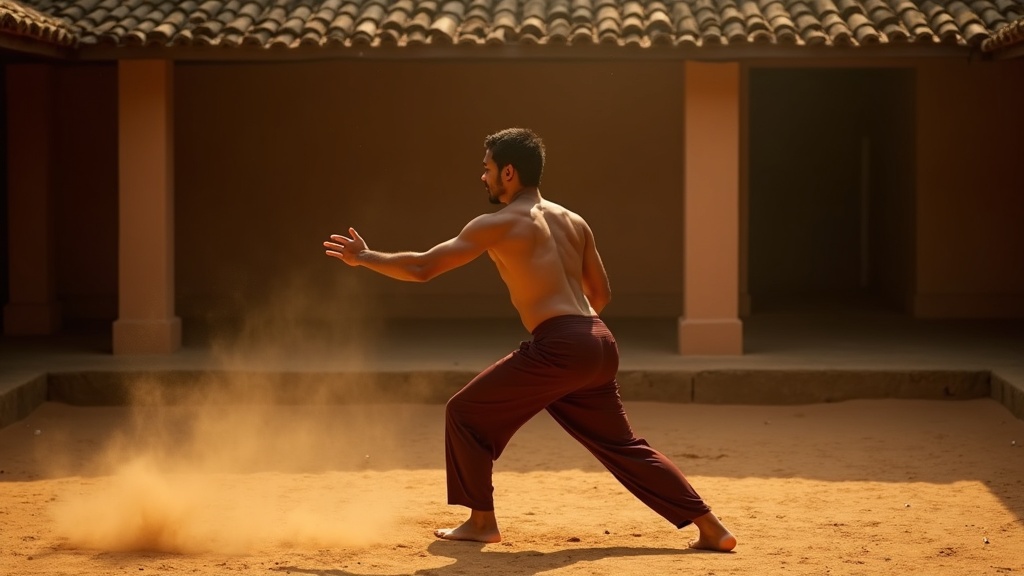
Vadakkan Pattukal: The Ballads That Kept Kalaripayattu Alive
Vadakkan Pattukal: The Ballads That Kept Kalaripayattu Alive
Last updated: 29 May 2026 — Raphael Gorschlüter
Most English-language pages that mention the Vadakkan Pattukal say the same thing in one sentence — "Malayalam ballads about Kalaripayattu heroes" — and move on. That is like describing the Iliad as "a Greek poem about a fight." Inside the kalari, these ballads are something else entirely. They are how a martial tradition under colonial ban kept its names, its ethics, its weapons and its felt memory alive in the mouths of farmers and singers — until the body was allowed to remember again.
This article does what no English page on the SERP currently does. It explains how the songs carried Kalaripayattu through the silent decades, names the major heroes and what their stories teach about how the kalari thinks about loyalty and skill, and shows where the literary tradition and the martial tradition meet — the way a Malayalam-speaking practitioner already knows them as one thing.
Vadakkan Pattukal are a corpus of Malayalam oral ballads from the North Malabar region of Kerala, composed between roughly the 16th and 20th centuries. The songs narrate the lives, duels and deaths of Kalaripayattu warriors — most famously Aromal Chekavar, Unniyarcha and Tacholi Othenan — and form one of the most important repositories of Kerala's martial heritage and its ethical code.
Key Takeaways
- Vadakkan Pattukal — literally "ballads of the north" — is the corpus of Malayalam oral epics from North Malabar that narrate the lives of Kalaripayattu warriors from roughly the 16th to the 20th century.
- The cycles centre on a small set of celebrated heroes: Aromal Chekavar, Chandu Chekavar, Tacholi Othenan, Tacholi Chandu, Palattu Komappan — and heroines including Unniyarcha and Aromaludaya Cherukunjali.
- Almost every hero is a master Kalari practitioner; specific stances, weapons and techniques are named in the verse and used as plot points.
- When the British East India Company banned active Kalari training in 1804, the songs continued, preserving technique vocabulary, lineage names and the warrior code across generations of silence.
- The ballads encode more than combat: caste relations between Thiyya-Chekavar and Nair households, family honour, the ethics of the ankam duel, and the place of women inside a martial culture.
- They are still performed today at temple festivals, in school curricula, on stage by the Kerala Folklore Academy and in films and television adaptations.
- For modern Kalaripayattu students — especially those outside Kerala — these ballads are the single most direct route into the cultural soul of the practice they are training.
What Vadakkan Pattukal Are
Vadakkan Pattukal is the name given by scholars and singers to a body of Malayalam oral ballads that grew up in the Malabar region — specifically the northern stretch from Kozhikode through Vatakara, Kannur and into the Kasaragod hinterland. The word is plain Malayalam: vadakkan means "of the north", pattukal is the plural of paattu, "song". Songs of the north.
The oldest written collections date to the 16th century, when scribes began to commit popular ballads to palm-leaf manuscripts. But the linguistic features of the verse — archaic case endings, a vocabulary thick with old Tamil and Tulu loanwords, place-names of villages that have disappeared — point to a much older oral life. The songs were almost certainly composed and recomposed for centuries before anyone wrote them down, the way every great folk epic begins.
New ballads continued to be added all the way through the 19th and into the 20th century. Singers in the kalari villages of North Malabar still adapt verses to fit a wedding, a temple feast, a remembered relative. The corpus is not a closed book.
Composition and structure
The verse is sung in a flowing trochaic metre suited to long narrative — a singer can carry several hundred lines without losing the line. Lines are typically grouped in couplets or short stanzas, with formulaic openings ("Listen now, you who gather…") and refrains that the audience joins. Repetition is built in: a single duel may be described three different ways, from the perspectives of attacker, defender and onlooker.
Accompaniment is minimal. A simple drum — usually the chenda or a smaller hand drum — keeps the pulse. Sometimes the singer carries the whole performance with voice alone, hand on chest or knee, marking the metre.
Performance contexts
The natural homes of the ballads were the social occasions that bound a village together: temple festivals (especially Theyyam and associated rituals where martial ancestors are venerated), Kalaripayattu graduation ceremonies, the harvest, the wedding, the wake. A skilled singer was paid, fed and respected. Knowing the ballads — and being able to perform them on demand — was a form of cultural capital that travelled.
What you have, then, is not a book. It is a living body of memory whose oldest threads reach back at least five hundred years, whose most recent additions are still being sung, and whose every major figure is a Kalari fighter.
How the Ballads Survived the British Ban — Kalari Memory in Song
This is the part of the story that English-language summaries skip. To understand why the Vadakkan Pattukal matter — not just for folklorists but for anyone training Kalaripayattu today — you have to understand what happened to the practice between 1804 and the 1920s.
In 1804 the East India Company, having absorbed Travancore into its sphere of influence and crushed the Pazhassi Raja uprising in Malabar, banned active Kalari training. The kalari halls — earthen pits dug into the ground, oriented to the cardinal directions, ritually consecrated — became dangerous to keep. Many families filled them in. Weapons were buried or melted. Public ankam duels stopped. Teachers who continued risked everything.
Active practice did not vanish entirely. It went underground, family by family, often reduced to a few morning movements and the marma knowledge passed quietly from father to son. But for two or three generations across most of Kerala, the public, visible life of Kalaripayattu was gone. (For the wider context, see a brief history of Kalaripayattu and why Kalari was called "the mother of martial arts".)
The songs did not stop.
What the songs preserved when the bodies could not train
Singing a ballad is not the same as banging a sword. The British administration had no interest in folk music, no apparatus to police it. Weddings, funerals, temple festivals all continued, and at each one a singer could be paid to perform the old cycles. The ballads carried four things forward:
The names. Every Kalari student in Kerala grows up knowing the names Aromal, Unniyarcha, Tacholi Othenan, Palattu Komappan the way an English child knows Robin Hood and King Arthur. When you know the name of the master, you know that mastery is possible. The ballads kept the line of memory unbroken even when nobody was being publicly trained.
The vocabulary of technique. Specific stances are named in the verse. Specific weapons — the urumi, the cherulekha (small sword), the otta (curved stick) — appear with their proper Malayalam terms. The vocabulary of the kalari was not lost; it was being sung. When practice resumed openly in the early 20th century under teachers like C. V. Narayanan Nair, the names of techniques were already on every villager's lips.
The ethical code. The ballads are not just fight scenes. They are sustained meditations on loyalty (a Chekavar fights the ankam he was hired for, even when he knows the contract is unfair), on honour (Unniyarcha refuses to be intimidated and walks her usual path through hostile territory), on the proper relation between a martial professional and the patron who calls on him. This is the ethics that made Kalaripayattu more than fight skill — and it survived in the song.
Cultural pride under suppression. A colonised people whose martial culture has been outlawed needs a story that says: we were once warriors, our women defeated armed men, our houses were famous from Kasaragod to Trivandrum. The Vadakkan Pattukal gave Malayalis exactly that story, sung at every gathering, in their own language, beyond the reach of the coloniser's law.
When I teach Western students in Germany or Spain and they ask why the practice "feels so alive" when they finally hear the names spoken in Malayalam, this is part of the answer. The body had centuries of silence; the song never went quiet.
The Major Heroes — Aromal, Chandu, Tacholi Othenan
The Vadakkan Pattukal are organised into cycles, each centred on a family or a hero. Two cycles dominate: the Puthooram cycle (Aromal Chekavar and his sister Unniyarcha) and the Tacholi cycle (Tacholi Othenan and his nephew Tacholi Chandu). Around these orbit shorter cycles devoted to figures like Palattu Komappan and Aromaludaya Cherukunjali.
Aromal Chekavar — the perfect duellist
Aromal of the Puthooram house is the archetype: a young man trained from childhood in the family kalari, an unmatched swordsman, hired out to fight the ankam — the formal duel — on behalf of patrons. The central ballad of the Puthooram cycle narrates the duel between Aromal and an opposing champion. Aromal wins, but is killed treacherously after the fight by a cousin or rival (depending on the recension), who is then hunted down across the next set of ballads.
What the songs put forward through Aromal is the figure of professional skill in the service of duty. He does not pick his fights for personal glory. He fights because the family has been hired, because the patron's cause is just, because the ankam was sworn before witnesses at the temple. When he is killed by treachery rather than fair combat, the moral universe of the ballad demands that the treachery be answered — and answered in a fair fight, not by stealth.
For a modern Kalari student the lesson is not "be a great fighter". It is something closer to: the kalari trains skill and the moral frame within which skill is exercised. Skill without frame is dangerous, and the ballads know it.
Chandu Chekavar — the cousin, the betrayer, the human
Chandu — Aromal's cousin in most versions, his rival in others — is the complicated figure. He is also Puthooram-trained, also a Chekavar, also skilled. He betrays Aromal in the moments after the duel and pays for it. But the ballads do not paint him as simply evil. The verse gives him reasons — slighted pride, an old quarrel, a Patron who manipulated him — and lets the audience feel the tragedy.
That moral complication is one reason the Vadakkan Pattukal endure as literature. They are not Disney. The Chekavar who breaks the code is still a Chekavar, still a man you knew, still part of the family house. The songs hold all of this at once.
Tacholi Othenan — the rule-breaker
Othenan of the Tacholi family is the other great hero, and his cycle has a completely different temperature. Where the Puthooram ballads are tragic and grave, the Tacholi ballads are flamboyant, romantic, full of escapes and pranks and confrontations with authority. Othenan steals cattle, breaks into rival kalaris at night, courts women across caste lines, defies the local raja and somehow survives every reckoning until he doesn't.
He is the Nair warrior chief of Vatakara, head of his own kalari, master of the churika (a North Malabar dagger) and the long sword. His exploits are remembered with affection more than awe — he is the warrior every village hopes one of its sons will turn out to be: skilled, loyal to his people, mischievous, ungovernable.
Tacholi Chandu, Palattu Komappan and the cycles around them
Tacholi Chandu — Othenan's nephew — carries the cycle forward into the next generation. Palattu Komappan is the great Thiyya warrior of the central Malabar plains, often paired in ballads with the Chekavars of the Puthooram line, sometimes set against them, always treated as a peer.
The cycles cross-reference each other. A Tacholi ballad will mention a Puthooram fighter; a Puthooram ballad will set part of its action near Vatakara. The picture you get, taken together, is of a single North Malabar martial culture with many famous houses, each producing its own line of trained Kalari warriors, each with its own honour code, all of them moving inside one shared social world.
The Major Heroines — Unniyarcha and Beyond
Most martial-art folk traditions push women to the margins. The Vadakkan Pattukal do not. The heroines of these ballads are not consorts and grieving mothers — they are trained Kalari practitioners, and their fight scenes are among the most loved passages in the entire corpus.
Unniyarcha at the Nallur festival
Unniyarcha is the sister of Aromal Chekavar, daughter of the Puthooram house, trained from girlhood in the same kalari as her brother. The most retold episode in her cycle is set at the temple festival at Nallur: Unniyarcha is travelling to the festival with her husband (in most versions a man named Kunjiraman), and the road passes through territory controlled by a band of Jonakar — Mappila Muslim traders or guards, depending on the recension — who have a reputation for harassing travellers.
Her husband urges her to take a detour. She refuses. She has a right to that road and she will use it. When the band confronts them and her husband freezes, Unniyarcha draws her urumi — the flexible whip-sword that only a trained Kalari practitioner can safely wield — and clears the road. Some versions add that the chief of the Jonakar later comes to her family to ask forgiveness and pays a respectful compensation.
The ballad is read in Kerala as a model of righteous courage, not aggression. Unniyarcha does not start the fight; she refuses to surrender the freedom to walk her path. Her urumi work is described in technical detail — the cracks of the blade, the footwork, the way she keeps her husband behind her — and the songs assume the audience knows enough kalari to follow.
I have watched a senior Indian woman in a workshop in Berlin draw the parallel out loud: we forget what was once normal. A woman with an urumi was once normal in North Malabar. The ballad keeps that normalcy on record.
(A planned dedicated article — /post/unniyarcha-kalari-warrior — will take Unniyarcha's full cycle in depth. Until then this section is the closest English-language source on her ballad inside a Kalari context.)
Aromaludaya Cherukunjali, Kunki and the unnamed mothers
Beyond Unniyarcha, the ballads name other women. Aromaludaya Cherukunjali — "the woman who is the source of Aromal" — appears as a trained warrior and matriarch. Kunki and others figure in the Tacholi cycle. There are mothers who train their sons, patrons who pay for the ankam, women who own the kalari and call the next teacher to it.
The texture is not flat. Women in the ballads negotiate, refuse, fight, mourn, plot revenge, found family lines. The pattern of medieval North Malabar — matrilineal among many Nair and Thiyya families, with property passing through women — leaves a fingerprint on every ballad. A Kalari student reading the Vadakkan Pattukal for the first time learns very quickly that the assumption "martial art = man's world" was not Kerala's assumption.
Caste, Family, Vengeance — What the Ballads Encode Beyond Combat
A reader who treats the Vadakkan Pattukal as adventure stories misses three-quarters of what is happening. The ballads are a sustained record of how a martial society organised itself — who could fight on behalf of whom, what a fight settled, what a fight could never settle, what loyalty meant and what it cost.
The Chekavar role inside Thiyya society
The Chekavars are a sub-grouping within the Thiyya community of North Malabar, historically associated with the ankam — the formal contracted duel. A Thiyya household with land or honour to defend, but without a son trained for combat, would hire a Chekavar family to fight on its behalf. The arrangement was hereditary, formal, witnessed at the temple, paid for in coin, harvest share and standing.
A Chekavar did not freelance. He fought for the contracted patron. The ankam was sworn before the temple deity and conducted at an appointed time, at an appointed place, by appointed seconds, with rules so detailed that violations were prosecuted by the village council afterwards. The Puthooram ballads spend long passages on the legal-ceremonial preparation for a single fight: this is part of what made the contract sacred.
Nair, Thiyya and the tensions the ballads document
North Malabar's martial culture cut across communities. The Nair households produced their own kalari lineages — Tacholi being the most famous. The Thiyya households produced theirs. The two sometimes cooperated, sometimes competed, occasionally fought each other in the ankam itself. The ballads document this without flattening it into either grievance or harmony.
Modern Indian conversations about caste are politically charged, and the Vadakkan Pattukal sit awkwardly inside them. A Kalari student outside India does not need to take a position. What the songs make clear is that medieval Kerala had a complex, regulated, sometimes brutal social arrangement in which Kalaripayattu was the shared skill of multiple communities, and the ankam was one of the institutions that managed disputes between them. That is the historical picture. The ethics of the contemporary kalari is to honour the lineage of every community whose work fed it.
Family rivalry and the moral weight of vengeance
Many of the longer ballads are revenge narratives. Aromal is killed by treachery; the next generation of Puthooram, including his sister Unniyarcha and later his son Aromal Cherukunjali, hunt his killer. The Tacholi cycle has its own rivals and its own answers.
What is interesting about these vengeance plots is how constrained the vengeance is. It is not free-fire. The avenger has to identify the killer, summon him to a proper fight, conduct the duel by the same ankam rules. Killing the killer's family, ambushing him, poisoning him — those would dishonour the dead more than not avenging him at all. The code is strict. The ballads enforce it through how they reward and punish their characters.
In a modern kalari I tell beginners: the practice is not about being dangerous. It is about being skilled and bound by something larger than the skill. The Vadakkan Pattukal are the older form of exactly that lesson.
Specific Kalari Techniques Mentioned in the Songs
This is the section that distinguishes the ballads from generic folk literature. The verse names Kalaripayattu techniques. A singer who didn't know the kalari couldn't sing the songs properly; a listener who didn't know the kalari couldn't fully follow them. The text and the practice are interlocked.
For a fuller map of what kalari technique consists of, see the article on the four disciplines of Kalaripayattu and their weapons. The ballads draw most heavily on the last two stages — angathari (weapon training) and verumkai (empty-hand combat).
Urumi against straight sword
The most famous technical sequences in the Puthooram cycle pit the urumi — the long, flexible, whip-like Kerala blade — against a conventional straight sword. The urumi is the signature weapon of the Chekavars and of Unniyarcha. The ballads describe it in motion: the wrap, the snap, the recovery, the way a trained user keeps the blade always moving so the metal never collapses on the hand. They also describe what a swordsman has to do to stay alive against it — close fast, control the urumi's working radius, accept a graze.
Anyone who has seen a Kerala demonstration of urumi work recognises immediately how accurately the verse describes the geometry. The poets were practitioners, or they were close to practitioners. They knew.
Marma references — striking and protecting
The Vadakkan Pattukal allude repeatedly to the vital points of the body — the marma — that Kalari practitioners learn to strike and to protect. A duel ballad will name the strike that ended the fight ("his blow fell at the joining of the neck and the shoulder") in language that lines up with the marma vocabulary of marma vidya as it is still taught. The songs do not teach marma — that is the job of the master inside the kalari — but they hold the technical world open, and they remind every village that the joining of neck and shoulder is not a random place to strike.
Stances and footwork named in verse
Specific Kalari stances appear in the ballad text. The poet will describe a fighter sinking into a low guard, then exploding upward and forward. The Malayalam terms used overlap with the names of chuvadu — the basic foot patterns — and vadivu — the animal stances — that every Kalari student still drills today. A modern teacher hearing the verse can almost see the footwork mapping under it.
The animal logic of combat
Several ballads use animal imagery — the lion's spring, the snake's recoil, the elephant's planted base — that mirrors the eight vadivukal (animal stances) of Kalaripayattu: gajavadivu (elephant), simhavadivu (lion), aswavadivu (horse), varaha (boar), sarpa (snake), marjara (cat), kukkuda (rooster) and matsya (fish). The ballads are not lecturing the audience about the system. They are using it as the natural metaphor stock — the way a sailor's poem uses the sea.
How the Ballads Are Performed Today
The Vadakkan Pattukal did not become museum pieces. They moved through the 20th century and into the 21st on several tracks simultaneously, and a Kerala traveller today can hear them in more places than most outsiders realise.
Temple festivals and ritual performance
In the North Malabar villages where the cycles were born, ballads are still sung at temple festivals — sometimes as standalone performances by hired singers, sometimes inside the larger frame of Theyyam ritual, where ancestral warriors are themselves invoked and embodied. A traveller in Kannur district during the December–March festival season has a good chance of hearing live ballad singing in its original setting.
Kerala Folklore Academy and scholarly preservation
The Kerala Folklore Akademi, established by the state government in 1995, runs systematic collection and documentation of the Vadakkan Pattukal. Field recordings, scholarly editions and trained performers are part of its programme. Several university music departments — at Kerala University, Calicut University and others — sustain the tradition as a living art form taught to new singers.
School curriculum and Malayalam literature
Selected ballads are read in Kerala school Malayalam textbooks. Most Kerala adults — Kalari practitioners or not — can recognise the opening lines of the Puthooram cycle or the most famous Tacholi episodes. The names Aromal, Unniyarcha, Tacholi Othenan are common cultural property in a way that has no equivalent in most English-speaking countries' relationship to their own folk heroes.
Films, television and modern adaptation
Malayalam cinema and television have adapted the cycles repeatedly. The most famous example is the 1989 film Oru Vadakkan Veeragatha ("A Northern Story of Valour") directed by Hariharan and written by M. T. Vasudevan Nair, which reimagined the Aromal–Chandu story from Chandu's perspective. The film was a critical landmark in Malayalam cinema and brought the Vadakkan Pattukal to a generation of viewers who had grown up away from the live ballad tradition. Television serials, theatre productions and Kerala stage adaptations continue.
Inside the kalari itself
In several living Kalari schools in Kerala — Belinjam, Vatakara, Tellicherry and others — students still hear fragments of the ballads invoked during training, especially during the guruthi (ritual blessing) ceremonies and on the days dedicated to the patron deity of the kalari. The link between the songs and the practice has never been formally broken, even where it has thinned to a thread.
Where to Find Translations and Recordings
A complete English-language critical edition of the Vadakkan Pattukal does not yet exist. What does exist is a useful patchwork that a serious reader outside Kerala can assemble.
Wikipedia overview. Vadakkan Pattukal on Wikipedia is the best free starting point in English. It is brief but accurate. Separate Wikipedia articles cover Aromal Chekavar, Unniyarcha, Tacholi Othenan and the Chekavar community.
Sahitya Akademi. India's National Academy of Letters, the Sahitya Akademi, has published Malayalam ballad selections with scholarly introductions in English. These are the most authoritative single-volume editions.
Kerala Folklore Akademi. The state academy publishes scholarly editions, field recordings, and Malayalam-language critical studies. Some material is digitally available; much remains in print only.
Kerala University and Calicut University Press editions. Both universities have published academic editions of the major cycles with scholarly apparatus. These are the editions Malayalam graduate students use.
Field recordings. Kerala Sangeetha Nataka Akademi and All India Radio (Akashvani) have archived live ballad performances by traditional singers across decades. Selected tracks are available on the Akashvani digital archive.
Academic translations. Selections of Unniyarcha episodes have been translated by scholars including Sara S. Joseph; Aromal cycle excerpts appear in M. V. Vishnu Namboothiri's work and in journal articles in the Journal of Kerala Studies. These are scattered but findable through the JSTOR interface or directly from the universities.
Online cultural magazines. Brhat and similar Indic cultural outlets publish English essays on specific ballads from time to time — these are useful supplements to the academic literature.
The reading order I suggest for a Kalari student starting from scratch: Wikipedia summaries first (Vadakkan Pattukal, Aromal, Unniyarcha, Tacholi Othenan), then the Sahitya Akademi selection, then a screening of Oru Vadakkan Veeragatha (subtitled), then — if Malayalam is workable for you — into the academic editions.
Why These Ballads Matter for Modern Kalari Students
If you are training Kalaripayattu today — online from Berlin, in person in Goa, at a workshop in Madrid — the Vadakkan Pattukal are not optional cultural background. They are part of the practice itself, and ignoring them produces a thinner Kalari student.
Cultural humility — knowing whose practice this is
I have taught beginners in Germany and Spain who could perform a passable meypayattu sequence after six months but who had never heard the name Aromal. That is not a moral failing — they were never told. But it is a missing piece. Kalaripayattu is not a generic Asian movement system; it is the embodied art of specific Malabar families, kept alive by specific people in specific villages, sung into permanence by specific singers at specific temple festivals. Knowing whose practice this is changes the way you stand in it.
You start to teach yourself: somebody fought and died and was remembered for this. You move differently. The respect is not performed; it arises.
Knowing the names changes how the techniques land
When a senior teacher mentions "the urumi the way the Chekavar fought it" and the student has Aromal and Unniyarcha already in their mind, the demonstration acquires depth. The technique is no longer a movement to copy. It is a movement that has been done before by people the practice has not forgotten. The ballads supply the names that turn drill into lineage. (For more on how the lineage is held by living teachers, see our piece on the Kalaripayattu guru tradition and on Kerala's Kalari warrior-statesman Velu Thampi Dalava.)
Understanding why specific weapons exist
A modern Kalari student often asks: why so many weapons, why this particular order, why the urumi at the end? The ballads give the operational answer. The urumi exists because situations exist in which a single fighter must hold a wide circle of attackers off long enough to escape or be reinforced. Unniyarcha at Nallur is the worked example. Once you see the use case, the weapon stops being exotic and becomes specific.
The same applies to most of the weapons in the kalari arsenal. They were not assembled to look impressive in demonstrations. They answered concrete combat problems that the ballads document.
A bridge into Kerala's wider culture
For a student who eventually visits India to deepen the practice — at a residential program, a retreat, a long stay in a Kerala kalari — knowing the Vadakkan Pattukal opens conversations that nothing else opens. Mentioning Aromal's name in a Kannur tea shop is a different experience from asking generically about "Kalari history." The local knowledge is right there.
The ballads as antidote to thin-content positioning
The Western marketplace of "ancient martial arts" tends toward two extremes — either tourist-board romance ("the deadliest art on earth") or skeptical academic deflation. The Vadakkan Pattukal sit outside both. They are how the culture remembered its own warriors — not for marketing, not for academic deconstruction, but for use, by the people who lived next to the kalaris and ate at the same temple feasts. That is a third position. It is the position Kalari University tries to write from. (Our longer treatment of this — why we don't call Kalaripayattu "the mother of all martial arts" lightly and why people practise Kalaripayattu in the first place — overlaps the same ground.)
Knowing the ballads is part of standing in that third position with you.
Frequently Asked Questions
When were the Vadakkan Pattukal composed?
The oldest written collections date to the 16th century, but the linguistic features of the verse — archaic Malayalam forms, old Tamil and Tulu loanwords, vanished place-names — point to an oral tradition reaching back further. Composition continued through the 19th and into the 20th century. New verses are still being adapted by traditional singers in North Malabar today.
Are the Vadakkan Pattukal historically accurate?
They are historical sources for North Malabar's martial culture, not court chronicles. Names, family lines, villages and feuds align with land records and oral genealogies. Specific dates, body counts and supernatural episodes have been stylised by centuries of retelling. Scholars treat them as one of the richest documentary sources for medieval Kerala society, with the standard caveats every folk epic requires.
Who is Aromal Chekavar?
Aromal Chekavar is the most celebrated male hero of the Vadakkan Pattukal — a young Thiyya-Chekavar warrior from the Puthooram family of North Malabar, famous for his skill with the urumi and his death through the treachery of a cousin after winning a contracted ankam duel. His story forms the central arc of the Puthooram cycle.
Who is Tacholi Othenan?
Tacholi Othenan was a Nair warrior chief from the Tacholi family of Vatakara, probably 16th century. The Tacholi cycle of ballads celebrates him as a master swordsman, a defender of his family's honour, a flamboyant rule-breaker and the subject of the most romantic and adventurous strand of the Vadakkan Pattukal.
Is Unniyarcha a real person?
Unniyarcha — sister of Aromal Chekavar — is a historical-legendary figure rather than a documented individual. The Puthooram family she belongs to is genealogically verifiable. Her single-handed defeat of a band of attackers at the Nallur temple festival, armed with her urumi, is the most retold ballad of female martial heroism in Kerala.
What is the Chekavar caste?
Chekavar is a sub-grouping within the Thiyya community of North Malabar, historically associated with the profession of the contracted duellist. A Chekavar family kept its own kalari, trained its sons (and often daughters) from childhood, and supplied fighters who would fight an ankam — formal duel — on behalf of a patron for payment, family honour and harvest share.
Are women named in the ballads?
Yes. Unniyarcha is the most famous, but the cycles also name Aromaludaya Cherukunjali, Kunki, several Puthooram mothers and patrons, and women who founded family lines and called the next teacher to the family kalari. Women appear as full Kalari practitioners, not as marginal figures.
How did the ballads keep Kalaripayattu alive during the British ban?
When the East India Company banned active Kalari training in 1804, public practice went underground for two or three generations. The songs kept going. They preserved the names of the great practitioners, the vocabulary of technique, the ethical code and a sense of cultural pride. When public practice resumed in the early 20th century, the ballads were one of the bridges across the silence.
Are the Vadakkan Pattukal sung today?
Yes — at North Malabar temple festivals, in school Malayalam classes, on stage by the Kerala Folklore Akademi and university music departments, in films and television adaptations, and inside several Kerala kalaris during ritual ceremonies. They have moved beyond being the sole memory medium for Kalari but they remain the most loved one.
Are there English translations of the Vadakkan Pattukal?
Partial. Selections appear in Sahitya Akademi and Kerala University Press anthologies, in scholarly translations of Unniyarcha episodes by Sara S. Joseph, and in scattered academic essays on Kerala folklore. A complete annotated English edition does not yet exist. The Wikipedia overview articles are the best free starting point.
What is the connection between the Vadakkan Pattukal and Kalaripayattu training?
Tight. Almost every hero in the ballads is a Kalari master. Specific weapons (the urumi, the cherulekha), specific stances and footwork, and specific marma references are named in the verse. A trained Kalari student listening to a ballad can map the technique onto what their body already practises; a student who knows the ballads brings a depth of cultural understanding into the kalari that nothing else supplies.
What is the ankam duel?
The ankam was a formal contracted duel — sworn before the temple deity, conducted at an appointed time and place, witnessed by seconds, governed by detailed rules. It was the institution by which medieval North Malabar communities resolved disputes over land, honour and patronage. A Chekavar family would be contracted to fight the ankam on behalf of a patron in exchange for payment and standing. The Vadakkan Pattukal devote long passages to ankam preparation and to the moral consequences when its rules were broken.
Sources & Further Reading
- Vadakkan Pattukal — Wikipedia — the best free English-language overview, with corpus context and links to individual hero pages
- Aromal Chekavar — Wikipedia — biographical entry for the central male hero of the Puthooram cycle
- Unniyarcha — Wikipedia — biographical entry for the most famous female Kalari warrior in the ballads
- Thacholi Othenan — Wikipedia — biographical entry for the great Nair warrior of Vatakara
- Chekavar community — Wikipedia — context for the Thiyya-Chekavar professional duellist sub-grouping
- Thiyya community — Wikipedia — North Malabar community context
- Malayalam literature — Wikipedia — places the ballads inside the wider history of writing in Kerala
- Malabar region — Wikipedia — the geographical and historical home of the ballad tradition
- Kalaripayattu — Wikipedia — the martial art the ballads are interlocked with
- Theyyam — Wikipedia — the ritual performance tradition in which ballad singing often lives
- Urumi — Wikipedia — the flexible-blade weapon central to the most famous fight scenes
- Kerala Folklore Akademi — Wikipedia — the state institution running the systematic preservation of the ballads
- Sahitya Akademi — Wikipedia — India's National Academy of Letters, publisher of authoritative ballad editions in English and Malayalam
- C. V. Narayanan Nair — Wikipedia — central figure in the 20th-century revival of public Kalaripayattu after the colonial ban
- Pazhassi Raja — Wikipedia — the Kerala ruler whose anti-British resistance preceded the 1804 ban on Kalari training
- Brhat — Cultural essays on Indic traditions — useful English-language essays on specific ballads and Kerala cultural heritage
Conclusion
The Vadakkan Pattukal are not background reading. They are the spine of how Kerala remembered its martial culture when the colonial law tried to delete it. They name the heroes, the heroines, the weapons, the footwork and the moral code that the kalari was built to transmit. They are sung today in temple courtyards, taught in school classrooms, watched in cinemas and quietly invoked inside the family kalaris of North Malabar.
For a modern Kalaripayattu student — wherever you train — knowing the ballads turns the practice from a movement system into a lineage you stand inside. Aromal, Unniyarcha, Tacholi Othenan: these were not movie characters. They were people whose names a culture under suppression refused to let go of. When you train, part of what you are training is what they trained. Knowing their names is the first respect you owe to the practice.
If you are at the start of that practice — if you want to begin standing inside the lineage, not just reading about it — the first foundational lesson at Kalari University is free to try. No equipment, no prior background needed; just the first movement, in your body, the way it was always taught. Start the free Lesson 1 →
About the Author
Raphael Gorschlüter — Co-Founder & Head Teacher, Kalari University
Raphael is the co-founder of Kalari University and one of Europe's most experienced Kalaripayattu teachers. He has trained for more than 12 years in Kerala and Europe, teaches internationally across Germany, Spain and India, and runs Kalari University's residential retreats at the foot of Arunachala in Tiruvannamalai. His work is known for developing the ability to feel movement — not just perform it — and for honouring the lineage of the masters and the singers who kept the practice alive across centuries of silence.
