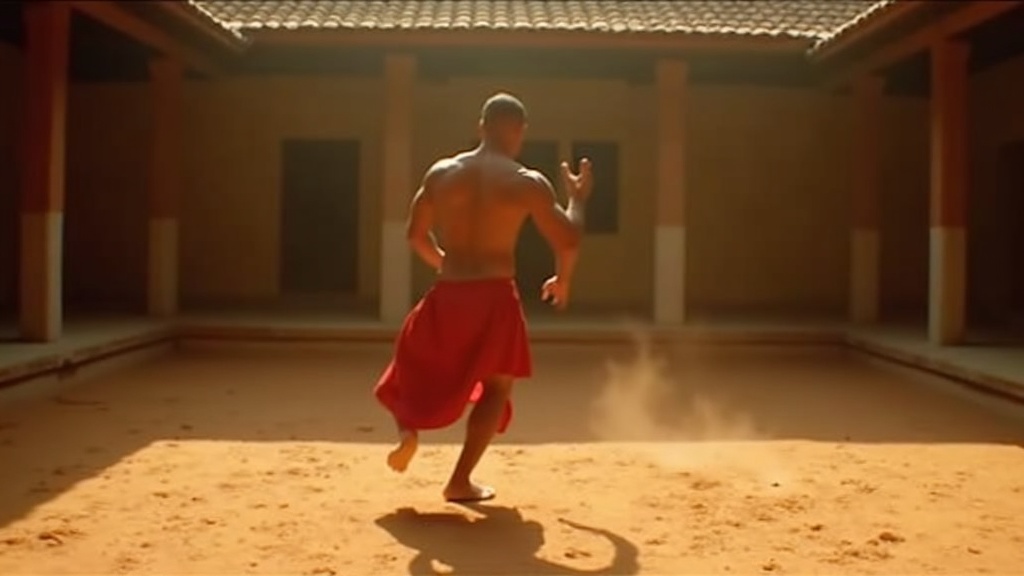
Kalaripayattu Masters: The Lineages That Saved the Art
Kalaripayattu Masters: The Lineages That Saved the Art
Last updated: 27 May 2026 · By Raphael Gorschlüter, Co-Founder, Kalari University · Direct student of Guru Balachandran Nair at Kalariyil Dharmikam
In 1804, the British colonial administration banned Kalaripayattu. Public kalaris closed. Weapons were confiscated. Teachers who refused to comply were jailed, exiled, or worse. By the end of the nineteenth century, an art that had been practised continuously in Kerala for at least two thousand years had almost disappeared.
It did not disappear because of a lucky accident. It survived because a small number of named families — and a smaller number of named teachers — refused to let it die.
This article maps those families. The northern lineages with one common root. The southern lineages with many. The masters whose names you should know if you are serious about understanding where this practice came from and how it reached you.
A Kalaripayattu lineage is the unbroken chain of teacher-to-student transmission inside one family or school of practice, traced back through named gurus (teachers, called gurukkal or ashan) to the era when public Kalari training was still allowed. The kalaripayattu masters who carried these lineages through the 1804 British ban are why the art exists today. Two broad traditions survive — Vadakkan (northern Kerala) and Thekkan (southern Kerala) — each with its own family map, teaching emphasis, and surviving schools.
Key Takeaways
- Kalaripayattu survived the 1804 British ban because of a handful of named family lineages — not by accident.
- Kottakkal Kanaran Gurukkal (1850–1935), often called the "Dronacharya of Kalaripayattu", is the single most influential modern master; roughly sixty per cent of surviving Vadakkan (northern) kalaris trace their lineage to him.
- The Vadakkan (northern) tradition is structurally unified because most of it descends from one teaching line; the Thekkan (southern) tradition is highly diverse, with many independent family lineages.
- C. V. Narayanan Nair (1905–1944), Kanaran's student, founded the CVN Kalari network that spread Kalaripayattu institutionally across twentieth-century Kerala.
- Women warriors trained inside family kalaris — Unniyarcha of the Puthooram family is the most famous, preserved in Kerala's medieval Vadakkan Pattukal ballads.
- Smaller regional styles still survive: Dronamballi, Odimurassery, Tulu Nadan Shaiva Mura, and Kayyangali.
- A genuine lineage is verifiable in one sentence — the teacher can name their teacher, where they trained, and which side of the tradition (Vadakkan or Thekkan) they hold.
Why Lineage Matters in Kalaripayattu
Most martial arts in the West are taught from a curriculum. A syllabus exists. Belts mark progress. A student who finishes one level moves to the next. The teacher is, in practical terms, an instructor — a competent person who delivers a structured course.
Kalaripayattu does not work that way. It never has.
The Kerala kalari is a family. The teacher is called gurukkal (in Vadakkan tradition) or ashan (in Thekkan tradition) — both words carry a meaning closer to "the one who initiates" than "the one who instructs". The student is not a customer. The relationship runs in two directions: the teacher takes responsibility for the student's body and conduct, and the student takes responsibility for carrying the practice forward intact. This is the guru-shishya parampara, the formal teacher-disciple lineage system that underlies most serious traditional knowledge in India.
What does this mean in practice? It means that everything important about the art lives in the transmission. The exact angle of a stance. The breath pattern that goes with a particular movement. The corrections a teacher makes silently, with a hand on a shoulder, that no manual could ever record. The order in which weapons are introduced and why. The marma points and what each one actually does. None of this was ever written down completely. It was passed, body to body, in the kalari pit, generation after generation.
What you cannot photograph, you can only inherit.
This is also why lineage is the single most useful filter when you are trying to figure out whether a kalari is real. A genuine teacher can name the line they come from in one sentence: "My teacher was X, his teacher was Y, the family kalari is in Z." Vague answers — "the tradition", "ancient masters", "many gurus" — are usually a sign that no specific teacher exists behind the claim. I write about how to do this verification in more detail in our guide to the kalaripayattu guru tradition.
The second thing lineage protects is integrity of method. Without it, Kalaripayattu drifts. The body sequences become showy choreography for tourists. The weapons turn into props. The marma teachings detach from kalari chikitsa, the healing system that was always taught alongside the fighting system. (We cover that pairing in detail in our pillar on Kalaripayattu marma therapy.) A lineage holds all of this together because it remembers the practice as a whole, not as separate modules.
How the Lineages Almost Died
To understand why the surviving lineages matter so much, you have to understand how close the entire system came to being lost.
The 1804 Ban
After the death of Pazhassi Raja and the consolidation of British control in Malabar, the colonial administration moved against the regional warrior class. The 1804 prohibition on Kalaripayattu was part of a broader campaign to disarm Kerala. Public kalaris — the dedicated training pits, usually built underground — were ordered closed. Possession of traditional weapons such as the urumi (flexible sword), churika (curved dagger), and the long kettukari staff became a punishable offence. Teachers were prosecuted.
The political backdrop is well covered in our profile of Velu Thampi Dalava, the Travancore Prime Minister and kalari warrior whose 1809 Kundara Proclamation was one of the first organised Indian revolts against British rule. Velu Thampi was himself part of the Kalari-trained Nair warrior class, and his uprising was both the high point and the breaking point of public Kalari resistance in the south.
The Hidden Years
Between roughly 1810 and 1920, Kalaripayattu went underground.
Most public kalaris closed. The dedicated buildings were repurposed or fell into disuse. Public competitions, including the ankam (judicial duels) and poithu (group fights) that had previously been part of village life, were forbidden. A handful of families kept teaching in private — at night, inside the household, with no fixed schedule and no public students. The training was often given only to direct relatives, because trusting an outsider was dangerous.
You can feel the consequences of this period when you compare what survived to what is described in older sources. Whole categories of weapon work shrank. Some of the longer combinations are mentioned in palm-leaf manuscripts and in the medieval Vadakkan Pattukal ballads, but no living teacher today claims to have inherited them in full. They went with the masters who died without students.
The art thinned. Within one generation it was bruised; within two it was barely upright; by the third generation — late nineteenth century — only a handful of named families were still actively transmitting the full system.
The 1920s Revival
The revival was not a public movement. It was a small group of teachers in a few Kerala districts who quietly began taking students again as colonial pressure eased and Indian nationalist sentiment grew. The most important of them was Kottakkal Kanaran Gurukkal, working out of Kottakkal in northern Kerala. By the late 1920s and 1930s, Kanaran was already teaching the students who would become the next generation of masters — among them C. V. Narayanan Nair (CVN).
When India formally lifted the colonial ban after independence, the structure for revival already existed. It existed because of fewer than a dozen named people who had refused to stop.
The Northern Tradition (Vadakkan) — One Trunk, Many Branches
The first thing to understand about the Vadakkan style is that it is unusually unified for a centuries-old art. Most surviving Vadakkan kalaris look structurally similar: the same body-sequence (meypayattu) progression, comparable weapons curriculum, similar opening rituals. They use overlapping Malayalam vaithari (oral commands).
There is a single historical reason for this unity. Most of them come from one master.
Kottakkal Kanaran Gurukkal — the Unifying Source
Kottakkal Kanaran Gurukkal (1850–1935) is the figure modern Kalaripayattu owes most to. Inside the tradition he is sometimes called the "Dronacharya of Kalaripayattu" — a reference to the master archer of the Mahabharata who trained an entire generation of warriors.
Kanaran taught in Kottakkal, in present-day Malappuram district, northern Kerala. The historical estimate — accepted across Vadakkan teaching circles — is that roughly sixty per cent of all modern Vadakkan kalaris trace their teaching lineage back to him or to one of his direct students. That is an extraordinary concentration. There is no other martial tradition I know of where a single twentieth-century teacher accounts for that proportion of a surviving regional style.
[planned: kanaran-gurukkal-vadakkan-lineage — full profile article on Kanaran's life, teaching method, and the spread of his lineage]
He was a strict teacher in the old mode. Students lived inside the kalari for years before being trusted with full sequences. Weapons came late and only after the body had been prepared — the traditional four-stage Kalaripayattu progression of meithari, kolthari, ankathari, verumkai was preserved intact under him. He taught marma alongside fighting, refusing to separate the strike from the repair.
When you train Vadakkan today — in Kottakkal, in Calicut, in Thrissur, in the CVN branches in Thiruvananthapuram, even in many of the Europe-based Vadakkan teachers — you are working inside a method that Kanaran shaped.
C. V. Narayanan Nair and the Institutional Spread
The figure who carried Kanaran's teaching into the institutional twentieth century was Chambadan Veetil Narayanan Nair, almost always known by his initials CVN. He was born in 1905 and died young in 1944, but in those four decades he reshaped how Kalaripayattu was organised.
CVN trained directly under Kanaran in Kottakkal. After several years inside the family kalari, he founded the first CVN Kalari in Thiruvananthapuram in 1956 — and from there the CVN network grew. Today CVN Kalari branches operate across Kerala. The network is by far the most visible institutional face of the Vadakkan tradition and has trained many of the teachers now working internationally.
CVN's contribution was not innovation in the technical sense. He did not invent a new style or a new sequence. He took what Kanaran had preserved and built a structure around it that could survive contact with the modern world — fixed locations, regular schedules, a recognised public face, students from outside the immediate region. He institutionalised a transmission that had only just managed to stay alive.
Why Vadakkan Is So Structurally Coherent Today
This is the part that often surprises Western students. If you sit in a Vadakkan kalari in Kerala and compare what you see with what you saw in a different Vadakkan kalari a thousand kilometres away in Europe, the basic vocabulary will overlap. The opening salutation (vandanam) will look similar. The first meypayattu sequence will use comparable footwork. The weapons will be introduced in roughly the same order.
That coherence is unusual for a tradition this old. It exists because almost all of it descends from one mid-twentieth-century master via one institutional channel. A trunk and branches, not a forest.
It also has a quieter cost. Variant teaching methods that may have existed in northern Kerala before the ban were not equally well-preserved. The Vadakkan style we have is excellent, but it is also relatively narrow when compared with the kind of diversity the southern tradition still preserves.
The Southern Tradition (Thekkan) — Many Roots, Diverse Forms
Cross from northern Kerala into Travancore and the situation reverses. There is no single Kanaran of the south. There is no equivalent of CVN. There are many family lineages, many smaller schools, and a great deal of variation between them.
No Single Unifying Master — Strength and Challenge
The Thekkan tradition resisted institutionalisation for much longer. Travancore had its own political history — including the Velu Thampi uprising of 1809 — and the kalaris of the south stayed more rooted in family-warrior communities, particularly Nair households and certain Chekavar (professional-warrior) families.
When you ask a senior Thekkan teacher about lineage, you almost never get a single famous name. You get a story. "My father trained under X. His teacher was Y. Before that the family had its own kalari in Z, which closed during the ban and reopened in the 1930s." Each lineage carries something slightly different.
The challenge of this diversity is that no Thekkan student can claim to represent "the southern style" as a whole. The strength of it is that the Thekkan tradition has preserved variation. Different family lineages emphasise different elements:
- Heavier marma and pressure-point work in some
- Closer-to-ground sequences in others
- More refined kalari chikitsa (healing) in others again
- Distinct weapons preferences family-by-family
You cannot reduce Thekkan to one curriculum because it is not one curriculum. It is a set of overlapping family curricula, all sharing the same southern core but each preserving its own emphasis.
Named Southern Lineages Still Operating
Several Thekkan family lineages remain actively teaching today, primarily clustered in and around Thiruvananthapuram (the old Travancore capital) and the adjacent districts. They include older Nair family kalaris that reopened after the ban, a small number of Chekavar-descent lineages, and several ashram-style Thekkan schools that combine practice with the broader Hindu spiritual framework — particularly references to the Agastya Muni tradition and Shaiva ritual practice.
Visually, Thekkan kalaris often look smaller than their Vadakkan counterparts. The training pit may be a single room rather than a dedicated underground building. The number of students per teacher tends to be lower. The instruction is often more individual and corrective — closer to the older village-kalari model.
Guru Balachandran Nair as One Contemporary Southern Thread
Guru Balachandran Nair (1949–2022) was one of the most respected modern teachers of the Thekkan tradition. He founded the Kalariyil Dharmikam Ashram near Thiruvananthapuram in 1981 and ran it until his death in 2022.
His lineage came down through several teachers in southern Kerala. He trained as a young boy in the family-kalari model — daily oil massage, body conditioning, weapons work, marma study — and later combined the martial side of the tradition with formal Hindu sannyasa, eventually taking the monastic name Satguru Dharamananda Swaroopa Hanuman Das.
What made his teaching distinctive within Thekkan was the integration of three things: full kalaripayattu training, full kalari chikitsa healing training, and the broader spiritual framework that situated the practice inside a coherent inner life. Most modern teachers carry one or two of those. Few carried all three at his depth.
I will return to my own training with him below. Here it is enough to say that the Kalariyil Dharmikam line is one specific Thekkan thread among many. It is not the whole southern tradition; it is one branch of it. That distinction matters when reading anyone's lineage claims — including mine.
Women in Kalaripayattu Lineages — Unniyarcha and Kerala's Warrior Women
When Western readers first hear that Kalaripayattu has a documented history of women warriors, the most common reaction is surprise. The surprise is understandable. Almost no major Indian martial tradition has preserved that history as cleanly as Kerala has.
The medieval Vadakkan Pattukal — literally "northern ballads", a cycle of sung narratives from northern Kerala dating roughly to the sixteenth century — preserves several figures of women trained in the kalari. The most famous is Unniyarcha of the Puthooram family.
Unniyarcha is described as a master of the urumi (the flexible sword that is the signature weapon of advanced Kalaripayattu) and is portrayed defending herself and her family against organised attack. She is not a symbolic or allegorical figure. The Puthooram family kalari is named, located, and woven into the same family tree as Aromal Chekavar and the other warrior figures of that cycle. The ballads themselves are historical sources that have been studied by the Kerala Folklore Akademi and academic Malayalam literature scholars.
What does her existence prove? Two things. First, women were trained inside the kalari — not as exceptions, but as part of certain family lines. Second, the system was not modified for them. The same urumi, the same meypayattu, the same combat training.
[planned: unniyarcha-kalari-warrior — full standalone profile of Unniyarcha and the Puthooram family kalari, with the historical Vadakkan Pattukal sources]
Whether any specific medieval women-warrior lineage survived intact to the present is unclear. The Puthooram family kalari itself does not appear to have transmitted continuously. But the broader cultural memory survived, and several modern kalaris in Kerala (including some Thekkan schools) again train women equally with men. The historical precedent is there. It was not invented to be inclusive — it was always there.
The Vadakkan Pattukal also preserve the figure of Chandu Chekavar — sometimes presented as the antagonist of Aromal Chekavar in the famous duel cycle. The Chekavar were a distinct warrior community whose members fought professional ankam — legally sanctioned judicial duels in marked combat grounds, with payment to the family of the slain. [planned: ankam-poithu-kalari-duels — full article on the ankam and poithu institutions and the Chekavar community that specialised in them] [planned: vadakkan-pattukal-ballads — survey of the full ballad cycle and the historical lineages it preserves]
Lesser-Known Regional Styles
The Vadakkan/Thekkan division covers the great majority of surviving Kalaripayattu, but four smaller regional styles deserve a brief mention. Most students never encounter them. They are listed here because they are part of the living lineage map.
Dronamballi. A smaller northern variant centred on a few specific family kalaris in central Kerala. Often grouped under Vadakkan but with its own teaching emphasis, particularly in the early body-conditioning stage. Continues to be taught in a small number of family lines.
Odimurassery. A close-quarters Thekkan branch that specialises in unarmed and short-weapon work with a particular focus on locks, throws, and marma application at very close range. Rare today; survives in only a handful of family lineages in southern Kerala.
Tulu Nadan Shaiva Mura. A coastal Karnataka tradition, technically outside Kerala state borders but historically and stylistically continuous with Thekkan Kalaripayattu. Embedded in Tulu culture and Shaiva ritual practice. Sometimes treated as a distinct martial tradition, sometimes as a regional variant of Thekkan; the truth is somewhere between.
Kayyangali. A northern Kerala unarmed tradition focused on strikes and grappling. Has its own lineage holders distinct from CVN. Smaller in scale than the main Vadakkan stream but actively practised.
None of these can fill the role of "the next Kalaripayattu" you should travel to find. They are listed because honest mapping requires it. If you ever encounter one of them in Kerala, you have stumbled into a thinner branch of the family tree — worth recognising, worth respecting.
How to Identify a Genuine Lineage Today
Most readers of this article will never go through a formal kalari initiation. But many will, at some point, have to decide whether a particular teacher, school, or online programme is connected to a real lineage. This is the practical part.
There are three things to check. Each is concrete. Each can be verified in a single conversation.
1. Can the teacher name their teacher in one sentence?
A genuine lineage holder will answer almost immediately: "My teacher was X, his teacher was Y, the family kalari is in Z." They will not hedge. They will not say "many gurus" or "the ancient tradition". The Indian guru-shishya tradition is intensely specific about whom you learned from, because lineage is the proof of authority.
If the answer is vague, soften, or trails into mysticism, the lineage is almost certainly not there. This is the single most reliable filter. I have used it for over a decade. It works.
2. Does the kalari use Malayalam vaithari?
Vaithari are the spoken commands used to call the meypayattu sequences. They are in Malayalam — not English, not Sanskrit, not Hindi. A real teacher uses them automatically because the body has learned to move to them. Watch the first ten minutes of a class. If the calls are in Malayalam and the bodies respond to the cadence of the calls rather than to the visual demonstration, you are inside a transmission.
Sreedharan Nair's 1937 Malayalam book on Kalaripayattu was the first to document the vaithari in print precisely because they are central. They are not decoration. They are the practice.
3. Does the teacher know both kalaripayattu and kalari chikitsa?
In genuine transmission the two were never separated. The teacher who could strike a marma point was the same teacher who could restore it. A kalari that teaches only the fighting half — without any reference to the healing half — is almost always working from a partial inheritance, usually a Western or institutional adaptation.
You do not need the teacher to be a full kalari chikitsa practitioner. You need them to know how the two relate and to refer students to a colleague for the healing work if they do not practice it themselves. The honest answer is enough.
Three soft signals worth noting
Beyond the three filters above, three soft signals usually accompany real lineage. None of them is definitive on its own, but together they make a strong picture: the kalari has an opening ritual (vandanam) performed without self-consciousness; the teacher corrects students with hands as well as words; and the teacher refuses to teach certain things to certain students — selectivity is one of the oldest signs that what is being taught actually matters.
Raphael's Lineage Position
A note about where I stand in this map, because I think the article would be dishonest without it.
I trained directly under Guru Balachandran Nair at the Kalariyil Dharmikam Ashram. I spent years inside that kalari. I did the body work, the weapons work, the marma study, and what I could of the kalari chikitsa side. I was there when he was teaching daily, and I was there in the closing years of his life. He died in 2022.
What that makes me is a student of one specific Thekkan lineage. One thread, not the whole tradition. I cannot speak with authority on the Vadakkan side — I can describe it, I can map it, I have trained briefly with Vadakkan teachers, but I did not grow up inside that branch. The historical material in this article comes from published sources, from years of conversation with senior teachers from both sides, and from my own teacher's accounts of the wider tradition. Where I have used my own experience I have said so. Where I am summarising the tradition more broadly I have leaned on documented sources.
I write about my teacher's specific lineage and method in much more detail in the Kalaripayattu guru tradition article. For anyone considering serious Kalaripayattu training, knowing which branch you are stepping into matters. Northern and southern are not interchangeable. Neither is better. They are different inheritances.
If you want a broader orientation to the practice as a whole before going further into lineage, our overview of what Kalaripayattu actually is is the right starting point. For the political backdrop to the lineage map — including the 1809 uprising that shaped how the southern tradition survived the ban — see the Velu Thampi Dalava profile. For how the lineages preserve the healing knowledge that was always taught alongside the fighting knowledge, our pillar on Kalaripayattu marma therapy covers it.
Frequently Asked Questions
What is the oldest Kalaripayattu lineage?
No single lineage can claim to be the oldest, because Kalaripayattu predates written lineage records. Sangam-era literature (roughly 300 BCE to 300 CE) already describes structured combat schools in the region that is now Kerala and Tamil Nadu. The lineages we can name today — northern Vadakkan families like Kottakkal, southern Thekkan families like those linked to Kalariyil Dharmikam — are the ones that survived continuously through the British colonial period. Older lineages almost certainly existed and were lost.
Are all modern Kalaris connected to one master?
Roughly sixty per cent of surviving Vadakkan (northern) kalaris trace their lineage in some form to Kottakkal Kanaran Gurukkal (1850–1935). That is why the northern style is so structurally unified today. The Thekkan (southern) tradition is the opposite: many independent family lineages, no single unifying master. Northern Kalaripayattu has one trunk and many branches; southern Kalaripayattu has many roots.
Who is the most famous Kalaripayattu master?
Inside the tradition, Kottakkal Kanaran Gurukkal is the most historically significant — he is the figure whose teaching shaped the modern Vadakkan style. C. V. Narayanan Nair (1905–1944), his student, is the best known institutionally because he founded the CVN Kalari network that spread the practice across Kerala. In the southern tradition, modern recognition often goes to Guru Balachandran Nair (1949–2022) of Kalariyil Dharmikam.
Did women have their own Kalari lineages?
Yes. Kerala's medieval ballad tradition (Vadakkan Pattukal) preserves the memory of women warriors such as Unniyarcha of the Puthooram family, who was trained inside her family kalari and is described as a master of the urumi. Whether her specific lineage survives is unclear, but the existence of women masters inside family kalaris is well documented. Several modern kalaris in Kerala continue to train women, though dedicated women-only family lineages are rare today.
What happened to Kalari families during the British ban?
After the 1804 British prohibition, most public kalaris closed. A small number of families continued teaching in secret — often inside the household, at night, with no fixed school and no public students. Knowledge thinned in one generation and almost disappeared in the next. By the early 1900s, only a handful of named lineages were still actively transmitting the full system. The revival began in the 1920s and 1930s, led by figures such as Kanaran Gurukkal.
Is CVN the only Northern school?
No, but CVN is by far the largest. The CVN Kalari network founded by C. V. Narayanan Nair has branches across Kerala and is the most visible institutional face of the Vadakkan tradition. Several smaller Vadakkan lineages exist independently, including Kayyangali in northern Kerala. Most of these smaller lineages, however, still trace their teaching back through students of Kanaran Gurukkal.
What is the difference between Vadakkan and Thekkan Kalaripayattu?
Vadakkan is the northern style centred on Malabar; Thekkan is the southern style associated with Travancore. Vadakkan emphasises flowing animal-form sequences (chuvadu), long preparatory body work, and an elaborate weapons curriculum. Thekkan is more compact, often closer to the ground, and traditionally puts heavier emphasis on marma (vital-point) application and quick close-range work. Vadakkan is structurally unified due to Kanaran Gurukkal's influence; Thekkan is far more diverse.
Who wrote the first book on Kalaripayattu?
Sreedharan Nair is generally credited with writing the first dedicated book on Kalaripayattu, published in Malayalam in 1937. The book documented the vaithari — the oral commands used to call the meypayattu body sequences — and helped preserve material that had until then existed almost entirely in oral form.
How can a Western beginner identify a genuine Kalari lineage?
Ask three questions. First, who was the teacher's teacher, and where did they train — a real lineage holder can answer in one sentence. Second, does the kalari use Malayalam vaithari and traditional opening rituals — these are practical lineage markers, not decoration. Third, does the teacher train in both kalaripayattu and kalari chikitsa — the two were never separated in genuine transmission. If all three answers are clear and verifiable, the lineage is almost certainly real.
Who was Chandu Chekavar?
Chandu Chekavar is a figure from the Vadakkan Pattukal ballad cycle, a professional warrior from the Chekavar community who fought ankam — legally sanctioned judicial duels held inside a marked combat ground. He is best known as the antagonist in the famous Aromal Chekavar narrative. The Chekavar lineage represents one of the historic professional-warrior families whose entire identity was built around Kalaripayattu.
Did Kalaripayattu lineages exist outside Kerala?
Yes, particularly along the western coast and into what is now Karnataka and Tamil Nadu. The Tulu Nadan Shaiva Mura tradition in coastal Karnataka preserves a closely related body-and-weapons system, and several southern Tamil Nadu lineages overlap with the Thekkan style. The Kerala lineages remain the best documented, but the practice was historically regional, not strictly state-bordered.
Why are lineages still important today?
Because Kalaripayattu was never reduced to a manual. The corrections, the timing, the way a hand is placed on a shoulder to change the angle of a stance — all of it lives in transmission, teacher to student. A lineage is a guarantee that what is taught today was once tested in a real kalari by a real teacher. Without lineage, an art becomes choreography.
Sources & Further Reading
- Kalaripayattu — Wikipedia — broad overview of the practice, its disciplines, and surviving major styles, with cited academic references.
- Chambadan Veetil Narayanan Nair — Wikipedia — biography of CVN and the founding of the CVN Kalari network.
- Vadakkan Pattukal — Wikipedia — the medieval Kerala ballad cycle that preserves the Aromal Chekavar, Unniyarcha and Puthooram family narratives.
- Unniyarcha — Wikipedia — primary source profile of the most famous documented woman warrior of Kerala's kalari tradition.
- Velu Thampi Dalava — Wikipedia — life of the Travancore Prime Minister and Kalari warrior whose 1809 uprising marked the political collapse of public Kalari resistance.
- Pazhassi Raja — Wikipedia — the Malabar ruler whose death preceded the 1804 colonial measures against the Kerala warrior class.
- Guru–shishya tradition — Wikipedia — formal background to the Indian teacher-student transmission system that underlies Kalaripayattu lineage.
- Indian martial arts — Wikipedia — broader context for Kalaripayattu inside the wider family of Indian fighting traditions.
- Travancore — Wikipedia — the southern Kerala princely state whose history shaped the survival of Thekkan lineages.
- Kerala — Wikipedia — regional context: geography, language (Malayalam), and the cultural milieu in which the kalari tradition developed.
- Kerala Tourism: Kalaripayattu — Kerala state cultural reference page summarising the surviving styles.
- Sangam literature — Wikipedia — the earliest layer of Tamil-Malayalam textual sources describing structured combat schools.
- Kalariyil Dharmikam Ashram — the southern (Thekkan) lineage school founded by Guru Balachandran Nair, where the author trained.
- Lieber Institute, West Point — Kalaripayattu and the law of armed conflict — institutional source treating Kalaripayattu's surviving warrior framework in modern academic context.
Conclusion
The Kalaripayattu masters whose names you have read in this article are not historical curiosities. They are the reason a Western reader in 2026 can even ask the question "how do I learn this?" and get a real answer. The Vadakkan trunk and its many branches descending from Kanaran Gurukkal. The diverse southern roots clustered around Thiruvananthapuram and the older Travancore districts. The smaller regional threads like Kayyangali and Tulu Nadan Shaiva Mura. The women warriors preserved in the Vadakkan Pattukal whose existence is the strongest possible refutation of the idea that the kalari was ever a closed door.
What every one of these lineages shares is a refusal to let the transmission break. That refusal is what you are entering when you walk into a real kalari — Kerala, Europe, anywhere — and start the first sequence under a teacher whose teacher can be named.
If you would like to step into that transmission yourself rather than read about it, the first lesson on Kalari University is free — no payment, no commitment. It is the foundational meypayattu sequence taught the way the lineage teaches it, with the vaithari spoken in Malayalam as they always have been. Start the free lesson here →
About the Author
Raphael Gorschlüter — Co-Founder and Head Teacher, Kalari University
Raphael Gorschlüter trained directly under Guru Balachandran Nair (1949–2022) at the Kalariyil Dharmikam Ashram in southern Kerala, inside one specific Thekkan (southern) lineage. He has practised Kalaripayattu for more than twelve years and now teaches internationally — primarily in Germany, Spain, and India. His teaching focuses on the embodied, somatic side of the practice: developing the ability to feel movement, not just perform it. He is the author of the long-form profile Kalaripayattu Guru Tradition: Balachandran Nair and the Living Lineage, and he writes about lineage, training, and the inner life of the practice from inside the tradition.
In twelve years of training and teaching, I have learned that nothing about this art transmits cleanly except in person. I have watched students arrive after years of online video work and discover within three days that what they thought they were doing was not what the tradition actually teaches. I have seen senior Indian teachers correct details I had been practising for years — silently, with a hand on my back, no explanation, just the right angle. And I have sat with my own teacher in his last years and understood that the only reason any of this still exists is because a few specific people, in a few specific families, refused to let it die. That is what a lineage is. That is what this article is trying to map.
