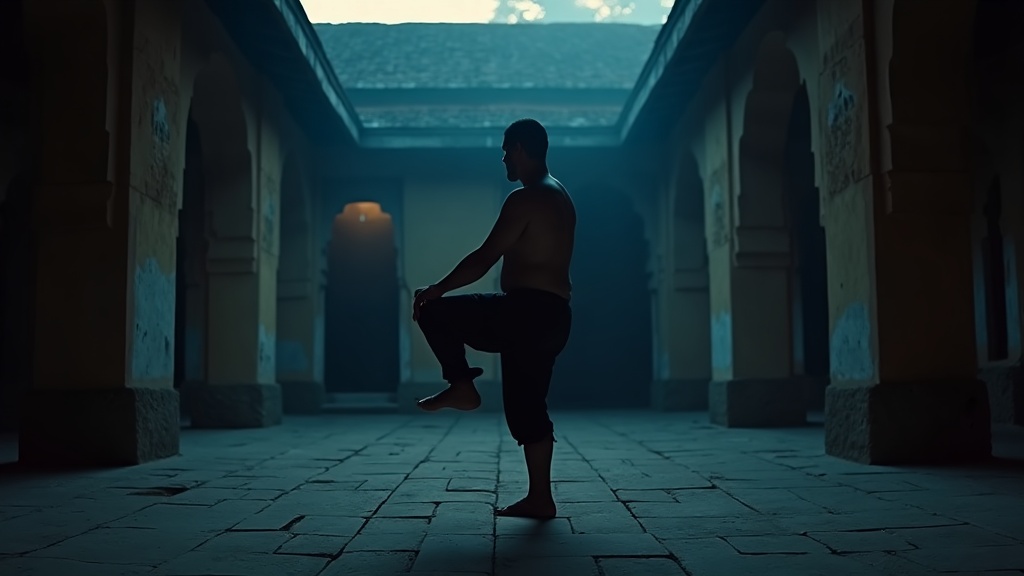
Kalaripayattu Training Schedule — Frequency, Rhythm, Recovery
Kalaripayattu Training Schedule — Frequency, Rhythm, Recovery
Last updated: 2 June 2026 · Reviewed by Raphael Gorschlüter, Co-Founder & Head Teacher, Kalari University
Almost everyone who asks how often they should train kalaripayattu wants a single number. They will not get one, because the right schedule depends on stage, age, recovery capacity and what else is in your week. What follows is the actual answer — frequencies, session lengths, weekly templates, periodization cycles, and rest-day rules that have worked across more than a decade of teaching adult beginners through meithari and into kolthari. The numbers are concrete. The trade-offs are honest. Pick the template that fits your life and protect it. This is the practical schedule sub-question inside the larger picture of what kalaripayattu training actually involves.
A kalaripayattu training schedule for an adult learner is built around two to five sessions per week of 45 to 90 minutes, with at least one full rest day every two training days, organised into modular four-to-eight-week cycles that alternate building and consolidation phases. The minimum viable schedule is two 45-minute sessions per week plus a short daily home drill; the dedicated end of the range is five sessions of 60 to 90 minutes plus daily 10-minute drills. The right schedule for you is the one you can keep for two years, not the one that looks impressive for two months.
Key Takeaways
- The realistic minimum for adult progression is two 45-minute kalaripayattu sessions per week, supplemented by a short daily home drill of 10 to 15 minutes.
- Three sessions per week for the first three months is the strongest predictor that a new student will still be training a year later.
- Rest days are non-negotiable — connective tissue adaptations happen between sessions, not during them, and most overuse injuries in adult beginners come from skipping rest, not from heavy training.
- The traditional Kerala schedule is daily dawn training under a resident gurukkal; the modern adult equivalent is two to five weekly sessions plus structured intensives one to two times per year.
- Periodization in kalaripayattu uses four-to-eight-week cycles: a building phase that adds volume or new material, then a consolidation phase that lets the body absorb it.
- Combining kalari with yoga works well on alternating days; combining it with heavy strength training requires separating loads by at least one rest day.
- A two-week break does not ruin progress — the body holds the practice for months. Calendar consistency over years matters more than perfect attendance in any given month.
- Schedules tighten when you move from meithari to kolthari because weapon work loads the shoulders and grip in ways floor work does not.
The Traditional Daily Routine in a Kerala Kalari
Every modern schedule is a translation of an older one, and the older one is worth knowing before you adapt it. In a traditional kalari in Kerala, the rhythm is daily and the rhythm is dawn.
Students arrive at the kalari before sunrise, usually between 5 and 6 a.m., because the air is coolest and the body is most receptive before the heat of the day. The session opens with the vandanam — the salutation to the floor, the teacher and the lineage — then moves through warm-up, meipayattu sequences, and the stage-specific material the student is working on. Training runs 60 to 120 minutes. By 7 or 8 a.m., the kalari empties and students return to work or school. Many traditional schools add a second, shorter session in the early evening for advanced students.
This schedule is daily — six or seven days a week — for residential students. A child who entered the gurukula at age seven might keep this rhythm for the entire twelve years of their formal training. That is the schedule the often-cited "twelve years to mastery" figure is measuring, and it is the schedule most adult learners outside India simply cannot replicate.
Two structural features of the traditional schedule are worth carrying into a modern adult version, even if the rest is not portable:
The monsoon intensive. The Malayalam month of Karkidakam — roughly mid-July to mid-August — is the classical intensive training period. Outdoor work decreases, oil massage (uzhichil) and floor conditioning increase, and the body is treated as more receptive to deep work in the humid air. The principle is portable: build one structured intensive cycle into every training year, regardless of climate.
Dawn timing. The decision to train at dawn was not symbolic. Cooler air, an empty stomach, undistracted attention and a freshly-rested body all combine to make the morning a measurably better training window than the evening for most people. For more on the practicalities of holding a dawn schedule as an adult, see how to get up early for a morning kalari routine.
This article is built around the modern adult version of these principles — fewer sessions, more deliberate cycling, and recovery treated as part of the schedule rather than as time off from it.
Modern Adult Schedules — Three Real Templates
What follows are three weekly templates that adult students actually keep. They are not theoretical maxima. Each one has been kept by enough students over enough years that the realistic trade-offs are visible.
Minimum Viable — 2 Sessions per Week, 45 Minutes Each
This is the schedule for the adult with a demanding job, family obligations and the realistic capacity to commit one short block at the start of the week and one at the end. Two 45-minute sessions, ideally on Tuesday and Saturday, with a short daily home drill of 10 to 15 minutes on the other days.
What it looks like:
- Tuesday, 45 minutes — full warm-up, vadivu work, the current meipayattu sequence, closing
- Saturday, 45 minutes — same shape, with slightly more time on the new material
- Monday, Wednesday, Thursday, Friday — 10 to 15 minutes at home: vandanam, a short joint-mobility sequence, one vadivu held for time, and the breath patterns from the most recent session
- Sunday — full rest
What you get: steady progress through meithari over 12 to 18 months, the practice installed into your week as a routine rather than an event, and a body that is recognisably more open within three months.
What you do not get: rapid progression, fluency with weapons, or the kind of nervous-system rewiring that higher frequencies produce. Two sessions per week is enough to make kalaripayattu a real lifelong practice. It is not enough to compress the calendar.
The single thing that makes this template work is the short daily drill. Without it, two sessions per week is closer to maintenance than progression — the body forgets between sessions. For exactly what the daily drill should contain, see the home practice routine for beginners.
Solid Practitioner — 3 to 4 Sessions per Week, 60 Minutes Each
This is the schedule where the practice starts compounding. Three to four 60-minute sessions per week, organised so that no two consecutive days are both kalari days, with one or two active recovery days and one full rest day.
A typical week:
- Monday — 60 min kalari (Session A: full warm-up, vadivu cycle, meipayattu sequence 1)
- Tuesday — active recovery: 30 min walk + 15 min mobility
- Wednesday — 60 min kalari (Session B: emphasis on chuvadu, new material)
- Thursday — rest or yoga
- Friday — 60 min kalari (Session C: integrating week's material)
- Saturday — optional 4th session (60 min, longer, deeper) or active recovery
- Sunday — full rest
What you get: meithari completed in 8 to 12 months instead of 12 to 18. The body adapts at a rate that two-session students cannot match. Joint mobility, breath capacity and structural awareness all visibly improve inside six months. By the end of year one, you are most likely starting to ask your teacher about kolthari, and the teacher's answer ("not yet") will arrive at a body that is genuinely closer to ready.
What you do not get: the deep saturation of daily training. The practice is a primary discipline in your week, but not the organising principle of your life.
This is the template that fits most working adults who are serious about the practice. It is also the template where the difference between training and overtraining starts to matter, because the body is now exposed often enough that recovery has to be deliberate.
Serious Dedicated — 5 to 6 Sessions per Week + Daily Short Drill
This is the schedule for the adult who has reorganised their life around the practice. Five to six 60- to 90-minute sessions per week, a daily 10-minute drill on the seventh day, and at least one structured intensive cycle per year of two to four weeks at higher volume.
A typical week:
- Monday — 75 min kalari (full session, primary material)
- Tuesday — 60 min kalari (shorter, focused on weakness)
- Wednesday — 30 min light drill + breath work, OR 60 min restorative yoga
- Thursday — 75 min kalari (full session, weapons or partner work if at kolthari)
- Friday — 60 min kalari
- Saturday — 90 min kalari (longest session, integration)
- Sunday — full rest, or 15 min vandanam-and-vadivu drill only
What you get: meithari in 6 to 9 months, kolthari accessible inside two years, and a body that has crossed an adaptation threshold beyond which the practice changes the structure of the day rather than fitting into it. Most serious students who keep this schedule for three years end up reorganising the rest of their training around it.
What you do not get without injury: this template only works if recovery is taken as seriously as training. Adults who push to five sessions per week without proper rest days, sleep and nutrition will be injured within six months. The schedule below is not a starting point. It is what a body that has earned it can absorb.
For the realistic timelines each stage takes at each of these frequencies, see how long each kalaripayattu stage really takes.
Schedule by Training Stage — Meithari to Verumkai
Training frequency and session structure are not fixed across a training life. They shift as the stages shift. Here is how a sustainable schedule changes from meithari through kolthari, ankathari and verumkai.
Meithari (body conditioning). The foundational stage. The body has not yet adapted to low stances, deep hip work or the breath patterns of the practice. Frequency: 2 to 4 sessions per week. Session length: 45 to 60 minutes. Rest: at least one full rest day every two training days. The biggest mistake at this stage is not training too little — it is training too much without recovery and accumulating a chronic hip or knee complaint that takes months to resolve.
Kolthari (wooden weapons). Weapon work loads the shoulders, grip and forearms in ways meithari does not. Most students reduce session length slightly (60 minutes instead of 75) and increase session count (four times per week instead of three). The body needs the variety, and the wooden weapons benefit from frequent contact even if each session is shorter. Rest: one full day per week plus one active recovery day.
Ankathari (metal weapons). Sharp blades require absolute attention quality. Schedules shift again — slightly fewer sessions, longer recovery windows, and the introduction of dedicated mental-rehearsal days where the student walks through patterns without weapons in hand. Frequency: 4 to 5 sessions per week, but with more variance in intensity. Realistically, this stage is only accessible to students training daily under a teacher qualified in metal weapons, which is rare outside India.
Verumkai (bare-hand combat and marma). The application stages do not follow a fixed schedule. By the time a student is in verumkai, they have been training for years and their schedule is shaped by their teacher's assessment, their own body's current state, and what marma study is being added. Most verumkai practitioners cycle between intensive periods (5 to 6 sessions per week) and consolidation periods (2 to 3 sessions per week), often coordinated with their teacher's calendar.
The pattern across stages is consistent: as the demands of the material increase, total session volume stays roughly constant, but its distribution across the week shifts and recovery becomes more deliberate. The schedule that worked for meithari does not automatically transfer to kolthari without adjustment.
Periodization — When to Push, When to Recover
A schedule held flat for a year is a schedule that stops producing results. The body adapts to constant input by reducing its response to it. The way around this is periodization — alternating cycles of higher and lower training load so the body always has something new to adapt to.
Traditional kalari already does this through the monsoon intensive: Karkidakam is the high-load month, the rest of the year is the maintenance period. Modern adult schedules can use the same principle on a shorter cycle.
A workable modular structure for adult learners:
The four-week building cycle. Four weeks of slightly higher volume — one extra session per week, or 10 to 15 minutes longer per session, or new material being introduced. The body is exposed to a load it has not adapted to.
The two-week consolidation cycle. Two weeks of returning to baseline volume, but holding the new material. The body absorbs what was introduced. Skill quality improves noticeably during consolidation because the nervous system has bandwidth to refine rather than acquire.
The one-week deload. Every six to eight weeks, a deliberate light week. Sessions cut to half length, intensity dropped, focus on mobility, breath and slow vadivu work. This is not lost training — it is when adaptation completes.
The annual intensive. Once or twice per year, a two-to-four-week period of high-volume work. This can be a retreat, a residential intensive, or a self-organised home block with daily training. The intensive shifts the body into a different rhythm than weekly classes can produce. One ten-day immersion advances a student more than three months of two-session-per-week training because the nervous system has nowhere else to go — it is in the practice all day.
The mistake adult students most often make with periodization is to push the building cycle harder rather than respecting the consolidation cycle. The consolidation weeks feel less productive because the load is lower; the body's adaptation is happening invisibly during them. Skipping consolidation in favour of permanent building produces the plateau the schedule was designed to avoid.
Recovery and Rest Days — Why They're Not Optional
The single biggest predictor of injury in adult kalaripayattu beginners is not training intensity. It is the absence of rest days. Adults who train three to four sessions per week with proper rest stay healthy. Adults who train three to four sessions per week without rest accumulate hip impingement, knee complaints and Achilles soreness within six months.
The reason is structural. The adaptations the practice depends on — improved joint range, denser connective tissue, recalibrated proprioception, better breath capacity — happen during recovery, not during training. Training is the stimulus. Rest is the adaptation. Skip the rest and you have all stimulus, no adaptation.
Three categories of recovery day, in order of how often they should appear:
Active recovery days. Light movement that keeps the body open without adding training load. Twenty to thirty minutes of walking, 15 minutes of gentle hip and shoulder mobility, or 30 minutes of restorative yoga. These days are between training days, usually two to three per week.
Full rest days. No structured training, no formal mobility work. The body's only job is to repair. At least one of these per week is non-negotiable for adult learners. Two per week is normal for two-or-three-session-per-week schedules.
Sleep, water, food. Less glamorous than the schedule but more important than the schedule. Seven to eight hours of sleep, hydration through the training day, and adequate protein are the single biggest determinants of whether the body absorbs the training or just survives it. For practical work on what the practice does to your nervous system and why sleep specifically matters for the adaptations kalari produces, see the body awareness benefits of kalaripayattu.
A short note on muscle soreness. The delayed-onset muscle soreness most beginners feel in early meithari — burning hamstrings, sore hip flexors, tender adductors — is normal and is not an injury. It resolves in 48 to 72 hours and improves with each cycle of training and rest. Sharp joint pain, especially in the hips or knees, is a different signal entirely. Soreness adapts. Joint pain compounds. Learn the difference early and stop training when you feel the second one.
Combining Kalaripayattu with Other Practice
Almost no adult student arrives at kalaripayattu with an empty training week. The realistic question is how to integrate kalari with what is already in your week — yoga, running, strength training, another martial art, swimming. The honest answer is: some combinations fit, some conflict, and the schedule has to respect both loads.
Yoga. Best companion. Kalari and yoga share breath, structure and presence; the trade-off is hip range, where deep yoga work and deep kalari stances can overload the same tissue. Practical pattern: alternate days, with yoga acting as active recovery between kalari sessions. A workable week is three kalari sessions and two yoga sessions, with the yoga sessions placed on the day after a kalari session. For the underlying differences and why the combination works, see kalaripayattu compared with yoga.
Strength training. Compatible with two adjustments. First, separate loads by at least one day — never back-to-back heavy lifting and kalari. Second, keep strength sessions moderate. Programs that leave you sore for three days will compromise your low stances and the kalari sessions become wasted. A sustainable combination once you have six months of kalari base is two strength sessions and three kalari sessions per week, with strength work focused on posterior chain, single-leg stability and grip rather than maximal lifts.
Running and cardio. Compatible at moderate volume. Long slow runs (Zone 2) actually complement kalari well because they train the same aerobic base the practice rewards. Sprint work, hill work or high-intensity intervals on the same day as kalari are too much. Practical pattern: easy runs on active recovery days, no hard runs within 24 hours of a kalari session.
Other martial arts. Variable. Internal arts (tai chi, qigong) combine well — the breath and structural emphasis transfer. External striking arts (Muay Thai, kickboxing) can conflict because the body is being asked to organise around two different structural logics simultaneously. Grappling (BJJ, judo) is workload-heavy and recovery-expensive; serious combination of grappling and kalari requires careful schedule management.
Swimming. Excellent active recovery. Low-impact, full-body, no loading conflict with kalari. Best used on recovery days or as a separate fitness practice.
The general rule across combinations: the body reads total weekly load, not the labels on each session. Two hard kalari sessions, two hard strength sessions and two hard runs per week is six hard sessions, regardless of how they are categorised. Adults who keep the total at four to five hard sessions per week, regardless of what fills them, generally stay healthy and progress.
Vacation Breaks and Time Off — Does It Ruin Progress?
The fear that a two-week holiday or a month-long work crunch will erase your kalaripayattu progress is one of the most common reasons adult students burn out trying to maintain unsustainable schedules. The fear is mostly unfounded.
Here is what actually happens at different break lengths:
One week. Effectively invisible. The first session back may feel slightly stiff. Within one or two sessions the body is fully back to where it was.
Two weeks. Detectable but small. One or two stiff sessions on return, then the body resolves. Most students notice that they actually return slightly fresher mentally and progress accelerates briefly after the break.
One month. Real but recoverable. Three to four sessions to feel normal again. Total recovery of any lost ground inside two to three weeks.
Three months. Significant. The cardiovascular and connective tissue adaptations soften measurably. Plan on four to six weeks of reduced intensity to rebuild safely. The technical knowledge is mostly preserved — the body remembers the vadivu and chuvadu even if it cannot hold them as long.
One year or more. Substantial reset. Treat yourself as a returning student rather than a continuing one. Drop intensity, rebuild base, expect six months to reach previous capacity. The foundations are still there but the load tolerance has to be re-established.
The implication for the weekly schedule: build for sustainability over years, not for perfection over weeks. The student who trains three times a week for ten years with two annual two-week breaks accumulates vastly more practice than the student who tries to train five times a week for two years and quits because the schedule was unsustainable. Calendar consistency over decades beats weekly perfection over months.
Two practical patterns for adults who travel for work or family:
Holiday minimum. When away from the kalari, commit to a 10-minute daily minimum: vandanam, three vadivu held for time, and the four basic chuvadu. This keeps the body in the practice without requiring space, equipment or time. It is not a training session. It is a thread that prevents the break from becoming a complete stop.
Return ramp. When returning from any break of two weeks or more, drop session volume by one third for the first week back. If you usually train 60 minutes, do 40. If you usually train three times a week, do two. The body's tolerance for load fades faster than its tolerance for movement, and adults who jump straight back to full schedule after a break account for a disproportionate share of return-from-holiday injuries.
Building a Sample Week — Concrete Templates
The templates earlier in this article are weekly frames. Here are four fully built-out sample weeks, with day, time and content, that adult students at four different stages and frequencies have actually kept.
Sample Week 1 — Working Adult, 2 Sessions, First 3 Months
Monday      — 15 min home drill (vandanam, joint mobility, 2 vadivu)
Tuesday     — 45 min kalari class, 18:00
Wednesday   — 15 min home drill
Thursday    — 15 min home drill
Friday      — rest
Saturday    — 45 min kalari class, 09:00
Sunday      — rest
Total: 90 min class + 45 min home work + 2 full rest days = ~135 min/week.
Sample Week 2 — Solid Practitioner, 3 Sessions, Months 6–12
Monday      — 60 min kalari, 19:00 (Class A)
Tuesday     — 30 min walk + 15 min mobility (active recovery)
Wednesday   — 60 min kalari, 19:00 (Class B)
Thursday    — 45 min yoga (active recovery)
Friday      — 60 min kalari, 19:00 (Class C)
Saturday    — 15 min home drill OR full rest
Sunday      — full rest
Total: 180 min kalari + 45 min yoga + 30 min walk + at least 1 full rest day = ~270 min/week.
Sample Week 3 — Dedicated Practitioner, 5 Sessions, Year 2+
Monday      — 75 min kalari, 06:30 (primary session)
Tuesday     — 60 min kalari, 06:30 (focused weakness work)
Wednesday   — 30 min light drill + 30 min restorative yoga
Thursday    — 75 min kalari, 06:30 (full session, partner work if available)
Friday      — 60 min kalari, 06:30 (technical refinement)
Saturday    — 90 min kalari (long integration session)
Sunday      — full rest, 15 min vandanam only
Total: 360 min kalari + 30 min yoga + 30 min drill + 1 full rest day = ~420 min/week.
Sample Week 4 — Intensive Cycle, 2-Week Block
Monday–Saturday  — 90 min kalari each morning (06:00)
Monday–Saturday  — 30 min evening session (light drill, breath work, mobility)
Sunday           — full rest, hammock, water, sleep
Total: 540 min morning + 180 min evening + 1 rest day = ~720 min/week.
This last template is unsustainable as a weekly norm but valuable as a one- or two-week annual intensive. The body responds to the saturation in a way that weekly classes cannot reproduce. Plan one of these per year, build around it, and recover from it for two weeks afterward with a deload cycle.
For students just beginning to think about whether the practice fits their life, the most honest starting point is not the schedule but a single first session — to feel what one chuvadu, one vadivu and one vandanam actually demand before designing a week around them. See the beginner's guide to starting kalaripayattu for what that first session is built around.
Frequently Asked Questions About Kalaripayattu Training Schedules
How often should I train kalaripayattu as a beginner?
Two to three sessions of 45 to 60 minutes per week is the realistic minimum for an adult beginner to make measurable progress. Below that, the body forgets between sessions and you spend each class re-learning rather than building. Three sessions per week for the first three months is the strongest predictor of whether a new student stays with the practice.
Can I train kalaripayattu every day?
An experienced practitioner can. A beginner cannot, not without injury. Adults new to the practice should keep at least one full rest day every two training days for the first six months. Daily training only makes sense once the body has learned to recover between sessions, which usually takes a year of consistent four-to-five-session weeks.
Is two sessions per week enough to progress in kalaripayattu?
Yes, slowly and only if you protect those two sessions. Two sessions of 60 minutes per week, supplemented by a short daily home drill of 10 to 15 minutes, will carry an adult through the meithari stage in 12 to 18 months. Without the daily home drill, two sessions per week is closer to maintenance than progression.
How long should a kalaripayattu training session be?
Forty-five to sixty minutes is the standard length for a meithari class — long enough for a proper warm-up, the main material and a closing. Beginners benefit from 45-minute sessions; intermediate students typically work in 60- to 90-minute blocks. Sessions longer than two hours rarely add value for adult learners because attention quality drops before the body does.
Do I need rest days from kalaripayattu?
Yes, and they are non-negotiable for adult learners. The connective tissue adaptations the practice depends on happen between sessions, not during them. A typical weekly schedule has two to three training days and at least one full rest day; intensive cycles include active recovery days with only walking, breath work or light mobility.
Can I combine kalaripayattu with yoga?
Yes — kalaripayattu and yoga complement each other well because both train breath, structure and presence. The practical schedule is to keep them on alternating days rather than the same day, with yoga acting as active recovery between kalari sessions. The combination most adult students settle into is three kalari sessions and two yoga sessions per week.
Will going on holiday for two weeks ruin my kalaripayattu progress?
No. The body holds the practice far longer than beginners fear. A two-week break shows up as one or two stiff sessions on return, then resolves. A two-month break sets you back four to six weeks. The longer interruption you can keep coming back from is a much better signal than the shorter one you can avoid.
What is the traditional kalaripayattu training schedule in Kerala?
In a traditional Kerala kalari, students train daily — typically at dawn, before the heat — for one to two hours under their gurukkal. The intensive season historically falls in the monsoon months of Karkidakam, when oil massage and floor work intensify. This residential schedule is the original context for the figure of twelve years to mastery and is not the schedule most modern adult learners can keep.
What should a recovery day from kalari look like?
Sleep, water, and a small amount of low-intensity movement. Twenty minutes of walking, gentle hip mobility, or restorative yoga keeps the body open without adding training load. Avoid heavy lifting, sprinting, or another martial art on the same day — the system reads them all as the same load and recovers less well.
Can I do strength training alongside kalaripayattu?
Yes, with two adjustments. Move strength work to a separate day from kalari rather than stacking both in 24 hours, and keep loads moderate — strength training that leaves you sore for three days will compromise your low stances. Two strength sessions and three kalari sessions per week is a sustainable combination once the body has a base of six months of kalari behind it.
How should the training schedule change as I move from meithari to kolthari?
Kolthari adds weapon work, which loads the shoulders and grip in ways meithari does not. Most students reduce session volume slightly in early kolthari (shorter classes, more sessions per week) so the new loading does not accumulate as injury. A typical kolthari schedule is four 60-minute sessions instead of three 75-minute sessions.
Is the monsoon season really a special training period?
Yes, in traditional Kerala kalaris. The month of Karkidakam (mid-July to mid-August) is the classical intensive season — oil massage (uzhichil), floor work and conditioning increase, and outdoor work decreases. The cooler, humid air is believed to make the body more receptive to deep work. Modern schools in cooler climates do not need to mirror this calendar but can use the principle: build one focused intensive cycle per year.
Sources & Further Reading
- Kalaripayattu — Wikipedia — encyclopedic overview of the practice including the four stages and traditional training context
- Kerala — Wikipedia — geography and cultural background of the region where the schedule originates
- Gurukula — Wikipedia — the residential training arrangement the daily traditional schedule is built around
- Sports periodization — Wikipedia — modern training-science background for the building/consolidation cycles described in this article
- Karkidakam — Wikipedia — the monsoon month that frames the traditional kalari intensive season
- Delayed-onset muscle soreness — ACSM — sports-medicine background on the soreness adult beginners encounter in early meithari
- Nervous system — Cleveland Clinic — overview of the system the early months of meithari quietly retrain
- Proprioception — Cleveland Clinic — medical explanation of the body-awareness sense kalari develops across the schedule
Conclusion — Pick the Schedule You Can Keep for Two Years
Almost every question about training frequency dissolves once you stop asking what is the maximum I can do and start asking what can I sustain for two years without quitting? The answer is usually one notch lower than the schedule that looks impressive on paper, and it produces vastly better results.
The single best schedule is the one you will still be keeping in twenty-four months. For most working adults that is three 60-minute sessions per week plus a short daily home drill, with one full rest day and one or two active recovery days. For students with more capacity it is closer to five sessions per week. For students with less it is two — and the daily drill becomes essential.
Whatever frequency you choose, protect the rest days and respect the consolidation cycles. The body adapts during them, and the schedule that ignores them stops working within months.
If you are still deciding whether the practice is worth committing a week around, the lowest-stakes way to test it is to feel one full session — to know what the warm-up demands, what your hips can hold, and how the breath organises around the movement. The first lesson at Kalari University is free, with no equipment and no prior experience needed. It will not tell you which schedule to keep. It will tell you what one session actually contains, which is the only honest starting point for designing a week around it. Start the free first lesson →
About the Author
Raphael Gorschlüter — Co-Founder & Head Teacher, Kalari University
Raphael has trained kalaripayattu for over twelve years, beginning his serious study under traditional teachers in Kerala and Tamil Nadu and continuing through annual immersive periods in India alongside teaching commitments in Europe. He is the co-founder of Kalari University, where he leads the international curriculum and works directly with adult beginners through every stage from foundational meithari into kolthari. He teaches publicly in Germany, Spain and India, and runs the annual Kalaripayattu retreat at the foot of Arunachala in Tiruvannamalai, Tamil Nadu.
The schedules in this guide come from watching several hundred adult beginners actually keep — or fail to keep — different training rhythms over the past decade. The most reliable predictor of long-term progress has nothing to do with maximum weekly volume. It has to do with whether the student picked a schedule they could still be keeping in two years, and then kept it.
