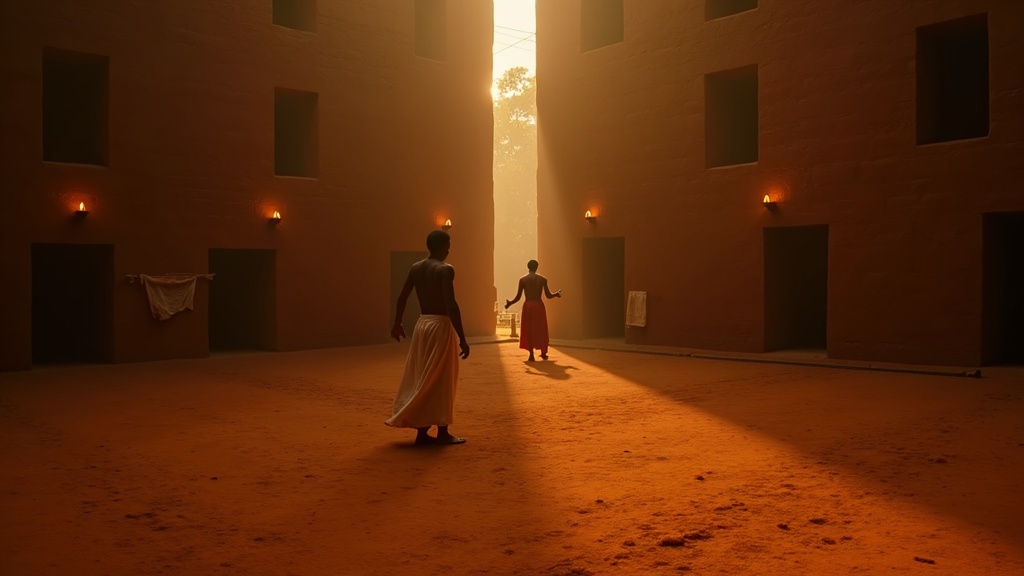
Kalaripayattu Training: A Teacher's Complete Guide
Kalaripayattu Training: A Teacher's Complete Guide
Last updated: 2 June 2026 · By Raphael Gorschlüter, Co-Founder, Kalari University · Trained 12+ years under Guru Balachandran Nair, Kalariyil Dharmikam Ashram
Most people who type "kalaripayattu training" into a search bar already know roughly what Kalaripayattu is. What they want to know is something more practical: how does the training actually work, what does it cost, where do I do it, and what does it ask of me. This guide answers those questions the way I would answer them for a new student walking into my school for the first time — with the structure clear, the trade-offs honest, and the marketing language left at the door. By the end you will know how Kalaripayattu training is built, which path makes sense for your situation, and what the first months of practice will actually feel like in your body.
Kalaripayattu training is the structured study of Kerala's traditional martial art, built around four progressive stages — body conditioning, wooden weapons, metal weapons, and bare-hand combat — taught inside a consecrated training ground called a kalari or, increasingly, through online programmes that carry the foundational work. Training combines physical conditioning, weapon work, vital-point knowledge, and traditional healing, and is typically structured around two to four sessions a week with a strong emphasis on slow, sequenced progression rather than fast results.
Key Takeaways
- Kalaripayattu training is built around four fixed stages — meithari, kolthari, ankathari, and verumkai — that must be followed in order, with each stage preparing the body for the next.
- The foundational stage meithari is where the practice is actually formed; serious students spend six months to two years here before touching a weapon.
- Four realistic training paths exist today: a traditional kalari in Kerala, an established teacher in your city, online training, or solo practice at home — each with different trade-offs in depth, cost, and accessibility.
- Adults can start at any age in reasonable health; what matters is willingness to train slowly, not previous fitness level or martial-arts background.
- A typical week of serious training involves two to four sessions, with morning practice preferred over evening — the body learns deeper patterns when fresh.
- Costs range from free (most online foundations) to €1,800 and up for residential retreats; in-person classes in Europe typically run €60–€120 per month.
- The first three months of training change body awareness, hip mobility, and floor-to-standing capability before they build any visible martial skill.
- Online training reliably transmits the foundational stage; hands-on correction and partner work require in-person time at some point in a serious practitioner's path.
- Traditional Kalaripayattu integrates martial training with kalari chikitsa — the same teacher who pushes the body also treats the injuries it accumulates.
- The single most reliable predictor of student progress is consistency, not talent: thirty minutes a day beats two hours twice a month, every time.
What Kalaripayattu Training Actually Is
Before you can choose how to train, it helps to understand what you are actually signing up for. Kalaripayattu training is not a workout, not a fitness class, and not a self-defence shortcut. It is the structured study of a complete martial system that builds the body in stages, integrates traditional healing, and treats the training space itself as part of the practice. (For the wider context of what Kalaripayattu is, before you decide whether to train, the practitioner's guide to what Kalaripayattu is is the place to start.)
The art originated in the southwestern Indian state of Kerala and was formalised in its present four-stage structure between the 11th and 12th centuries. Documented references to proto-Kalaripayattu practices appear in Sangam-period Tamil literature stretching back nearly two thousand years. Practically every school teaching today descends from a lineage that was nearly extinguished by the 1804 British colonial ban and revived publicly in the 1930s.
What this history means for training: the structure you encounter when you begin is not a curriculum someone invented this year. It is a sequence built and tested over centuries, refined inside a network of kalaris across Kerala, transmitted from teacher to student by direct apprenticeship. When you train Kalaripayattu seriously today, you are stepping into a chain of practice that has very few equivalents in any martial tradition.
Three distinguishing features set Kalaripayattu training apart from most modern martial arts. First, it begins with the body itself — months of conditioning before any weapon is touched. Second, weapons are taught before bare-hand combat, in a deliberate inversion of what feels intuitive to most Western students. Third, the practice integrates marma knowledge and the traditional healing system of kalari chikitsa — in a complete lineage, the same teacher who teaches the strike also treats the injury. (For how that healing dimension actually works, the guide to kalari chikitsa healing goes deeper than this overview can.)
In twelve years of teaching, the students who progress fastest are not the strongest or the most flexible. They are the ones who arrive willing to let the structure work on them rather than trying to skip ahead. Kalaripayattu training rewards patience, and it punishes shortcuts in ways that are not always obvious until years later.
The Four Stages — Meithari, Kolthari, Ankathari, Verumkai
The four stages are the spine of all Kalaripayattu training. Whether you train in a Kerala kalari, with a European teacher, or online with a structured programme, you are working through some version of this sequence. The order is fixed; the depth at each stage varies by lineage and by teacher.
A full breakdown of every weapon and discipline inside each stage is in the four levels of Kalaripayattu training explained. The summary below frames the logic.
Meithari — sometimes spelled meipayattu, meaning "body practice" — is the first stage. It builds the conditioning, flexibility, and body awareness that every subsequent stage depends on. Students learn low standing postures (chuvadu), animal-named stances (vadivu) such as the horse, elephant, lion, and serpent, long sequences of kicks and ground-to-standing transitions, and the foundations of breath-and-movement coordination. A serious student spends six months to two years inside meithari before touching a weapon. Western beginners often resist this — the body is asked to wait while the mind wants to skip ahead. Almost every long-time practitioner I have trained with says the same thing in retrospect: the slowness of meithari was the entire point.
Kolthari — wooden weapons — is the second stage. The long staff (kettukari, around 1.5–1.8 metres), the short stick (cheruvadi), and the curved club (ottakkol or otta) are introduced in sequence. Each teaches a different geometric relationship — long-range distance with the staff, close-range timing with the short stick, vital-point precision with the curved club. Partner work begins here. By the end of kolthari, students hold the basic relationship between their body, the weapon, and another body in space.
Ankathari — sometimes spelled angathari — is the third stage. The weapons become metal. The sword and shield (val and paricha), the dagger (katara), and at advanced levels the urumi (the flexible whip-sword) are taught. The shift from wood to metal is not just about danger; it is about precision. A wooden staff forgives sloppy distance. A blade does not. Students who have rushed through meithari and treated kolthari as exercise rarely make meaningful progress in ankathari — the body lacks the precision metal requires.
Verumkai — bare hand — is the fourth and final stage. Strikes, locks, throws, and the application of marma knowledge to disable an opponent at vital points. The empty hand comes last because the body must already understand geometry, timing, and force application from the weapon stages before it can apply those qualities cleanly with no tool. A practitioner who reaches verumkai in a traditional lineage has typically trained five to ten years. The strikes themselves often look simple — and they are — but their economy reflects everything that came before.
The four-stage structure is also why Kalaripayattu training cannot be cleanly described as "beginner," "intermediate," and "advanced" in the way other martial arts can. Every stage contains beginner, intermediate, and advanced work. A senior student in meithari is still doing meithari — just at a depth that took years to reach.
Your Training Options
Four realistic paths exist for someone who wants to train Kalaripayattu today. Each has different trade-offs, and the choice depends on geography, budget, available time, and how deep you intend to go. The honest truth is that most committed practitioners eventually combine two or three of these paths over the years.
At a Traditional Kalari (India)
Training in a traditional kalari in Kerala is the deepest form of Kalaripayattu training that exists. You enter a consecrated space, you work with a teacher who carries a lineage, and you train alongside other students — many of whom started as children. The body learns faster in this environment because the corrections are constant, the floor itself has been trained on for decades, and the rhythm of daily practice settles into the bones in a way no other format quite matches.
The trade-off is that it requires time and travel. Most foreign students who go this route spend at least a month, often three, in a Kerala kalari to make the trip worthwhile. Costs vary widely — anywhere from ₹15,000 to ₹40,000 per month including accommodation at established schools, sometimes more for the better-known ashrams. The classical schools tend to expect a quiet, disciplined student who shows up at 5:30 in the morning and works without complaint.
For students based outside India, the local equivalent is finding a qualified teacher in your own city or country. The guide to finding kalaripayattu near me walks through what to look for, what questions to ask, and how to evaluate a school before you commit. In twelve years, I have seen students travel two hours each way to a competent teacher and progress steadily; I have also seen students with a teacher in the next town stagnate because the teaching was thin. Geography matters less than the quality of the transmission.
Online Training
Online Kalaripayattu training has become legitimate in the last five years. This was not true a decade ago, when most online "Kalari" content was unstructured demonstration videos with no real curriculum. Today, several established schools — including Kalari University — offer structured programmes that carry the foundational stage (meithari) with proper sequencing, proper pacing, and live class options for direct feedback.
What online reliably transmits: the structure of the meithari stage, the daily discipline of practice, the sequence of postures and forms, the breath-and-movement coordination, the foundation that everything else builds on. What online does not transmit: hands-on correction of subtle postural errors, the felt presence of a teacher in the same room, the kalari space itself, partner work with weapons, and the deep transmission that happens when a senior practitioner adjusts your stance with their hands. (A more complete treatment of what works and what does not is in the online Kalaripayattu training guide.)
For most adults outside Kerala, online is the realistic entry point. Used well — as a structured beginning rather than a permanent substitute — it builds a strong foundation that makes any future in-person training far more productive. The Kalari University free first lesson is designed exactly as that kind of starting place. I have watched students train online for six to twelve months, then arrive at a retreat or in-person workshop and progress in a week the way an untrained beginner would progress in a month. The foundation transfers.
Solo Practice at Home
Solo home practice sits between online training and in-person training. It is what happens between sessions — and for many adult practitioners, it is where most of the actual training time accumulates. A teacher will not be there to correct you; you are working with what you have already been taught, repeating sequences until the body learns them.
This is honest work and it can carry a serious practice. But there are limits. New material is hard to learn alone — without external correction, errors stabilise and then have to be unlearned later. The body's tendency to favour patterns of least resistance compounds when there is no eye on it. Some of the more advanced material, particularly partner work and weapons, cannot be developed solo at all.
Used well — with material you have already been taught, with a clear sequence to repeat, and with realistic expectations about depth — solo practice is what turns weekly classes into actual capability. How to build a solo kalaripayattu practice at home goes into the specifics: what to drill, what not to attempt alone, how to structure a thirty-minute session, and how to use solo time to deepen rather than corrupt what you have learned in class.
Residential and Intensive Programs
Residential Kalaripayattu training is what happens when you set aside everything else for a period — a week, a month, three months — and train under one roof with a teacher and a community. This is how the art was traditionally transmitted, and it is still the format that produces the deepest shifts in body and practice.
Residential programmes range from week-long intensives in Europe and India to multi-month immersions at established Kerala kalaris. Costs vary accordingly — a one-week intensive in Europe typically runs €600–€1,200 including food and accommodation; a month-long residential at a Kerala kalari runs roughly ₹40,000–₹80,000 (around €450–€900) including basic accommodation; longer immersions scale from there. Specialised retreats, including Kalari University's own From Mind to Body retreat in Tiruvannamalai (August 2026, €1,800–€2,200), sit at a different price point because they include teaching, accommodation, full board, and structured integration time over a longer arc.
The intensity of residential training is its main feature and its main risk. Students who arrive without a foundation often overextend in the first three days and lose the rest of the week to soreness or strain. Students who arrive with a base — six months of consistent home or online practice — get the full benefit. The guide to residential Kalaripayattu training breaks down what to look for, how to prepare, and which formats fit which kind of practitioner.
Getting Started
If you are reading this article and have not yet trained Kalaripayattu, the question is no longer "what is it" but "how do I begin." There is a structured answer to this, and there is a practical one.
The structured answer is laid out in the beginner's guide to Kalaripayattu: what to expect in your first month, what your body will feel, what to avoid, and what mistakes most beginners make. That guide is the longest single read on the question and worth working through if you are serious.
The practical answer is shorter. Pick one entry point, commit to twelve weeks before evaluating, and let the body learn at its own pace. In twelve years of teaching, the students who progress are not the ones who pick the perfect school; they are the ones who pick a workable school and stay long enough for the practice to land. The choice between options matters less than the choice to start.
The first month of Kalaripayattu training does three things, regardless of where you train. It teaches the body what a low stance feels like. It begins to wake up the deep stabilisers of the hips and the diaphragm. And it shows you, often uncomfortably, where the body is asymmetric — where the left side is shorter than the right, where one hip is tighter than the other, where breath is shallow under load. These are the foundations the rest of the practice builds on, and they cannot be skipped.
For a fuller treatment of the question — including the difference between learning Kalaripayattu and learning a Kalaripayattu form, and what to look for in a first teacher — see how to learn Kalaripayattu.
If you want the simplest possible first step, the Kalari University Lesson 1 is free, takes about thirty-five minutes, and is structured to give you a real felt experience of the foundational stance and breath work. It is enough to know whether the practice fits you before any further commitment.
Training at Different Ages
The most common question I get from adult beginners is some version of "am I too old to start this?" The honest answer is almost always no — but with caveats that depend on the body, not the calendar.
In Kerala, traditional families often begin children around age seven. This is cultural transmission, not a biological requirement. The body of a seven-year-old learns Kalaripayattu's low geometry differently than the body of a thirty-five-year-old, but both bodies learn it. What the adult brings that the child does not is patience, body awareness, and the willingness to feel where things are tight rather than push past them. What the child brings is a body that has not yet rigidified into adult patterns. Both can train; the training looks different.
I have taught beginners in their twenties, thirties, forties, fifties, and sixties. The decisive variable is not age and not raw fitness. It is willingness to train slowly. People who arrive expecting to perform tend to plateau or strain themselves; people who arrive willing to feel tend to progress steadily for years.
Some specific notes by life stage. Teenagers and young adults often have the easiest time with the low postures and the fastest learning curve with sequences — but also the highest injury risk if pushed too fast. Practitioners in their thirties typically start from less mobility than they expect and gain more than they expect within three to six months. Practitioners in their forties and fifties usually find that Kalaripayattu addresses problems they did not know they had — chronic lower back tension, restricted hip rotation, asymmetries that built up over years of desk work. The deeper somatic dimension of the practice often becomes more accessible in mid-life, when the urgency of performing has settled.
For a more complete treatment of age-specific concerns — including injury prevention, modification of postures for older joints, and what realistic progress looks like at each life stage — see the guide to starting Kalaripayattu at any age.
The only honest contraindication is acute injury or unresolved joint pathology. If you have an acute knee or hip injury, the low postures will aggravate it. Address the injury first, then begin. The same applies to spinal issues that have not been worked through with a physiotherapist or qualified clinician. With those caveats addressed, the body that walks into a kalari at fifty-five is not meaningfully less able to begin than the body that walks in at twenty-five — just different.
What Training Actually Builds (Body, Awareness, Presence)
The question of what Kalaripayattu training actually builds depends entirely on the timeframe. Inside the first month, it builds soreness and the first openings of hip mobility. Inside the first three months, it begins to build coordination, breath, and the foundations of body awareness. Inside the first year, it builds the felt structure that all subsequent training depends on. Inside five years, it builds something closer to the deep transformation that draws people to the practice in the first place.
The clearest single benefit, and the one that students most consistently report, is the development of body awareness. Kalaripayattu trains proprioception — the sense of where the body is in space — and interoception — the felt sense of what is happening inside the body — far more directly than most movement practices. Within six months of consistent training, most students report being able to feel parts of their body they had not been aware of for years.
The second benefit is structural. The low standing postures train the legs in slow, controlled work that gym training rarely touches. Hip mobility opens. Floor-to-standing transitions, which most adults gradually lose, return as an unconscious capability. The breath drops out of the chest and into the belly, not as a technique but as a consequence — you cannot hold a deep low posture with shallow chest breathing, so the breath adapts.
The third benefit is harder to name and is the one most students do not anticipate. It is the quiet effect of training a body and mind together inside a structured tradition, of standing on a floor that has been trained on for decades, of letting a sequence shape your nervous system over years. People describe it differently — grounded, settled, less reactive, more present. None of this is mystical; it is what happens when somatic training is sustained over time. (For why the practice produces these effects — and the wider question of why people keep coming back to it for years — why practice Kalaripayattu goes deeper than this overview can.)
A note on what Kalaripayattu training does not directly build, because the marketing language sometimes overstates it. It does not build large-muscle gym strength — there are simpler tools for that. It does not build fast self-defence capability — the four-stage structure is the wrong timeline for that. It does not produce dramatic visible changes in the first few weeks; the visible changes are subtle and slow. What it builds is depth, and depth takes time.
The Daily Rhythm — Morning Routines and Off-Days
Traditional Kalaripayattu training is built around the morning. In Kerala, classes typically start at 5:30 or 6:00 in the morning, before the heat, when the body is fresh and the mind has not yet filled with the day. This is not arbitrary. The body learns somatic patterns better when the nervous system is calm and undisturbed. Morning practice settles into a deeper layer than evening practice does.
For adult practitioners outside Kerala, replicating this is harder. Most students work, raise children, and live lives that resist a 5:30 wake-up. The pragmatic compromise is to find a regular early time — even 6:30 or 7:00 — and protect it. Three early-morning sessions a week are worth more than five evening sessions, in my experience teaching adults across Europe.
What helps the morning rhythm settle is structural, not motivational. Going to bed earlier (and stopping screens by a defined time) does more than any morning routine hack. A simple morning sequence that does not require thinking — light stretching, a few low stances, fifteen minutes of breath work — anchors the practice on days when motivation is low. The practical guide to getting up early for a morning kalari routine covers what actually works for most adults and what is folk wisdom dressed as advice.
A typical week of serious training, for a working adult, looks something like this. Two longer sessions (60–90 minutes) on Tuesday and Thursday mornings, either online live or in person at a school. One shorter solo session (30–45 minutes) on Saturday morning. Optional fifteen-minute daily anchors on the remaining days. Sunday off. This rhythm holds for a year, and the body remembers everything taught in the longer sessions because the daily anchors keep the patterns alive.
Off-days are not absences from the practice. They are part of the structure. The body integrates training during rest — adaptations happen between sessions, not during them. Practitioners who train hard seven days a week often progress more slowly than those who train moderately five and rest two. This is true at every level of seriousness. Inside the traditional Kerala kalari, the master sets the rhythm; outside, the practitioner has to.
One more practical note. The body of a serious Kalaripayattu practitioner needs oil. Daily self-application of warm oil to the major joints — knees, hips, shoulders — is a feature of traditional practice and a real one. Sesame oil works for most; coconut for warmer climates. Five minutes of self-massage before a morning session is worth more than any pre-workout supplement on the market. This is the kind of detail that does not appear in online articles but matters for sustaining training over years.
Costs and Investment
Costs for Kalaripayattu training vary widely, from free first lessons to multi-thousand-euro residentials, and the price says less about quality than most people assume. A complete breakdown of what training costs in different formats is in the full guide to Kalaripayattu training fees. The overview below sets reasonable expectations.
Online foundations from reputable schools typically range from free (introductory lessons) to €30–€60 per month for a structured membership with regular live classes. Kalari University's own Level 1 membership sits in this range. The Lesson 1 onboarding is free, which is enough to evaluate the practice before any commitment.
In-person group classes in Europe, at the schools I know well, run roughly €60–€120 per month for weekly or bi-weekly group sessions. Quality varies more than price; a €60 class with a well-trained teacher is often far better than a €120 class taught by someone who learned from videos two years ago.
Private one-to-one sessions in Europe run €60–€150 per hour. A taster session at Kalari University is €120. This is the fastest format for learning new material, but most students do not need it for the foundational stage — group training and structured online programmes carry the conditioning work fine.
Residential and retreat formats sit at a different price point. A one-week intensive in Europe typically runs €600–€1,200 including accommodation and food. Month-long stays at Kerala kalaris run ₹40,000–₹80,000 (around €450–€900) for accommodation, food, and training combined. Structured retreats with a defined teaching arc — Kalari University's August 2026 From Mind to Body retreat is in this category — run €1,800–€2,200 for two weeks, including everything except flights.
The honest cost question is not the monthly fee but the cumulative investment over years. A practitioner who trains seriously for three years probably spends €3,000–€6,000 in total across classes, occasional intensives, and one or two trips to India. Spread across thirty-six months, this is comparable to most regular gym memberships, and it carries a depth of training that no gym membership does.
How Often and How Long — Schedule
The question of how often to train Kalaripayattu has a clear answer for the foundational stage and a more nuanced answer for the later stages. The full breakdown of weekly and yearly training rhythms is in the kalaripayattu training schedule guide. The summary below covers the essentials.
For meithari — the first year or two — three sessions a week of 45–90 minutes is the realistic minimum for actual progress. Below this, the body forgets between sessions and never settles into the patterns. Above five sessions a week, the body usually needs the rest more than the additional training. The sweet spot for most adults is three to four sessions per week, with most days carrying some kind of short anchor practice (fifteen minutes of stances, breath work, or stretching).
For kolthari and later stages, the training requirement grows. Weapon work requires partner time, which usually means scheduled classes, which usually means four to five sessions a week to make meaningful progress. This is one of the practical reasons most adult practitioners outside Kerala plateau partway through kolthari — the training time required becomes hard to sustain.
The length of each session varies by stage and by school. Foundational meithari classes typically run 60–90 minutes. Weapon classes often run 90–120 minutes because the partner work requires warmup and repetition. Solo sessions can run anywhere from 15 to 60 minutes, depending on the day. The shorter sessions are not less serious — a focused 30-minute daily practice over a year builds more depth than 90-minute weekend marathons.
The yearly arc matters too. Most traditional schools follow a roughly six-month seasonal rhythm — heavier training during the cooler months, lighter maintenance during the hot months. Outside Kerala, this translates loosely to harder training in autumn and winter, lighter in summer. The body benefits from the variation; a constant-intensity year flattens out the gains.
A note on holidays and breaks. Two-week gaps in training are recoverable in a week. Six-week gaps take a month to recover from. Six-month gaps essentially reset you to where you were six months earlier. Consistency is the real currency.
What You Need to Start — Requirements
The practical requirements for starting Kalaripayattu training are fewer than most beginners expect. You do not need previous martial-arts experience. You do not need a particular level of fitness. You do not need flexibility — the practice itself builds it. The full breakdown of what to bring, wear, and prepare is in the Kalaripayattu training requirements guide. The essentials are below.
Physical requirements. Reasonable general health. No acute knee or hip injuries. No unresolved spinal conditions. Beyond this, the practice meets the body where it is. I have taught beginners who could not touch their toes in week one and were sitting in a stable horse stance by month six. The mobility comes from the training, not before it.
Time requirements. Three sessions a week, plus short daily anchor practice. This works out to roughly four to six hours of training per week for the foundational stage. Less than this and progress slows to the point of frustration. More than this is usually not necessary in the first year.
Equipment requirements. Almost none for the first stage. A pair of loose trousers (traditional cotton if possible, but standard yoga pants work fine), a top that allows shoulder mobility, and bare feet. A clean floor with enough space to lie down fully extended in any direction. A wall to brace against for some stretches. That is the full equipment list for meithari. Weapons come later, and they come with the curriculum — you do not need to buy them in advance.
Space requirements. For solo practice at home, a space roughly two by two metres clear of furniture is enough for most foundational work. For partner work and weapon training, you eventually need more space and a real floor (carpet is workable for meithari; hard floor is preferable for serious training). Outdoor practice on grass is fine in good weather.
Mental and emotional requirements. This is where the real prerequisites sit, and they are harder to name than the physical ones. Willingness to be a beginner. Willingness to feel uncomfortable in a low stance for longer than you want to. Willingness to train without immediately visible progress, for months at a time. Willingness to take correction. Practitioners who arrive with these qualities, regardless of physical condition, usually progress. Practitioners who arrive without them — looking for fast results, looking to impress, looking to skip the foundations — usually stop within the first three months.
The honest truth is that the requirements for starting are far lower than the requirements for sustaining. Anyone can begin. The practitioners who stay are the ones who let the structure work on them over years.
Common Questions
Before the formal FAQ section, a few questions that come up almost weekly in conversation with prospective students.
"How is Kalaripayattu training different from yoga?" They share roots in pre-classical South Indian movement traditions, but they are not the same practice. Yoga centres on internal work; Kalaripayattu centres on external structure that produces internal effects as a consequence. The deeper treatment is in kalaripayattu vs yoga.
"Can I cross-train with other martial arts?" Yes, with awareness. The lower stance geometry of Kalaripayattu does not mix cleanly with the upright geometry of most striking arts; the body has to learn to switch between them. After a year of solid Kalaripayattu foundation, cross-training becomes additive rather than confusing.
"How long until I can defend myself?" The honest answer is that defending yourself in a real situation does not depend on training stage; it depends on calm, judgement, and basic awareness. Within six months of serious training, you will move differently. Within a year, your nervous system handles surprise better than most people's. Reliable physical self-defence capability is a different question, and Kalaripayattu's four-stage structure is not the fastest path to it.
"Do I have to convert to anything?" No. Kalaripayattu has Hindu cultural roots, including the salute to the kalari's deities, and most schools maintain these traditions. Practitioners of any background train without complication. The cultural elements are part of the practice's context, not a religious prerequisite.
"Is this safe at my age?" For almost any age, with reasonable health, yes. The slowness of the foundational stage is what makes it safe. Practitioners who get injured are almost always the ones who push past their current capability to perform for a teacher or for themselves. The students who train inside their current range progress steadily and rarely injure.
Frequently Asked Questions
What is Kalaripayattu training?
Kalaripayattu training is the structured study of Kerala's traditional martial art, organised into four progressive stages — meithari (body conditioning), kolthari (wooden weapons), ankathari (metal weapons), and verumkai (bare-hand combat). Each stage must be worked through in sequence, with the foundational meithari stage taking six months to two years before any weapon is introduced. Training combines physical conditioning, weapon work, vital-point knowledge, and traditional healing under the same teacher, and typically runs two to four structured sessions a week with additional daily practice.
How long does Kalaripayattu training take?
Mastery of the full four-stage system traditionally takes seven to twelve years of consistent training. Practical capability — strong stances, basic forms, a working staff sequence — usually arrives inside the first year. Body awareness and the deeper somatic effects show up within three to six months of three-times-weekly practice. Most adult practitioners outside Kerala work through meithari and parts of kolthari over three to five years and develop a sustainable lifelong practice from there.
How much does Kalaripayattu training cost?
Costs range from free (introductory online lessons including Kalari University's Lesson 1) to several thousand euros for residential immersions. Online structured memberships typically run €30–€60 per month. In-person group classes in Europe run €60–€120 per month. Private sessions run €60–€150 per hour. Month-long stays at Kerala kalaris run €450–€900 all-inclusive. Specialised retreats like Kalari University's August 2026 From Mind to Body retreat run €1,800–€2,200 for two weeks including accommodation and full board.
Can I learn Kalaripayattu online?
Yes, the foundational meithari stage transmits well online when the programme is structured properly. What online reliably gives: the sequence of postures and forms, the daily discipline, the breath-and-movement coordination, the foundation everything else builds on. What it does not give: hands-on posture correction, partner work, the kalari space itself, and the deeper transmission that requires in-person time. For most adults outside Kerala, online is the realistic entry point — used as a structured beginning rather than a permanent substitute.
How often should I train Kalaripayattu?
For the foundational meithari stage, three sessions per week of 45–90 minutes is the realistic minimum for steady progress. Most adult practitioners settle into three to four structured sessions plus short daily anchor practice. Below three sessions a week, the body forgets between training and patterns never settle. Above five sessions a week, the body usually needs rest more than additional training. Morning practice settles deeper than evening practice when the rhythm can be arranged.
What are the four stages of Kalaripayattu training in order?
The four stages, in fixed order, are: meithari (body conditioning through low postures, animal forms, and ground work, typically six months to two years), kolthari (wooden weapons including staff, short stick, and curved club, typically two to three years), ankathari (metal weapons including sword, dagger, and the flexible urumi, typically two to four years), and verumkai (bare-hand combat applying everything learned in the earlier stages, typically the remaining years of practice). The order is structural — each stage builds the prerequisite the next assumes.
How old do I need to be to start Kalaripayattu?
Traditional Kerala families often begin children around age seven, but this reflects cultural transmission rather than a biological requirement. Adults can start at any age in reasonable health — I have taught beginners from their twenties through their sixties. What matters more than age is willingness to train slowly. People who arrive expecting to perform tend to plateau or strain; people who arrive willing to feel tend to progress steadily for years.
Do I need to be fit to start Kalaripayattu training?
No. The practice itself builds the conditioning. What you need is reasonable general health, no acute joint injuries, and willingness to feel uncomfortable in low stances for longer than you want to. The mobility, strength, and breath capacity develop over the first three to six months of training. Trying to "get fit before starting" usually delays beginning by months and adds little — the practice trains the body in a specific way that gym work does not replicate.
Can I practise Kalaripayattu at home?
Yes, for two purposes. First, for daily anchor practice between classes — fifteen to thirty minutes of stances, breath work, and short sequences that keep the patterns alive. Second, for solo practice of material already taught by a teacher. What home practice does not do well is teach new material — without external correction, errors stabilise and have to be unlearned later. Most serious adult practitioners combine structured classes (online or in-person) with daily home practice; this combination is what actually sustains progress.
What is the best way to start Kalaripayattu training?
The most reliable path for adults outside Kerala is to start with a structured online foundation programme — Kalari University's free Lesson 1 is designed for exactly this — and add in-person training when it becomes available. Twelve weeks of consistent foundational work creates the base that makes everything subsequent more productive. After three to six months, a one-week intensive or retreat accelerates progress dramatically. The structured-online-plus-occasional-intensive pattern is what most serious adult practitioners outside Kerala settle into.
What should I wear and bring to Kalaripayattu training?
Loose cotton trousers and a top that allows shoulder mobility. Bare feet — Kalaripayattu is traditionally trained without footwear. A water bottle. For solo home practice, a clean floor with enough space to lie down extended in any direction. For partner work, eventually a wooden staff (most schools provide them in early stages). That is the full list for the foundational stage. Weapons come with the curriculum and do not need to be purchased in advance.
Is Kalaripayattu training safe for adults?
For adults in reasonable health, yes. The slowness of the foundational stage is what makes it safe — the body is given time to adapt before depth is asked of it. Practitioners who get injured are almost always the ones who push past their current capability to perform. People with acute knee or hip injuries should address those first; people with unresolved spinal conditions should work with a physiotherapist before beginning. With those caveats, the practice is safer than most contact martial arts and comparable to a serious yoga practice.
Sources & Further Reading
- Kalaripayattu — Wikipedia's comprehensive entry on the art's history, stages, and modern practice.
- Indian martial arts — Wikipedia overview placing Kalaripayattu in the wider South Asian martial context.
- Kalaripayattu — Kerala Tourism — Kerala state government's official cultural-heritage page.
- Marma (Marma Adi) — Wikipedia entry on the vital-point knowledge inside Kalaripayattu training.
- Ayurveda — Wikipedia entry on the medical tradition Kalaripayattu inherited its healing knowledge from.
- Proprioception — Wikipedia entry on the body-awareness sense Kalaripayattu training develops.
- Interoception — Wikipedia entry on the felt-sense dimension Kalaripayattu cultivates.
- Sangam period — Wikipedia entry on the early Tamil literary period containing the earliest references to proto-Kalaripayattu.
- Kerala — Wikipedia entry on the Indian state where Kalaripayattu originated.
- Urumi — Wikipedia entry on the flexible whip-sword taught at the ankathari stage.
Conclusion
Kalaripayattu training is not a quick path to anything. It is a structured, time-tested system that teaches the body to know itself in a fixed sequence — first through conditioning, then through wooden weapons, then through metal, and finally through bare hands. It rewards patience and consistency more than talent or fitness. It works for adults of almost any age who are willing to train slowly and let the structure shape them over years.
If you have read this far, the question is no longer whether Kalaripayattu training is for you. The question is which entry point fits your life — a local teacher if one exists, an online foundation if not, a residential intensive when the time is right. The best practitioners I know have used all three over the years; the choice between them today does not foreclose any future path.
The simplest first step is to feel the practice in your own body, without commitment, before deciding anything else. The first Kalari University lesson is free — no payment, no obligation, just a real foundational session in your body. Create your account and start today →
About the Author
Raphael Gorschlüter — Co-Founder & Head Teacher, Kalari University
Raphael Gorschlüter has trained Kalaripayattu for more than twelve years under Guru Balachandran Nair at the Kalariyil Dharmikam Ashram in Kerala, and teaches internationally — at Kalari University's main school in Germany, in Spain, and on annual retreats in India. He co-founded Kalari University to make foundational Kalaripayattu training available to adult learners who cannot easily reach a traditional kalari, and he is known among his students for developing the ability to feel movement rather than only perform it. His teaching is grounded in the Vadakkan northern lineage and informed by ongoing study with senior teachers in Kerala. He has taught both Western beginners with no martial background and practitioners from established martial-arts traditions adapting to Kalaripayattu's lower geometry. The first Kalari University retreat under his direction takes place in Tiruvannamalai in August 2026 — see the retreats overview for details.
