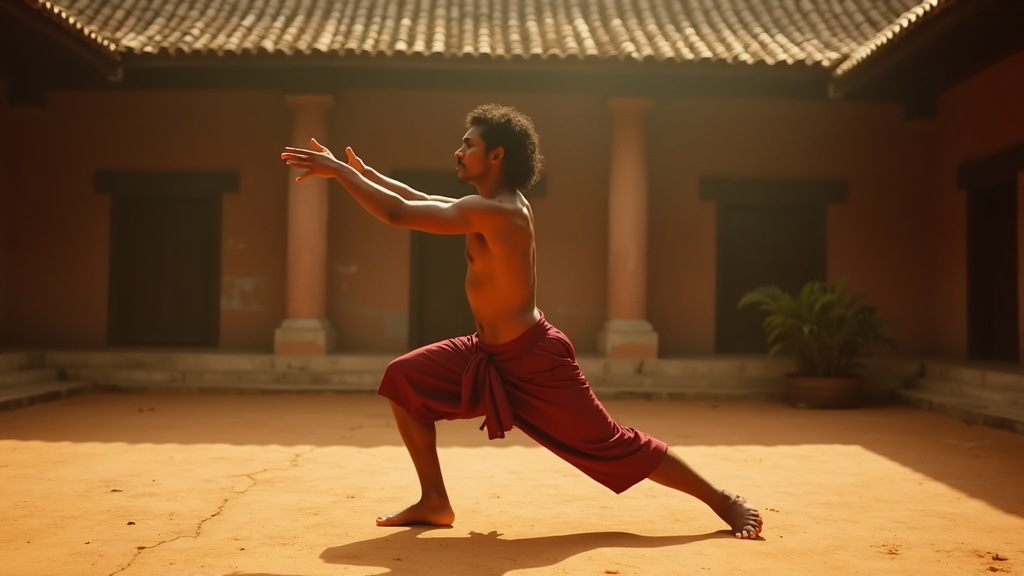
Kottakkal Kanaran Gurukkal: Master of Northern Kalari
Kottakkal Kanaran Gurukkal: The Master Who Unified Northern Kalari
Last updated: 29 May 2026 · By Raphael Gorschlüter, Co-Founder, Kalari University · Trained in the southern (Thekkan) lineage of Guru Balachandran Nair
Most short bios online treat Kottakkal Kanaran Gurukkal as a name in a list — one historical Kalaripayattu teacher among others, born 1850, died 1935, taught the famous CVN. That sentence is technically correct and almost completely misses the point.
The reality is structural. If Vadakkan — the Northern style of Kalaripayattu — looks coherent and broadly standardised today, it is not because the tradition was naturally unified. It is because one late-nineteenth-century master in Kottakkal trained a generation of students whose curriculum became the de facto reference. Estimates from within the tradition place the share of modern Kalaris descending from his line at around sixty percent. That is a remarkable concentration for any martial art.
This article is a long-form attempt to take Kanaran Gurukkal seriously as the structural figure he was — not just as a teacher in a list, but as the single teacher whose transmission shape the entire Northern style still carries. I write this as an outsider to that lineage. My own training is in the southern Thekkan tradition, under Guru Balachandran Nair. I have respect for the Vadakkan line, not personal stake in it. That outsider position is, I think, useful for writing about it honestly.
Kottakkal Kanaran Gurukkal (1850–1935) was a Vadakkan (Northern style) Kalaripayattu master from Kottakkal in the Malabar region of Kerala. He is widely known as the "Dronacharya of Kalaripayattu" for the number and quality of students he produced — most famously Chambadan Veetil Narayanan Nair (CVN, 1905–1944), founder of the CVN Kalari Sangham. Approximately sixty percent of modern Kalaris worldwide trace their lineage through him, and the structural unity of the Northern style today is largely the result of his curriculum becoming the de facto reference.
Key Takeaways
- Kottakkal Kanaran Gurukkal (1850–1935) was a Vadakkan, that is Northern style, Kalaripayattu master from Kottakkal in the Malabar region of Kerala.
- He is widely called the "Dronacharya of Kalaripayattu" after the legendary teacher of warriors in the Mahabharata, for the number and calibre of students he produced.
- His most famous student was Chambadan Veetil Narayanan Nair (CVN, 1905–1944), founder of the CVN Kalari Sangham, the institutional vehicle that spread Northern Kalaripayattu across Kerala and abroad.
- Roughly sixty percent of modern Kalaris worldwide trace their lineage through him, a concentration unmatched by any other figure in Kalaripayattu's modern history.
- The structural unity of Vadakkan Kalaripayattu today — the reason different Northern kalaris look broadly similar — is largely a downstream effect of his curriculum becoming the reference template.
- Thekkan (Southern) Kalaripayattu has no equivalent single unifying figure, which is why Southern kalaris show much greater stylistic variation between schools.
- He lived through nearly the entire period of British colonial suppression of Kalaripayattu (1804 ban onwards) and helped bridge the practice into the twentieth-century revival.
- The CVN network founded in his lineage has active kalaris in Kozhikode, Thiruvananthapuram, Bengaluru, Delhi and abroad — and through this network his teaching is still being transmitted today.
Why Kanaran Gurukkal Matters
The first thing to understand about Kanaran Gurukkal is that he is not significant only as one master among many. He is significant because of what came out of his kalari — and what that did to the shape of an entire style.
The figure most often cited from within the tradition is that around sixty percent of modern Kalaris worldwide can trace their lineage back to him. This is not the kind of figure that emerges from a formal census — there is no global registry of kalaris, no licensing body, no count. It is a figure that gets repeated by senior teachers within the tradition because it matches what they see when they ask other teachers who their grandfather-teachers were. Sixty percent is an estimate, but it is the kind of estimate that is consistent across decades of asking the question.
That share is unusually high for any martial art. Most traditional martial systems are fragmented — many lineages, many schools, many styles, no single dominant transmission line. The reason Vadakkan Kalaripayattu looks the way it does today, the reason a student walking into a Northern style kalari in Kozhikode and a Northern style kalari in Delhi will recognise broadly the same curriculum, is downstream of this one transmission concentration. One late-nineteenth-century master, one generation of students, one network that scaled.
The Northern unity thesis
Here is the argument compressed: Vadakkan Kalaripayattu's structural unity is not natural. It is the result of a historical accident — the right teacher, in the right place, at the right time, with the right student, in a culture that was actively trying to recover its martial tradition after a long colonial suppression. If those four things had not aligned, the Northern style today would look as fragmented as the Southern style does.
This is not a criticism of either style. Fragmentation has virtues — it preserves variation, it allows for local adaptation, it makes the loss of any one line less catastrophic for the whole. Unity also has virtues — it allows for institutional spread, for cross-school recognition, for a shared technical vocabulary that lets practitioners from different kalaris train together. Both shapes are legitimate. They are different shapes.
But to understand why Vadakkan Kalaripayattu looks the way it does, you have to start with Kanaran Gurukkal. He is the structural reason, not a footnote to it.
What the "60%" really means in practice
Concretely: if you walk into a Vadakkan kalari almost anywhere in Kerala or in the Indian diaspora today, the chances are very high that your teacher's teacher — or your teacher's teacher's teacher — sat in the kalari of one of Kanaran Gurukkal's students. The names change. The kalaris change. The geography changes. The transmission line, traced back three to five generations, converges on a small physical space in Kottakkal in the late nineteenth century.
That is what lineage concentration means at the level of an art. Not "he was important." His curriculum is, structurally, the thing most modern Vadakkan practitioners are doing.
If you want to understand the broader history of Kalaripayattu — Sangam-era roots, the 1804 British ban, the twentieth-century revival — Kanaran Gurukkal is the figure who bridges the long suppression and the modern recovery. He is the seam in the cloth.
His Life (1850–1935)
The detailed biographical record of Kottakkal Kanaran Gurukkal is thinner than one might expect for a figure of his importance. Much of what is known has been preserved through CVN-lineage oral history rather than through contemporary written documentation. This is itself revealing: he lived during a period when Kalaripayattu was officially banned, and the practice survived precisely by not making itself visible to the colonial record.
What follows is the outline that is reasonably well attested, with care taken to flag where the record becomes uncertain.
Birth and early years in Kottakkal
He was born in 1850 in Kottakkal, a town in the Malabar region of what is now Kerala, in northern Kerala. Kottakkal is now best known internationally as the seat of the famous Kottakkal Arya Vaidya Sala — one of the oldest and largest Ayurvedic institutions in India — but in the nineteenth century it was also a centre of traditional martial training, with several active kalaris.
The year 1850 places him firmly inside the long colonial period. The British East India Company had banned Kalaripayattu in 1804, after the Pazhassi Raja rebellions made it clear that armed kalari-trained fighters could pose a real threat to colonial rule. (Our article on Velu Thampi Dalava, the 1809 Travancore rebellion leader, gives the political context for that suppression in detail.) From 1804 until well into the twentieth century, kalaris officially did not exist. They continued, of course — quietly, in families, in courtyards, behind closed doors — but the public infrastructure of the tradition was deliberately invisible.
So Kanaran was born into a tradition that was already going underground. His early training would have happened in this constrained environment: small kalaris, family transmission, no public schools, no recognition from any authority.
Training under his own gurukkal
The specific name of Kanaran's primary gurukkal is recorded in some CVN-lineage accounts but is not universally agreed in published sources. What is consistent across accounts is that he trained in the classical Vadakkan curriculum — the four-stage progression of meipayattu (body conditioning), kolthari (stick weapons), ankathari (sharp weapons), and verumkai (empty-hand) — and that his training was thorough enough that by his twenties he was recognised as a senior practitioner.
The classical pattern of a Malabar kalari boy of that period was to begin training at seven or eight, train daily through his teenage years, become a senior student in his twenties, and take over teaching responsibility in his thirties if his gurukkal recognised him. Kanaran appears to have followed this pattern. There is no record of any career outside Kalaripayattu — no military service, no civil employment, no trading life. He was, from his early years, a kalari man.
Becoming a gurukkal
By his thirties he was teaching in Kottakkal in his own right. The title gurukkal — the plural-honorific form of guru, used in Vadakkan tradition for the senior teacher of a kalari — is given by the lineage, not chosen by the holder. (Our article on the kalaripayattu guru tradition explains the distinction between teacher and gurukkal in detail.) He was given it because his own gurukkal judged him competent to hold the full body of knowledge: the techniques, the marma, the kalari chikitsa healing system, and the conduct that holds them together.
What distinguished his kalari from the others operating in the Malabar region at the same time appears to have been two things: the rigour of his foundation work, and the openness with which he took students. He did not, as some teachers of the period did, restrict his teaching to caste-relatives or to a small circle of family inheritors. He took students who came to learn, and he held them to a high standard.
The long teaching life
He taught actively in Kottakkal for nearly half a century. This is the part of his life about which there is least dramatic biographical material and most structural importance. Year after year, students came to his kalari, trained for the necessary years, and either left as practitioners or stayed long enough to become teachers in their own right. The number compounded over the decades.
By the early twentieth century — when he was in his sixties and seventies — his kalari had become something close to a regional reference point. Other Vadakkan teachers sent their senior students to him for advanced work. Families in the Malabar region who wanted serious training for their sons sought out his kalari. The reputation was not loud, in the modern sense; he was not a public figure, did not give interviews, did not travel for demonstrations. The reputation was the slow accumulation of student-quality across decades.
Recognition and the Dronacharya title
The title "Dronacharya of Kalaripayattu" appears to have come into use in his later years, as the calibre of his students became visible across the region. It was not a formal honorific bestowed by an institution. It was a description that other teachers and senior practitioners began to use, and that stuck.
He died in 1935, aged about eighty-five. By that point his most famous student, the young CVN Narayanan Nair, had been training under him for the better part of a decade and was about to begin the work that would carry the lineage further than any individual kalari ever could.
The arc of his life is therefore almost the opposite of the dramatic-biography template. He did not have a single signature event. He did not lead an uprising, did not travel internationally, did not write a famous book. What he did was teach, in one place, for almost fifty years, to a standard that produced the next generation of teachers. The significance is cumulative.
The Dronacharya Title — Why He Earned It
To understand why Kanaran Gurukkal is called the Dronacharya of Kalaripayattu, you need to know who Drona was in the Indian epic tradition.
Dronacharya is one of the central figures of the Mahabharata, the great Sanskrit epic. He is the teacher of warriors — specifically, the teacher of the Pandavas and the Kauravas, the two princely lineages whose conflict drives the epic. Drona is the master who shapes a generation of warriors: he trains Arjuna into the greatest archer of the age, he produces the famous fighter Ashwatthama, he sets the standard of martial skill for an entire epoch.
When someone is called "the Dronacharya" of a martial tradition, the comparison is doing specific work. It is not saying they were the greatest fighter — Drona himself is not the greatest fighter in the Mahabharata, his student Arjuna is. The comparison says they were the teacher who produced the greatest fighters. The honour is the honour of the teacher.
The analogy applied
Kanaran Gurukkal earned the title because of the calibre of practitioners who came out of his kalari. Not because he was the most spectacular technician of his generation (the records do not even let us judge that), but because of what his students went on to do.
The most famous of those students was CVN. But CVN was not the only one. The Kottakkal kalari produced multiple senior teachers in the early twentieth century — men who went on to establish or run their own kalaris in the Malabar region and beyond. The depth of the student bench is part of what justifies the title. A teacher who produces one famous student is fortunate. A teacher who produces a generation of competent senior practitioners has done the deeper work.
There is also a structural parallel that is worth naming. Drona, in the Mahabharata, gives a generation of warriors a shared technical vocabulary. The Pandavas and Kauravas can fight each other in a recognisable common form because they have all trained under the same master. Kanaran Gurukkal did something analogous, on the historical level: he gave a generation of Vadakkan practitioners a shared curriculum, which became the substrate on which the twentieth-century revival of the Northern style was built.
Comparison with other traditions
Other Indian martial traditions have their own legendary teachers, but few have a single comparably concentrated figure within living memory. The fact that the Dronacharya analogy stuck to Kanaran Gurukkal — and stuck specifically — is itself a piece of evidence about how significant his role was felt to be within the tradition.
I will be honest about one thing here. There is a tendency in writing about traditional Indian masters to inflate their stature with epic-scale comparisons that the historical record cannot really support. The Dronacharya comparison, in the case of Kanaran Gurukkal, is not that kind of inflation. The historical evidence — the documented student lineage, the share of modern kalaris that trace back to him, the survival of his curriculum as the de facto reference for Vadakkan training — supports the claim that this was a teacher whose impact on his art is genuinely comparable to what the epic ascribes to Drona. It is a strong claim. The evidence is strong.
His Most Famous Student — CV Narayanan Nair
If Kanaran Gurukkal is the structural reason Vadakkan Kalaripayattu is coherent today, Chambadan Veetil Narayanan Nair — known almost universally as CVN — is the institutional reason it spread.
CVN was born in 1905 in northern Kerala. He came to Kanaran Gurukkal's kalari in Kottakkal as a young man and trained under him for the better part of a decade. By the time of Kanaran's death in 1935, CVN was in his late twenties and was recognised within the lineage as one of the senior holders of the Kottakkal curriculum.
What CVN did, that distinguishes him from other senior students of his generation, was institutional. He recognised that the survival and spread of the practice would require something more than a single kalari in a single town. He began to think in terms of a network.
The founding of the CVN Kalari Sangham
CVN himself died young, in 1944, aged thirty-nine. The first kalari to formally carry the CVN name was established in Kozhikode — known to the British as Calicut, the original Malabar trading port — in 1945, the year after his death, by his senior students continuing the work he had begun.
The choice of Kozhikode mattered. Kozhikode was, and is, one of the major urban centres of northern Kerala — a city with the infrastructure to support a public training institution in a way that a small Malabar town could not. The CVN Kalari in Kozhikode became the flagship of the network, and from there the model spread.
Within a few decades there were CVN-affiliated kalaris in Thiruvananthapuram in the south, in cities across India, and eventually overseas. The institutional form was deliberately replicable: a formal kalari space, a structured curriculum (inherited largely from Kanaran's teaching), public visibility, the willingness to take students from outside the traditional caste-and-region pool.
Why this matters for understanding Kanaran's reach
The reason Kanaran Gurukkal's reach is so wide today is that his curriculum travelled, through CVN and the CVN network, in a way that no single teacher's curriculum had travelled before. The pre-CVN pattern of kalari transmission was strictly local. A gurukkal taught a few students; those students taught a few students; the geographic spread was slow and bounded by family and regional ties. The CVN model broke that pattern by being explicitly institutional — a name, a model, a curriculum that could be exported.
In effect, CVN industrialised the inheritance. He did not change the practice in any substantial way — the CVN curriculum is recognisably Kanaran's curriculum — but he changed the transmission mechanism. The same content, distributed through a scalable institutional form, reached an order of magnitude more practitioners than it would have under the old purely-local model.
This is why the sixty-percent figure for modern lineage convergence is meaningful. It is not that Kanaran's teaching was uniquely brilliant in a way that crowded other lineages out by sheer quality. It is that his teaching was the first to be carried by a scalable institutional vehicle. Other Vadakkan lineages of the same period were comparable in quality; they were simply not exported in the same way.
The relationship between teacher and student
What is touching, in the human sense, about the Kanaran-CVN relationship is that the teacher did not live to see the institutional flowering of his curriculum. Kanaran died in 1935. The first CVN Kalari was founded in 1945. The international spread began in earnest only in the second half of the twentieth century. The teacher gave the substance; the student gave it the vehicle; the vehicle outlived them both.
This is, in some way, the deepest meaning of guru-shishya parampara: the teacher transmits what they have, the student does with it what only they can do, and the line continues. Kanaran could not have built the CVN network — that was not his work. CVN could not have built the curriculum — that was not his time. Together they did what neither could have done alone.
Northern Style Unity vs Southern Diversity
Here is the comparison that makes the historical argument concrete. Set the Northern style of Kalaripayattu next to the Southern style — Vadakkan next to Thekkan — and you see two very different shapes of lineage.
The Northern style is broadly coherent. A Vadakkan kalari in Kozhikode, a Vadakkan kalari in Thiruvananthapuram, a Vadakkan kalari in the Indian diaspora abroad — these will share a recognisable curriculum, a similar sequence of teaching, a common technical vocabulary. The differences between them are real but limited: regional emphasis, individual teacher style, particular weapon preferences. The shared substrate is unmistakable.
The Southern style is different. Thekkan Kalaripayattu has many independent lineages. Different schools — the lineage carried by my own teacher Balachandran Nair, the lineages of the various Panniyodu and Moolachal teachers, the further south Tamil-influenced lines — show substantially more variation between each other than Vadakkan schools do. The technical vocabulary overlaps but is not uniform. The sequences differ. The marma teachings are organised differently in different schools.
What explains the difference
The difference is not random. It is the direct downstream effect of the lineage structure of each style.
The Northern style had one late-nineteenth-century teacher whose curriculum spread through a single institutional vehicle. The Southern style had no equivalent figure. There is no single late-nineteenth-century Thekkan master who produced a CVN-equivalent student who founded a Sangham-equivalent network. The Southern tradition was carried by multiple parallel lineages, each holding its own variant, none of them ever consolidating into a dominant institutional form.
Both shapes have history behind them. The Northern style benefited from a particular alignment — right teacher, right student, right cultural moment, right city. The Southern style preserved more variation because no comparable consolidation ever happened, partly because the colonial suppression was more total in some parts of the south, partly because of geographic dispersion, partly because the traditional patronage structures were different.
Why this matters for any student
If you are training in Kalaripayattu today, this structural difference affects what you are actually doing. A student in a Vadakkan kalari is, with high probability, doing Kanaran Gurukkal's curriculum in some recognisable form. A student in a Thekkan kalari is doing the curriculum of their specific lineage, which may differ substantially from a Thekkan kalari ten towns away.
Neither is better. They are different histories producing different present-day shapes. But understanding which shape you are inside changes how you understand what you are learning.
It also changes how you read other people's claims. A teacher claiming to teach "traditional Kalaripayattu" is making a claim that depends on which lineage they are in. A Vadakkan teacher whose lineage runs back through CVN to Kanaran is making a claim with a relatively standardised content. A Thekkan teacher's claim points to a more particular lineage whose content cannot be guessed without naming the line. The word "traditional" is doing different work in each case.
For more on what the practice itself actually is, our overview article what is Kalaripayattu covers the four disciplines, the training stages, and how the practice is structured across both styles. Our disciplines and weapons article maps the technical curriculum that both Vadakkan and Thekkan traditions share at the structural level.
Where His Lineage Lives Today
The practical answer to "where is Kanaran Gurukkal's teaching today?" is: in active CVN-lineage kalaris across India and abroad.
The CVN Kalari Sangham network includes major kalaris in:
- Kozhikode (Calicut) — the original CVN Kalari, founded in 1945, still operating today.
- Thiruvananthapuram — multiple CVN-affiliated kalaris in Kerala's capital city, including the well-known CVN Kalari Sangham at East Fort, established in the mid-twentieth century.
- Bengaluru and other major Indian cities — CVN-lineage kalaris have been established in several urban centres outside Kerala over the past several decades.
- Delhi — including kalaris associated with the broader institutional spread of Northern style Kalaripayattu through Indian government cultural initiatives.
- International branches — students of senior CVN-lineage teachers have established training spaces in Europe, North America, and other regions, generally through the personal teaching networks of individual senior students rather than through formal franchise structures.
This is not an exhaustive list. The full reach is greater than any single article can map. What is reliable is that anyone training in a kalari described as "CVN tradition" or "CVN Kalari Sangham affiliated" or as "Northern style traceable through CVN" is, in a direct genealogical sense, sitting inside Kanaran Gurukkal's continuing lineage.
What "living lineage" means in practice
A lineage does not live in buildings or in names on signs. It lives in the bodies of teachers who have been trained, who have absorbed the curriculum deeply enough to transmit it, and who are actively teaching the next generation. By that measure, Kanaran Gurukkal's lineage is alive — visibly and demonstrably — across multiple continents.
The institutional infrastructure (the CVN Sangham network, the named kalaris, the formal affiliations) is the visible scaffold. The actual lineage is what is happening on the floor of those kalaris, in the daily training, in the corrections passed from senior to junior students.
I have not trained in the CVN tradition myself. My own training is southern. What I can say from observing CVN-lineage training and speaking with its practitioners is that the curricular coherence is real. You can recognise the inheritance.
How to Recognise a Kanaran-Lineage Kalari
If you encounter a Vadakkan kalari and want to know whether it is part of the Kanaran-CVN lineage, there are several practical signs.
The four-stage progression, kept strict
The classical four stages — meipayattu (body conditioning), kolthari (stick weapons), ankathari (sharp weapons), verumkai (empty-hand) — are taught in CVN-lineage kalaris with a strict insistence on the order. A student does not move to kolthari until meipayattu is structurally sound. The progression is not a suggestion. This rigour with the foundation is one of the lineage's hallmarks.
Meipayattu sequences as the long foundation
The opening months and often years of training are dominated by long meipayattu sequences — the formal exercise patterns that build stance, leg strength, hip mobility, spinal coordination, and the characteristic low-and-flowing Vadakkan body. These sequences are taught in a recognisable order, and a CVN-lineage student trained for a year can usually move through them in conversation with another CVN-lineage student trained in a different city.
Marma teaching integrated with the technical work
Marma — the system of vital points used both to strike and to heal — is taught inside the technical curriculum, not as a separate subject. The same points appear in combat applications and in kalari chikitsa treatments. This integration is one of the strongest markers of an authentic kalari teaching across both Northern and Southern styles, and the CVN lineage preserves it strongly.
Weapon progression that respects classical order
The CVN-lineage weapon progression follows the classical sequence: long stick (kettukari), short stick (cheruvadi), curved stick (otta), then sharp weapons (sword and shield, dagger, mace, urumi), then empty-hand. The order has pedagogical logic — the stick teaches the principles of weapon use without the consequence of an edge — and the lineage holds that logic seriously.
A senior teacher who can name the chain
A CVN-lineage gurukkal will be able to name their teacher, their teacher's teacher, and the chain back to CVN and, in many cases, to Kanaran himself. This is the most reliable single sign. The chain is the inheritance, and a real lineage holder carries the chain.
If you want a fuller treatment of how to recognise a serious kalari teacher in general — across all lineages, both Vadakkan and Thekkan — our article on the kalaripayattu guru tradition covers the practical signs in detail.
His Influence on the Twentieth-Century Revival
The twentieth-century revival of Kalaripayattu — the period in which the practice came back out from underground after the long colonial suppression — is a story with many actors. The cultural reawakening of Kerala in the 1920s and 1930s, the gradual loosening of British attention on regional martial traditions, the role of the Kerala Folklore Academy in later decades, the broader Indian independence-era recovery of traditional cultural forms — all of these mattered.
But within Kalaripayattu specifically, the revival had a very particular structural feature: it consolidated around the CVN model. The reasons for this go back directly to Kanaran Gurukkal.
The 1920s context
By the 1920s, when Kanaran was in his seventies and CVN was a young man training under him, the political environment had begun to shift. The British were still in India, the official ban on Kalaripayattu was technically still in force, but enforcement had become patchy. Cultural revival movements across India were beginning to reclaim suppressed traditions. The mood was different from the early nineteenth century, when the suppression had been at its most active.
This created an opening. Kalari practitioners who had been training quietly for generations could begin to teach more openly. New kalaris could be established. A public face for the tradition became possible in a way it had not been for over a century.
Kanaran's kalari was already in a strong position to take advantage of this opening. Decades of quiet teaching had produced a deep bench of senior students. The technical content of his curriculum was structurally complete — meipayattu, kolthari, ankathari, verumkai, marma, kalari chikitsa, the full body of knowledge. When the cultural moment arrived for Kalaripayattu to come back into the light, the Kottakkal kalari had something ready to bring.
What the revival looked like institutionally
The revival was not a single event. It was a gradual process across several decades — from the 1920s reawakening through the post-independence consolidation in the 1950s and 1960s, into the international spread of the late twentieth century. Throughout this period the CVN-lineage kalaris were the dominant institutional form for Northern style Kalaripayattu, and they continued to grow through each phase.
The Kerala state's eventual recognition of Kalaripayattu as a cultural heritage practice, the inclusion of Kalaripayattu in Kerala Tourism promotion, the international documentary attention that came in the 1990s and 2000s — all of these built on a foundation that the CVN network had been laying for decades.
In this sense, Kanaran Gurukkal's influence on the revival is indirect but enormous. He did not himself drive the revival — he died in 1935, before its main institutional phase. But his curriculum, transmitted through his students, was the substance that the revival institutionalised. Without that substance, the revival would have had less to work with.
The story sits in instructive parallel with the political-martial history of Kerala — figures like Velu Thampi Dalava, the Travancore rebellion leader of 1809 whose resistance helped trigger the British suppression, and the long century of underground survival that followed. Kanaran is the figure on the other end of that long arc: not the leader of the resistance, but the teacher who held the practice through the silence and prepared it for the return.
Sources & Further Reading
- Wikipedia — Kalaripayattu — General overview of the practice, the four stages, the regional styles, and the historical context.
- Wikipedia — C. V. Narayanan Nair — Biographical entry for Kanaran Gurukkal's most famous student, the founder of the CVN Kalari Sangham network.
- Wikipedia — Drona — Background on the legendary teacher of warriors in the Mahabharata, the namesake of the Dronacharya honorific.
- Wikipedia — Kottakkal — The town in northern Kerala that was Kanaran Gurukkal's home and the site of his kalari.
- Wikipedia — Malabar region — The cultural and geographical region in northern Kerala where the Vadakkan tradition is rooted.
- Wikipedia — Kozhikode — Major city in northern Kerala, site of the first CVN Kalari (1945) and the institutional flagship of the network.
- Wikipedia — Guru–shishya tradition — Background on the teacher-student transmission model that structures the kalari lineage system.
- Wikipedia — Marma adi — Reference on the system of vital points central to both Vadakkan and Thekkan Kalaripayattu.
- Wikipedia — Indian martial arts — Wider context for Kalaripayattu among the martial systems of the subcontinent.
- Wikipedia — Pazhassi Raja — The eighteenth-century rebellion leader whose conflicts with the British contributed to the 1804 colonial ban on Kalaripayattu.
- Wikipedia — East India Company — The colonial authority responsible for the 1804 ban on Kalaripayattu.
- Wikipedia — Mahabharata — The Sanskrit epic in which Dronacharya appears as the great teacher of warriors.
- Wikipedia — Kerala — Geographical and cultural home of Kalaripayattu.
- Wikipedia — Kerala Folklore Academy — State institution that has played a role in the documentation and recognition of Kerala's traditional cultural forms.
- Wikipedia — Pandavas and Wikipedia — Kauravas — The two princely lineages of the Mahabharata, both students of Dronacharya.
- Wikipedia — Arjuna — Dronacharya's greatest student in the Mahabharata, archetype of the warrior-student.
- Wikipedia — Ashwatthama — Another of Dronacharya's most famous students.
Frequently Asked Questions
Who was Kottakkal Kanaran Gurukkal?
Kottakkal Kanaran Gurukkal (1850–1935) was a Vadakkan (Northern style) Kalaripayattu master from Kottakkal in the Malabar region of Kerala. He is widely called the "Dronacharya of Kalaripayattu" for the number and quality of students he produced. His most famous disciple, C. V. Narayanan Nair, founded the CVN Kalari Sangham, and roughly sixty percent of modern Kalaris worldwide trace their lineage through him.
When was Kanaran Gurukkal born and when did he die?
Kottakkal Kanaran Gurukkal was born in 1850 and died in 1935, aged about eighty-five. He lived through almost the entire period of British colonial suppression of Kalaripayattu, which makes the survival and broad transmission of his teaching all the more historically significant.
Why is Kanaran Gurukkal called the Dronacharya of Kalaripayattu?
Dronacharya is the legendary teacher of warriors in the Mahabharata — the master who produced the greatest fighters of his age. Kanaran Gurukkal earned the title because of the number and the calibre of students who came out of his kalari. His curriculum became the reference template for the northern style, much as Drona's teaching shaped a generation of warriors in the epic.
Who was C. V. Narayanan Nair?
Chambadan Veetil Narayanan Nair (1905–1944), known as CVN, was Kanaran Gurukkal's most famous student. He founded the CVN Kalari Sangham, the network of kalaris that spread Northern style Kalaripayattu across Kerala and laid the foundation for its international reach. The first CVN Kalari was established in Kozhikode (Calicut) in 1945, the year after his early death, by his senior students continuing the work.
Was Kanaran Gurukkal Vadakkan (Northern) or Thekkan (Southern) style?
Kanaran Gurukkal was a Vadakkan, that is Northern style, master. The northern tradition is centred on the Malabar region of Kerala and is structurally different from the southern (Thekkan) tradition. The fact that he was Vadakkan is critical to understanding the article's central point: the northern style's coherence today is in large part the result of his curriculum spreading through the CVN network.
How many modern Kalaris trace their lineage to him?
Estimates from within the tradition place the figure at roughly sixty percent of modern Kalaris worldwide. The number is not a precise census — there is no global registry — but it reflects the historical reality that the CVN Kalari Sangham, founded by his student CVN, became the dominant institutional vehicle for Northern style Kalaripayattu in the twentieth century.
Was he ever in the British army?
There is no reliable record that Kottakkal Kanaran Gurukkal ever served in the British army. He lived his entire life as a kalari practitioner and teacher in the Malabar region, during a period when Kalaripayattu was officially suppressed by the colonial authority. His significance comes from the quiet preservation of the practice, not from public service to the colonial state.
Did Kanaran Gurukkal teach women?
Detailed records of his individual students are limited, but the broader nineteenth-century Vadakkan tradition included strong precedent for women practitioners — the Unniyarcha tradition of female kalari warriors is one famous example. In practice, Kanaran's primary documented students were male, in line with the conventions of his time, but his curriculum is now taught to women in most CVN-lineage kalaris worldwide.
Was his teaching written down?
His teaching survives primarily through oral transmission and through the curricula of the kalaris his students founded. Some palm-leaf manuscripts on marma and kalari chikitsa from his lineage are held within CVN-lineage families. There is no single published manual of his teaching, which is typical for the Indian guru-shishya tradition; the knowledge lives in the bodies of teachers, not in textbooks.
Did Kanaran Gurukkal travel outside Kerala?
There is no evidence that Kanaran Gurukkal taught outside Kerala during his lifetime. He spent his entire teaching life in the Malabar region. The international spread of his teaching happened later, through the CVN network and through students of students who took the practice to other Indian cities and eventually overseas.
Where is Kanaran Gurukkal's memorial?
Kottakkal Kanaran Gurukkal is commemorated in his home region of Kottakkal in the Malabar district, and his memory is honoured in the kalaris of the CVN Kalari Sangham network. There is no single grand mausoleum; the tradition's manner of honouring its masters is through continuing the practice in their lineage rather than through monumental architecture.
Are his descendants still teaching?
His lineage continues both through direct descendants of his students and through the wider CVN Kalari Sangham network, with active kalaris in Kozhikode, Thiruvananthapuram, Bengaluru, Delhi and several countries abroad. Anyone training in a CVN-lineage kalari today is, in a real sense, his lineage continuing.
Conclusion
The reason to take Kottakkal Kanaran Gurukkal seriously is not that he is one famous teacher among many in the long history of Kalaripayattu. It is that he is the structural figure whose teaching, more than any other, shapes what Vadakkan Kalaripayattu actually looks like today. The Northern style's coherence is his coherence. The CVN network's spread is the spread of his curriculum. The roughly sixty percent of modern kalaris that converge on his lineage are the visible measure of one teacher's transmission becoming the substrate of an entire style.
He did this without spectacle. He did not lead a rebellion. He did not travel. He did not write a manual. He taught, in one place, for nearly fifty years, to a standard high enough that the next generation could carry it. He produced a student — CVN — who built the institutional vehicle the curriculum needed. He died ten years before that vehicle began to scale. The shape of the inheritance is, in the end, the shape of a teacher who did his work and trusted his students with what came next.
That is not just a piece of Kalaripayattu history. It is the deeper pattern of how parampara works. The teacher does what only the teacher can do; the student does what only the student can do; the line continues into hands neither of them will live to meet.
If reading this has made you curious about the practice itself — the body of techniques Kanaran preserved and CVN spread — the first lesson at Kalari University is free, with no payment and no commitment. It is the smallest possible way to put one of these traditions into your own body. The lesson is taught in the southern (Thekkan) lineage I trained in, not the Vadakkan lineage of this article, but the foundational principles are recognisably the same practice. Start the first lesson here.
That is, after all, what every master in this tradition was finally working toward: that the practice would still be in some new body, somewhere, after they were gone.
About the Author
Raphael Gorschlüter — Co-Founder & Head Teacher, Kalari University. Twelve-plus years of Kalaripayattu training and teaching. Direct student of Guru Balachandran Nair at the Kalariyil Dharmikam Ashram in Parasuvaikkal, Thiruvananthapuram, Kerala — a southern (Thekkan) lineage. Teaches internationally in Germany, Spain and India. This article on the Vadakkan tradition of Kottakkal Kanaran Gurukkal is written from the perspective of a respectful outsider to that lineage, not from inside it. Where the Thekkan tradition I trained in shows variation across schools, the Vadakkan tradition's coherence is one of the most striking features of the modern Kalaripayattu landscape, and the figure most responsible for that coherence deserves to be taken seriously on his own terms.
