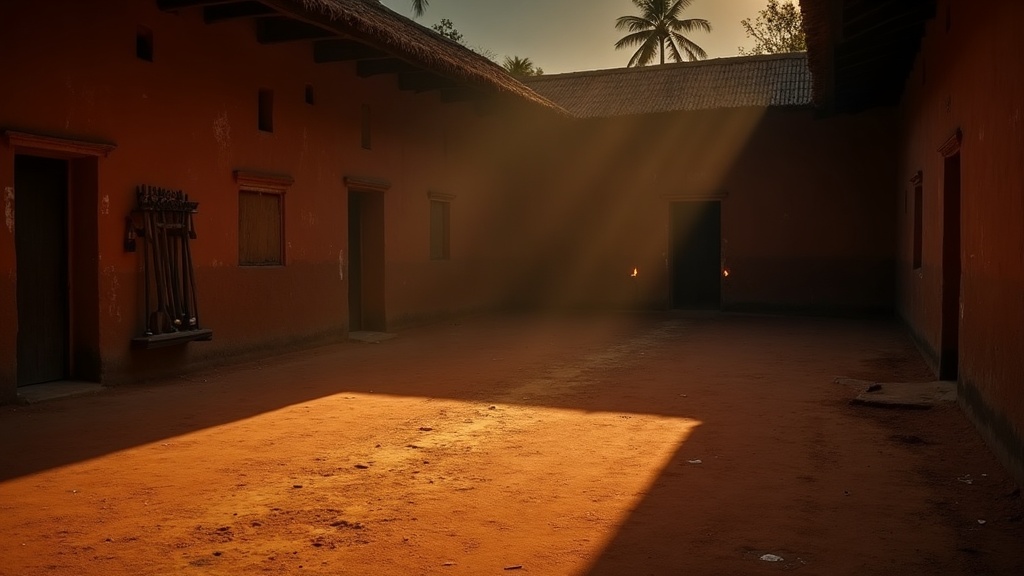
Why Was Kalaripayattu Banned? The 1804 British Suppression
Why Was Kalaripayattu Banned? The 1804 British Suppression
Last updated: 6 June 2026 · By Raphael Gorschlüter, Co-Founder, Kalari University · Trained in the southern (Thekkan) lineage of Guru Balachandran Nair
Definition. Kalaripayattu was suppressed by the British East India Company beginning in 1804, after the Pazhassi Raja revolt in Malabar. The Company issued disarmament orders prohibiting weapons, armed gatherings and public martial training across northern Kerala. A second pan-India layer followed with the Indian Arms Act 1858 after the Sepoy Mutiny. There was no single statute titled a Kalaripayettu ban, but in practice the art could not be taught openly. It survived in Theyyam rituals, private family kalaris, Vadakkan Pattukal ballads and Kalari chikitsa healing. The suppression effectively ended at Indian Independence in 1947.
Key Takeaways
- Kalaripayattu was not banned by a single law. It was suppressed through a layered set of colonial measures beginning in 1804.
- The trigger was the Pazhassi Raja revolt of 1793–1805 in Malabar, a guerilla war the British struggled to suppress for over a decade.
- The 1804 disarmament order targeted weapons, gatherings and martial training, which made public Kalari instruction impossible.
- Velu Thampi Dalava's 1809 Kundara Proclamation triggered further restrictions on the southern kingdom of Travancore.
- The Indian Arms Act 1858, passed after the Sepoy Mutiny, added a pan-India arms regime that affected Kalaripayattu for nearly a century.
- The art survived in four hidden channels: Theyyam ritual performance, private family practice, folk ballads and Kalari chikitsa healing.
- Phillip Zarrilli, A. Sreedhara Menon and K.K.N. Kurup are among the historians who have documented the suppression.
- The de jure end of the ban came with Indian Independence in 1947 and the Arms Act 1959 of the new republic.
- The de facto revival began earlier, in the 1920s and 1930s, carried by figures like Kottakkal Kanaran Gurukkal and his student C. V. Narayanan Nair.
- Modern Kalaripayattu is not an unbroken transmission. It is a partially reconstructed tradition, which is part of what makes its survival remarkable.
The Short Answer
Kalaripayattu was suppressed because it was the training system of the men who refused to surrender. When the British East India Company moved into Kerala in the late eighteenth century, they did not face a single army. They faced a network of small warrior households whose sons trained from the age of seven in pits behind their homes. Those warriors followed local rajas, not Calcutta. So the Company did the only thing that could break the network — they took away its weapons, its meeting grounds and its instruction.
The pivotal year is 1804. The Pazhassi Raja revolt had dragged on for more than a decade in north Kerala, and the British finally moved from chasing rebels to disarming the population. The order made it illegal to possess Kalari weapons, to gather in armed groups, or to conduct martial training. The word ban is a modern shorthand for what was technically a disarmament regime — but the effect on Kalaripayattu was the same as a ban.
That regional measure was followed by two more layers: the suppression of Velu Thampi Dalava's 1809 revolt in Travancore, and the Indian Arms Act of 1858 after the Sepoy Mutiny. By the time the dust settled, the art that had once been Kerala's everyday training had retreated into shadow. It would not return openly until the twentieth century.
The Political Context — Kerala Before 1804
To understand why the British targeted Kalaripayattu, you have to understand what Kerala looked like before they arrived. The state we now call Kerala did not exist as a single political unit. It was a patchwork of small kingdoms. In the north sat the kingdoms of the Malabar coast, including Kottayam, Kadathanad and Kurumbranad. In the centre lay Cochin. In the south stretched Travancore, which under Marthanda Varma in the eighteenth century absorbed many smaller polities.
Each of these kingdoms maintained its own warrior class. Kalaripayattu was the standard training. Boys of the Nair, Thiyya and certain other castes entered a kalari — the training pit dug into the earth — between the ages of seven and twelve. They trained for years in body conditioning, footwork, locked-hand combat, stick fighting, sword and shield, dagger, spear and the urumi flexible sword. By the time they were adults, they were the standing army of their region.
The art was woven into the social fabric. Kalaris stood next to temples. Gurukkals were respected community figures. Combat duels, the ankam, were formal events that settled disputes between families. The Kerala-born art was therefore not a fringe practice but the core military system of a society organised around small-scale war.
The historian A. Sreedhara Menon, in his standard textbook A Survey of Kerala History (1967), describes this period as one in which Kalari training was as ordinary as schooling. When the British arrived as a commercial power and then as a political one, they encountered this system head-on.
The Third Anglo-Mysore War of 1792 reshaped the map. The Travancore raja allied with the British against Tipu Sultan, and in the aftermath the Company gained political footholds it had not had before. Within a decade those footholds had become a grip, and Kerala's small kingdoms began to lose their independence one after another.
The Pazhassi Raja Revolt (1793–1805) — The Immediate Trigger
The man whose name appears in every history of this period is Kerala Varma Pazhassi Raja, born in 1753 in the small kingdom of Kottayam in Malabar. He is the figure most directly responsible — through his resistance — for the British decision to disarm Kerala.
Pazhassi Raja was, by all accounts, exactly the kind of opponent a colonial administration most feared. He understood the forest. He understood his people. And he understood that against superior firepower, the answer was guerilla war. From 1793 he led raids and ambushes against East India Company columns in Malabar. When the British thought he was finished, he reappeared. When they thought they had cornered him, he vanished into the Wayanad forests where the Kurichiya and Kurumba tribal communities sheltered him.
His warriors were Kalari-trained. The historian K.K.N. Kurup, who has written extensively on Kerala folklore and martial traditions, has documented how the rhythm of Pazhassi Raja's campaigns matched the rhythm of Kalari combat: long patient preparation, sudden close-range engagement, immediate dispersal. It was not the war of standing armies. It was the war of small bands trained for decades in the same skill.
The revolt continued for twelve years. Twelve years is a long time for any colonial administration to fail to crush a single regional opponent. By the early 1800s, the East India Company in Madras and Calcutta was demanding decisive measures. The 1804 disarmament order was part of that demand.
On 30 November 1805, at a place called Mavila Thodu — some sources record the location as Pulpally — Pazhassi Raja was killed. With his death, organised north-Kerala resistance against the Company ended. But the order that his revolt had triggered was already in force, and it would outlast him by more than a century. The article on the history and origin of Kalaripayattu traces how this military function had built up over centuries; the Pazhassi Raja revolt was, in a sense, the last large-scale battlefield use of that system in Kerala.
What "The Ban" Actually Was
This is the section that most online accounts of Kalaripayattu get wrong. The truth is more interesting than the myth.
The 1804 Disarmament Order
In 1804, the East India Company issued disarmament orders covering the Malabar district. The Company had administrative control of Malabar from 1792 onward, and the orders were enforced through Company-appointed collectors backed by sepoy detachments. The orders made three categories of activity illegal under Company regulations:
- Possession of weapons — swords, the urumi flexible sword, daggers, spears, shields and combat-grade sticks. Householders were required to surrender these to Company officers.
- Armed gatherings — any assembly of more than a small number of men carrying weapons, or any gathering for the purpose of weapons training.
- Public martial instruction — the open running of a kalari as a training school, with students and a gurukkal teaching weapons, was no longer permitted.
The historian Phillip Zarrilli, in When the Body Becomes All Eyes (1998) — the definitive English-language ethnography of Kalaripayattu — discusses this 1804 measure as the practical end of public Kalari training in Malabar. Zarrilli notes that while the orders did not use the word Kalaripayattu, every component of public training fell under one of the three prohibitions.
Why "ban" is partially a misnomer
The English word ban suggests a single statute with a date and a title. That is not what happened. What happened was a disarmament regime. The reason this distinction matters is that it changes how the suppression was experienced on the ground. There was no announcement that Kalaripayattu was now illegal. There was instead a steady tightening of what you could do, what you could carry and where you could gather.
The historian M.G.S. Narayanan, in his work on Kerala's medieval and early-modern history, has argued that the British disarmament approach was deliberately designed to avoid creating a focal point for resistance. If you ban a named tradition, you create martyrs. If you simply confiscate weapons and disperse training groups, you erode the tradition without giving it a heroic profile.
What was actually prohibited
A practical list helps. In the years after 1804, the following became impossible or illegal in Malabar:
- Carrying weapons in public, including the warrior's sword
- Running a kalari with paying students openly
- Holding ankam duels or large-scale combat demonstrations
- Storing weapons in private homes if a Company patrol found them
- Travelling between villages in armed groups
The following remained possible, and this is what kept the tradition alive:
- Practising body work, footwork and meipayattu — the body sequences — in private
- Teaching Kalari chikitsa, the healing bodywork, openly
- Performing movement-rich rituals like Theyyam in temple contexts
- Keeping warrior ballads alive in song
This selective prohibition is the reason Kalaripayattu survived at all. The British targeted the warlike face of the tradition and left the ritual and medical faces alone.
Velu Thampi Dalava and the 1809 Kundara Proclamation
If the 1804 order broke the back of Kalari training in Malabar, the events of 1809 sealed the same fate for the southern kingdom of Travancore. The story is told in detail in the article on Velu Thampi Dalava; here it is a brief recap.
Velu Thampi Dalava was the Dalava — Prime Minister — of Travancore in the early 1800s. He was Kalari-trained and had risen through the kingdom's administrative ranks. By 1808 his relationship with the British Resident, Colonel Macaulay, had collapsed into open hostility. On 11 January 1809 he issued the Kundara Proclamation, a public document calling on the people of Travancore to rise against the British.
It is one of the earliest mass proclamations against colonial rule in Indian history, predating the 1857 Sepoy Mutiny by nearly half a century. It explicitly described British rule as alien and oppressive, and it called on Kalari-trained men to arms.
The rising was suppressed within months. On 29 March 1809, knowing capture was imminent, Velu Thampi took his own life rather than surrender. His body was publicly dishonoured by the British — a deterrent gesture. After the rebellion, Travancore was placed under stricter British supervision, and the weapons restrictions that had been enforced in Malabar were extended in practice to the south.
So by 1810, the entire stretch of Kerala from the Malabar coast to the southern tip of Travancore was under a regime that made Kalari training as it had existed for centuries effectively impossible.
The 1858 Arms Act — The Second Layer of Suppression
Half a century later, after the Indian Rebellion of 1857, the British administration introduced a pan-India arms regime. The Indian Arms Act of 1858 codified firearm and weapons restrictions across British India. It was not aimed at Kalaripayattu specifically — its scope was the whole subcontinent — but it added a national layer of suppression on top of the regional measures already in force in Kerala.
Under the 1858 Act, possession of weapons of any kind required a licence. Licences were issued sparingly to Indians, generously to Europeans and to certain favoured groups such as Anglo-Indians and police auxiliaries. For an ordinary Nair or Thiyya household in Kerala, keeping a sword in the home was now a national legal risk on top of being a local one. The 1858 Act was succeeded by the Arms Act of 1878, which extended and tightened the same regime, and that 1878 Act remained in force until Independence.
This is why Kalaripayattu did not simply rebound after the rebellion. Even if a Kerala family had wanted to revive open weapons training, doing so risked imprisonment under all-India law. The historian C.A. Innes, in the Malabar Gazetteer compiled in the early twentieth century as part of the standard colonial administrative reference series, records the steady decline of weapon possession in Malabar households across the nineteenth century as a direct consequence of these layered acts.
The picture, by 1900, was of a tradition that had been driven out of public life almost entirely. There were gurukkals still alive. There were kalaris still being dug. But the everyday social presence of the art — the training pits next to temples, the duels that settled disputes, the boys learning swordwork at twelve — was gone.
How the Ban Was Enforced
It is worth being specific about enforcement, because online accounts often skip this. Enforcement worked through three mechanisms.
First, the Company sepoy detachments and later the Crown police forces. These were the boots on the ground. They conducted house searches, particularly in areas where revolt was suspected. They confiscated weapons. They detained men found carrying swords or training in groups.
Second, the village headman system. The British administration used local headmen — often co-opted from the existing power structure — to report on weapons possession, armed gatherings and martial training. A village headman who failed to report was held responsible, which created strong incentives to police one's neighbours.
Third, the courts and fines. Possession of weapons without a licence carried criminal penalties. Fines were the most common consequence for first offences; imprisonment followed for repeat offenders or for those caught in clear training groups. The historian Padmanabha Menon, in his classic History of Kerala, records cases from the mid-nineteenth century of gurukkals being fined or briefly jailed when weapons were found on their premises.
The result was an atmosphere of caution. Training continued — but it continued out of sight, in small groups, with weapons stored in places where they could be quickly hidden. The article on Kalari masters and lineages describes how some family lines preserved the full curriculum through this period and how others lost specific weapon forms when the gurukkal died before he could pass them on.
How Kalaripayattu Survived Underground
The survival story is the most important part of this history, because it answers the question that practitioners always ask: how is it that we can train this art today at all? The answer is that four parallel channels kept it alive.
In ritual — Theyyam and temple performance
The first channel was ritual. Theyyam is a temple ritual performance tradition of north Kerala in which performers embody deity figures through elaborate costume, makeup and movement. Many Theyyam dancers were drawn from communities — particularly Thiyya and other warrior-adjacent castes — who also practised Kalaripayattu. The movement vocabulary of Theyyam includes elements that are clearly Kalari-derived: the low stances, the spinning footwork, the controlled descent and recovery.
Because Theyyam was a religious practice rather than a martial one, the British did not target it. Performers could move with full Kalari technique under the cover of ritual duty. This meant that the movement library was kept in living bodies even when the kalari pit could no longer be openly trained in. The longer relationship is explored in the Kalaripayattu–Theyyam connection.
In private — domestic family kalaris
The second channel was private family practice. Across north Kerala, certain Nair and Thiyya families maintained small training pits in the back courtyards of their compounds. They did not call them schools. They did not have paying students. They had sons, nephews and trusted relatives, and they trained them quietly.
The most consequential figure of this underground period is Kottakkal Kanaran Gurukkal (1850–1935), who quietly trained students in surviving family kalaris in north Kerala across the late nineteenth and early twentieth centuries. C. V. Narayanan Nair (1905–1944), Kanaran Gurukkal's most famous student, became the institutional bridge to the revival generation. The CVN Kalari Sangham bearing his name was consolidated in the mid-twentieth century. The full story of this lineage is told in the article on Kanaran Gurukkal and the Vadakkan lineage.
What is important here is that without these private family kalaris, the curriculum would have been lost. They are why we can speak today of an unbroken-in-essence transmission from the eighteenth century, even though the public practice was broken.
In song — Vadakkan Pattukal ballads
The third channel was song. The Vadakkan Pattukal are the ballads of north Kerala, sung in the working rhythm of village life, that preserve the stories of warrior heroes — Aromal Chekavar, Unniyarcha, Thacholi Othenan. These ballads kept the warrior ethos in cultural memory at a time when it could not be kept in public training.
The historian K.K.N. Kurup has shown how Vadakkan Pattukal references to Kalari technique — to specific ankam duels, to footwork, to weapons — track recognisably with the body knowledge preserved in private family kalaris. The ballads were a vernacular archive. When the revival came in the twentieth century, the songs were already familiar to ordinary Keralites. The cultural ground had been kept.
In medicine — Kalari chikitsa as cover
The fourth channel was medicine. Kalari chikitsa is the healing tradition that runs alongside the martial one — bodywork, bone-setting, marma point therapy, herbal preparation. Because chikitsa was visibly useful and visibly non-violent, the British did not target it.
This had two effects. It allowed gurukkals to maintain a public identity as healers, which gave them social standing and a livelihood, even while the martial side of their work had to go underground. And it preserved the deep anatomical knowledge that underpins both the healing and the martial practice. The vital points used in marma therapy are the same vital points that inform Kalari combat. So as long as chikitsa survived, the anatomical map of Kalaripayattu survived.
These four channels together — ritual, private practice, song and medicine — kept the tradition breathing through the colonial period.
When the Ban Effectively Ended
The end of the suppression came in stages, not in a single declaration.
The first stage was cultural. From the 1920s onwards, Indian cultural nationalism encouraged the revival of traditional Indian arts. In Kerala, this meant that the social atmosphere around Kalaripayattu shifted. Public demonstrations became possible again. Gurukkals who had taught quietly for decades began to take students more openly. This was the decade in which C. V. Narayanan Nair began his organised teaching work in north Kerala.
The second stage was legal. Indian Independence in 1947 ended colonial governance. The colonial Arms Act of 1878, which had succeeded the 1858 Act, was eventually replaced by the Arms Act 1959 of the new Republic of India. The 1959 Act, while it still regulates weapons, did so under a domestic Indian legislature rather than a colonial one. The question of whether Kalaripayattu weapons could be possessed shifted from a colonial restriction to an Indian regulatory question, which institutional kalaris were able to navigate.
The third stage was administrative. The state of Kerala was formed in 1956, bringing Malabar, Cochin and Travancore under a single state government for the first time. This created an institutional partner for the revival of traditional arts. The Kerala Sangeeta Nataka Akademi and the Kerala Folklore Akademi became channels for documentation and support. Senior Kalaripayattu masters were recognised, archived and given platforms.
By the 1960s, Kalaripayattu had returned to public life in Kerala. By the 1980s, it had begun to attract international attention. Phillip Zarrilli's ethnographic research from the late 1970s onwards introduced the tradition to English-language academia. The institutional CVN Kalari Sangham trained generations of teachers. Kalari was no longer banned, no longer hidden — but it was also no longer the universal training of a warrior society. It had become a specialised art, taught in schools, attracting students from India and abroad.
What the Ban Cost the Tradition
It would be dishonest to write about the survival of Kalaripayattu without also writing about what was lost. The colonial suppression took real things away. We should name them.
Lineages were lost. Some family kalaris simply did not survive. The gurukkal died without a successor who had completed the curriculum. The weapons were buried or surrendered. The training pit was filled in. There is no way to count how many small lineages disappeared in this way, but historians who have surveyed the family kalaris of north Kerala estimate that the network of active training households in 1800 was an order of magnitude larger than what survived to 1900.
Weapons forms were lost. Each weapon in Kalaripayattu has its own training sequences and combat applications. Where a single gurukkal carried the only living memory of a particular sequence, his death without a fully trained successor meant that sequence was lost. Some surviving lineages preserved the full sword curriculum. Some lost the urumi. Some kept the spear but lost certain dagger forms. The version of Kalaripayattu we train today is a recovered and assembled curriculum, drawn from the lineages that survived.
Manuscripts were lost. Kerala's traditional knowledge was preserved in palm-leaf manuscripts. Many Kalari families kept manuscripts describing technique, anatomy and chikitsa. During the colonial period, some of these were hidden, some were destroyed by humidity and neglect, some were lost in the deaths of households. Historians working with Kerala folklore archives have catalogued surviving Kalari-related manuscripts in the hundreds, but the original universe was certainly larger.
Practical wisdom was lost. The training of a Kalari warrior was a fifteen-year process beginning in childhood. The colonial suppression broke that continuity for whole generations. When the revival came, the new institutional kalaris were teaching adults, often part-time. The depth of body that a sixteen-year-old Kalari warrior in 1780 carried — fluent in eight weapons, conditioned for nine years, trained in chikitsa, soaked in ankam culture — is not the depth we can produce today in the same time. We have rebuilt the curriculum. We have not rebuilt the social context that made the deep version of it possible.
This is the inheritance of the ban. The article on Kalari masters and lineages goes into more detail on which lines preserved which parts of the curriculum.
Why This History Matters Today
When students ask me why this history matters for someone training today, my answer is this. The romance of Kalaripayattu — the story you find on tourist sites and in lazy magazine pieces — is that it is an ancient, unbroken warrior tradition handed down for three thousand years through an unbroken chain of masters. That story is wrong, and the real story is more interesting.
The real story is that an art was almost destroyed and survived in hiding. The real story is that the curriculum we train today is the work of stubborn family lineages who refused to let it die, of revivers like C. V. Narayanan Nair who put it back together, of healers like the Kalari chikitsa gurukkals who kept the anatomical map alive, of village singers who kept the warrior ethos in the air. The art we train is a recovery, not an inheritance. The relationship between the art described as the mother of martial arts and the art we step into a kalari to train today is a relationship of survival across rupture, not of unbroken transmission.
This matters for three reasons.
First, it changes how you respect a gurukkal. The men and women holding lineages today are not just keepers of an old thing. They are descendants of people who refused to give in to the British and who quietly trained anyway. Their lineage is, in part, a lineage of resistance.
Second, it explains the variation between lineages. If you train in a Vadakkan kalari in north Kerala and then visit a Thekkan kalari in the south, you will see real differences. Some of those differences are old regional styles. Some are the result of which lineages preserved which forms through the colonial period. Knowing the history makes the variation make sense.
Third, it changes how you understand your own training. You are not joining an unbroken stream. You are joining a tradition that almost vanished and then was rebuilt. The body work you do, the meipayattu you sweat through, the marma points you learn — these were carried through a hundred and forty years of disarmament law by people who never met you and never imagined that one day a German co-founder of an international Kalari school would be writing this sentence. The continuity is fragile and the responsibility is real.
At Kalari University we make the historical claim that what we teach is rooted in the southern (Thekkan) lineage of Guru Balachandran Nair at the Kalariyil Dharmikam Ashram. We make that claim because the lineage is real and traceable. We do not make the claim that Kalaripayattu is an ancient unbroken tradition because that would be a flattering lie. The truer story — the story of a tradition the British tried to bury and that survived in temples, songs, kitchens and quiet courtyards — is the one we teach our students. It is the story you become part of when you step into a kalari today.
Frequently Asked Questions
Why was Kalaripayattu banned by the British?
Kalaripayattu was suppressed because it was the training system of the warriors who fought the East India Company in Kerala. After the Pazhassi Raja revolt of 1793–1805 in Malabar, the British recognised that armed Kalari-trained men were the backbone of regional resistance. The 1804 disarmament order targeted weapons, gatherings and martial training as a way to dismantle that resistance at its root.
When exactly was Kalaripayattu banned?
Most historians point to 1804, when the East India Company issued disarmament orders in Malabar after years of revolt under Pazhassi Raja. There was no single statute called a Kalaripayattu ban — instead, a layered suppression unfolded: regional disarmament in 1804, the suppression of Velu Thampi Dalava's 1809 Kundara Proclamation, and the pan-India Indian Arms Act of 1858 after the Sepoy Mutiny.
Who banned Kalaripayattu?
The British East India Company banned Kalaripayattu in practice, beginning with the 1804 disarmament orders in Malabar. After 1858 the British Crown took over direct rule and continued this policy through the Indian Arms Act 1858. So the answer is the colonial British administration, in two phases: Company rule and Crown rule.
Was Kalaripayattu actually banned by law, or just suppressed?
There was never a single law titled the Kalaripayattu Prohibition Act. The suppression worked through general disarmament orders, arms regulation and bans on armed gatherings. In practice, this made public training, weapons possession and large-scale instruction impossible. The art was functionally banned even if the word Kalaripayattu rarely appeared in colonial statutes.
What happened to Kalari masters during the ban?
Many gurukkals lost their public role. Some were jailed or fined when weapons were found. Others quietly continued teaching inside family kalaris, treating the art as ancestral inheritance. Many shifted their public identity toward Kalari chikitsa, the healing tradition, which remained visible because the British did not target bodywork and bone-setting.
How did Kalaripayattu survive the ban?
It survived through four channels. First, in Theyyam rituals where Kalari movement was woven into temple performance. Second, in private family kalaris of Nair, Thiyya and other warrior-caste households. Third, in the Vadakkan Pattukal ballads that kept the warrior ethos alive in song. Fourth, in Kalari chikitsa, which preserved the underlying anatomical and marma knowledge.
When was the ban on Kalaripayattu lifted?
There was no single moment of lifting. The de facto revival began in the 1920s and 1930s as cultural nationalism brought Indian traditional arts back into the open. The de jure end came with Indian Independence in 1947, when colonial governance ended. The colonial arms regime was finally replaced by the Arms Act 1959 of independent India.
Did the ban apply to all of India or just Kerala?
The 1804 disarmament order was a regional measure in Malabar. The Indian Arms Act of 1858 was pan-India and restricted firearms and weapons across British territory. So the early suppression was Kerala-specific, while the second layer was national. Kalaripayattu was uniquely affected because it was concentrated in Kerala and because its weapons component made it a direct target of arms law.
What role did Pazhassi Raja play?
Kerala Varma Pazhassi Raja of Kottayam in Malabar led a guerilla resistance against the East India Company from 1793 until his death in 1805. His warriors were Kalari-trained, and they used the Wayanad forests to evade British columns for over a decade. His revolt was the immediate trigger for the 1804 disarmament order.
What was the Kundara Proclamation?
On 11 January 1809, Velu Thampi Dalava, the Dalava or Prime Minister of Travancore, issued the Kundara Proclamation calling for revolt against the British. It is one of the earliest mass appeals against colonial rule in India. The rising was suppressed within months and Velu Thampi took his own life on 29 March 1809 to avoid capture.
How did the 1858 Arms Act affect Kalaripayattu?
The Indian Arms Act 1858 codified firearm and weapons restrictions across British India after the Sepoy Mutiny. For Kalaripayattu, it added a second, pan-India layer of suppression. Possession of the sword, urumi, dagger and spear became a legal risk anywhere under Crown rule. This is one reason public Kalari training did not return at scale until the twentieth-century revival.
Why does the colonial ban still matter today?
Because the modern story of Kalaripayattu is not one of unbroken transmission. It is a story of survival, hiding, partial loss and revival. Understanding the ban is essential for anyone training today. It explains why some lineages are stronger than others, why some weapon forms are reconstructed from memory and why the tradition we inherit is both ancient and freshly rebuilt.
